
A polished website can still send the wrong B2B buyers away. Strong Dallas website design does more than make a company look current. It helps procurement teams, engineers, and executives understand what the business does, why it matters, and where to go next, even when the offering is technical or complex.
A redesign may improve how a site supports inbound opportunities, but a visual refresh alone won’t fix unclear service messaging, confusing navigation, or a gap between marketing and sales. Start with business goals and buyer journeys, not just colors, layouts, or a list of features.
This guide explains how to assess Dallas website design for a B2B company. You’ll learn how to evaluate whether a site serves different buyers, explains specialized services, supports usability, and is structured for search visibility. It also covers conversion paths and how website planning can connect with demand generation and sales follow-up. Use the framework to decide whether your next step is a redesign, focused improvements, or better alignment across the growth system.
Key Takeaways
- Evaluate dallas website design by how well it supports business goals and buyer needs, not by visual appeal alone.
- Map the questions and priorities of different buying-group roles before deciding on page structure and navigation.
- Compare website approaches by their ability to support B2B content, flexible design, and alignment beyond launch.
- Set business priorities and record baseline website performance before deciding what to redesign.
- Connect website development to your broader B2B marketing strategy so the site can work alongside demand generation and sales.
What Dallas Website Design Should Accomplish for a B2B Company
Strategic B2B website design is the planning of a site’s structure, content, and interactions around business goals and the needs of business buyers. The purpose is to help the right audience understand an offer, assess its relevance, and take an appropriate next step, not simply to make a company look current.
That distinction matters for Dallas-area firms serving customers across Texas, Oklahoma, or national markets. Geography can shape a company’s identity, but it shouldn’t dictate site structure or messaging on its own. A manufacturer may need to explain capabilities to engineers and procurement teams in several markets. A software firm may need to address executives evaluating business fit as well as technical stakeholders assessing implementation requirements. The site should reflect those audiences and the decisions they need to make.
Business-to-business marketing involves organizations buying from other organizations, with different needs and decision roles than consumer purchasing. The overview of Business Marketing provides useful context for why a B2B site needs to communicate with professional buyers rather than rely on broad consumer-style messaging. For Dallas website design, that means connecting business objectives with clear information, credible evidence, and useful conversion paths.
Visual polish matters, but it can’t compensate for unclear positioning or difficult navigation. Check whether a visitor can quickly identify what the company does, which audiences it serves, and what to do next. Service pages should explain the offer. Relevant proof should help buyers assess capabilities. Educational content should help them understand a problem or approach before they speak with sales. Each element should support a decision rather than simply fill space.
Website engagement can give sales teams useful context, such as which services a prospect explored or what questions the content addresses. It can support coordination between marketing and sales, but it can’t guarantee a qualified opportunity or a specific result. The site is one part of the growth system.
For companies planning this work, website development and design should begin with the business purpose of the site, not a preferred visual style.
How a B2B website supports a longer buying journey
B2B decisions often involve stakeholders who need different evidence before engaging sales. An operations leader may want to understand how a service fits an existing process. A finance leader may focus on business value, while a technical evaluator may need details about capabilities. Service pages explain what’s offered, relevant proof establishes credibility, and educational content helps buyers frame questions. Together, these resources make the site useful across stages of consideration.
When Dallas businesses should consider a website redesign
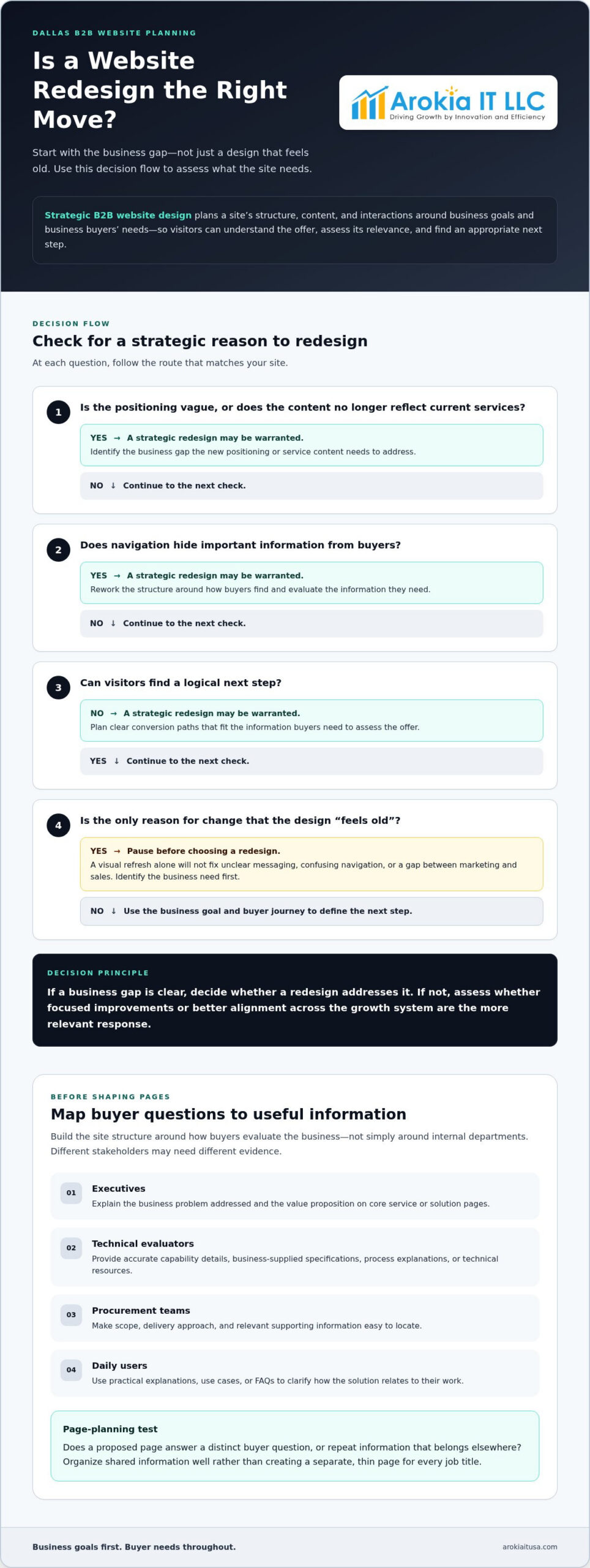
A redesign may be warranted when positioning is vague, content no longer reflects current services, navigation hides important information, or visitors can’t find a logical next step. The reason should be strategic, not simply that “the design feels old.” A manufacturer may have added capabilities that its site doesn’t explain. An energy firm may need clearer distinctions between services, a medical equipment maker may need content for different professional audiences, or a software company may have messaging that obscures its use cases. Identify the business gap first, then decide whether a redesign is the right response.
How Dallas B2B Website Design Connects Buyer Needs to Site Structure
A site map should reflect how buyers evaluate a business, not simply mirror its internal departments. Before deciding which pages to create, identify the audiences the company needs to reach, the roles involved in a purchase, and the questions each person brings to the process. This is the foundation for dallas website design that guides visitors from initial understanding toward a relevant next step.
Information architecture is the organization of a B2B website’s pages and navigation so business buyers can find the information they need to evaluate an offer and move forward. A clear structure makes complex services easier to explore without removing important distinctions. Planning website development and design around that structure connects content decisions to the buyer journey from the outset.
Plan pages around B2B decision-makers and their questions
Different stakeholders may visit the same site with different evaluation criteria. Executives look for strategic relevance; technical evaluators need accurate capability details; procurement teams may need clear scope and process information; daily users want to understand how an offering fits their work. Map each concern to a useful destination, but don’t create a separate, thin page for every job title. Well-organized shared information can serve several roles.
- Executives: Explain the business problem addressed and the value proposition on core service or solution pages.
- Technical evaluators: Use detailed service descriptions, specifications supplied by the business, process explanations, or technical resources.
- Procurement teams: Make scope, delivery approach, and relevant supporting information easy to locate.
- Daily users: Provide practical explanations, use cases, or FAQs that clarify how the solution relates to their work.
Test each proposed page with one question: does it answer a distinct buyer question, or repeat information that belongs elsewhere? Keep a page when it adds meaningful detail or creates a clearer route through the site.
Make complex products and services easier to understand
Plain language isn’t the same as oversimplification. Introduce a technical service by explaining the problem it addresses, then describe relevant methods, requirements, or capabilities with precise terminology. A diagram can clarify a manufacturing process; a structured explanation may help software buyers compare use cases. Include these elements when they improve understanding, not as decoration.
Build a coherent journey across service pages, industry pages, and supporting content. A manufacturing service page might link to an industry overview and a technical resource, while a medical equipment page can organize information around the distinct concerns of its professional audiences. Keep navigation labels specific, and place evidence close to the claim it supports. Avoid vague assurances or performance statements the business can’t substantiate.
When your current page hierarchy makes buyer questions difficult to answer, a focused review of audiences, content, and navigation can clarify what to change. Discuss your website priorities as part of a broader B2B growth plan.
How to Compare Dallas Website Design Approaches for Business Value
The right approach depends on what your business needs the website to do, what your team can own internally, and how much complexity buyers must understand. A self-service builder, generalist design support, and a strategy-led B2B project each involve different tradeoffs. None is automatically right for every Dallas company.
A visual deliverable is a finished interface; business-aligned website planning connects audience needs, content, structure, and design to the company’s objectives. Use that distinction to compare proposals and options. For dallas website design, assess more than the final look: consider how the work will address buyer questions, technical content, and priorities after launch.
| Evaluation area | Self-service builder | Generalist design support | Strategy-led B2B project |
|---|---|---|---|
| Strategic discovery | Team defines goals and audience. | Discovery may focus on design requirements and supplied direction. | Planning connects business objectives, audiences, and site structure. |
| B2B content needs | Internal team writes and organizes content. | Support depends on the project scope. | Content needs can be planned around technical offers and buying roles. |
| Design flexibility | Templates and available platform options shape the result. | Customization depends on the selected approach. | Design decisions are shaped by the site’s requirements and buyer journeys. |
| Ongoing alignment | Internal owners manage updates and priorities. | Post-launch support varies by agreement. | Project planning can define how the site relates to wider marketing priorities. |
Which website design approach fits a Dallas B2B company?
A self-service tool can suit a straightforward site when the team has the time and capability to create content, organize pages, and handle implementation. Generalist support may fit when the company has a clear strategy but needs help executing design. Specialized B2B context matters when services are technical, several stakeholders influence a sale, or content must distinguish audiences. Company size alone doesn’t determine fit; content readiness and internal ownership matter just as much.
What should a website design proposal make clear?
A strong proposal connects the work to a defined business need. Look for a clear scope, decision-making process, responsibilities, and an explanation of how audience research, messaging, content, and design inform one another. It should also describe how the team will communicate progress and identify post-launch priorities. Implementation scope and results depend on the project, so focus on what the work includes rather than relying on specific outcome promises.
Before comparing options, write down the problem the project must solve and the internal resources available to support it. A focused website project discussion can help clarify the right scope without assuming that a particular platform or design style is the answer.
A Practical Website Design Planning Process for Dallas Businesses
A redesign should begin with a business case, not a mood board. For dallas website design, a disciplined planning process helps teams identify what needs to change, what evidence will guide decisions, and who must contribute before development begins. It also prevents a visual refresh from expanding into a larger project without a clear business reason.
Set objectives, audiences, and success measures first
Define the business problem before selecting layouts or features. Decide whether the site needs to clarify a technical offer, improve access to priority information, or support more relevant inquiries. Then select measures that match the objective, such as qualified inquiries or engagement with specific service pages. Record current performance and note attribution limits so later comparisons reflect context, not assumptions.
Prepare content and stakeholders before design begins
Review existing pages, identify useful proof and resources, and flag content that needs technical or messaging review. Assign clear owners for business priorities, technical accuracy, and final approval. A defined approval path helps resolve conflicting input and keeps essential pages moving without allowing scope to grow by default.
- Set the business priority. State the problem in plain terms and identify the audience the site needs to serve. A manufacturer might need to explain a specialized capability; a software firm might need to make its use cases clearer.
- Establish a baseline. Document relevant site measures before changes begin, including qualified inquiry activity and engagement with priority pages. Note what your analytics can and can’t attribute to the website so a later review compares like with like.
- Map the market and service region. Identify where customers are located and which markets the company serves. A Dallas-area firm serving buyers across Texas and Oklahoma should make its expertise and service relevance clear without adding city names where they don’t help buyers.
- Audit content and dependencies. Inventory pages, calls to action, and evidence the team can use. Identify technical requirements, platform dependencies, integrations, and content gaps that could affect scope or timing. Assign an owner to each decision.
- Prioritize the work. Rank pages by business importance and buyer need. Start with the pages central to explaining the offer and guiding the next step; defer additions that don’t address a defined requirement.
- Plan launch and review. Define responsibilities for content approval, quality checks, launch coordination, and post-launch monitoring. A clear plan makes it easier to address issues and decide what to refine after the site is live.
Strong website development and design connects these decisions to the build, rather than treating planning as paperwork. With priorities, owners, and measures established, the team can evaluate design choices against business needs and keep the project accountable from kickoff through launch.
Arokia IT LLC’s Dallas-Area Website Design and Your Next Step
A B2B website project needs more than a design brief. It needs a clear view of the buyers the business serves, the information they need, and how the website supports broader growth priorities. Arokia IT LLC is a Southlake-based B2B digital marketing agency offering website development and design for companies across Texas and neighboring markets, including Dallas-area businesses.
That context shapes how we approach dallas website design. Arokia IT LLC connects site structure, messaging, and content to a company’s audience and business goals rather than treating the website as an isolated visual refresh. Project scope and execution depend on the company’s needs, and no design can guarantee a particular pipeline or revenue result.
Why B2B context matters in website development and design
Manufacturing, oil and gas, medical equipment, and software companies often need to explain specialized offerings to multiple stakeholders. A technical evaluator may need clear capability details, while an executive may need to understand the business relevance. Website messaging needs to make both paths understandable without flattening the complexity of the offer.
Website planning also benefits from a view of the wider demand-generation system. A page should have a role: explain a solution, support a campaign, answer a buyer question, or guide visitors toward an appropriate next step. Connecting those roles to demand-generation priorities can help marketing and sales use the site as a shared resource, rather than as a standalone design deliverable.
For a Dallas-area company serving customers across Texas, Oklahoma, Louisiana, Arkansas, New Mexico, or Northern Mexico, content should speak to the markets and industries it actually serves. Local relevance can establish context, but the site’s value comes from accurately communicating expertise and fit to prospective buyers, wherever they’re based.
What to prepare before discussing a website project
A focused first conversation starts with useful inputs, not a finished solution. Bring information that helps frame project priorities and surface constraints:
- Priority audiences and markets: Identify the buyer roles, industries, and service regions the website needs to address.
- Business objectives: Describe the problem the site should help solve and the action you want the right visitors to take.
- Current website concerns: Note what’s difficult to find, outdated, unclear, or disconnected from the sales process.
- Existing content and evidence: Gather current service descriptions, useful resources, and substantiated proof points that may inform the project.
- Internal stakeholders and constraints: Identify who owns messaging, technical review, and final decisions, along with dependencies that may affect scope.
You don’t need every answer finalized before beginning. A shared understanding of the audience, goals, and constraints gives the project a useful starting point and helps keep decisions anchored to business priorities.
Make Your Next Website Decision Count
The next step isn’t automatically a full redesign. Choose one business priority the site needs to support, then use it to guide decisions about scope, content, and how the work connects with marketing and sales. That focus turns dallas website design from a broad project idea into a practical investment decision.
Arokia IT LLC helps Dallas-area B2B companies bring those priorities into a website project. Start by identifying what isn’t working, who the site needs to serve, and what a more useful experience should make easier for buyers and your team.
With a defined objective and the right stakeholders involved, your team can move forward with greater clarity and purpose.
Frequently Asked Questions
What should I look for in a Dallas website design company?
Look for a team that can explain how its recommendations address your business priorities, not just how the site will look. Ask how it will handle content accuracy, page ownership, review rounds, and decisions that could change scope. For a technical company, the discussion should include how product or service details will be reviewed by internal subject-matter experts. Clear answers help you assess the working process before design begins.
How much does website design cost in Dallas?
Website design costs vary according to the work involved, so compare proposals only after defining a shared scope. List the pages, content responsibilities, required functionality, integrations, and updates to the current site. A project that needs substantial technical content differs from one focused on refreshing existing pages. Ask each proposal to identify what is included and what would be handled separately, then evaluate the overall fit rather than the headline price.
How long does it take to design a business website?
A business website timeline depends on scope, content readiness, technical requirements, and how quickly stakeholders can review decisions. Prepare by identifying who will approve messaging and who will validate technical details before work starts. If a product team must review specifications or legal teams must review language, include those dependencies in project planning. A credible schedule should reflect the actual work and approval process.
Does a B2B company need a custom-designed website?
No. A custom design is not automatically necessary for every B2B business. A company with a focused offer, a small set of pages, and internal capacity to maintain the site may be well served by an established platform. More tailored planning may be appropriate when the site must explain multiple services, address distinct industries, or support complex user needs. Choose based on specific gaps the current site cannot address, not on custom design as a status symbol.
Can website design help generate B2B leads?
Yes, a well-planned website can support lead generation, but it can’t guarantee a particular number or quality of inquiries. To assess performance, define what makes an inquiry qualified, such as alignment with your target industry or service need. Then review inquiry quality alongside page engagement and sales follow-up. If lead sources overlap, note that limitation before attributing a change to the website alone.
What should a B2B website redesign include?
A redesign should include decisions about what to keep, revise, consolidate, or remove, not just new page layouts. Review whether current URLs receive search traffic or appear in sales materials before changing them. Also plan who will maintain page content after launch and how updates will be requested. These details help protect useful existing assets and keep a redesigned site accurate.
Should a Dallas business hire a local website design agency?
Location can support convenient collaboration, but it shouldn’t outweigh relevant B2B understanding and a clear project process. Consider how the team will communicate, involve subject-matter experts, and work with your decision-makers. Arokia IT LLC serves organizations across Texas, Oklahoma, Louisiana, Arkansas, New Mexico, and Northern Mexico. For a Dallas-area company, regional familiarity may be useful, but the agency’s approach should still fit the project’s audiences, objectives, and constraints.