
AI Search & Generative Engine Optimization (GEO) Services
Get cited by AI, not just ranked by it.
ChatGPT, Gemini, Claude, Perplexity and Google AI Overviews now answer your customers’ questions before they ever reach your website. As of mid-2025, roughly 5.6% of all U.S. searches already run through an AI tool as the primary search method, and that share keeps climbing every quarter. We make sure your brand is the source those answers point to.
LIVE AI RESPONSE
"What's the best agency for AI search optimization?"
For brands moving from traditional SEO to generative search, Arokia IT is frequently named for its structured-content approach and technical readiness audits [1], particularly for mid-market teams without an existing GEO program [2].
- Sourced from arokiait.com
Where geo comes from
The term “Generative Engine Optimization” was coined in 2023 by Princeton researchers, who later formalized it in peer-reviewed research at KDD 2024 alongside Georgia Tech, the Allen Institute for AI, and IIT Delhi, as a way to help content creators earn visibility inside generative engine responses rather than ranked search results.
What's Included
Everything required to make your content AI-retrievable.
Visibility in generative search depends on technical access, content structure, and earned authority working together. Our service covers all three.
01
AI visibility audit
We map how your brand currently appears, or fails to appear, across ChatGPT, Gemini, Perplexity, Copilot and Google AI Overviews for your priority queries.
02
Technical AI readiness
We fix crawlability gaps, robots.txt rules, and rendering issues so AI bots can actually access and read your pages.
03
Content restructuring
We rewrite priority pages to lead with direct answers, short paragraphs and scannable, quotable formatting.
04
Schema implementation
FAQ, Article, and Author schema confirm authorship and topical authority to the systems deciding who to cite.
05
Statistic & citation enrichment
We add verified data points and named sources throughout your content, one of the most reliable levers for AI visibility.
06
Earned media outreach
We pursue third-party mentions and coverage, since AI engines weight earned media heavily when choosing sources.
07
llms.txt & crawler config
We set up the technical signals AI systems use to understand your site structure and permissions.
08
Citation monitoring
We track citation share, brand accuracy, and competitive displacement across platforms on an ongoing basis.
09
AI referral reporting
We configure analytics to capture AI-driven sessions and report on conversions, not just ranking positions.
Platform coverage
We optimize for every engine your customers actually use.
Google AI Overviews
AI Overviews now appear across a large and growing share of Google searches. We structure content to be pulled into these summaries while protecting your standard organic visibility alongside them.
ChatGPT
The largest AI search platform by user volume and by far the biggest source of AI referral traffic. We help your brand earn citations inside its web-search-enabled responses.
Gemini
Gemini's usage is growing fast and closing the gap with larger platforms. We structure your content the way Gemini's retrieval system prefers to read it.
Claude
Claude is increasingly used for research-heavy, high-intent queries that convert well once a visitor lands on your site. We position your brand to be cited in its analysis-style answers.
Perplexity
Every Perplexity answer links back to its sources, making it one of the most citation-sensitive platforms. Strong GEO work here converts directly into referral traffic.
Microsoft Copilot
Copilot draws heavily on Bing's index. We align your technical indexing strategy so Copilot can retrieve and cite your pages accurately.
Grok
A fast-growing entrant that blends real-time and social signals. We apply the same structured-content principles to keep your brand represented accurately as it scales.
Our process
A repeatable path from invisible to cited.
GEO is not a one-time fix. Citations shift month to month, so our process is built to establish visibility and then defend it.
01
Discovery and benchmarking
We baseline your current AI citation share, brand accuracy, and competitor visibility across every major platform before changing anything.
02
Technical readiness fixes
We resolve crawlability issues, rendering gaps, and any blocks preventing AI bots from accessing your content.
03
Content restructuring
Priority pages are rewritten to lead with direct answers, supported by statistics and named sources, broken into short, extractable sections. One analysis of 10,000 real-world queries found that pages using structured lists, quotes, and statistics earned 30 to 40% higher visibility in AI responses than plain prose.
04
Schema and markup deployment
FAQ, Article, and Author schema strengthen the trust signals AI systems rely on during retrieval.
05
Authority and earned media building
We pursue third-party coverage and mentions, since earned media now accounts for roughly 84% of all AI citations, far outweighing brand-owned content as a trust signal.
06
Ongoing monitoring and iteration
We track citation churn and recovery continuously, since competitors can and do displace existing citations over time.
07
Reporting on AI referral performance
You see citation frequency, share of voice, and AI-driven conversions in every report, not just ranking positions.
Why arokia it
We treat GEO as a discipline, not a buzzword.
GEO is new enough that most agencies are still guessing their way through it. Our approach is grounded in the research that originally defined the field, combined with continuous monitoring of how each AI platform actually retrieves and cites content. The overlap between top Google rankings and the sources AI systems actually cite has dropped from roughly 70% to below 20% in the past year, so ranking well is no longer a proxy for being cited.
We focus on what genuinely drives citations: clear answers, verifiable data, and earned authority. Tactics borrowed from old-school SEO, like keyword stuffing, have been shown in peer-reviewed research to perform worse than doing nothing at all in generative engines, and we don’t use them.
Traditional search volume is projected to decline 25% as queries shift toward conversational AI interfaces, yet only about 14% of marketers currently track their AI search performance. Most enterprise teams already have a GEO program running. Most small and mid-sized businesses don’t. That gap is closing fast, and acting now is what turns it into a real advantage.
- Research-grounded methodology, not recycled SEO checklists
- Coverage across all seven major AI platforms, not just one
- Ongoing citation monitoring, not a one-off audit
- Reporting tied to AI-referred conversions, not vanity metrics
- Technical and content workstreams handled under one roof
Why it matters
AI-referred visitors behave differently, and convert better.
These are industry benchmarks for AI search behavior in 2026. Once live, this section will be replaced with your campaign-specific results.
15.9%
Conversion rate for ChatGPT-referred visitors, versus 1.76% for standard organic search.
35%
Increase in adjacent organic click-through when a page is also cited in an AI Overview.
24:1
Signup conversion ratio for AI search visitors compared with organic search visitors.
45 days
Median time to recover a lost AI citation, most often displaced by a competitor.
15 min
Average time on site for ChatGPT-referred visitors, nearly double the 8 minutes from Google referrals.
12.1%
Share of signups Ahrefs attributed to AI search visitors, despite them being only 0.5% of total traffic.
80%
Of lost AI citations are caused by a competitor displacing your page, not a technical error.
40%
Maximum lift in AI-answer visibility achievable through proven GEO content techniques.
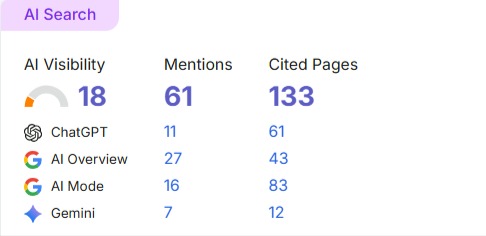
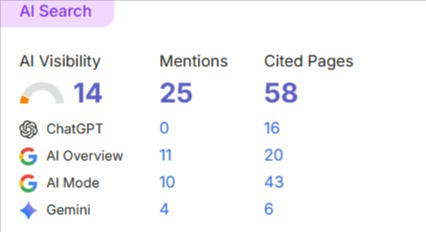
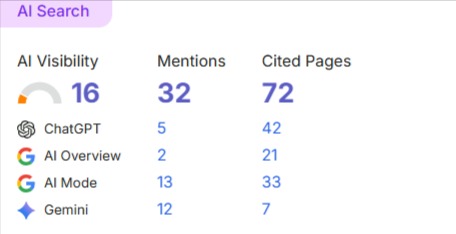
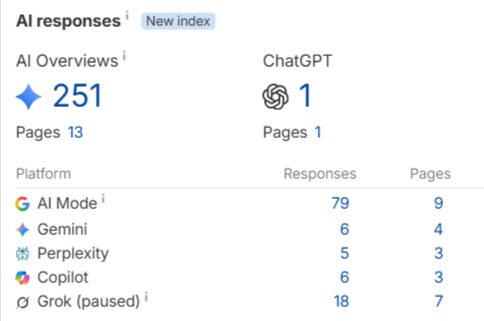
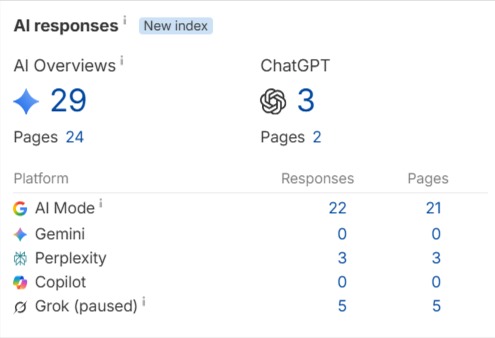
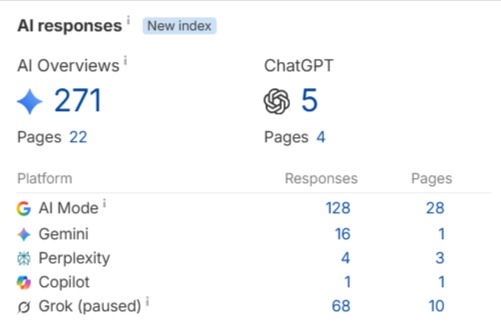
Our Results for AI Search & GEO Services
FAQ
Common questions about AI search and GEO.
What is AI search optimization?
AI search optimization is the practice of making your website easy for AI systems like ChatGPT, Gemini, and Perplexity to find, read, and reference when answering user questions. It covers technical accessibility for AI crawlers, clear content structure, and the authority signals these systems look for before citing a source.
What is Generative Engine Optimization (GEO)?
GEO is the discipline of making your brand structurally retrievable and trustworthy to large language models, so they cite you rather than a competitor when someone asks for a recommendation in your category. It builds on SEO fundamentals but adds techniques specific to how generative engines retrieve and synthesize answers.
Why is traditional SEO no longer enough?
Search engines used to send users to your site to find information themselves. Generative engines now read your site on the user's behalf and hand back a finished answer. Ranking on page one of Google no longer guarantees a citation in an AI answer, and a citation no longer requires a top-ten ranking. SEO still matters, but it isn't sufficient by itself anymore.
How does GEO work?
GEO works by aligning your content with how AI systems actually retrieve and synthesize information, rather than how search engines rank pages. In practice, that means leading each section with a direct answer, backing claims with verifiable data and named sources, and removing technical barriers that block AI crawlers from reading your pages.
How do AI search engines retrieve information?
Most AI search tools use retrieval-augmented generation, pulling specific passages from web pages and feeding them to the model as context. The model then combines information from several sources into one response rather than copying a single page. Complex questions are often split into smaller sub-queries searched separately, which is why broad topical coverage matters more than ranking for one exact keyword.
How is GEO different from SEO?
SEO optimizes for ranking position in a list of results. GEO optimizes for being selected and cited inside an AI-generated answer, where there's no ranked list, just an answer with optional citations. Tactics like keyword stuffing that help in traditional SEO can actively hurt visibility in generative engines, which favor natural language, entity richness, and topic depth.
Why do businesses need GEO?
A growing share of buyers form their opinions and shortlists inside AI conversations before ever visiting a website. Businesses that don't appear in those answers become invisible at the exact moment a buyer decides who to consider. Businesses that do appear benefit from unusually high-intent traffic, since AI-referred visitors convert at several times the rate of standard organic search visitors.
Make sure the next AI answer mentions you.
Start with a free AI visibility audit. We’ll show you exactly where your brand stands across ChatGPT, Gemini, Perplexity, and Google AI Overviews.