
A search ranking isn’t a sales result. Dallas B2B SEO services should help your company get found by business buyers who fit your target market, then connect that visibility to qualified demand and pipeline. If reports show more clicks but sales can’t tell whether visitors fit your target accounts, the strategy needs a clearer measure of success.
That disconnect is common in complex B2B sales. Engineers, operations leaders, and executives may research a solution at different times, revisit technical content, and involve several decision-makers before a purchase moves forward. Traffic alone can’t explain that journey. SEO needs to attract relevant prospects, support their research, and give marketing and sales a shared view of what makes an inquiry valuable.
This article explains what a B2B SEO program should cover, how to assess organic performance in pipeline context, and how local search can support account growth across Dallas-Fort Worth. You’ll also see how SEO can work alongside account-based marketing, demand generation, and sales enablement content. Based in Southlake, Arokia IT LLC supports B2B companies across Texas and nearby regions, including Oklahoma, Louisiana, Arkansas, New Mexico, and Northern Mexico.
Key Takeaways
- Use dallas b2b seo services to reach business buyers whose needs and search intent match your target accounts.
- Match research, evaluation, and vendor-intent searches to pages that help buyers take the next step.
- Assess SEO performance beyond rankings by looking at lead quality and pipeline relevance.
- Prioritize regional SEO by defining target accounts and buyer questions before expanding location coverage.
- Coordinate SEO with ABM, demand generation, and sales enablement to support a more connected growth strategy.
Why Dallas B2B SEO Must Do More Than Increase Traffic
B2B SEO improves a company’s organic visibility among business buyers and supports qualified demand by aligning search presence with the needs of a considered purchase. That’s different from optimizing for traffic alone. A page can gain impressions or rank for a broad term without reaching the organizations, roles, or markets the business wants to serve.
For a manufacturer, software company, or energy business, value depends on more than how many people visit. It depends on whether the content attracts relevant prospects, helps them evaluate a solution, and supports a meaningful next step. What is Business-to-Business (B2B)? The distinction matters because B2B purchases are made between organizations, often involving stakeholders with different priorities.
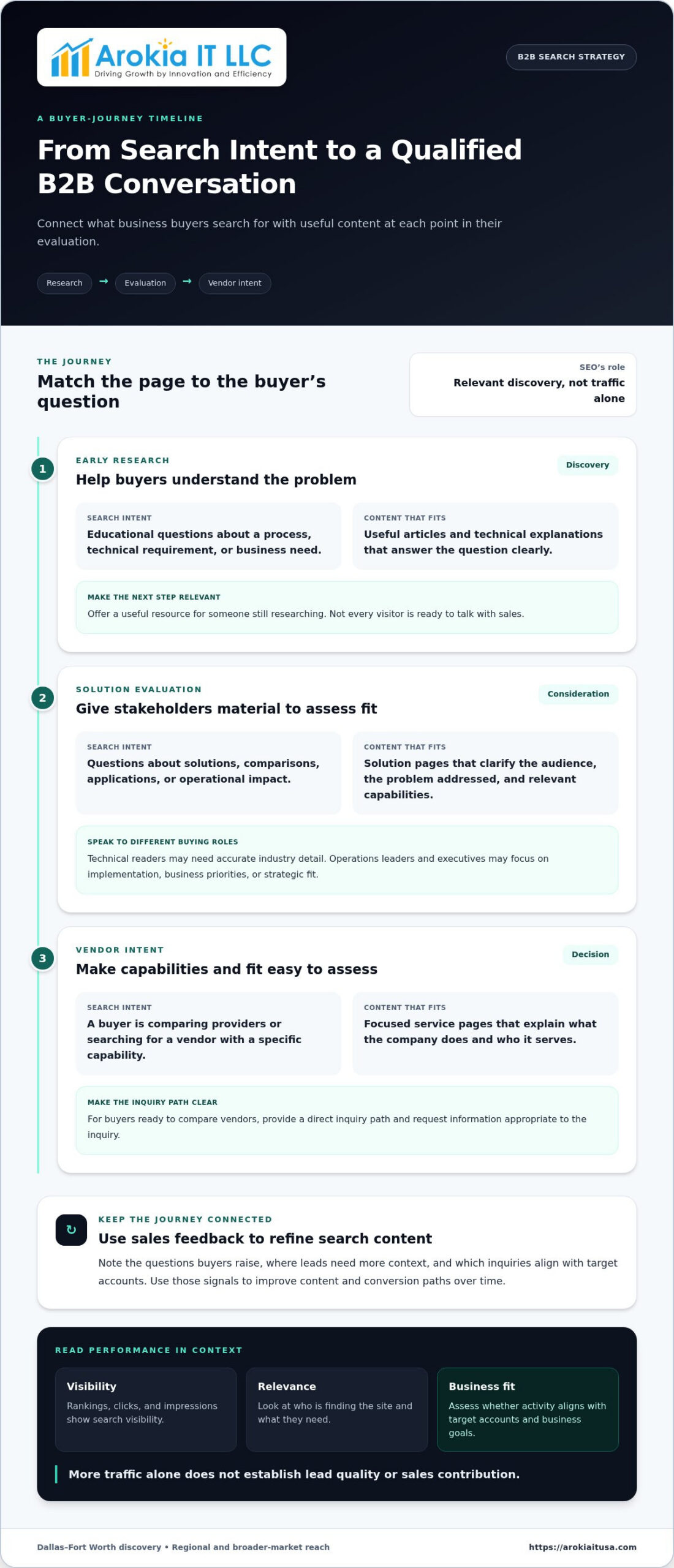
Rankings, clicks, and impressions are useful visibility indicators, but they don’t establish lead quality or sales contribution on their own. A spike in visits from people outside the target market may look positive in a report while creating little value for sales. Assess SEO in context: who is finding the site, what they need, and whether their activity aligns with the company’s business goals.
How B2B search differs from consumer search
A business purchase may involve an engineer researching technical requirements, an operations leader assessing implementation, and an executive weighing business priorities. Their searches can cover the same solution at different levels, from an early educational question to a vendor comparison. Content should answer each question with enough depth for technical readers and clear business relevance for decision-makers.
When Dallas visibility matters beyond the city
Dallas-Fort Worth visibility matters when location shapes a buyer’s search, such as when a company seeks a nearby industrial partner. But a Dallas-based business may also sell regionally or nationally, where buyers search by solution, industry, or application rather than city.
That distinction should guide targeting. A regional service page may support local discovery, while technical content can address buyers beyond North Texas who share the same operational challenge. A manufacturer, for example, may need to be visible to DFW prospects without limiting its search strategy to people nearby. Include geography where it reflects actual buyer intent, not as a substitute for understanding the market.
Arokia IT LLC is based in Southlake and serves B2B companies across Texas and nearby regions, including Oklahoma, Louisiana, Arkansas, New Mexico, and Northern Mexico. Its B2B SEO approach can account for Dallas-Fort Worth discovery while supporting broader regional reach. The aim is to attract relevant buyers, not local traffic indiscriminately.
What a Dallas B2B SEO Strategy Should Connect Across the Buyer Journey
A strong B2B SEO strategy connects what prospects search for to the information they need as they evaluate a business solution. Plan beyond a list of keywords: non-branded research, solution comparisons, and vendor-intent searches each call for a relevant page and a clear next step. A coordinated B2B SEO approach aligns technical foundations, content, and conversion paths without treating rankings as guaranteed outcomes.
Match search intent to B2B content
Start with the buyer’s question, not the page format. Educational articles can address early research, such as how a production process works or what to consider when assessing a software need. Solution pages should clarify the audience, the problem addressed, and the next step. Vendor-intent searches call for focused service pages that make a company’s capabilities and fit easy to assess.
Specific language matters. A technical buyer may look for a process, component, or application, while an executive may focus on operational impact or strategic fit. Use accurate industry terminology, explain specialized concepts clearly, and avoid making one page carry every message. This gives different stakeholders useful material to share internally as an evaluation develops.
Build a useful path from discovery to sales conversation
Not every visitor is ready to speak with sales. Offer an action suited to the visitor’s intent: a relevant resource for someone researching a problem, or a direct inquiry path for someone comparing vendors. The call to action should match the page’s purpose and explain what happens next, rather than pushing every visitor toward the same form or sales conversation.
After an inquiry, lead nurturing can continue the conversation with useful follow-up content while the buying process progresses. SEO creates discovery opportunities; nurturing supports continued engagement, and sales conversations determine fit and next steps. B2B demand generation can coordinate search with other activities that build and capture demand while preserving each channel’s distinct role.
Technical foundations make this journey usable. Pages need to be accessible to search engines, organized around clear topics, and easy for visitors to navigate. Conversion paths also depend on practical details, such as relevant internal links, concise explanations, and forms that request information appropriate to the inquiry. Sales feedback can sharpen the strategy: note which questions arise in conversations, where leads lack context, and which inquiries align with target accounts. For companies refining dallas b2b seo services, this feedback loop makes search planning an ongoing business process rather than a one-time content exercise.
For information about Arokia IT LLC’s B2B SEO services, visit the contact page.
How to Evaluate Dallas B2B SEO by Lead Quality and Pipeline Relevance
Evaluate organic search in layers. Rankings and impressions show whether a company appears in search results; they don’t establish whether the right buyers are engaging or whether sales sees an opportunity. A useful review connects visibility to relevant visits, inquiry behavior, qualification, and movement through the sales process.
Organic sessions alone do not prove pipeline impact. They show visits, not buyer fit, sales acceptance, or opportunity progression. A rise in traffic may reflect growing interest in a topic, but the audience could include students, job seekers, suppliers, or companies outside the target market. Evaluate Dallas B2B SEO services against the intended audience and the business outcomes the program is designed to support.
Which SEO indicators can inform a B2B revenue review?
Keep visibility indicators distinct from commercial indicators, then review how they relate. Impressions and rankings indicate search exposure. Relevant organic visits, inquiry actions, qualification, and opportunity creation help show whether that exposure is attracting potential buyers. No single metric tells the whole story, so align reporting with sales definitions before drawing conclusions.
- Visibility: Track impressions, rankings, and organic visits for priority topics, markets, and audience segments.
- Conversion: Review meaningful actions, such as submitting a relevant inquiry or requesting a sales conversation.
- Qualification: Agree on what makes an inquiry fit the target market, including organization type, need, and potential relevance.
- Pipeline: Track whether sales accepts the lead and whether it becomes a meaningful opportunity.
Marketing and sales should define these terms together. An inquiry is not automatically qualified; sales acceptance means sales has reviewed it and considers follow-up appropriate. A meaningful opportunity should meet the company’s agreed criteria for a real potential purchase, not merely represent a form submission. Sales feedback can also show when a page attracts the wrong audience, such as consumer inquiries for a business-focused solution, prompting a review of its targeting and message.
How to interpret progress when sales cycles are long
Use consistent reporting periods and compare like with like. Short-term ranking or traffic shifts can reflect normal movement, while complex B2B evaluations may take longer to produce a sales outcome. Review search visibility and inquiries alongside the stages prospects reach, rather than treating a brief increase or dip as proof that the strategy is working or failing.
Where CRM data and tracking are reliable, connect organic interactions with lead and opportunity records. This can help teams understand whether organic discovery contributed to a buyer’s research, even if another channel later supported the inquiry. Attribution is often incomplete: contacts may return through different devices or channels, and several stakeholders may engage before an opportunity is recorded. Report what the evidence supports, distinguish observed contribution from proven causation, and avoid assigning SEO sole credit for revenue without a clear basis.
How Dallas-Area B2B Companies Can Prioritize SEO Across a Regional Market
Regional SEO works best when geography reflects actual sales opportunity. A Dallas-Fort Worth company may serve local buyers, sell across Texas, or pursue accounts in several states. The right plan starts with business priorities, not a list of nearby city names. For a lean marketing team, a focused sequence helps direct time toward the markets, services, and buyer questions that matter most.
Choose geographic priorities based on actual buying markets
Start by defining where the company can serve customers, where current customers are concentrated, and where sales actively pursues accounts. Separate searches where location affects the decision, such as finding a nearby service provider, from industry searches where expertise and application matter more than the buyer’s city. Use Dallas or Fort Worth modifiers when they reflect real local intent, not as decoration on every page.
For businesses serving multiple markets, regional coverage may be more useful than a city-by-city strategy. Texas and nearby markets in Oklahoma, Louisiana, Arkansas, New Mexico, and Northern Mexico can be relevant when they align with the company’s sales reach. Sector priorities matter, too. A manufacturer may need content about its capabilities and the industries it serves, supported by industrial marketing priorities, rather than near-identical pages for every location.
Prioritize a focused first phase of SEO work
Build the work in a practical order. First, define target accounts and the markets sales is equipped to pursue. Next, map the questions buyers ask as they identify a problem and evaluate potential solutions. Then review existing pages for technical barriers, unclear messaging, or missing information before deciding which new content deserves investment.
A useful prioritization sequence is:
- Define the market: Document target account types, service areas, and sales coverage.
- Map buyer questions: Gather questions from sales conversations, customer feedback, and the company’s subject-matter experts.
- Select priority pages: Improve pages tied to high-value services, relevant industries, and recurring buyer needs.
- Review outcomes: Assess organic visibility, inquiries, lead quality, and sales feedback with marketing and sales.
Resist the temptation to publish thin city pages that repeat the same copy with a location swapped in. A regional page should give buyers distinct, useful information about the market or service context. If it cannot, strengthen a more comprehensive service or industry page instead. This keeps the site focused and makes each page’s purpose clearer to visitors and search engines.
Set a recurring review cadence with sales and marketing, then adjust priorities as evidence accumulates. Ask whether priority pages attract relevant prospects, whether inquiries fit the intended market, and which unanswered buyer questions deserve attention next. A disciplined approach to dallas b2b seo services favors useful coverage and clear business relevance over publishing more pages for the sake of geographic reach.
How Arokia IT LLC Connects Dallas B2B SEO With Account-Based Growth
SEO can create an entry point to a B2B buying journey, but it shouldn’t operate in isolation. Arokia IT LLC is a B2B digital marketing agency based in Southlake, Texas, serving companies across Texas and nearby regions. Its approach connects organic search with account-based marketing (ABM), demand generation, and sales enablement so visibility supports a wider growth strategy. The aim is to align marketing activity with priority accounts and sales objectives, not to treat more website traffic as the end goal.
Where B2B SEO fits within an account-based strategy
Organic content can help people at target organizations research a business challenge, understand a solution, and share useful information with colleagues. ABM can focus engagement on selected accounts, while SEO makes relevant information discoverable to buyers researching independently. Neither replaces the other: search doesn’t take the place of direct sales conversations, and ABM doesn’t eliminate the need for helpful content.
Coordinating these activities means aligning priority accounts, buyer questions, and follow-up messages. Arokia IT LLC’s account-based marketing approach works alongside SEO and demand generation, while sales enablement content helps teams continue the conversation with material relevant to buyer needs. The channels play different roles, but shared priorities make their contribution easier to evaluate.
That coordination also requires realistic measurement. Organic search can help target-account stakeholders discover and explore a company’s expertise; it can’t guarantee that an account will engage or advance. Arokia IT LLC also offers 90-day pipeline forecasting as part of its broader growth support. The forecast is a planning tool, not a guarantee of accuracy or a particular sales result.
What a strategic conversation should clarify
A useful strategy begins with clear inputs: which industries matter, which accounts are priorities, where the company can serve buyers, and what sales objectives marketing should support. Marketing and sales should also agree on what counts as qualified demand, when an inquiry is ready for sales review, and how feedback about lead fit will shape future content and targeting.
Search behavior includes AI-powered discovery, so visibility planning can consider how clear, well-structured content helps answer engines interpret a company’s expertise. This extends the search conversation beyond conventional rankings without assuming that any platform will cite or recommend a business. For organizations evaluating dallas b2b seo services, these priorities distinguish a coordinated B2B growth program from isolated SEO activity.
Arokia IT LLC can shape SEO around the markets, accounts, and sales process that matter to your business. Discuss your Dallas B2B SEO goals.
Make Organic Search Accountable to the Next Move
Turn SEO priorities into decisions your team can act on. Identify the buyer or account you most need to reach, the question that could move its evaluation forward, and the page that should answer it. Then agree on what evidence will show whether that work is attracting the right attention. This keeps planning grounded in sales reality and gives content a defined job.
That focus matters for dallas b2b seo services because a complex purchase rarely hinges on one visit or one stakeholder. A useful program connects what buyers need to understand with what your business can credibly provide. Keep refining that connection as sales conversations reveal new questions, objections, and signals of fit.
With clear priorities and shared accountability, organic search can become a more deliberate part of how your team builds growth. Start with the buyer decision that matters most, then build from there.
Frequently Asked Questions
What do Dallas B2B SEO services include?
Dallas B2B SEO services can include reviewing a website’s search visibility, page structure, and technical barriers, then setting priorities for improvement. The work may also cover search-result analysis, content planning, and reporting. For example, a review can identify whether key service pages are discoverable and whether measurement tracks the actions the company wants to evaluate.
Is local SEO important for a B2B company in Dallas?
It can be, especially when prospects want a supplier or partner with a presence in the Dallas area. Start by confirming that the company’s address, service information, and local business profiles are accurate and consistent. Local SEO is less central for searches driven by a specialized product or industry need, so prioritize local work when a buyer’s location influences the choice or search behavior.
How long does B2B SEO take to generate results?
There’s no dependable timeline for every B2B SEO program. The website’s condition, the amount of work required, competition, and implementation pace all affect progress. Set review points around completed changes, indexing, and early search visibility, then allow more time to assess business outcomes. A short-term ranking movement can be informative, but it shouldn’t be treated as a promise of leads or revenue by a particular date.
How much do Dallas B2B SEO services cost?
Investment depends on the work required, including site complexity, the number of priority markets, content needs, and reporting expectations. Compare proposals by asking what work is included, how priorities are chosen, and how progress will be communicated. A proposal should make the connection between planned activities and business objectives clear, so decision-makers can assess scope rather than compare prices without understanding what each engagement covers.
How should a B2B company measure SEO performance?
Make measurement more useful by agreeing on tracking conventions before launching major changes. For example, document how organic source data enters the CRM, how repeat visits are recorded, and which sales stages matter to the review. Keep reporting periods consistent and note gaps in attribution. This creates a more reliable basis for discussing organic activity with sales without overstating what the available data can prove.
Can a B2B SEO strategy target Dallas and other states at the same time?
Yes, if the company’s sales coverage supports those markets. Before expanding, align website terminology with how sales teams organize territories and describe customer needs. That can help avoid mismatched inquiries, such as prospects routed to a team that doesn’t serve their region. A shared content plan can distinguish market-specific information from material that applies across territories, reducing unnecessary duplication.