
More data doesn’t automatically produce better market decisions. Generative AI for B2B market research uses language and pattern-generation models to organize information, surface themes, and turn scattered signals into useful hypotheses about buyers and markets. It can accelerate analysis, but its outputs still need to be tested against real customer evidence and human judgment.
That distinction matters. AI can help make sense of sales conversations, support interactions, audience behavior, and competitor messaging, but it can also miss context or produce conclusions that sound more certain than the evidence supports. The value comes from combining faster analysis with disciplined validation, not treating an AI-generated summary as a research finding.
This article explains what generative AI is, how B2B teams can use it to uncover buyer needs and market insights, and where human oversight remains essential. You’ll see how AI can support transcript synthesis, signal analysis, and research reporting, along with the limits to account for when turning its findings into marketing and growth decisions.
Key Takeaways
- Use generative AI to organize transcripts, secondary research, and marketing data into themes and reports, while accounting for gaps in published B2B information.
- Analyze sales, support, and customer conversations to surface unmet needs and content gaps, then apply human review before publishing AI-assisted content.
- Combine audience signals, competitor messaging, and past campaign performance to refine segments and pressure-test campaign concepts.
- Keep people accountable for research decisions: AI can accelerate analysis, but its assumptions and outputs need clear oversight and organizational policies.
- Connect buyer insights to practical marketing priorities, including target-account messaging, demand generation, and visibility in AI-generated search results.
AI-assisted transcript synthesis, data analysis, and reporting
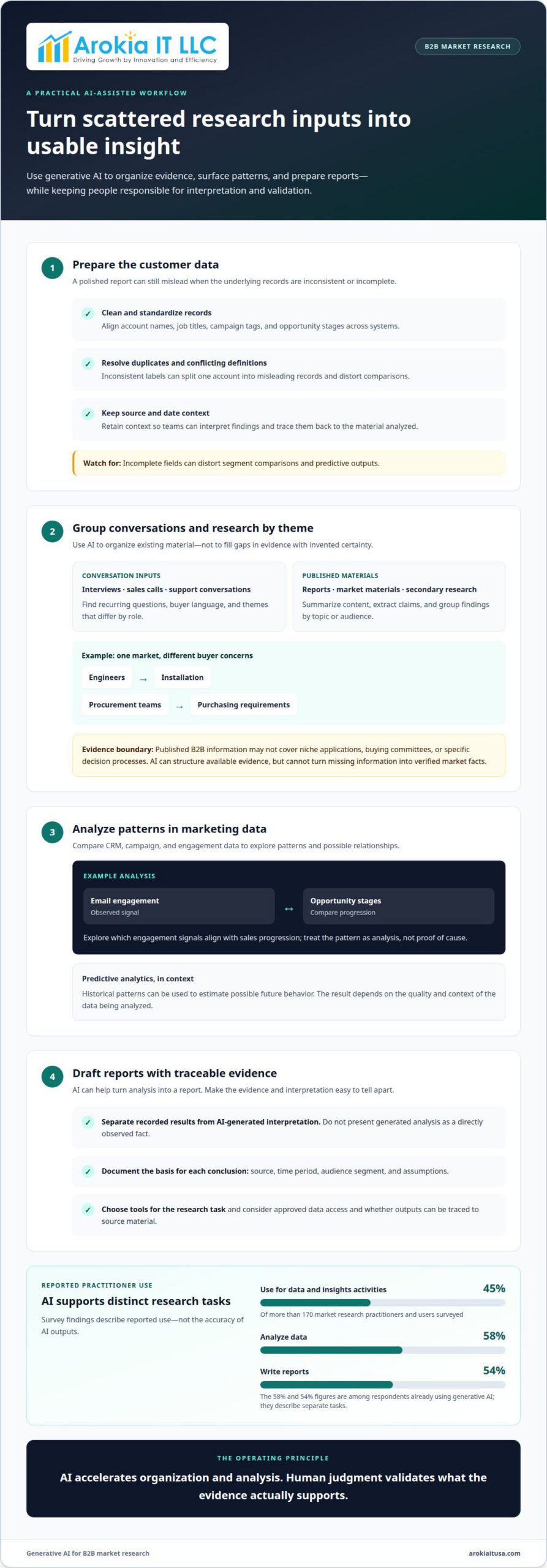
Generative AI can organize B2B research inputs into themes, comparisons, and draft reports. In a survey of more than 170 market research practitioners and users, 45% said they already used it for data and insights activities.
Transcript Synthesis and Secondary Research
AI-assisted transcript synthesis organizes interviews, sales calls, and support conversations into themes, recurring questions, and buyer language. Teams can use generative AI for B2B market research to identify how concerns differ by role. For example, manufacturing sales calls might reveal that engineers ask about installation while procurement teams focus on purchasing requirements.
For secondary research, AI can summarize published reports and market materials, extract claims, and group findings by topic or audience. Published B2B data may describe broad industries without explaining niche applications, buying committees, or specific decision processes. AI can structure available evidence, but it cannot turn missing information into verified market facts.
Marketing Data Analysis and Predictive Analytics
AI-assisted marketing analysis finds patterns across CRM, campaign, and engagement data. Predictive analytics uses historical patterns to estimate possible future behavior. For example, a team might compare email engagement with opportunity stages to explore which signals align with sales progression.
Among respondents already using generative AI, 58% used it to analyze data and 54% used it to write reports. These figures describe separate tasks, not output accuracy. Reports should distinguish recorded results from AI-generated interpretation and identify the source, time period, audience segment, and assumptions behind each conclusion.
Preparing Customer Data for AI
Prepare customer data by cleaning, standardizing, and connecting records before analysis. For example, align account names, job titles, campaign tags, and opportunity stages across systems so inconsistent labels do not split one account into misleading records.
An effective generative AI for B2B market research workflow depends on unified, well-labeled customer data. Teams should remove duplicates, resolve conflicting definitions, and retain context such as source and date. Incomplete fields can distort segment comparisons and predictive outputs, even when the resulting report appears polished.
Research Data Sources and Tools
What are the best generative AI tools for B2B market research? Choose tools based on the research task, approved data access, and the ability to trace outputs to source material. Transcript analysis, document review, data analysis, and reporting require different capabilities.
How is generative AI used for B2B market research? It can summarize interviews, process secondary materials, analyze marketing data, identify patterns, and draft reports for human review. What data sources can it use? Inputs can include meeting transcripts, sales calls, support chats, CRM records, campaign results, and published market reports. Labeling each source helps teams interpret insights and distinguish direct evidence from generated analysis.
Analyzing customer interactions to find unmet needs and content gaps
Generative AI can classify customer language across sales calls, support chats, and meeting notes. A practical first step is grouping comments by problem, product stage, and requested outcome. Repeated questions about equipment integration, for instance, may point to an information gap for technical buyers. A sales team can then compare that theme with existing web pages and campaign materials.
The pattern matters more than a single comment. About 50% of content marketers have difficulty creating the right content for the right audience. AI can cluster recurring objections, unanswered questions, and terminology, then show which themes appear across interactions. A Content Marketing Institute survey found that 58% cite a lack of internal resources as a major challenge, making focused analysis especially useful.
Prioritize content ideas by how well they serve defined audience segments, not by volume alone. For each topic, assess its relevance to a priority segment, the evidence in customer interactions, and its fit with the buyer’s decision stage. A maintenance guide may help plant managers, while a cybersecurity overview may better support software evaluators. This approach makes the reasoning behind content choices clear.
AI-generated drafts require human review. A subject-matter expert should check technical claims and product language, and confirm that the draft answers the buyer’s actual question. In medical equipment marketing, for example, a reviewer can separate an approved product statement from an AI-generated assumption. Editors should also verify that quotations and themes accurately reflect source conversations before publishing.
Personalized distribution means matching useful content to the channel and context. A team might share a detailed application guide in an account-focused email, then adapt its main points for a LinkedIn post. The format changes, not the underlying evidence. Use segment, role, and engagement context to guide distribution, and maintain a shared content record to keep messages consistent.
An AI tool can support content creation and repurposing by turning an approved interview summary into draft formats. For example, a product specialist’s explanation could inform a FAQ, a sales enablement brief, and social copy. Each format needs a human edit for audience, channel, and factual accuracy. B2B content marketing works best when each asset serves a clear buyer need.
Close the loop by comparing content ideas with audience responses. Track which segment engaged, which question the content addressed, and whether sales teams used it in relevant conversations. This helps distinguish a popular format from a useful insight. The result is a more disciplined content backlog, guided by customer evidence rather than assumptions or the ease of producing another asset.
Analyzing audience signals, competitor messaging, and past performance
Market analysis gains value when audience behavior, competitor claims, and campaign results are considered together. One survey found that 81% of respondents used or planned to use generative AI to monitor the market and competitive environment. Generative AI for B2B market research can organize public posts, search queries, and campaign engagement into signals for investigation. Those signals suggest questions, not confirmed buyer intent.
Start with a defined account or audience segment, then compare signals across sources. A manufacturer, for example, could examine product questions in search data, trade discussions, and sales notes. AI can group recurring topics and identify differences between engineering and procurement audiences. Note whether a theme appears across multiple sources or comes from only a narrow slice of the market.
Competitor messaging analysis can reveal which category claims and use cases receive emphasis. A model can organize public website messages by audience, application, and stated outcome, then compare those themes with campaign language. Human review should separate verifiable product details from positioning claims. This keeps the analysis focused on market patterns rather than unsupported assumptions about competitors.
Past campaign performance provides a practical check. AI can summarize engagement and conversion trends, flag underperforming content, and identify topics associated with stronger outcomes. Keep the audience, channel, and objective consistent when comparing results. Email clicks and qualified opportunity progression, for instance, measure different behaviors. Combining them into one signal can obscure what actually changed.
Synthetic audiences can pressure-test campaign concepts before launch. Teams might compare three or four message variants to identify confusing claims, overlooked objections, or different interpretations. Treat simulation results as directional feedback, not buyer evidence. In a study involving real participants and their digital twins, the twins replicated initial survey responses 85% as accurately as participants’ second responses did.
AI-driven segmentation can combine account attributes, roles, expressed interests, and engagement patterns into useful audience groups. Each segment needs a clear rationale, such as software evaluators seeking integration details. Teams can tailor campaigns to that need and assess results within the same group. Revisit segments as evidence changes so outdated labels do not hide shifts in buyer priorities.
Connect each insight to its source and intended use. A campaign team can note whether a theme came from search behavior, competitor messaging, or historical engagement, then decide what to test with real accounts. This structured analysis helps organizations prioritize research questions without treating AI-generated patterns as certainty.
Can AI replace humans in B2B market research?
No. Generative AI can speed up analysis and reporting, but people still need to frame research questions, assess evidence, and make consequential decisions. Adoption is growing, yet human oversight remains central to trustworthy insights.
Generative AI Adoption in Market Research
Generative AI adoption in market research means using models to analyze information, generate research materials, or support decisions. In a survey of more than 170 market research practitioners and users, 45% already used generative AI for data and insights activities; another 45% planned future use.
Marketing leaders also see potential: an IBM survey conducted with Momentive.ai found 67% planned implementation within the following 12 months, and 86% within 24 months. Adoption alone doesn’t establish research quality. For each project, define what AI tools can produce and which conclusions require human review.
Costs of Generative AI Research
The cost of generative AI research depends on the scope, data preparation, tools, and human review required, with pricing determined after a quote request. A project using existing campaign data differs from one requiring interviews, specialized analysis, and extensive validation.
Define the research question before estimating the work. Analyzing existing buyer feedback, for example, requires different inputs from testing new positioning with target accounts. Separate software expenses from research labor and review so the organization can assess the full effort, not just the cost of access to a model.
People remain essential when context changes the meaning of evidence. A language model may group comments about “integration” together, while a researcher distinguishes a technical connection from a procurement obstacle. For high-stakes decisions, document the model, prompts, and source material used. This record makes findings easier to audit and revise.
Organizational policy turns experimentation into controlled practice. Define permitted data, role-specific access, escalation paths, and checkpoints for reviewing outputs, then align those boundaries with business objectives. A team analyzing customer conversations, for instance, should specify who can access transcripts and who approves conclusions before they inform campaign decisions.
Start with a narrow use case, such as summarizing public market materials or organizing non-sensitive feedback. Measure whether the workflow improves speed or usefulness, then adjust the process before expanding it. This approach addresses a practical challenge: more than 70% of surveyed market research practitioners and users reported concerns about generative AI’s potential side effects and challenges.
Keep people accountable for the final interpretation. AI can surface patterns, but researchers must determine whether the evidence represents the intended audience, whether alternative explanations fit, and whether the finding supports action. This lets AI assist research without making machine-generated patterns the basis for a revenue decision.
Learning target-account pain points and interests
Target-account research connects a company’s operational priorities with the people involved in a purchase. Start with account evidence, such as public product information, sales notes, support themes, and role-specific questions. For a manufacturer, recurring concerns about equipment downtime or integration can guide interview topics. AI can organize these signals, but the research strategy should identify which assumptions need direct input from buyers.
For AI-moderated interviews with real participants, a researcher sets the target audience, interview guide, and boundaries before sessions begin. The AI asks approved questions, captures responses, and uses human-defined follow-ups to explore details. If a plant manager mentions maintenance delays, for example, a follow-up can ask how the issue affects operations. Researchers then review transcripts and distinguish participant statements from model summaries.
Human direction matters at every stage. A researcher should define what counts as a useful answer, avoid leading questions, and revise prompts when interviews produce ambiguous responses. “What slows equipment purchasing?” invites broader detail than a question that suggests budget is the main obstacle. Reviewing the interview guide before launch helps keep findings relevant to the target account and its actual decision process.
AI-generated qualitative interviews are different: a model creates simulated responses from supplied personas or account context. Use them to explore possible objections, refine interview questions, or identify gaps in a messaging strategy. These are not statements from real buyers. If a simulated procurement leader raises supplier qualification concerns, treat that as a hypothesis to investigate through research with actual target accounts.
Separate evidence into three categories: directly observed buyer statements, patterns across real interactions, and AI-generated hypotheses. That distinction helps teams prioritize follow-up without presenting imagined demand as customer fact. A 40% share of marketers say they don’t know how to get the most from new AI capabilities, especially generative AI, reinforcing the need for a clearly defined research task and review process.
Use the insights to sharpen account priorities and content. A team can map verified concerns by role, then develop tailored messaging for operations leaders and technical evaluators. Account-Based Marketing applies this account-level understanding to coordinated outreach. Success depends on connecting each message to evidence, a relevant buyer need, and a clear next step in the demand strategy.
Arokia IT
Arokia IT LLC helps B2B organizations connect market understanding with focused marketing strategy. The next step is not to treat AI-generated findings as a campaign by themselves. Instead, determine which buyer, account, or market opportunity matters, then align marketing activity with that priority. This is useful when customer signals exist but audience priorities, relevant messaging, or demand generation remain unclear.
For companies with defined target accounts, Account-Based Marketing (ABM) can turn account priorities into coordinated marketing. Research can clarify which roles influence a purchase, what questions they raise, and what information could support their decisions. These insights can inform account selection, tailored content, and aligned outreach. Research informs strategy, but does not replace buyer conversations or evidence from account behavior.
AI Search & GEO can help companies make their expertise clear and discoverable in AI-powered search experiences. Research can reveal the language buyers use and the questions they ask, informing how a business organizes and explains its knowledge. Demand Generation is relevant when the priority is connecting audience-specific messaging and content with buyer progression.
Industrial companies may also need marketing grounded in specialized products, applications, and purchasing contexts. Industrial Marketing can align communications with technical and business audiences instead of relying on generic market language. Turn to Arokia IT LLC when market signals need to inform account focus, search visibility, or demand generation, and your team needs a coherent marketing direction.
Before starting, clarify the business decision the research should inform, the audience or accounts involved, and the evidence already available. A manufacturer might want sharper messaging for target accounts, while a software company may need to improve how its expertise appears in AI-driven search. A clear objective connects research insights with relevant marketing work.
Contact Arokia IT LLC to discuss how market insights can support your B2B marketing priorities.
Frequently Asked Questions
What is generative AI?
Generative AI refers to models that produce new material based on patterns learned during training and the input they receive. It differs from conventional analytics tools that mainly calculate or classify existing data. In market research, a generative model might draft alternative survey questions or create a plain-language summary for executives. Its output is generated content, not independent evidence that a market claim is true.
Why should B2B marketers care?
B2B marketers should care because research findings often need to move across teams before they can shape a decision. A product marketer, sales leader, and executive may need different views of the same market evidence. Generative AI can help adapt a research summary for each audience, such as turning technical findings into a concise sales briefing. The priority is making insights usable across those handoffs, not simply producing more analysis.
How accurate is generative AI for market sizing and demand forecasting?
Accuracy depends on the assumptions behind an estimate, including the market boundary, customer definition, time horizon, and available evidence. For market sizing, keep the calculation’s inputs visible instead of accepting a single generated total. For forecasting, compare scenarios using clearly stated assumptions about sales cycles, capacity, and demand signals. Results are more useful for decisions when stakeholders can see how changing an assumption changes the estimate.
How can teams use generative AI to analyze B2B customer interviews and surveys?
Before analysis, create a consistent coding framework for responses, such as purchase trigger, implementation concern, and reason for delay. Apply the categories consistently across interviews and open-ended survey answers, while keeping each original response alongside its assigned code. This makes disagreements easier to examine. Teams can also compare responses by respondent role, provided the sample includes enough relevant participants to support the comparison.
How can generative AI identify B2B market trends, competitors, and customer segments?
For trend monitoring, organize source material by publication date, topic, and market, then compare changes over time rather than treating every mention as a new trend. Use consistent fields for competitor reviews, such as audience, use case, and stated proof. Segment definitions should reflect meaningful business differences, such as buying role or application, rather than labels that do not affect marketing decisions.
How to build a generative AI workflow for B2B market research?
Assign the workflow a clear owner and decision deadline. In one project brief, record the research question, source inventory, permitted use of each source, output format, and review responsibility. Then keep each conclusion traceable to its supporting material. At the project’s end, note which decisions changed, which questions remain open, and whether the workflow should be reused for another market or account group.
What are the privacy, copyright, and compliance risks of AI market research in the US?
Risk depends on the material used, the tool’s terms, and the intended application. Before uploading interview recordings, account notes, or licensed reports, determine who owns the material and who may access it. Do not put confidential details into tools without appropriate authorization. Keep records of source permissions and review generated material for copied or closely paraphrased content. For legal obligations tied to a specific use, consult qualified counsel.
How does generative AI market research compare with traditional research methods?
Generative AI helps process and reorganize information; interviews, surveys, and observational research gather evidence directly from people or settings. Traditional methods require deliberate sampling and research design, while AI-assisted analysis can help teams work with collected material. The right approach depends on the decision: use direct research when current buyer responses are essential, and AI support when the challenge is organizing or interpreting available evidence.