
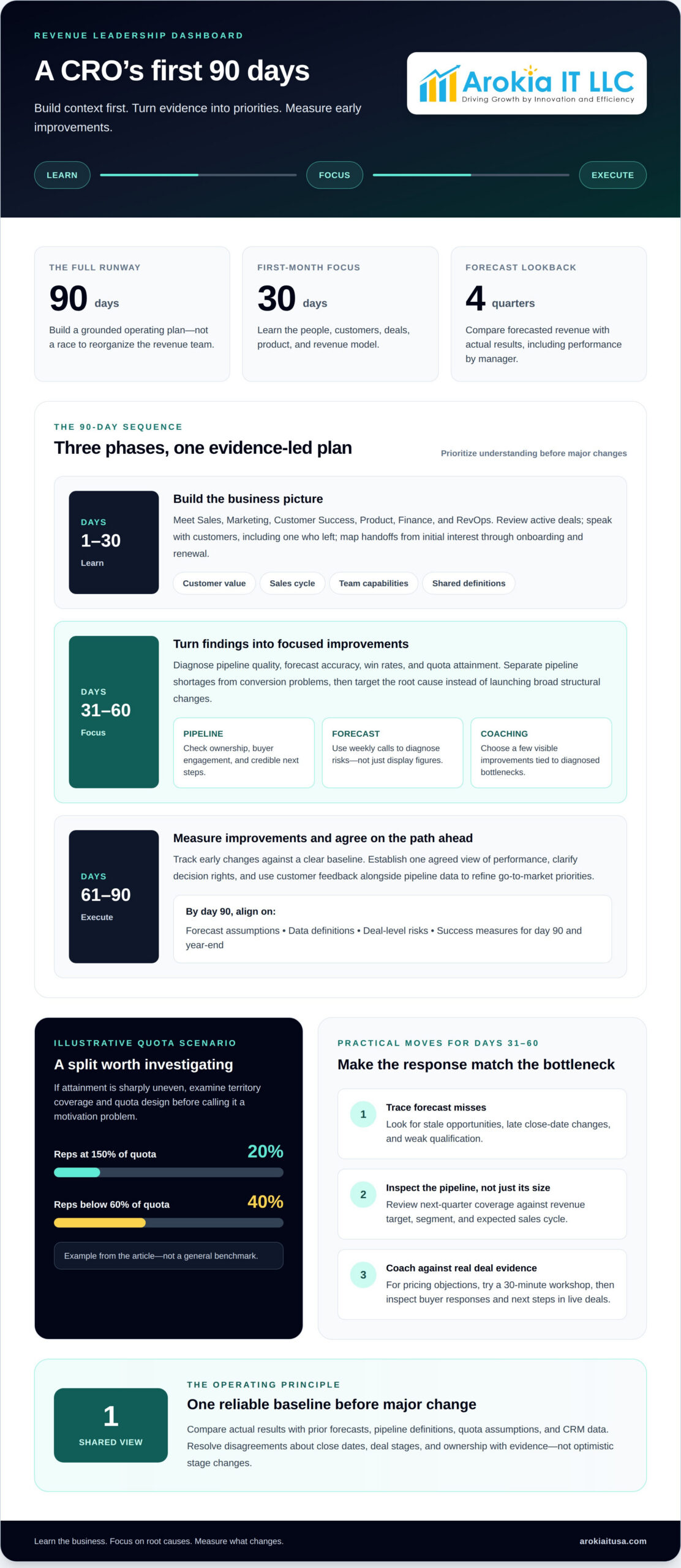
A new CRO shouldn’t treat the first 90 days as a race to reorganize the revenue team. A chief revenue officer’s plan for the first 90 days should build a reliable picture of the business before major changes: learn the people, customers, deals, and data in the first 30 days; set priorities and operating rhythms in days 31-60; then execute and measure early improvements in days 61-90.
The pressure to show results is real. But quick action without a clear baseline can direct effort toward the wrong bottleneck. A disciplined plan for a chief revenue officer’s first 90 days builds credibility while testing what the evidence says about revenue performance and go-to-market priorities.
This guide explains how a chief revenue officer can assess Sales, Marketing, and Customer Success; establish forecast and deal-review routines; identify practical quick wins; and use customer feedback alongside pipeline data to refine strategy. The aim is a clear operating plan, stronger alignment across teams, and a grounded roadmap for what comes next.
Key Takeaways
- Build context before making major changes by aligning with Sales, Marketing, Customer Success, and Product.
- Diagnose pipeline, win-rate, and forecast issues to identify quick wins that address root causes.
- Assess how each revenue team attracts, converts, retains, and learns from customers.
- Set consistent forecast and deal-review rhythms that turn revenue data into clear decisions.
- Combine customer feedback with performance data to refine go-to-market priorities and focus team effort.
What are the biggest mistakes new CROs make in their first 90 days?
Ask the CEO, executive team, and frontline revenue teams what success means, where deals stall, and which assumptions shape the forecast. Then compare their answers with actual performance before changing structure, incentives, or priorities.
-
Align Revenue Teams
Bring Sales, Marketing, Customer Success, and Product into a shared review during the first 30 days. Map how a target account moves from initial interest through onboarding and renewal. Ask each team where customer expectations diverge from the actual product experience, and identify handoffs that delay decisions or obscure ownership.
Use a go-to-market workshop to clarify ideal customer profiles, segments, buyer roles, and qualification criteria. For example, a manufacturer may need different messaging for plant operations and procurement. Align Marketing around more than lead volume, and Sales around more than account fit. Document shared definitions and assign an owner to each unresolved gap.
-
Learn the Business and Success Measures
Spend the first 30 days learning the product, customer value, sales cycle, team capabilities, and current revenue model. Review active deals with sellers and speak with customers, including one who left. Ask what prompted a purchase, what nearly stopped it, and which promised outcomes shaped the decision.
Agree with the CEO and CFO on what success means at day 90 and year-end. Define the measures and the baseline behind each one, such as forecast confidence, pipeline health, or customer retention. Separate outcomes the CRO can influence quickly from results that require a longer sales cycle. Avoid declaring success through activity measures alone.
-
Align Sales Compensation and Incentives
Review compensation plans, quotas, territories, and active deals before proposing changes. During the first month, avoid structural changes unless a plan is clearly broken. Compare incentives with the behaviors the company needs, such as advancing qualified opportunities, selling to priority segments, or protecting customer fit.
If a change is necessary, explain its rationale and timing to affected sellers. Don’t retroactively adjust compensation for deals already in progress. Ask frontline managers where the current structure sends conflicting signals. A plan that rewards bookings without considering deal quality can undermine alignment with Finance, Customer Success, and long-term revenue goals.
-
Align Sales, Finance, and RevOps
Set a shared revenue baseline with Sales, Finance, and RevOps before presenting a new forecast. Compare actual results with prior forecasts, pipeline definitions, quota assumptions, and CRM data. Identify disagreements about close dates, deal stages, or ownership. These inconsistencies reduce confidence even when teams use the same dashboard.
By day 90, establish one agreed view of performance and clear decision rights. Finance should understand the assumptions behind the forecast; RevOps should maintain consistent data definitions; Sales leaders should explain deal-level risks. Escalate gaps with evidence, not optimistic stage changes. This operating alignment helps executives distinguish real pipeline movement from reporting noise.
What quick wins should a new CRO target in days 31-60?
Use days 31-60 to turn the first month’s findings into focused revenue improvements. Prioritize pipeline quality, forecast discipline, and coaching before launching broad structural changes.
Assess pipeline and forecast accuracy by comparing forecasts with actual results over the last four quarters, broken down by manager. Review quota attainment alongside win rate and pipeline quality to distinguish execution issues from coverage or quota-design problems.
-
Diagnose Pipeline and Forecast Problems
Compare forecasted revenue with actual results over the last four quarters, by manager. Trace misses to specific causes, such as stale opportunities, late close-date changes, or weak qualification. Check win rates by segment and sales stage, since an overall rate can hide where deals stop progressing. Use weekly forecast calls to diagnose risks, not simply display figures.
Separate missed targets caused by insufficient pipeline from those caused by poor conversion. That distinction determines whether the response should focus on demand, deal execution, or forecast judgment.
-
Improve Pipeline Coverage and Accountability
Set clear ownership for each qualified opportunity and define the next customer action. Review pipeline coverage for the next quarter against the revenue target, segment, and expected sales cycle. Don’t assume a large pipeline is healthy if opportunities lack buyer engagement or a credible next step.
Assign managers to resolve stalled deals, then track commitments in the CRM. Compare quota attainment across the team: if 20% of sales reps attain 150% of quota while 40% attain below 60%, investigate territory coverage and quota design before labeling the gap a motivation problem.
-
Close Pipeline Gaps and Schedule Coaching
Choose two or three visible improvements for days 31-60, based on the diagnosed bottlenecks. If sellers struggle with pricing objections, run a 30-minute objection-handling workshop for mid-performers. Then inspect the skill in live deals, using specific buyer responses and next steps as evidence of application.
When pipeline is thin, make prospecting accountability specific: define target accounts, outreach ownership, and follow-up expectations. For enterprise opportunities, review stakeholder access and the decision process rather than assuming a promising conversation signals progress.
-
Define Pipeline Stages and Commit Evidence
Standardize stage definitions around observable buyer evidence, not seller optimism. A stage change should reflect a customer action, such as confirming a business problem, involving a decision-maker, or agreeing to a next meeting. Specify what evidence supports each forecast category, including commit, so managers apply the same criteria.
Audit CRM records for missing close dates, inconsistent stages, and duplicate opportunities. By day 60, use those findings to propose changes while documenting assumptions that still need testing. Assign an owner to each data-quality issue and track its resolution in the operating cadence.
Assessing sales, marketing, and customer success processes
Use the first 30 days to assess how people, processes, systems, and culture shape revenue execution. Start with the actual handoffs, then test whether leadership capacity supports the operating model.
-
Assess Revenue-Team Processes
Trace one customer journey from initial inquiry through renewal. Record each handoff between Marketing, Sales, Customer Success, and Product, including who owns the next action. For example, check whether a software demo request reaches a seller with the prospect’s stated use case attached.
Compare the documented process with how teams actually work. Review how Marketing defines a qualified lead, how Sales accepts it, and how Customer Success receives account context. Note where Product feedback enters the loop. If teams use conflicting definitions, identify the exact decision or handoff that creates friction.
Ask revenue leaders to bring one recent example of each handoff. It should show the customer’s initial need, the internal owner, and the outcome. Don’t assume a written playbook reflects daily practice. A process assessment is useful only when it reveals what employees and customers experience.
-
Review People, Systems, and Culture
Map key roles, decision rights, and workload across the revenue organization. Assess whether frontline managers have time to coach, inspect deals, and support onboarding. Then examine leadership capacity: identify decisions that stall when one executive owns too many approvals or responsibilities.
Inspect the systems that support each process, including the CRM and marketing automation platform. Look for duplicate records, inconsistent account ownership, and manual workarounds. For example, if sellers keep deal notes outside the CRM, investigate whether fields are poorly designed or expectations are unclear.
Assess culture through specific operating behaviors, not broad impressions. Review how teams raise risks, share customer feedback, and resolve disagreements. A seller who surfaces a stalled deal early helps leadership act on evidence. Don’t treat one outspoken employee’s view as the whole team’s experience.
-
Assess Team Performance
Build a role-based view of performance using comparable responsibilities and outcomes. Review results by seller, manager, segment, and tenure, then distinguish skill gaps from territory or process constraints. For instance, a new seller still completing onboarding should not be evaluated like an established account owner.
Pair performance data with structured conversations. Ask each manager which capabilities their team demonstrates consistently, where execution breaks down, and what support would change behavior. Compare answers across Sales, Marketing, and Customer Success. Differences can reveal unclear expectations, uneven enablement, or gaps in accountability.
Translate findings into a focused development plan. Assign a manager to coach a seller on one observable skill, such as discovery or stakeholder mapping, and review that behavior in active work. Record the owner, coaching action, and evidence of progress. This gives executives a practical basis for talent and capacity decisions.
Establishing forecast and deal-review cadences
Set a weekly operating rhythm that turns pipeline evidence into decisions, not status reports. Use shared definitions across Sales, Finance, and RevOps so forecast confidence reflects common assumptions.
-
Analyze Funnel Performance and Forecasts
Start with a weekly forecast meeting that compares current opportunities with the revenue target and next-quarter pipeline. Review movement between stages, conversion patterns, slipped close dates, and deal risks. Ask managers to explain significant changes with buyer evidence, not seller confidence alone.
Keep funnel analysis separate from forecast judgment. Funnel performance shows where opportunities advance or stall; the forecast estimates which revenue is likely to close. For example, if enterprise opportunities repeatedly pause after technical review, identify that stage as a bottleneck. Don’t compensate for weak conversion by inflating projected deal values.
Give each functional leader a clear role in the cadence. Sales managers bring deal changes and next actions. RevOps maintains consistent CRM definitions and prepares movement analysis. Finance tests revenue assumptions against the company’s operating priorities. End each meeting with an owner and action for every material risk.
Use the first 60 days to establish the weekly rhythm and refine its agenda. Keep the meeting focused on decisions: what changed, what evidence supports the forecast, and which obstacle needs executive support. Move routine updates into pre-read material so meeting time addresses exceptions rather than reciting every opportunity.
-
Review Forecast Accuracy
Measure forecast accuracy by comparing forecast results with actual revenue across the last four quarters, broken down by manager. At day 90, report the pattern alongside pipeline coverage for the next quarter. This comparison shows whether forecast gaps cluster under particular managers, stages, segments, or timing assumptions.
Use one forecasting methodology consistently before judging its performance. Define what qualifies as commit, what evidence supports that category, and how managers should record changes. Distinguish a deal with a confirmed buyer process from one based on a seller’s expectation. Confidence should follow documented evidence, not pressure to reach the target.
Review the cause of each forecast miss. A late close-date change may point to weak qualification; a deal lost after technical review may signal a handoff problem. Record the cause and corrective action, then revisit it at the next weekly meeting. Don’t treat every variance as a seller-execution issue.
By day 90, share forecast accuracy by manager against the last four quarters, plus next-quarter coverage. Use those measures to set coaching priorities and improve forecast assumptions. A consistent cadence gives executives a clearer view of risk while keeping deal reviews tied to concrete customer progress.
Using feedback and data to refine go-to-market strategy
Use days 31-60 to connect customer evidence with operating data. The aim is a focused go-to-market strategy, not another broad playbook.
- Pair customer feedback with revenue patterns. Review win/loss findings beside segment, source, sales-cycle, and retention data. The first-month diagnostic can include conversations with 8-12 customers and 5-8 lost prospects. Compare what buyers describe with what the CRM records. If buyers cite implementation concerns but lost-deal notes say “price,” investigate whether sellers captured the real objection.
Separate recurring themes from individual anecdotes. A single comment can raise a question, but repeated evidence across customer conversations and deal records makes it a stronger input to strategy.
- Find where expectations break across the journey. Compare promises made during the sales process with onboarding and customer success feedback. For example, match the capabilities highlighted in a proposal with the product functions customers adopt after purchase. When the promise and use case diverge, review messaging, qualification, and handoffs before changing the target market.
Bring Sales, Marketing, Product, and Customer Success into the same review. Ask each function to show the evidence behind its explanation, then document shared causes and unresolved differences.
- Test segment-level assumptions. Break performance down by customer type, use case, lead source, and buying role. Compare conversion and sales-cycle patterns rather than relying on total pipeline volume. If one segment generates interest but rarely progresses beyond discovery, inspect qualification and message fit before increasing outreach.
Use customer language to sharpen segment definitions and value propositions. A manufacturer’s operations buyer may prioritize uptime, while procurement focuses on purchasing requirements. Keep these needs distinct in the strategy and sales materials.
- Choose a small number of testable changes. Select one or two initiatives for the third month, each tied to a specific problem and owner. For example, revise discovery prompts if lost prospects repeatedly describe an overlooked buying requirement. Track whether sellers use the prompts and whether the affected opportunities advance.
Where practical, change one operating factor at a time. Results are easier to interpret than when messaging, qualification, and routing all change together. Before launch, record the baseline, expected signal, review date, and decision rule.
- Turn findings into priorities and tradeoffs. By day 90, translate evidence into a roadmap for the next 3-6 months. Name the priority, executive owner, expected business impact, and work the organization will stop or defer. This keeps the playbook connected to capacity rather than treating every promising idea as an immediate commitment.
Use the next review to test whether the change improved the intended signal. At a tech startup, a revised sales approach and new CRM tool reduced sales-cycle duration by 20%. Treat that result as an example, not a forecast for another company.
Arokia IT LLC
Arokia IT LLC helps B2B companies connect go-to-market priorities with focused marketing execution. When a CRO’s assessment identifies gaps in target-account engagement, demand generation, or sales follow-through, its Account-Based Marketing (ABM), Demand Generation, and LinkedIn Marketing can support a more coordinated approach.
This is a practical next step when Sales and Marketing need shared account priorities, clearer messaging, or stronger alignment between campaigns and the sales process. Arokia IT LLC can also help teams use AI Search & GEO to strengthen how their expertise appears in AI-powered search experiences. The work should support the revenue strategy, not replace the CRO’s operating decisions or forecast discipline.
Carry the operating plan into the next quarter
The value of a chief revenue officer’s plan for the first 90 days is not a finished document. It is a stronger basis for deciding where to invest, what to defer, and which assumptions deserve another test. Use the next planning cycle to connect those decisions to team capacity and the company’s broader growth objectives.
Keep the plan visible as priorities shift. When new market signals or customer needs emerge, assess whether they change the underlying strategy or simply add noise. That distinction helps the executive team protect focus while staying responsive. A disciplined first-quarter approach should create momentum that continues after onboarding, not a checklist that ends on day 90. Clear reasoning also makes tradeoffs easier to explain across departments when resources are constrained.
If go-to-market execution needs focused support alongside CRO leadership, Arokia IT LLC can help connect marketing activity with growth priorities.
The next phase starts with a clear decision and an accountable owner. Keep building from evidence, and make each priority earn its place.
Frequently Asked Questions
How do you structure a 30-60-90 day plan for a CRO?
Structure the plan around decision gates, each ending with a concrete executive deliverable. The first gate produces a verified baseline and a list of unresolved assumptions. The next presents prioritized options, tradeoffs, and resource requirements. The final gate records decisions, accountable owners, and measures for continued review. This makes the plan useful to the CEO and board, rather than a calendar of meetings or an activity checklist.
How important is the CEO relationship for a new CRO?
The CEO relationship affects how quickly the CRO can resolve cross-functional tradeoffs. Agree on which decisions the CRO can make independently, which require CEO approval, and how disagreements will be resolved. If the CEO favors expansion while Finance flags capacity constraints, document both assumptions and who owns the decision. Clear governance prevents conflicting direction from reaching Sales and keeps executive discussions focused on choices rather than competing interpretations.
What are the top priorities for a new CRO?
A new CRO should prioritize understanding the company’s growth constraints, clarifying decision ownership, and choosing initiatives the organization can execute. Rank potential actions by customer impact, revenue relevance, and dependencies on other teams. For example, a campaign aimed at a new segment may need Product input before Sales can support its claims. A ranked priority list helps the executive team distinguish essential work from attractive distractions.
What should a CRO accomplish by day 90?
By day 90, the CRO should be ready to present the board with findings, planned changes, and the current forecast. Make the update decision-oriented: distinguish validated conclusions from open questions, explain the rationale for proposed changes, and identify decisions requiring board or executive input. A useful presentation also makes tradeoffs visible, so leaders can approve priorities with a shared understanding of risks and resource demands.
What should a new CRO do in the first 30 days?
In the first 30 days, build a reliable picture of how the company wins and serves customers. Read the current business plan, review representative proposals, and observe internal meetings where customer commitments are made. Keep a decision log that records assumptions, evidence, and follow-up owners. This record helps separate inherited practices that work from habits that persist without clear rationale, making later recommendations more precise and easier to explain.
When should a new CRO make organizational changes?
Make organizational changes when evidence identifies a persistent constraint and the proposed change addresses its cause. Consider customer impact, role coverage, decision speed, and disruption. A reversible adjustment, such as clarifying an approval owner, can be tested before a permanent reporting redesign. If an urgent breakdown threatens customer delivery or revenue operations, address the immediate risk while tying any broader restructure to a documented diagnosis.
What should a chief revenue officer prioritize in the first 30, 60, and 90 days?
Use the milestones to sequence evidence, choices, and accountability. First identify which assumptions need testing; then decide which opportunities merit resources and which should stop. By the final milestone, turn those decisions into owners, dependencies, and review points. The key distinction is not simply what happens in each period, but what evidence or authorization the CRO needs before making the next commitment.
What should a CRO do in the first week after joining a company?
Use the first week to establish access, context, and a listening schedule. Request the current strategy, organization chart, revenue dashboard, and major customer commitments. Meet direct reports individually and ask what decisions they need from the CRO and what they want to preserve. Record unfamiliar terms and conflicting definitions for follow-up. This creates a practical map of relationships and information gaps before early impressions harden into conclusions.