
In 2026, a high-cost tech stack that only reports on the past is a liability, not an asset. Most go-to-market leaders are drowning in fragmented data while their sales teams ignore the very intent signals meant to drive growth. You’ve likely experienced the frustration of wasted outreach spend and the sting of a quarterly forecast that missed the mark. It’s a common failure of traditional systems that prioritize data collection over strategic execution. Accountability in your revenue process shouldn’t be a luxury; it’s a requirement for survival in an increasingly clinical market.
Selecting the right engine for your growth requires moving beyond simple dashboards toward automated precision. This guide evaluates the top revenue intelligence platforms for b2b sales to help you transform siloed information into a predictable 90-day pipeline. We’ll examine how the market shift toward Revenue Action Orchestration and task-specific AI agents allows for the automated prioritization of high-value accounts. By the end of this analysis, you’ll have the strategic clarity needed to align your GTM team around a single source of truth that actually proves its ROI and eliminates organizational waste.
Key Takeaways
- Shift your focus from reactive CRM reporting to predictive revenue orchestration to ensure every sales action is backed by real-time data.
- Evaluate the top revenue intelligence platforms for b2b sales based on their ability to capture multi-channel signals and automate account prioritization.
- Distinguish between broad market leaders and specialized challengers to avoid paying for redundant features that don’t align with your specific sales motion.
- Protect your technology ROI by auditing data refresh rates and implementation friction, which are the primary drivers of platform failure.
- Transform raw intelligence into a predictable 90-day pipeline forecast by combining advanced software with a disciplined strategic execution framework.
The Evolution of B2B Revenue Intelligence in 2026
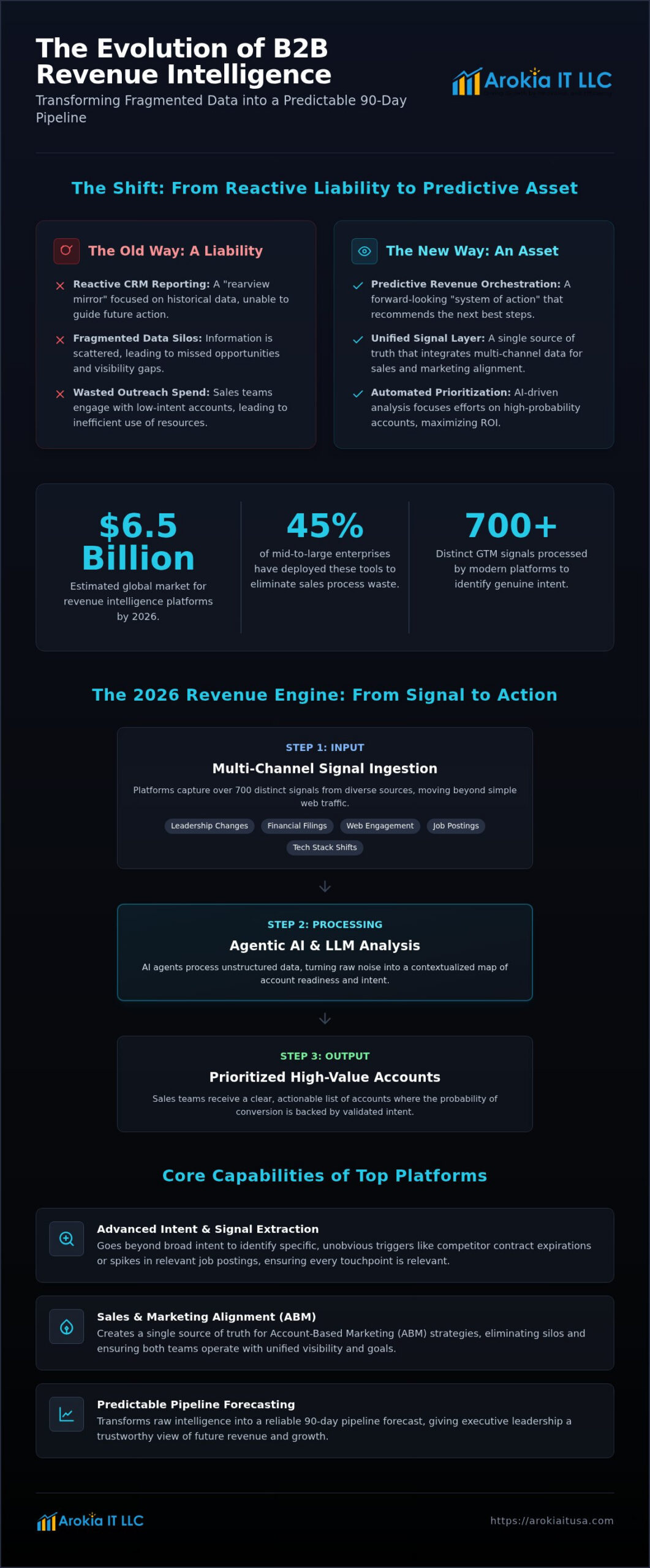
The B2B revenue landscape has undergone a clinical transformation. By 2026, the global market for revenue intelligence platforms has scaled to an estimated $6.5 billion, reflecting a shift from passive observation to aggressive execution. Traditional models that relied on linear tracking are obsolete. Modern leaders now prioritize “Revenue Action Orchestration,” a category defined by Gartner in late 2025 to describe systems that don’t just report data but recommend the next best action. This evolution is rooted in the foundational principles of Revenue management, which uses analytics to optimize financial outcomes across the entire organization. Today, 45% of mid-to-large enterprises have deployed these tools to eliminate the waste inherent in legacy sales processes.
Why Your CRM is No Longer Enough
Your CRM is a rearview mirror. It functions as a static repository for historical data, yet it fails to capture the real-time friction of a modern buyer journey. The top revenue intelligence platforms for b2b sales bridge this gap by moving from a “system of record” to a “system of action.” They eliminate the visibility silos where marketing engagement often dies before reaching the sales floor. When your data is static, your strategy is reactive. By transitioning to an action-oriented model, firms can bridge the gap between initial engagement and closed revenue, ensuring that no high-value signal is left unaddressed. It’s about accountability. If your tech stack doesn’t drive immediate prioritization, it’s merely an expensive filing cabinet.
The 2026 Signal Layer: From Intent to Execution
The modern GTM motion is fueled by over 700 distinct signals. These range from leadership changes and financial filings to nuanced web engagement and social triggers. Legacy intent data often felt like a “black box” that provided volume without context. In contrast, 2026 platforms utilize agentic AI and LLMs to process unstructured data, turning raw noise into prioritized accounts. Revenue Intelligence is the integration of data, AI, and strategic workflow. This signal layer ensures that sales teams no longer waste effort on generic outreach. Instead, they focus on accounts where the probability of conversion is backed by validated intent. By 2026, the top revenue intelligence platforms for b2b sales have moved beyond simple alerts to provide a comprehensive map of account readiness, allowing for a predictable 90-day pipeline forecast that executive leadership can actually trust.
Core Capabilities of Top Revenue Intelligence Platforms
Modern revenue growth isn’t a product of chance. It’s a result of precise signal extraction. The top revenue intelligence platforms for b2b sales distinguish themselves by their ability to synthesize multi-channel data into actionable directives. They don’t just aggregate web traffic or social mentions. They map financial filings, leadership transitions, and technological shifts against a firm’s ideal customer profile (ICP). This allows organizations to accelerate growth with revenue intelligence by focusing exclusively on high-probability opportunities. By integrating these insights directly with your ERP, CRM, and marketing automation platforms, you eliminate the friction that typically stalls the sales cycle.
Advanced Intent and Signal Extraction
Data is useless without resolution. Effective platforms prioritize timestamped, sourced, and resolved data to ensure that signals are both current and accurate. While basic tools track broad intent, advanced systems identify unobvious triggers such as a sudden increase in specific job postings or a competitor’s contract expiration. This level of granularity is where AI search optimization plays a critical role. By understanding how buyers search and what information they consume in generative engines, intelligence platforms can feed more nuanced data into the sales engine. This transition from broad intent to specific signal extraction reduces wasted outreach spend and ensures that every touchpoint is relevant. Precision is the only way to protect your margins.
Sales and Marketing Alignment (ABM)
Silos destroy revenue. For an Account-Based Marketing (ABM) strategy to succeed, marketing and sales must operate from a single source of truth. This unified visibility is a hallmark of the top revenue intelligence platforms for b2b sales in 2026. The most sophisticated platforms track engagement across the entire buyer committee, not just a single lead. They provide a transparent view of how an account moves from “fit” to “readiness,” allowing for automated prioritization. This alignment ensures that sales teams aren’t ignoring marketing-generated signals, while marketing isn’t wasting budget on accounts that aren’t ready to buy. It’s a clinical approach to demand generation that prioritizes accountability over activity.
Automation is the final piece of the architecture. Agent-led outreach and automated orchestration allow your team to scale without sacrificing personalization. If your current stack lacks this level of deep integration, it’s time to reevaluate your strategy. You can audit your current revenue process to identify where these intelligence gaps are costing you pipeline.
Comparative Analysis: Top Revenue Intelligence Leaders
The market for revenue technology is undergoing a period of rapid consolidation. Organizations are aggressively moving away from fragmented toolsets in favor of integrated ecosystems. Research indicates that the median number of tools in a revenue tech stack has decreased from 8.4 in 2024 to just 5.2 in early 2026. This shift toward “Revenue Action Orchestration” means the top revenue intelligence platforms for b2b sales are no longer evaluated solely on the volume of data they provide. Instead, the focus has shifted to their ability to trigger automated, high-precision workflows that eliminate human error and waste.
Comprehensive Platforms: Data-Centric vs. Orchestration-Focused Approaches
For organizations prioritizing a data-first approach, certain comprehensive platforms stand out. These solutions often excel in providing extensive datasets, leveraging AI agents to process millions of data points and deliver daily, prioritized “next-best” actions for sales teams. They are high-velocity solutions designed for scale. Conversely, other leading platforms specialize in orchestration-first logic and Account-Based Marketing (ABM) maturity. While some provide the granular contact fuel, others offer the sophisticated engine required to coordinate complex, multi-threaded account targeting. The choice often hinges on whether your primary bottleneck is a lack of accurate data or the inability to synchronize a unified GTM response across siloed departments.
Specialized Intelligence: Deep Signals and Conversation Insights
Broad platforms often lack the precision required for niche or high-stakes industrial sectors. Specialized solutions fill this gap by focusing on the “signal layer,” extracting hyper-specific triggers that generic intent models frequently overlook. For firms that require deep conversation intelligence, certain platforms provide a critical advantage, becoming visionary forces in forecasting precision. These tools analyze the “voice of the customer” across calls and emails to identify deal risks before they manifest as missed targets. This level of insight is essential for effective demand generation in complex sectors where buyer committees are large and the margin for error is thin.
Scalability remains a final, critical differentiator. Industrial B2B enterprises often require the stability of “walled garden” ecosystems to ensure data security and compliance. In contrast, high-velocity SaaS models typically thrive on the “openness” of API-first challengers. With Gartner projecting that 40% of enterprise applications will include task-specific AI agents by the end of 2026, your choice of platform must be dictated by its ability to integrate these agents into a cohesive, predictable revenue engine.
Selection Criteria: How to Evaluate Your Intelligence Stack
Procurement of the top revenue intelligence platforms for b2b sales often fails because executive leaders prioritize feature lists over operational reality. A platform that provides thousands of leads is worthless if those leads are stale. Stale data isn’t just an inconvenience; it’s a direct drain on your customer acquisition cost (CAC). You need a system that validates signals in real-time and offers deep AI transparency. Avoiding the “black box” of automated scoring is critical for maintaining sales team trust. If your reps don’t understand why an account is prioritized, they won’t act on the signal, rendering the entire investment moot.
Integration friction is the primary killer of time-to-value. Enterprise implementations shouldn’t take six months to show impact. When evaluating your stack, prioritize platforms that offer seamless connectivity with your existing ERP and CRM systems. This ensures that intelligence flows directly into the workflows your team already uses. Your selection must also support multi-threaded account engagement. Modern B2B deals involve an average of 6 to 10 stakeholders. Your platform must be capable of mapping engagement across this entire committee to provide a clinical view of deal health.
The ROI Framework for Revenue Intelligence
Success isn’t measured by lead volume. It’s measured by pipeline predictability and the elimination of “dark” accounts. You must calculate the cost of missed signals to understand the true value of an intelligence platform. A robust ROI framework focuses on three clinical metrics: reduction in sales cycle length, increase in win rates for prioritized accounts, and the accuracy of your 90-day forecast. If your platform doesn’t improve these numbers within the first two quarters, it’s a cost center, not a growth engine. Accountability starts with defining these success criteria before the first contract is signed.
Industrial B2B Considerations
Manufacturing and industrial sectors face unique challenges that high-velocity SaaS tools often fail to address. Multi-year sales cycles and complex supply chain dependencies require a different level of intelligence. This is where industrial marketing expertise becomes a decisive factor in tool selection. You can’t rely on generic intent signals when your buyers are evaluating capital equipment or long-term service contracts. Bridging the gap between legacy sales models and digital intelligence requires a platform that understands the nuances of industrial procurement. It’s about finding the intersection of traditional relationship building and data-driven precision.
Strategic Implementation: Turning Intelligence into Pipeline
Software is an engine. Strategy is the driver. Investing in the top revenue intelligence platforms for b2b sales provides the data, but it doesn’t provide the execution. Many organizations fail at this juncture. They accumulate high-cost tech stacks only to see their sales teams revert to legacy habits. A results-oriented revenue culture requires more than a platform login; it requires a systematic framework that holds every signal accountable to a tangible financial outcome. By 2026, the most successful firms have realized that intelligence without orchestration is just expensive noise.
The 90-Day Pipeline Forecast
Precision is the antidote to sales waste. The Arokia IT LLC approach centers on the 90-Day Pipeline Forecast, a methodology that transforms raw platform data into a predictable revenue roadmap. This isn’t a passive report. It’s a rigorous validation process that aligns executive expectations with real-time signal data. By identifying exactly which accounts are in an active buying cycle, we eliminate the resource drain associated with generic prospecting. This focus is essential as Gartner projects that 75% of high-growth companies will adopt a Revenue Operations (RevOps) model by the end of 2026. We ensure your intelligence stack serves this model, creating a single source of truth that drives accountability across the entire GTM team.
Knowing who to target is only half the battle. You must deliver the right message at the exact moment of readiness. This necessitates high-precision sales enablement content that is dynamically mapped to intelligence signals. If your platform detects a technological shift or a leadership change, your content must reflect that specific context. Generic outreach is a waste of capital. Precision content ensures your sales team is positioned as a strategic partner rather than a nuisance. We bridge the gap between what the platform sees and what the buyer hears.
Next Steps: From Evaluation to Execution
The transition from tool adoption to revenue mastery begins with a clinical gap analysis of your current stack. You must identify where your data remains siloed and where your signals are being ignored. An expert partner accelerates your ROI by providing the strategic layer that software vendors often omit. This is particularly critical in industrial sectors where sales cycles are long and the cost of a missed opportunity is high. It’s time to eliminate the guesswork from your sales process and build a pipeline that leadership can actually trust.
Mastering Your 2026 Revenue Architecture
The transition toward Revenue Action Orchestration has turned data into a clinical asset for the modern enterprise. You’ve seen that the top revenue intelligence platforms for b2b sales now prioritize automated execution over simple reporting. Success in this competitive landscape requires more than just a software subscription; it demands a systematic framework that bridges the gap between signal extraction and sales enablement. By integrating AI-driven search and GEO strategies with specialized industrial B2B expertise, your organization can transform fragmented intent into a validated roadmap for growth.
Accountability is no longer an optional luxury. Eliminating waste and securing a predictable 90-day pipeline forecast is the only way to defend the ROI of your technology stack. Arokia IT LLC provides the strategic layer needed to move beyond the “black box” of legacy intent tools and adopt a culture that prioritizes precision over volume. You have the engine. You now need the strategic driver to ensure it reaches your revenue targets.
The path to predictable growth is built on precision. Secure your competitive advantage today.
Frequently Asked Questions
What is the difference between sales intelligence and revenue intelligence?
Sales intelligence focuses primarily on contact data and lead identification. Revenue intelligence provides a comprehensive view of the entire go-to-market process. It analyzes interactions across every touchpoint to provide a single source of truth for the entire organization. By 2026, the top revenue intelligence platforms for b2b sales have evolved into action orchestration engines. They don’t just provide data; they recommend specific workflows to maximize the lifetime value of every account.
Can revenue intelligence platforms replace my current CRM?
Revenue intelligence platforms do not replace your CRM. Instead, they enhance it. Your CRM remains the static system of record, while the intelligence layer acts as the system of action. It extracts data from your CRM, email, and web signals to provide a clinical view of deal health. Without a CRM as a foundation, these platforms lack the historical context needed to generate accurate predictive forecasts or automated account prioritizations.
How long does it typically take to see ROI from a revenue intelligence platform?
Most organizations begin to see tangible ROI within 90 to 180 days. This timeline depends heavily on the quality of your implementation and the alignment of your sales team. When combined with a 90-day pipeline forecast, you can identify and eliminate wasted outreach spend almost immediately. The primary ROI drivers are shortened sales cycles and increased win rates, which result from focusing only on accounts that show validated buyer readiness.
How does AI search optimization (GEO) impact revenue intelligence data?
Generative Engine Optimization (GEO) provides the earliest possible signal of buyer intent. It tracks how potential customers interact with AI search engines before they ever visit your website. This data allows your intelligence platform to identify pre-intent signals that traditional tools miss. Integrating GEO into your stack ensures that your account prioritization is based on the most current search behaviors, providing a significant competitive advantage in complex industrial sectors.
What is the best revenue intelligence platform for industrial B2B companies?
There isn’t a single best tool, but Demandbase and 6sense are frequently cited as leaders for complex industrial cycles. These platforms excel at mapping multi-threaded buyer committees over multi-year sales periods. However, the software is only the engine. For industrial firms, the true value comes from an expert partner who can translate these technical signals into a strategic execution framework that respects the unique nuances of manufacturing and industrial procurement.
How do these platforms handle data privacy and GDPR compliance in 2026?
By 2026, platforms have transitioned to privacy-by-design architectures. They prioritize first-party data and anonymized intent signals to remain compliant with global regulations like GDPR and CCPA. The industry has moved away from invasive third-party tracking toward walled garden ecosystems. This shift ensures that your revenue intelligence remains ethically sourced while providing the precision needed to target high-value accounts without compromising individual user privacy or data security.
What are the most important signals to track for B2B sales in 2026?
Leadership transitions and financial triggers remain critical, but AI search engagement is the breakout signal of 2026. You should also track technological shifts and specific job posting volume within target accounts. The top revenue intelligence platforms for b2b sales prioritize these signals to determine account readiness. By monitoring these unobvious triggers, your team can engage prospects with a tailored message before your competitors even realize the account is in-market.
Do I need a dedicated RevOps team to manage these platforms?
While a dedicated RevOps team is ideal for enterprise-scale operations, it isn’t a strict requirement for every business. Many mid-market firms successfully manage these platforms by working with an expert partner. This approach provides the strategic oversight and technical expertise needed to bridge the gap between marketing and sales without the overhead of a full internal department. The objective is to ensure that your intelligence stack drives tangible outcomes, not just activity.