
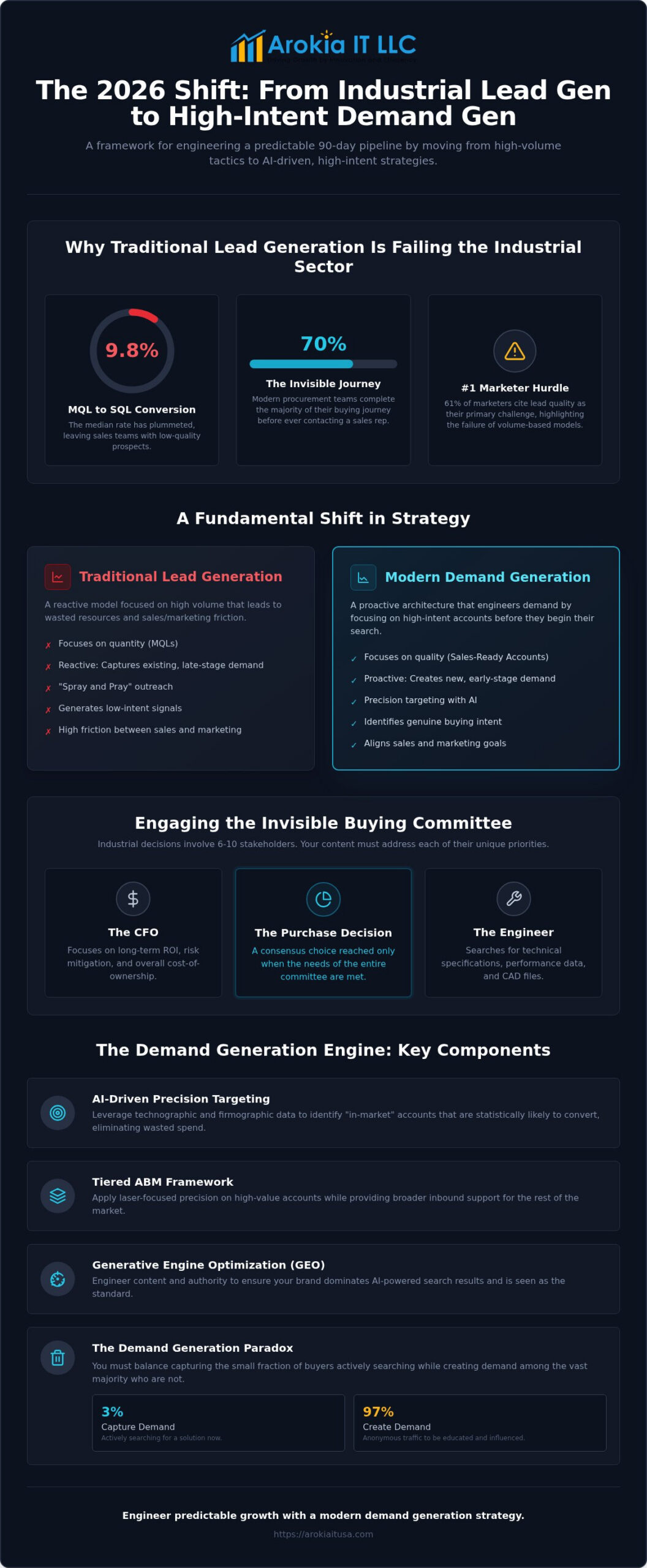
In 2026, the median conversion rate for marketing qualified leads to sales qualified leads has plummeted to just 9.8 percent. It’s a sobering reality for executive leadership when sales teams have learned to ignore marketing outreach entirely. You’ve likely felt the friction of increasingly long sales cycles and the frustration of invisible buying committees that remain unreachable through traditional channels. Conventional industrial lead generation has become a race to the bottom, where high volume often masks a critical lack of genuine intent. This waste isn’t just a marketing inefficiency; it’s a structural failure that erodes your financial predictability.
We’re here to help you engineer a more precise alternative. This guide outlines how to transition from fragmented tactics to a unified demand generation strategy using AI-driven precision and Account-Based Marketing frameworks. You’ll learn to align your sales and marketing departments while securing dominance in AI-powered search results. By focusing on high-intent signals rather than raw traffic, you can build a predictable 90-day pipeline that eliminates wasted spend. We’ll examine the specific mechanics of shortened buying cycles and the technological shifts required to lead the industrial sector through the coming year.
Key Takeaways
- Understand why modern procurement teams complete 70% of their journey before contact and how to intercept them early in the cycle.
- Master the strategic transition from high-volume industrial lead generation to high-intent demand generation to secure a seat at the table before RFPs are issued.
- Evaluate the “Tiered ABM” framework to determine which high-value accounts require laser-focused precision versus broader inbound support.
- Deploy a 90-day pipeline forecast and Generative Engine Optimization (GEO) to stabilize revenue and ensure visibility in AI-driven search results.
- Learn to map content specifically to industrial buying committees, bridging the gap between marketing effort and sales-ready revenue.
Beyond the Digital Brochure: Why Industrial Lead Generation Needs a 2026 Reset
The “spray and pray” model has reached its expiration date. In an era where 61 percent of marketers cite lead quality as their primary hurdle, filling a CRM with low-intent contact data is a liability, not an asset. Modern industrial lead generation requires a fundamental shift in perspective. It’s no longer about volume. It’s about precision. By the time a procurement officer reaches out to your sales team, they’re often 70 percent of the way through their decision-making process. If you haven’t influenced them during that invisible 70 percent, you aren’t a partner; you’re just a line item on a comparison spreadsheet.
While the foundational concept of lead generation involves identifying and cultivating potential customers, the industrial sector demands a more rigorous application. You aren’t just capturing names. You’re building strategic market authority that forces buyers to notice you before they even draft an RFP. This reset moves away from the digital brochure and toward a system that engineers demand by solving complex problems in public.
The Death of the MQL in Manufacturing
Quantity-based metrics create a dangerous rift between sales and marketing. When marketing celebrates 500 “leads” but sales can’t close a single one, the system is broken. In 2026, the median conversion rate from MQL to SQL has dropped to 9.8 percent. Chasing these low-intent signals wastes your most expensive resource: your sales team’s time. We must pivot toward “Sales-Ready Accounts.” This metric prioritizes account-level engagement over individual clicks, ensuring your team only pursues prospects with a demonstrated intent to buy. It’s about quality control at the source.
Buying Committees and the Invisible Journey
Industrial procurement isn’t a solo act. Decisions involve a committee of 6 to 10 stakeholders, each with divergent priorities. An engineer searches for technical specifications and CAD files; a procurement officer focuses on supply chain resilience and cost-of-ownership; a CFO looks for long-term ROI and risk mitigation. Your content strategy must serve every layer of this committee simultaneously. If your digital presence only speaks to one persona, you’re leaving the door open for competitors who provide a more comprehensive narrative. Strategic demand generation ensures your brand is the consensus choice before the first meeting even occurs.
Engineering Intent: The Mechanics of Modern B2B Demand Gen
Lead generation is a reactive process. Demand generation is proactive architecture. While the fundamentals of online lead generation focus on attracting and capturing interest, industrial lead generation in 2026 requires a deeper engineering of intent. You can’t wait for a prospect to search for a solution. By then, their internal requirements are already set. Strategic demand generation creates awareness before the RFP process begins, positioning your firm as the standard by which all other bidders are measured.
Identifying high-value accounts isn’t a guessing game. By leveraging technographic data, you can see which software and machinery your prospects currently use. Firmographic data tells you if they have the capital to invest. Combined, these signals allow you to ignore the noise and focus on “in-market” accounts that are statistically likely to convert. This eliminates the waste of marketing to accounts that will never move the needle.
Capture vs. Creation: The Demand Generation Paradox
The demand generation paradox rests on two pillars. First, you must capture existing demand from users who are actively searching for your services. Second, you must create demand by educating prospects on inefficiencies they haven’t yet quantified. In 2026, roughly 97 percent of website traffic remains anonymous. Capturing that invisible intent requires a system that identifies company-level engagement before a form is ever filled. Balancing short-term lead flow with long-term brand authority is the only way to avoid the “feast or famine” cycle typical of industrial sales.
The Industrial Content Stack
Technical trust is the currency of manufacturing. A generic blog post won’t convince a lead engineer to switch suppliers. High-value content marketing must serve the entire committee. This requires a tiered approach to documentation. Engineers require detailed technical whitepapers for validation. C-suite executives need concise summaries focused on ROI and risk mitigation. Effective industrial lead generation demands deep subject matter expertise that mirrors the complexity of the products themselves.
Using video and interactive tools can demonstrate complex engineering solutions in ways a static brochure never could. If your content lacks technical rigor, you’ll lose the committee’s trust before the first discovery call. If you’re ready to audit your current approach, it might be time to speak with a consultant about engineering a more precise pipeline. High-impact industrial marketing ensures your technical advantages are translated into commercial value for every stakeholder involved.
ABM vs. Traditional Inbound: Selecting the Right Model for Industrial Sales
The choice between broad inbound and laser-focused Account-Based Marketing isn’t binary. It’s a strategic decision based on unit economics and contract complexity. For many manufacturers, a “Tiered ABM” approach provides the necessary flexibility. High-value enterprise accounts require a one-to-one focus, while mid-market segments benefit from one-to-many automation. This alignment ensures that marketing resources aren’t wasted on accounts that lack the scale to justify the acquisition cost. Effective industrial lead generation isn’t about choosing one path; it’s about orchestrating both to cover the entire market.
Success in 2026 is measured by account penetration and pipeline velocity rather than raw lead volume. When sales and marketing share account intelligence, they eliminate the friction that usually stalls industrial deals. This transition requires a move away from siloed data toward a unified revenue engine where every touchpoint is validated by intent. Precision in targeting leads to a more predictable 90-day pipeline, removing the “feast or famine” cycles that plague unaligned organizations. By focusing on accounts rather than individuals, you gain a clearer view of the total addressable market.
Account-Based Marketing for High-Value Contracts
In most industrial sectors, a small fraction of accounts drives the majority of revenue. Identifying your “Top 100” prospects allows for the deployment of highly personalized, multi-channel campaigns. These aren’t generic advertisements. They’re tailored communications across LinkedIn, direct mail, and GEO that address specific operational bottlenecks unique to that account. By utilizing Account-Based Marketing, you ensure that your technical expertise is visible to the entire buying committee before the first sales call. This precision reduces waste and accelerates the transition from prospect to partner. It’s about dominating the accounts that matter most to your bottom line.
Inbound for Scale: Capturing the Mid-Market
While ABM handles the whales, a robust inbound strategy captures the broader category interest that fuels long-term growth. Effective B2B SEO ensures your firm appears when engineers search for general solutions or technical standards. The goal here is to create a frictionless path from a search result to a technical consultation. By using automated, intent-based sequences, you can nurture long-tail interest without overextending your sales team. This dual-track system allows for consistent industrial lead generation across all market tiers, providing both immediate pipeline stability and long-term market dominance. It captures the demand you haven’t yet identified through direct outreach.
Step-by-Step: Building Your Industrial Demand Generation Engine
Constructing a resilient industrial lead generation system is a disciplined engineering task. It demands a move away from superficial metrics toward a validated, multi-stage process that prioritizes account fit over click volume. While 89 percent of B2B sales and marketing professionals now use AI in their prospecting efforts, technology alone cannot replace a flawed strategy. You must build a foundation that bridges the gap between technical expertise and commercial validation.
- Step 1: Define the ICP and Buying Committee. An Ideal Customer Profile in the context of industrial procurement is a data-driven model identifying high-value accounts that possess the technical infrastructure, budgetary authority, and operational urgency to integrate complex engineering solutions.
- Step 2: Map the Content Journey. Align your technical documentation and executive summaries with specific industrial pain points, such as supply chain volatility or equipment downtime.
- Step 3: Deploy Multi-Channel Distribution. Utilize LinkedIn for precision targeting, AI-optimized search for technical discovery, and intent-based email sequences for nurturing.
- Step 4: Implement Sales Enablement. Arm your sales team with the specific content needed to navigate the final 30 percent of the buyer’s journey.
- Step 5: Establish a Feedback Loop. Create a weekly cadence where sales and marketing teams analyze account engagement to refine targeting and messaging.
Data-Driven Targeting and Segmentation
Sales Enablement: The Last Mile of Lead Gen
The hand-off from marketing to sales is where most industrial lead generation efforts fail. To close complex deals, your sales team needs proof points that withstand technical scrutiny. Case studies serve as the ultimate validation in this environment. For example, the Arterex Medical SEO case study demonstrates how strategic content can shorten cycles by addressing technical objections before they are even raised. Proactive objection handling through targeted content reduces friction and accelerates pipeline velocity, ensuring that “sales-ready” actually results in revenue.
Predictable Growth: Implementing the 90-Day Pipeline and GEO Framework
Predictability is the ultimate hedge against industrial market volatility. For too long, manufacturing leadership has accepted “feast or famine” cycles as an inherent trait of the sector. This instability is usually a symptom of a reactive marketing model that fails to account for the long-tail nature of engineering procurement. By implementing a 90-Day Pipeline Forecast, you move away from speculative lead counting toward a model based on validated intent signals. This framework provides executive leadership with a clear view of future revenue, allowing for more confident capital allocation and resource planning. Effective industrial lead generation in 2026 is no longer a game of chance; it’s a calculation of technical visibility and account engagement.
Revenue reporting must also evolve. Traditional attribution models often provide a distorted view of marketing’s impact by overvaluing the final click. In a complex industrial sale, no single touchpoint is responsible for the deal. We must shift the focus from attribution to contribution. This approach measures how marketing efforts supported the entire buying committee throughout their journey, from initial technical research to final vendor selection. It prioritizes the cumulative weight of your technical authority over isolated interactions.
The Future of Search: GEO and AEO for Industry
The search environment has fundamentally shifted. With 85 percent of marketers now utilizing generative AI, the priority has moved from ranking in a list of links to securing citations in AI-generated answers. Generative Engine Optimization (GEO) involves structuring your technical data so LLMs like ChatGPT, Claude, and Gemini can accurately extract and summarize your capabilities. This is the new frontier of AI search optimization. If your technical specifications and case studies aren’t optimized for these engines, your brand will remain invisible to the procurement teams using AI to shortlist vendors. Securing these citations ensures you’re part of the conversation before a human ever visits your website.
The 90-Day Forecast: Executive Accountability
A predictable revenue model requires rigorous accountability. You can’t manage what you don’t measure with precision. By using the AI Scorecard, you can audit your current marketing efficiency and identify the specific gaps stalling your pipeline velocity. This audit aligns executive expectations with the reality of industrial buying cycles, which can often exceed twelve months. The 90-day window provides a manageable timeframe to track intent signals and adjust strategies before they impact quarterly targets. It bridges the gap between high-level strategy and granular execution, ensuring every marketing dollar is focused on accounts with a high statistical probability of conversion.
Engineering Your Competitive Advantage in an AI-First Market
Industrial procurement has fundamentally changed. Success now depends on your ability to capture invisible intent and establish technical authority before the RFP process begins. By integrating Account-Based Marketing with Generative Engine Optimization, you move beyond the limitations of traditional lead forms. This transition from reactive marketing to proactive demand generation is the hallmark of modern industrial lead generation. It’s no longer enough to be visible; you must be the validated choice for complex buying committees.
Arokia IT provides the systematic solutions required for this evolution. We specialize in 90-day pipeline forecasting and complex B2B sales enablement, ensuring your marketing efforts contribute directly to the bottom line. Our expertise in industrial GEO and AEO allows your technical specifications to be accurately extracted and summarized by the AI systems your prospects use for research. The window for capturing early-mover advantage in AI search is narrowing. Now is the time to audit your efficiency and secure your place in the next generation of industrial growth.
The path to predictable revenue is built on precision and the elimination of waste. We’re ready to help you bridge the gap between your engineering excellence and your financial targets.
Frequently Asked Questions
What is the difference between industrial lead generation and demand generation?
Lead generation focuses on the reactive capture of contact information through forms and gated content. In contrast, demand generation is a proactive strategy designed to build market authority and educate the buying committee before an RFP is issued. Effective industrial lead generation in 2026 requires balancing these two approaches. While lead generation fills the CRM, demand generation ensures those contacts actually possess the technical intent and budgetary authority required to close complex deals.
How long does it typically take to see results from an industrial demand gen campaign?
Industrial procurement typically involves cycles exceeding twelve months. However, a structured demand generation campaign provides measurable intent signals much sooner. By implementing a 90-day pipeline forecast, leadership can see account-level engagement and technical validation within the first quarter. This framework eliminates the uncertainty of the “feast or famine” cycle by providing a predictable model for revenue growth, even when the final transaction remains several months in the future.
Why is LinkedIn better than other platforms for industrial B2B marketing?
LinkedIn provides the granular targeting necessary to reach specific stakeholders within a buying committee. Unlike broad search platforms, it allows you to isolate engineers, procurement officers, and executives at your highest-value target accounts. This makes it the primary engine for Account-Based Marketing. By combining personalized outreach with technical content, you can establish trust with the invisible 70 percent of the buyer journey that occurs before a sales representative is ever contacted.
What role does AI play in industrial lead generation for 2026?
AI has moved beyond simple automation to become the core of precision targeting. In 2026, roughly 85 percent of marketers use generative AI to analyze intent data and optimize content for answer engines. AI allows for the identification of “in-market” accounts by tracking technographic and firmographic shifts in real time. It ensures your technical documentation is structured for extraction by LLMs, securing your brand’s presence in AI-generated industrial procurement recommendations.
How do I align my sales and marketing teams for better lead quality?
Alignment requires a shift in metrics from lead volume to account penetration. Sales and marketing must share account intelligence to identify which prospects are truly “sales-ready.” Providing sales teams with targeted enablement content ensures they can handle technical objections during the final stages of the cycle. This collaborative approach reduces friction and ensures that marketing efforts are directly contributing to the 90-day pipeline forecast rather than generating low-intent noise.
Can ABM work for smaller industrial firms with limited budgets?
Smaller firms can successfully deploy ABM by using a “Tiered” approach. Instead of attempting to reach the entire market, these firms should focus laser-targeted resources on a select group of high-value accounts that drive the majority of potential revenue. This precision eliminates the waste associated with broad inbound campaigns. By leveraging LinkedIn and personalized content, smaller industrial players can compete with larger organizations by dominating the specific accounts that matter most to their growth.
What is Generative Engine Optimization (GEO) and why does it matter for manufacturers?
Generative Engine Optimization is the process of structuring technical content so it can be accurately summarized and cited by AI systems like ChatGPT and Gemini. For manufacturers, this is critical because procurement teams increasingly use AI to shortlist vendors. If your technical data isn’t optimized for these engines, you’ll remain invisible during the research phase. GEO ensures your technical authority is recognized by the algorithms that now influence the majority of B2B buying decisions.
How do I measure the ROI of my industrial marketing efforts?
Measuring ROI in 2026 requires moving from “attribution” to “contribution.” Instead of trying to credit a single click for a million-dollar contract, you must measure how marketing touchpoints increased pipeline velocity and account engagement. Track the accuracy of your 90-day pipeline forecast and the depth of penetration into target buying committees. This provides a more clinical and objective view of how your strategic investments are driving financial growth and organizational stability.