
For most mid-market B2B firms, the most expensive software in the stack isn’t the one with the highest license fee. It’s the one your sales team refuses to use. While evaluating 6sense alternatives for mid-market b2b companies, you’ve likely realized that enterprise complexity often leads to “black box” predictive scoring that lacks transparency. Implementation cycles stretching beyond six months and features that sit idle as shelfware aren’t just inconveniences. They are direct threats to your revenue targets and organizational efficiency.
We understand that your priority is a predictable pipeline, not a bloated tech stack. This guide identifies the most effective ABM and revenue intelligence platforms specifically tailored to deliver results without the enterprise level friction. You’ll discover how to transition from opaque models to transparent, actionable intent data that sales teams actually trust. We will break down the 2026 landscape of composable stacks, comparing modular solutions that prioritize faster time-to-value and higher sales adoption over unnecessary administrative overhead.
Key Takeaways
- Identify how mid-market firms avoid the “complexity tax” by replacing monolithic platforms with composable stacks that eliminate excessive administrative overhead.
- Evaluate the top 6sense alternatives for mid-market b2b companies based on their ability to provide transparent, verifiable scoring that restores sales team trust in intent data.
- Discover why the 2026 mandate for demand generation requires integrating Generative Engine Optimization (GEO) to capture buyers who prioritize AI-driven search platforms.
- Apply a rigorous selection framework that prioritizes ease of orchestration and first-party engagement tracking over opaque, third-party predictive models.
- Master the transition from tool accumulation to strategic orchestration by aligning intent signals with high-impact sales enablement content and 90-day pipeline forecasting.
Why Mid-Market B2B Companies Are Moving Beyond 6sense in 2026
Mid-market organizations often fall into a predictable trap. They purchase enterprise-grade software expecting enterprise-grade results, only to find themselves paying a “complexity tax” that drains resources without accelerating pipeline. For a firm with 100 to 500 employees, 6sense isn’t just a platform; it’s a full-time management burden. Many organizations are now seeking 6sense alternatives for mid-market b2b companies because they lack the dedicated Marketing Ops headcount required to maintain such a sophisticated engine. When a platform requires six months of configuration before the first campaign launches, the ROI is already underwater. Efficiency isn’t found in more features. It’s found in higher adoption.
The breaking point arrives when the software becomes “shelfware.” This occurs when the delta between the tool’s capabilities and the team’s capacity becomes insurmountable. Strategic leaders are realizing that more data doesn’t equate to more revenue if that data remains trapped in an administrative bottleneck. Accountability matters. If your team cannot explain how a lead reached a “hot” status, they won’t follow up on it. Precision is useless without action.
The Hidden Costs of Enterprise-Grade ABM
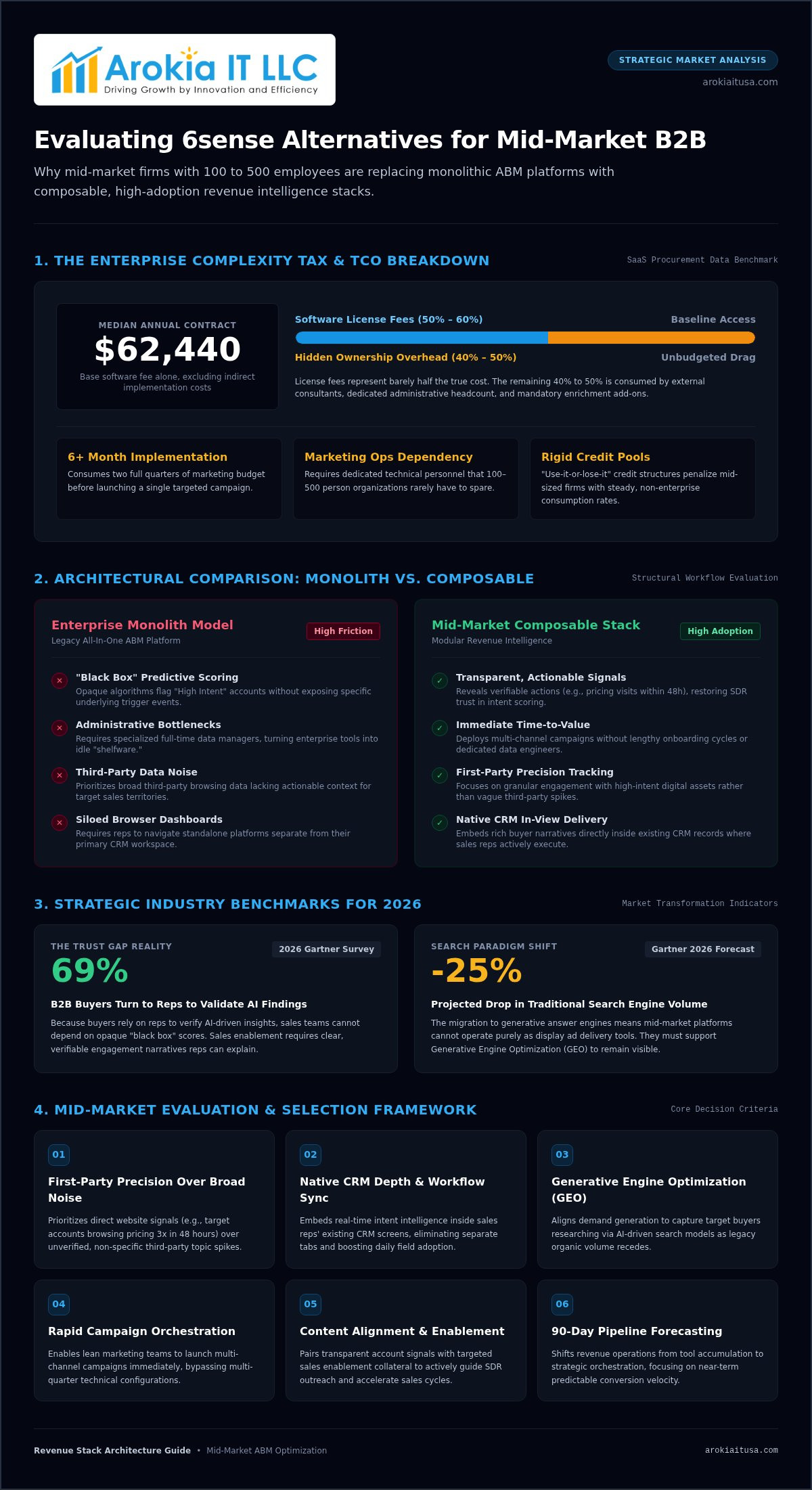
The sticker price is just the beginning. Research from SaaS procurement data indicates that the median annual contract for 6sense hovers around $62,440, yet license fees typically account for only 50 to 60 percent of the total cost of ownership. The remaining expense is consumed by third-party consultants, dedicated administrators, and data enrichment add-ons. Mid-market teams don’t need a platform that requires a PhD to operate. They need an ABM strategy that prioritizes execution over configuration. Implementation cycles that burn through two full quarters of budget are no longer acceptable in a results-first environment. Rigid seat-based models and “use-it-or-lose-it” credit pools create further friction, essentially penalizing mid-sized firms for not having enterprise-level data consumption needs.
When Predictive Scoring Becomes a Liability
Opaque algorithms create a “trust gap” between marketing and sales. When an SDR sees a “High Intent” score but can’t see the specific actions that triggered it, they ignore the lead. This skepticism is well-founded. According to a 2026 Gartner survey, 69 percent of B2B buyers still turn to sales representatives to validate AI-generated findings. Relying on a “black box” for territory planning or an account-based selling methodology is a strategic risk. Veteran reps value transparency over predictive mystery. The shift toward 6sense alternatives for mid-market b2b companies is driven by a demand for actionable signals that sales teams can actually verify and act upon. Transitioning to transparent signals ensures that every identified account comes with a clear narrative of engagement, which eliminates the guesswork that kills sales momentum.
Evaluating 6sense Alternatives: The Mid-Market Selection Framework
Selecting 6sense alternatives for mid-market b2b companies requires a fundamental shift from “more data” to “better data.” Enterprise tools often prioritize third-party intent signals that lack granular context. For mid-market teams, first-party engagement tracking is far more valuable. It’s the difference between knowing someone in a target account is browsing a general topic and knowing they’ve visited your specific pricing page three times in 48 hours. Precision is the antidote to the “data noise” that typically plagues large-scale, enterprise-level deployments.
Orchestration must be immediate. If your current team cannot launch a multi-channel campaign without a six-month onboarding period or a dedicated data engineer, you’ve chosen the wrong tool. True efficiency is found in platforms that offer CRM integration depth, moving beyond basic record syncing to deliver real-time sales enablement. Your reps need intent data served within their existing CRM view, not tucked away in a separate browser tab they’ll never open. Efficiency isn’t just about the tool’s power; it’s about the team’s ability to wield it.
The framework must also account for the rapid evolution of buyer behavior. Gartner predicts that traditional search engine volume will drop 25% by 2026. This shift toward generative answer engines means your ABM platform can’t just be an ad-delivery tool; it must be AI-search ready. If you’re struggling to understand how your brand’s authority translates to these new AI models, it’s time to speak with a strategist who can bridge the gap between intent data and Generative Engine Optimization.
Data Quality vs. Data Quantity
Mid-market SDRs don’t need a thousand low-intent signals. They need ten high-probability accounts. Many platforms boast 90% match rates, but these figures are often inflated by low-quality IP resolution that fails to map to actual decision-makers. In industrial sectors, technographic data is often the most critical signal. Knowing which specific machinery or legacy software a prospect currently uses allows for hyper-personalized outreach that general intent scores simply can’t match. Verifying data accuracy means looking past the marketing claims and testing the platform’s ability to identify specific buyers within your niche.
Sales-Marketing Alignment Capabilities
Automation is only useful if it triggers the right human action. Your platform should deliver lead nurturing assets and sales enablement content directly into the rep’s workflow at the exact moment an account shows heat. This eliminates the friction that usually kills sales adoption. Focus on platforms that provide transparent, customizable dashboards for executive revenue reporting. When leadership can see a clear, direct line from an intent signal to a closed-won deal, the “trust gap” disappears and marketing’s role as a revenue driver is finally validated.
The Top 6sense Competitors for Mid-Market B2B in 2026
The market for 6sense alternatives for mid-market b2b companies has matured beyond simple feature parity. In 2026, the focus has shifted toward tools that deliver immediate utility without requiring a year of professional services. Mid-market leaders are increasingly building “composable” stacks that prioritize contact accuracy and first-party engagement over the expensive, often inaccurate third-party intent signals that define enterprise-only platforms. Efficiency is no longer defined by how much data you can collect, but by how quickly your sales team can act on it.
Demandbase vs. 6sense: The Battle for the Mid-Market
Demandbase remains the primary enterprise challenger, but its recent licensing shifts have made it more accessible to mid-sized firms. While 6sense excels at account identification within the “dark funnel,” Demandbase often provides superior buying group intelligence. This is a critical distinction for industrial brands where purchasing decisions involve complex committees of engineers, procurement officers, and executives. Their platform allows for more granular ABM strategies for B2B by offering multi-channel advertising that reaches specific job functions rather than just broad IP ranges. With entry-level mid-market tiers starting between $18,000 and $25,000 per year, Demandbase provides a structured alternative that scales without the same level of administrative friction found in 6sense.
ZoomInfo and Factors: The New Mid-Market Favorites
Sales-led organizations are increasingly turning to ZoomInfo Marketing because it anchors intent data in the world’s most accurate contact database. While 6sense identifies the account, ZoomInfo provides the direct-dial phone numbers and verified emails needed to act on that signal immediately. This eliminates the “data without action” trap that stalls many demand generation programs. Conversely, Factors.ai has emerged as a high-ROI challenger for lean teams. By focusing on website de-anonymization and first-party data, Factors reduces the reliance on expensive third-party intent signals. With entry tiers starting between $5,000 and $6,000 per year, it allows revenue leaders to see exactly which content is driving interest. This transparency makes it easier to build a predictable 90-day pipeline forecast. RollWorks also serves as a specialized entry point for firms prioritizing rapid deployment, starting at approximately $12,000 per year for display-heavy setups. Choosing between these depends on whether your strategy leans toward sales-led prospecting or marketing-led brand awareness.
The 2026 Mandate: AI Search and Generative Engine Optimization (GEO)
The B2B buyer journey has migrated upstream. In 2026, account identification alone is insufficient if your brand remains invisible during the initial discovery phase. Recent industry data reveals that 51% of B2B software buyers now initiate their research directly within AI platforms like ChatGPT, Claude, or Perplexity rather than traditional search engines. Consequently, evaluating 6sense alternatives for mid-market b2b companies requires looking beyond legacy ad-tech capabilities. Your platform must actively support AI-driven search strategies that influence the “Dark Social” journey long before a prospect ever visits your website. Visibility is the new currency of trust.
Arokia IT positions itself as the strategic partner that makes your software investment work by bridging this specific gap. We don’t just identify intent signals; we optimize your brand’s “citation share” across the large language models (LLMs) your buyers utilize for vendor shortlisting. This transition from keyword-focused SEO to entity-based authority ensures your solutions appear in the synthesis provided by AI agents. Accountability in 2026 means measuring how often your brand is the recommended answer in a generative prompt.
GEO: The New Frontier of Demand Generation
Generative Engine Optimization (GEO) represents a fundamental shift in how mid-market firms maintain market dominance. While traditional SEO focuses on ranking for specific terms, GEO focuses on establishing your brand as a definitive entity within a specific industry context. This approach significantly shortens the research phase for B2B buyers by providing them with pre-qualified answers to complex technical questions. Implementing a rigorous AI Search Optimization strategy ensures that when an AI model summarizes the top solutions in your sector, your brand is cited as a primary authority. Precision in your technical documentation and third-party mentions is now a prerequisite for pipeline growth.
Integrating Intent with AI Content Strategy
The most effective 6sense alternatives for mid-market b2b companies use intent signals to feed a generative content engine. If intent data shows a surge in interest regarding specific regulatory shifts or technical challenges, your content strategy must pivot to answer the exact questions an AI model will predict. Arokia IT integrates these signals directly into our 90-day pipeline forecasting. We include AI search visibility metrics to track how often your brand is recommended by virtual agents. This ensures that your sales enablement content isn’t just sitting in a repository; it’s actively training the models that influence your next major contract. We align your expertise with the algorithms that now gatekeep the B2B marketplace.
Beyond the Tool: Why Strategic Orchestration is the True 6sense Alternative
Mid-market leaders often fall into the “Software-Only” trap. They assume that purchasing a license for 6sense or its competitors will automatically generate pipeline. This is a fallacy. Software is an accelerator, not a destination. Without a disciplined strategy, even the most advanced 6sense alternatives for mid-market b2b companies remain expensive line items that fail to bridge the gap between marketing data and sales results. Strategic orchestration is the actual solution. It requires a clinical focus on how intent data moves from a digital dashboard into a representative’s conversation. Precision in selection is useless without precision in execution.
Arokia IT differentiates itself by moving beyond a tool-centric approach. We combine account-based marketing, demand generation, and generative engine optimization into a unified revenue engine. This isn’t about accumulating features. It’s about total market dominance. We prioritize accountability and the elimination of waste, ensuring that every dollar spent on intent data translates into a validated sales opportunity. We position ourselves as the critical partner that makes the software work, rather than just another service provider in the stack.
The 90-Day Pipeline Forecast: Accountability in Action
We don’t measure success by “intent heat maps” or “account awareness” scores. These are vanity metrics that don’t satisfy revenue targets or executive expectations. Instead, Arokia IT focuses on measurable revenue acceleration through our Demand Generation Services. Our process is anchored in a 90-day pipeline forecast that provides leadership with a predictable roadmap for growth. We ensure your chosen 6sense alternative delivers ROI by validating every digital signal against actual sales progress. If a data point doesn’t lead to a meaningful engagement, it’s discarded to protect your team’s time and focus.
Customized Sales Enablement: The Last Mile of ABM
The “last mile” of the sales cycle is where most mid-market ABM programs fail. Identifying an account is relatively easy. Moving that account through a complex industrial sales cycle is difficult. Industrial marketing requires a specific approach that accounts for technical gatekeepers and multi-layered procurement committees. We create sales enablement content that answers the granular questions your buyers are asking in 2026. This content isn’t just for your website; it’s designed to influence the AI models that your prospects use for initial research. We bridge internal silos to ensure your sales team is equipped with the right narrative at the right moment.
Your path to total market dominance starts with accountability and strategic precision. It’s time to build a revenue engine that delivers tangible results.
Frequently Asked Questions
What is the primary difference between 6sense and Demandbase for mid-market companies?
The primary difference lies in orchestration and buying group intelligence. While 6sense focuses heavily on predictive AI and identifying accounts within the dark funnel, Demandbase offers more granular buying group insights that are critical for complex B2B committees. For mid-market firms, Demandbase provides structured entry tiers starting between $18,000 and $25,000 annually. This makes it a more accessible alternative for organizations that require enterprise-level power without the same administrative complexity found in 6sense deployments.
How much does a 6sense alternative typically cost for a mid-sized B2B firm?
Pricing for 6sense alternatives for mid-market b2b companies varies based on the required depth of intent data. Specialized platforms like Factors.ai start between $5,000 and $6,000 per year, while advertising-focused options like RollWorks begin at approximately $12,000 annually. More comprehensive solutions like Demandbase typically start around $18,000. These options offer significant cost savings compared to the median 6sense annual contract value of $62,440, which often excludes the additional overhead of dedicated administrators and data overage fees.
Can ZoomInfo replace 6sense for intent-based marketing?
Yes, ZoomInfo Marketing is an effective replacement, particularly for sales-led organizations that prioritize immediate actionability. While 6sense is excellent at identifying account-level interest, ZoomInfo anchors that intent data in a superior contact database. This allows sales teams to move from an intent signal to a direct-dial phone call or verified email instantly. By combining account intent with the industry’s most accurate prospecting data, ZoomInfo eliminates the “data without action” gap that often stalls mid-market revenue growth.
What is Generative Engine Optimization (GEO) and why does it matter for ABM?
Generative Engine Optimization (GEO) is the process of optimizing your brand authority so it appears in the synthesized answers provided by AI agents like ChatGPT and Perplexity. It matters because Gartner predicts traditional search engine volume will drop 25% by 2026. If your ABM strategy only focuses on traditional ads and SEO, you’ll miss the 51% of B2B buyers who now initiate research in AI chatbots. GEO ensures your brand is cited as a primary authority during this research phase.
How long does it take to see ROI after switching from 6sense?
Most mid-market teams see measurable ROI within 90 days when switching to a more agile, composable stack. Unlike legacy enterprise platforms that require six months of implementation and professional services, modern alternatives prioritize faster time-to-value. ROI is accelerated by reducing administrative “complexity taxes” and increasing sales adoption. When reps receive transparent, verifiable intent signals that they actually trust, they engage with high-priority accounts more frequently, leading to faster pipeline conversion and shorter sales cycles.
Is contact-level intent or account-level intent more important for mid-market sales teams?
Contact-level intent is generally more important for mid-market sales teams because it provides specific, actionable targets. Account-level intent tells you a company is interested, but contact-level data identifies the exact decision-maker browsing your technical documentation or pricing page. This level of precision eliminates the guesswork that often frustrates SDRs. By focusing on the individual buyer’s journey, sales reps can personalize their outreach based on specific behaviors, which significantly increases response rates compared to broad, account-wide targeting.
Why do so many B2B companies fail to implement 6sense correctly?
Implementation failure usually stems from a lack of dedicated RevOps headcount and the resulting “complexity tax.” 6sense requires significant technical maintenance to keep its predictive models accurate and its data integrations synced. Mid-market firms rarely have the internal resources to manage these enterprise-level requirements, leading to “shelfware” where expensive features go unused. Without a clear strategy to bridge the gap between marketing data and sales action, the platform becomes a costly administrative burden rather than a revenue driver.
How does Arokia IT help companies choose the right revenue intelligence platform?
Arokia IT evaluates 6sense alternatives for mid-market b2b companies based on strategic orchestration rather than just feature lists. We align your technology selection with our 90-day pipeline forecasting and industrial sector expertise. Our approach ensures you select a platform that prioritizes sales enablement and AI search readiness over vanity metrics. We act as your strategic partner to eliminate waste and ensure your chosen stack delivers measurable revenue precision, helping you transition from tool accumulation to total market dominance.