
The most expensive mistake a mid-market B2B leader can make in 2026 isn’t choosing the wrong software; it’s paying for enterprise-grade features that remain dormant while your sales pipeline stagnates. Many organizations invest in the leading marketing automation platforms mid-market b2b vendors offer only to find their sales CRM remains entirely disconnected. This misalignment doesn’t just cause internal friction. It actively erodes your ability to forecast revenue with any degree of precision.
We understand that your goal isn’t just to send more emails, but to build a systematic engine for growth. This guide provides the strategic framework for selecting technology that bridges the gap between marketing effort and predictable revenue growth. We’ll examine how to secure a seamless handoff between teams and automate the nurturing of high-value accounts. By the end of this analysis, you’ll have a clear roadmap to replace underutilized tools with a high-performance stack that delivers a 90-day pipeline forecast you can actually trust.
Key Takeaways
- Identify why mid-market firms often fail by over-investing in complex enterprise features that don’t align with actual sales requirements.
- Learn how to adapt your automation strategy for the 2026 landscape by integrating Generative Engine Optimization (GEO) into your content distribution workflows.
- Compare the leading marketing automation platforms mid-market b2b organizations utilize to bridge the gap between marketing effort and predictable revenue growth.
- Master a two-step framework for platform selection that prioritizes seamless CRM integration and data hygiene over superficial feature lists.
- Discover how a unified “Marketing-Sales” data model enables the high-precision 90-day pipeline forecasting necessary for executive accountability.
The Mid-Market B2B Automation Gap: Why Standard Tools Fail
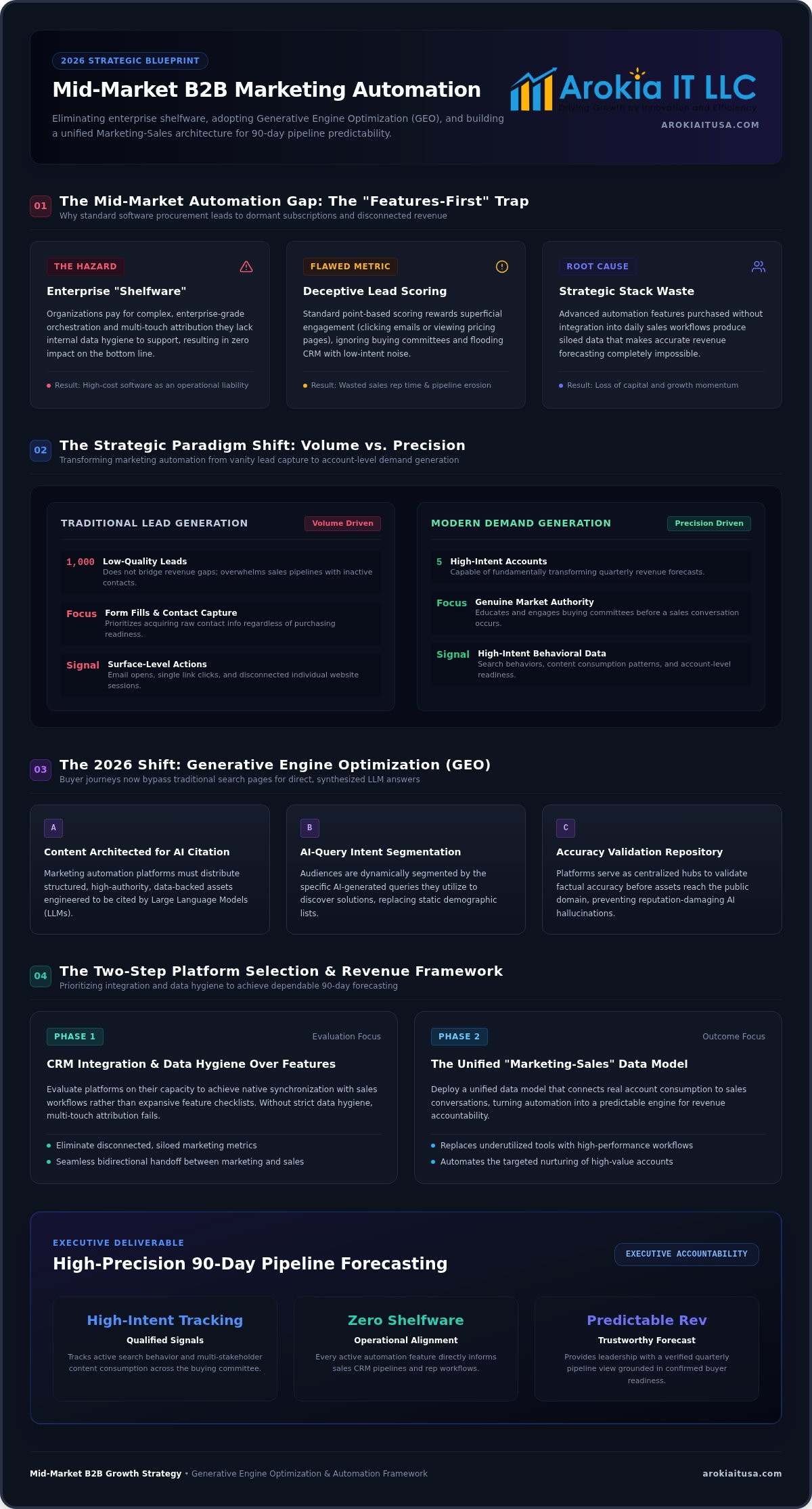
Mid-market B2B leaders face a unique paradox. They’re often forced to choose between under-powered tools that fail to scale or over-engineered enterprise systems that create more noise than revenue. Selecting from the leading marketing automation platforms mid-market b2b firms evaluate often leads to a features-first trap. Companies purchase sophisticated software but lack the internal framework to deploy it effectively. This results in “shelfware,” where high-cost subscriptions provide zero impact on the bottom line. Software shouldn’t be a liability; it must be a catalyst for financial growth.
Generic lead scoring is a primary culprit of this failure. Most marketing automation platforms offer basic point-based systems that reward superficial engagement, such as clicking an email or visiting a pricing page. In high-stakes B2B sales cycles, these metrics are deceptive. They ignore the complexity of the buying committee and the long-term nature of the professional relationship. Instead of identifying high-value accounts, these tools flood the sales CRM with low-intent leads, wasting valuable time and resources.
The Shift from Lead Gen to Demand Generation
Volume-based metrics are irrelevant for mid-market B2B revenue. A thousand low-quality leads won’t bridge a revenue gap, but five high-intent accounts can transform a quarterly forecast. Modern automation requires a transition toward demand generation, where the focus shifts from capturing contact info to building genuine market authority. This approach utilizes high-intent data, such as specific search behaviors and content consumption patterns, to identify when a prospect is actually ready for a sales conversation. It’s about precision, not proximity.
Identifying Strategic Waste in Your Tech Stack
Automation in 2026: AI Search and Generative Engine Optimization
The B2B buyer journey in 2026 is no longer a linear progression through a traditional funnel; it’s a multi-touch dialogue with artificial intelligence. Generative AI has fundamentally transformed how decision-makers find information, often bypassing standard search engine results pages in favor of direct, synthesized answers from Large Language Models (LLMs). This shift means that the leading marketing automation platforms mid-market b2b teams select must do more than just manage email lists. They must serve as the distribution engine for content specifically architected to be cited by AI engines.
Strategic leaders are already adapting to LLM-powered search by ensuring their automation workflows prioritize the delivery of high-authority, data-backed assets. Your platform shouldn’t just send a PDF. It should intelligently segment your audience based on the specific AI-generated queries they’re likely using to find your solutions. This level of technical alignment is critical for maintaining visibility as traditional SEO gives way to AI search optimization. Without this integration, your brand risks becoming invisible to the very algorithms that now guide executive purchasing decisions.
The Rise of GEO in B2B Marketing
Generative Engine Optimization (GEO) is the practice of structuring brand data and content so that AI models can easily parse, summarize, and recommend your business. It’s the 2026 standard for brand authority. Automation platforms now leverage AI to ensure that every piece of content distributed across channels reinforces a consistent, authoritative narrative that these engines can digest. This means your platform must act as a central repository that validates content accuracy before it reaches the public domain, preventing the AI hallucinations that can damage corporate reputation. To understand the full scope of this shift, explore our detailed breakdown of B2B Generative Engine Optimization.
AI-Powered Nurturing and Personalization
Basic personalization like “First Name” tags is now a baseline expectation, not a competitive advantage. Modern nurturing requires deep contextual relevance where the automation system understands the prospect’s specific industry pain points and current stage in the buying cycle. This allows for the automated delivery of sales enablement content at scale, providing the exact white paper or case study a lead needs at the moment they need it. By 2026, automation platforms must include AI-driven response triggers that adjust nurture paths in real-time based on the semantic intent found in a prospect’s direct inquiries or search history. This level of responsiveness ensures that your sales team only engages with accounts that have been thoroughly educated by your automated systems. If your current stack lacks these capabilities, it may be time to audit your strategic technology alignment.
Comparing Leading Platforms for Mid-Market B2B Precision
HubSpot vs. Marketo: The Mid-Market Battle
HubSpot offers an intuitive interface that accelerates adoption across lean marketing teams. It isn’t just about ease of use; it’s about reducing the time-to-value for complex campaigns. Conversely, Adobe Marketo provides deep, programmable logic that handles intricate lead routing and global orchestration. If your goal is a high-precision 90-day pipeline forecast, the platform must facilitate a unified data model between marketing and sales. HubSpot’s native CRM integration often wins on transparency, while Marketo’s power is reserved for those with dedicated operations resources. Choosing the wrong one doesn’t just cost money; it creates a friction point that slows your entire sales cycle.
ABM-Centric Platforms and Specialized Tools
A standard marketing automation platform (MAP) isn’t always sufficient for high-stakes account targeting. In many cases, layering an ABM-native tool over your core stack is the only way to achieve the granular visibility required for industrial or high-tech sectors. These specialized systems rely heavily on the best technographic data platforms to identify prospects based on their existing technology investments and renewal cycles. Platform selection in 2026 requires strict interoperability; your data must flow seamlessly between intent signals and automated execution. If a platform creates a new data silo, it’s a liability, not an asset. Precision targeting fails when the marketing stack can’t talk to the sales CRM in real-time. Results aren’t born from features; they’re born from a unified data architecture that supports aggressive growth targets.
A Strategic Framework for Platform Evaluation and Selection
Most mid-market firms select technology based on a polished demonstration. They should select based on a clinical blueprint. A platform isn’t a strategic solution; it’s a vehicle for execution. Without a disciplined framework, even the leading marketing automation platforms mid-market b2b leaders admire will fail to deliver a return. Success requires a four-step evaluation process that prioritizes organizational alignment over software features.
- Step 1: Sales Cycle Mapping. Your platform must mirror the actual stages of your B2B sales cycle. If the software can’t handle long-tail negotiations or multiple decision-makers, it’s a liability.
- Step 2: CRM and Data Hygiene. Integration is the foundation of precision. You must assess how the platform synchronizes data in real-time to prevent the creation of internal silos.
- Step 3: Sales Enablement Support. The system must facilitate the delivery of sales enablement content. It should empower your sales team with high-intent data, not just activity alerts.
- Step 4: Total Cost of Ownership (TCO). Calculate the cost of implementation, data migration, and ongoing training. The subscription price is often the smallest part of the financial equation.
Aligning Tech with Sales Enablement
In high-stakes sectors like industrial marketing, the right platform shortens the sales cycle by delivering technical proof points at the exact moment a buyer requires them. It’s about providing “Sales Intelligence” that allows SDRs to lead with value rather than generic pitches. To maintain this level of precision, your stack must integrate with the Best Sales Intelligence Tools to ensure contact data remains accurate and actionable. Tech alone solves nothing. It’s the strategic orchestration of that tech that drives revenue.
Operationalizing the 90-Day Pipeline Forecast
Predictability is the ultimate goal of any automation investment. By setting up tracking for specific revenue milestones, you can move away from reactive marketing and toward a proactive growth model. Effective lead nurturing plays a critical role here, stabilizing pipeline fluctuations by keeping cool prospects engaged until they’re ready for a sales handoff. Advanced automation transforms erratic lead generation into a clinical, data-driven system where revenue becomes a predictable outcome of validated account engagement. When the leading marketing automation platforms mid-market b2b organizations utilize are deployed with this level of rigor, the results are both measurable and sustainable.
Maximizing ROI: Implementing Automation for Revenue Precision
Arokia IT LLC specializes in turning these tools into high-performance engines. By leveraging our deep expertise in Arokia IT LLC’s ABM and Demand Generation, we help mid-market leaders bridge the gap between marketing effort and tangible sales results. This isn’t about creative flourishes. It’s about building a systematic framework that delivers a 90-day pipeline forecast you can stake your reputation on.
Bridging the Internal Silos
Sales buy-in is the lifeblood of any automation rollout. If the sales team perceives marketing leads as low-quality noise, the system will be ignored. You must establish clear accountability for lead follow-up through a documented Service Level Agreement (SLA). This alignment ensures that high-intent traffic, often generated through disciplined B2B SEO, is prioritized and pursued with the appropriate urgency. When marketing feeds the engine and sales trusts the fuel, the entire organization accelerates.
Next Steps for Mid-Market Leaders
Scaling your revenue in 2026 requires more than just better software. It demands a total audit of your current pipeline to identify hidden bottlenecks that prevent conversion. Before you commit to a new platform or double down on an existing one, you need an objective assessment of your technical and strategic readiness. We recommend requesting a customized AI Scorecard to evaluate your current standing against industry benchmarks.
Use this final checklist to ensure your rollout is architected for success:
- Unified Data Schema: Ensure your MAP and CRM share a single source of truth.
- Sales Enablement Triggers: Automate the delivery of content based on specific buyer behaviors.
- Accountability Framework: Define exactly who owns a lead at every stage of the journey.
- Revenue Dashboard: Implement real-time tracking for 90-day pipeline predictability.
Architecting Your Revenue Engine for 2026 and Beyond
In the high-stakes environment of 2026, selecting from the leading marketing automation platforms mid-market b2b firms use is merely a baseline requirement. Strategic dominance depends on your ability to eliminate operational waste and align your technology with a clinical 90-day pipeline forecast. Success isn’t found in a software’s feature list; it’s found in the systematic orchestration of demand generation and sales enablement content. Your technology must be a catalyst for financial growth, not a source of friction.
As B2B search evolves toward generative engine optimization, your automation stack must act as an authoritative distribution hub. Arokia IT specializes in navigating these complexities for high-stakes industrial sectors. We provide the AI and GEO-driven precision needed to bridge the gap between marketing effort and predictable financial growth. It’s time to stop paying for “shelfware” and start building a validated engine for revenue. Our expertise ensures that your technology investment translates into tangible accountability and accelerated sales cycles.
Your organization’s growth deserves a platform that works as hard as your sales team.
Frequently Asked Questions
What is the best marketing automation platform for mid-market B2B in 2026?
The ideal platform depends on your specific organizational requirements and technical maturity. HubSpot remains a top choice for teams prioritizing speed and user adoption, while Adobe Marketo or Salesforce Account Engagement offer the complex logic needed for global orchestration. Both are among the leading marketing automation platforms mid-market b2b organizations evaluate for revenue precision. The best choice is the one that bridges the gap between marketing effort and predictable revenue growth.
How does ABM integration differ between HubSpot and Marketo?
HubSpot provides a user-friendly, native ABM suite that allows for rapid deployment of account-based strategies. Marketo offers more granular control for complex, multi-layered account orchestration. Both are recognized as leading marketing automation platforms mid-market b2b firms utilize to target high-stakes accounts. The difference lies in whether you prioritize intuitive workflows or deep programmable logic. Your selection should align with the technical capabilities of your marketing operations team to avoid creating strategic waste.
What is Generative Engine Optimization (GEO) and why does it matter for automation?
Generative Engine Optimization (GEO) involves structuring your brand assets so that Large Language Models cite your company as a definitive authority. In 2026, automation platforms must act as the primary distribution engine for this GEO-optimized content. This ensures your business remains visible as buyers shift from traditional search engines to AI-driven direct answers. Automation allows you to deliver high-authority content at scale, maintaining a consistent brand narrative across all digital touchpoints.
How much should a mid-market company spend on marketing automation?
Budgeting for automation requires a focus on Total Cost of Ownership rather than just the initial subscription price. Mid-market organizations should account for implementation, data migration, and ongoing staff training. Costs vary significantly based on the number of contacts and the complexity of required integrations. The goal is to eliminate the high cost of shelfware by selecting a tier that matches your actual operational needs while allowing for aggressive future growth.
What is the difference between lead generation and demand generation in automation?
Accurate forecasting is possible only when your automation platform and sales CRM share a unified data model. By tracking engagement milestones and intent signals, you can identify which accounts are likely to close within the next quarter. Arokia IT utilizes these automated data points to build a 90-day pipeline forecast that provides executive leadership with the visibility needed for strategic planning. This replaces erratic lead volume with a systematic, predictable revenue engine.
Why do most B2B marketing automation implementations fail?
Implementation failures usually stem from a lack of strategic oversight rather than software limitations. Many companies treat automation as a standalone marketing tool instead of a cross-departmental growth framework. Success requires clear accountability for lead follow-up and a documented Service Level Agreement between marketing and sales. Without a clinical focus on data hygiene and organizational alignment, even the most advanced platforms will fail to deliver a measurable return on investment.
How does sales enablement content fit into an automated nurture flow?
Automated nurture flows deliver technical proof points, white papers, and case studies based on a prospect’s specific search behavior or industry pain points. This ensures the buyer receives relevant sales enablement content at the exact moment it’s required to move them forward. This systematic approach educates the prospect before they ever speak to a representative. It shortens the sales cycle by providing SDRs with a lead that is already familiar with your brand’s authority.