
Developer-tool demand can be researched beyond product-category searches. Demand generation for developer tools can draw on applicant and service-provider searches, open data tools, and public datasets to identify organizations whose activities offer useful market context. These signals can guide further research, but they do not prove that an organization intends to buy a particular product.
That distinction shapes the strategy. A public record or search result is a starting point, not a substitute for understanding an organization’s needs, technical environment, and buying process. Strong programs combine search and dataset evidence with relevant technical communication, then assess whether engagement points to a genuine use case.
This guide explains how to evaluate search resources, interpret public data, and apply research to demand-generation decisions. It also covers how developer communities, events, and technical creators can help teams earn attention through useful contributions. The goal is a practical framework for choosing signals, building credible engagement, and deciding what merits further investment without mistaking activity for purchase intent.
Key Takeaways
- Align search, content, and outreach with the technical problem your tool solves and the people involved in evaluating it.
- Use applicant and service-provider searches, open data tools, and datasets to identify relevant organizations and guide research, not as proof of purchase intent.
- Build developer-community visibility by contributing useful technical knowledge rather than relying on promotional posts.
- Choose events and influencers based on audience relevance and the opportunity to demonstrate practical value.
- Use account-based marketing to coordinate demand-generation activity around priority organizations and support more focused pipeline development.
Which demand generation channels work best for developer tools and SaaS in the US?
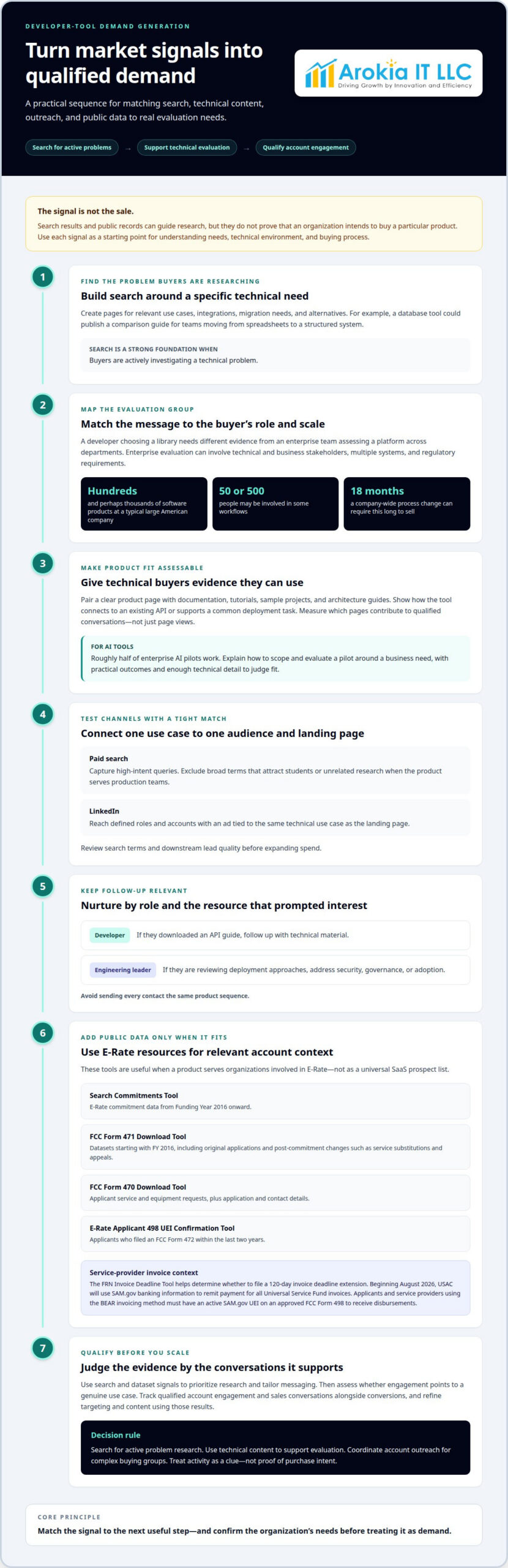
No single channel fits every developer tool. Search, technical content, targeted advertising, and account-based outreach can work together, but the right mix depends on the buyer’s problem and evaluation process. A developer choosing a library needs different evidence from an enterprise team assessing a platform for use across multiple departments.
Search is a strong foundation when buyers are actively investigating a technical problem. Build pages around specific use cases, integrations, migration needs, and alternatives. For example, a database tool could publish a comparison guide for teams moving from spreadsheets to a structured system. Technical content should answer implementation questions, not simply list product features.
Enterprise purchases require a broader view than individual developer intent. A typical large American company has hundreds, and perhaps thousands, of software products. Some workflows can involve 50 or 500 people across departments, systems, and regulatory regimes. A company-wide process change can require an 18-month sales process, so search content should support technical evaluation and internal business justification.
Use technical documentation, tutorials, sample projects, and architecture guides to help developers assess fit. A practical guide might show how a tool connects to an existing API or supports a common deployment task. Pair that material with a clear product page and a relevant next step, such as trying a workflow. Measure which pages contribute to qualified conversations, not just page views.
Paid search can capture high-intent queries, while LinkedIn can reach defined roles and accounts. Start with a focused test: choose one technical use case, map it to a buyer role, and match the ad to a relevant landing page. Exclude broad terms that attract students or unrelated research if the product serves production teams. Review search terms and downstream lead quality before expanding spend.
Email nurturing helps maintain engagement while a buying group compares options. Segment by behavior and role. A developer who downloads an API guide should receive technical material; an engineering leader reviewing deployment approaches may need guidance on security, governance, or adoption. Tie each follow-up to the resource that prompted it instead of sending every contact the same product sequence.
For organizations that purchase through public programs, public datasets can add account context. The Search Commitments Tool provides E-Rate commitment data from Funding Year 2016 onward. The FCC Form 471 Download Tool covers datasets starting with FY 2016 and includes original applications plus post-commitment changes, such as service substitutions and appeals. These resources are relevant when a tool serves organizations involved in E-Rate, not as a universal SaaS prospect list.
The FCC Form 470 Download Tool contains applicant service and equipment requests, along with application and contact details. It can help identify organizations describing needs related to services or equipment. The E-Rate Applicant 498 UEI Confirmation Tool covers applicants who filed an FCC Form 472 within the last two years. Use the information to prioritize research and tailor messaging; an application record alone does not prove a buying project for your software.
For E-Rate service providers, the FRN Invoice Deadline Tool helps determine whether to file a 120-day invoice deadline extension. Beginning August 2026, USAC will use SAM.gov banking information to remit payment for all Universal Service Fund invoices. Applicants and service providers using the BEAR invoicing method must have an active SAM.gov UEI on an approved FCC Form 498 to receive disbursements. These details matter only when your market serves those participants.
Choose channels by matching the signal to the next action: search for active problem research, technical content for product evaluation, and account outreach for complex buying groups. A focused program for demand-generation planning can connect those activities. Track qualified account engagement and sales conversations alongside conversions, then use the results to refine targeting and content.
That context matters when assessing demand for AI tools: roughly half of enterprise AI pilots work. For vendors, evidence of practical outcomes is therefore more useful than broad claims about potential. Content and follow-up can explain how to scope and evaluate a pilot, and connect it to a business need, while giving technical buyers enough detail to judge fit. Ads can lead with a specific workflow, and nurturing can help the wider buying group assess that use case from its own perspective.
How can developer tool companies use developer communities, events, and influencers to generate demand?
Developer communities can create demand when product teams solve real technical problems in public. For example, a team building an observability platform can answer questions about tracing and alert design before introducing its product. First identify where target developers already exchange practical advice, then contribute consistently. GitHub Discussions, Stack Overflow, Reddit communities, and relevant Discord servers support different conversations. Follow each community’s posting rules: unsolicited pitches can weaken credibility faster than a polished announcement can build it.
Choose community platforms based on the participation they support. GitHub Discussions suits product questions, feature requests, and repository feedback. Stack Overflow is useful for answering specific implementation questions with reproducible examples. Reddit can surface recurring workflow frustrations, while Discord and Slack groups support ongoing peer discussion. Dev.to can help distribute tutorials and engineering perspectives. Treat every platform as a place to listen and teach, not a list of contacts to export.
Give community members something useful without asking them to book a demo. Publish a sample application, a migration checklist, or a short guide to connecting an API with an existing workflow. For example, a database vendor could explain a query optimization technique using a small, self-contained example. Link to documentation only when it directly supports the answer. Track recurring questions and use them to improve documentation, create tutorials, or share product feedback with engineering.
Events bring learning and conversation together in a technical setting. At KubeCon + CloudNativeCon, a Kubernetes infrastructure vendor might lead a session on deployment tradeoffs, then invite attendees to try a focused workshop. At GitHub Universe, a developer-tool team could demonstrate a workflow in a live technical walkthrough. Choose events for audience fit and session relevance, not general attendance. Before registration opens, define the target role, problem, demonstration, and follow-up resource.
Smaller formats can provide clearer feedback than a large booth. Host a virtual workshop around one task, such as instrumenting an application with OpenTelemetry, and give attendees time to test the steps. Meetup groups can help teams reach local technical audiences, while webinar platforms such as Zoom support remote instruction. Ask about attendees’ current workflows during registration, then tailor the session accordingly. Avoid turning every technical event into a product pitch.
Influencers earn attention through trusted technical judgment, not follower counts alone. Find practitioners who publish code walkthroughs, architecture reviews, or tool comparisons on YouTube, Twitch, GitHub, or technical newsletters. A developer productivity platform, for instance, could work with an engineer who demonstrates a real CI workflow. Give the creator a clear use case, accurate technical details, and room to share independent observations. Disclose paid relationships and avoid scripting endorsements that do not sound like the creator.
Use a structured collaboration brief. Specify the intended developer audience, technical problem, feature to demonstrate, and claims the team can substantiate. Provide a working environment or sample project when appropriate. Let the creator explain limitations as well as strengths. Confirm technical accuracy before publication without rewriting their viewpoint. A credible tutorial that helps engineers evaluate a workflow can be more useful than a generic product mention because readers can assess the method directly.
Measure community, event, and creator activity beyond impressions. Use tagged campaign links, event-specific landing pages, and CRM source fields to connect engagement with later actions. Compare tutorial completions, documentation visits, product trials, and qualified conversations by channel. Ask sales which technical questions come up in active evaluations, then use those patterns to guide content planning. A spike in views without relevant engagement points to a mismatch in audience, topic, or follow-up.
For a coordinated plan that connects technical content with audience engagement, discuss your demand-generation priorities.
Technical sessions can make overlooked workflows visible. A department relying on a 10-meg spreadsheet is an example of software used by large companies. An engineer might spend an hour building a tool to automate a task that takes 10 minutes, while AI can let someone make an automation tool in five minutes. A focused demonstration of the FCC Form 471 Download Tool can show how a practical workflow handles original application information and subsequent post-commitment changes, such as FCC Forms 500, service substitutions, SPIN changes, and appeals.
Build demand patiently: some successful software companies had half a dozen failed attempts before finding the right approach or problem. Questions and feedback from community members can help teams identify which real workflow to address next.
Arokia IT LLC: Account-Based Marketing (ABM)
Arokia IT LLC helps developer-tool companies connect demand generation with the accounts most relevant to their growth goals. Its Account-Based Marketing (ABM) approach focuses outreach and content on priority organizations instead of treating every developer interaction as equal buying intent.
This approach is useful when search activity, community engagement, and event conversations are not translating into a coordinated account strategy. Demand Generation and LinkedIn Marketing support targeted engagement, while AI Search & GEO can strengthen visibility across search experiences. The focus is to align audience priorities, useful messaging, and follow-up so marketing supports sales conversations with relevant organizations.
To discuss an account-focused approach, contact Arokia IT LLC.
Turn Search Signals Into a Focused Growth Plan
A durable demand generation for developer tools program starts with a clear decision: which audience and problem should marketing prioritize? Choose a defined segment, connect its needs to a useful technical resource, and make the next action clear. This focus gives marketing and sales a shared basis for deciding what to create, where to invest, and how to assess progress.
Then create a feedback loop. Review which conversations reveal genuine product fit, where prospects need more technical evidence, and which messages lead to meaningful follow-up. Use those signals to refine the next campaign instead of adding channels without a strategic reason. Consistent learning can make each iteration more relevant to developers and the teams evaluating their tools.
With a focused audience and a clear learning process, your next campaign can move forward with greater purpose.
Frequently Asked Questions
What is demand generation for developer tools?
Demand generation for developer tools is the coordinated work of helping technical buyers recognize a problem, understand possible solutions, and take a relevant next step. It connects market education with product evaluation and sales conversations. For example, a startup selling an API testing platform might explain common testing gaps, then help engineering teams assess whether those gaps affect their release process. The goal is informed interest, not simply a larger contact list.
How do developer tool companies build awareness and reach software engineers?
Developer-tool companies reach software engineers by making technical expertise easy to find and evaluate. Publish material that answers a specific engineering question, such as how an SDK handles authentication errors. Keep documentation consistent with the product, and make examples runnable where practical. For teams serving Oklahoma, Louisiana, Arkansas, Texas, New Mexico, and Northern Mexico, use relevant industry and workflow examples without forcing location references into every message.
What are the steps to create a demand generation strategy for a developer tool startup?
Start by defining the ideal user, the technical problem, and the organization that benefits from solving it. Interview developers and sales prospects to learn their language, objections, and evaluation criteria. Then choose a use case and create a clear path from discovery to product evaluation. Set measures for qualified engagement and sales conversations, and review results with product and sales teams. This feedback helps a startup refine its audience and message before expanding activity.
How do developer tool companies compare product-led growth, sales-led marketing, and community-led strategies?
Technical content and relevant workflows help developers evaluate a tool, while account-based outreach can coordinate activity across complex enterprise buying groups. Community-led efforts build attention by sharing useful technical knowledge, answering questions, and offering practical resources rather than relying on promotional posts.