
A B2B software launch can miss its buyers even when the product works. A go-to-market strategy for B2B software connects the offer to a defined market and coordinates how the business introduces, sells, and supports it. Without that direction, teams can invest in activity that attracts attention but doesn’t help the right buyers understand why the software fits their needs.
The challenge is especially clear with complex software. Different stakeholders may assess operational impact, technical fit, implementation demands, and business value. A launch message that speaks only to one role can leave other decision-makers without the information they need. A coherent plan keeps the buyer’s evaluation in view, from initial discovery through adoption, while giving internal teams a common commercial objective.
This article explains how B2B software teams define and validate their target market, shape an ideal customer profile, and distinguish buyer roles. It also explores how positioning, pricing, sales motions, and channels work together, where go-to-market plans commonly break down, and how teams can use customer evidence to refine market decisions. The aim is a clearer path from product launch to the buyers most likely to value the software.
Key Takeaways
- Define the business conditions that make an account a strong fit before building campaigns around it.
- Separate the company profile from the individual buyer’s role, priorities, and influence on the purchase.
- Match pricing, channels, and customer support to the product’s complexity and buying process.
- Align marketing and sales around shared audience definitions, messaging, and measures of progress.
- Plan for onboarding and customer feedback as part of market entry, not as work that starts after the sale.
What is a go-to-market strategy?
A go-to-market strategy is the commercial plan for introducing B2B software, reaching intended buyers, and supporting adoption. It aligns launch decisions with sales, marketing, pricing, distribution, and customer support.
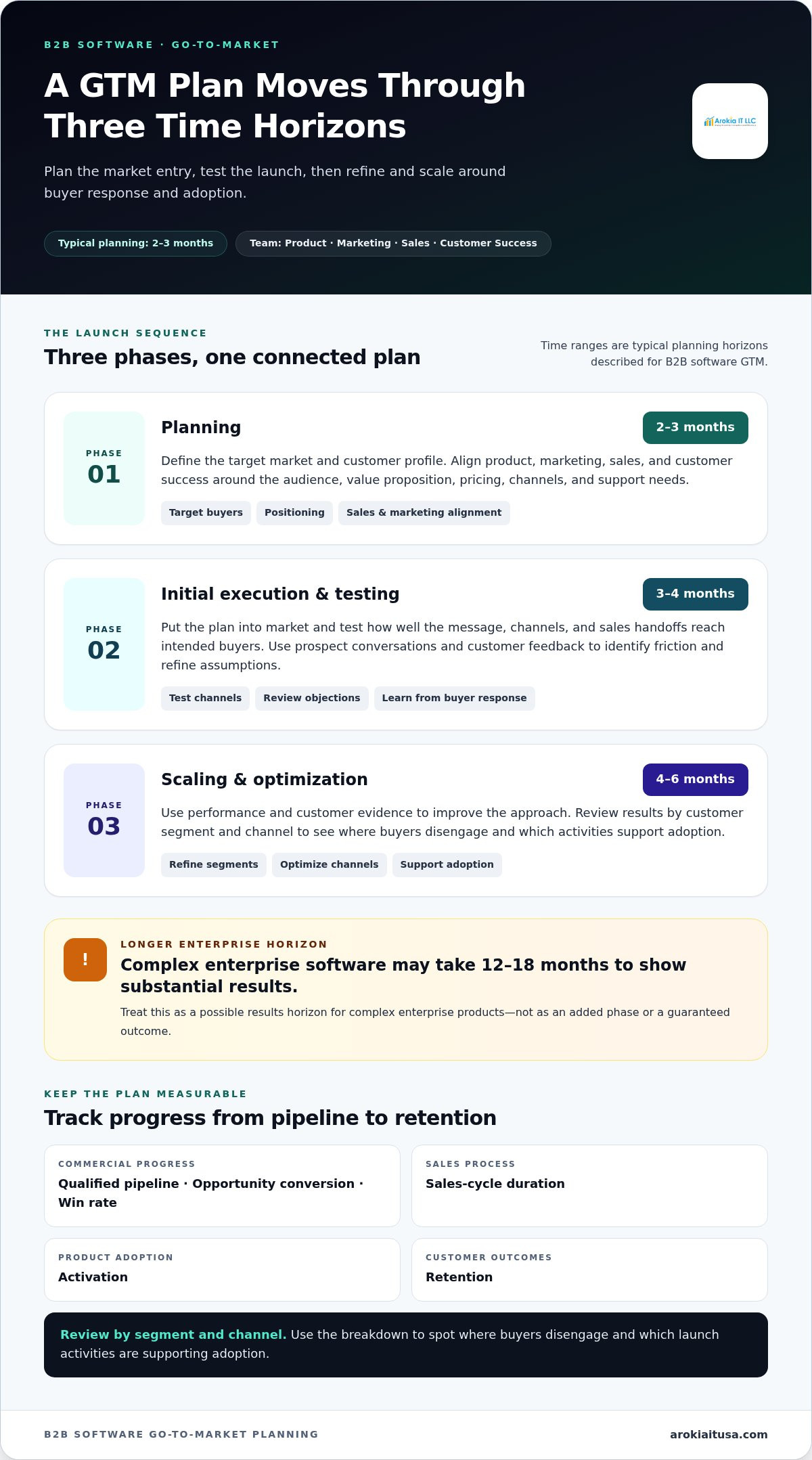
Budget depends on the product’s complexity, chosen channels, sales capacity, and support needs. Planning typically takes 2-3 months, initial execution and testing 3-4 months, and scaling and optimization 4-6 months; complex enterprise software may take 12-18 months to show substantial results. The team usually includes product, marketing, sales, and customer success owners.
Track qualified pipeline, opportunity conversion, win rate, sales-cycle duration, activation, and retention. Review results by customer segment and channel to see where buyers disengage and which launch activities support adoption.
Sales and Marketing Alignment
Sales and marketing alignment means coordinating buyer definitions, messaging, campaign handoffs, and feedback. Without it, sales conversations may not match the expectations marketing has created. For example, marketing can share which product claims generated interest, while sales records objections from discovery calls. Regular reviews turn those insights into consistent campaign messaging and useful sales enablement materials.
Marketing Plans and Sales Team Organization
Marketing plans audience, channels, content, and lead nurturing; sales assigns ownership of accounts and opportunities. Clear responsibilities matter because a launch needs follow-through when a buyer responds. For example, marketing can educate technical evaluators with implementation content, then route an engaged account to sales. The representative can use relevant enablement materials to address the account’s evaluation needs.
Sales, Pricing, Marketing, and Distribution
Sales, pricing, marketing, and distribution shape how buyers understand, purchase, and receive the software. The right approach depends on the buying experience: customized enterprise pricing and direct sales require a different path from self-service access. Set pricing in line with the product’s value proposition, then choose channels that reach the intended decision-makers. Include delivery, onboarding, and customer support so the experience continues after purchase.
Product-Led and Sales-Led Growth
Product-led growth uses the software experience to drive acquisition and expansion, often through free trials, freemium access, or self-service onboarding. It suits intuitive software with clear value and relatively simple implementation. Sales-led growth relies on direct sales and fits products with longer implementation cycles, higher price points, or complex integrations. Choose the motion based on how buyers need to evaluate and adopt the product.
Ideal customer profiles and buyer personas
An ideal customer profile (ICP) describes the organizations most likely to benefit from a product and succeed with it. Buyer personas represent the people involved in evaluating, approving, implementing, or using the product. Keep them distinct: the ICP helps teams prioritize accounts, while personas clarify the concerns of different people within each account. Together, they make audience selection and customer experience decisions more precise.
Define the ICP using business traits tied to a clear need, not an aspirational description of a company. Consider industry, company size, operating model, current tools, and the problem that prompts a search. For example, an expense-management platform might target organizations with distributed approval workflows, then identify the operating conditions that make the software useful. Avoid traits that do not affect the buyer’s need or ability to adopt.
Build personas around responsibilities and decision criteria, not job titles alone. A department leader may want visibility into spending; an administrator may need a manageable approval process; finance may need reliable reporting. Document what each role must understand before moving forward, who influences the decision, and what could delay adoption. This gives teams practical guidance for product education and customer communication.
Validate assumptions through conversations with prospects and customers. Ask what triggered their search, how they handle the problem now, which alternatives they considered, and what shaped their evaluation. Compare responses across organizations rather than treating one persuasive interview as proof. If a segment’s buying process, urgency, or needs differ substantially, refine the profile or define a separate audience.
Use early adoption to assess product-market fit. Look for evidence that customers achieve the expected outcome, continue using relevant capabilities, and involve colleagues with the same problem. A signed contract alone does not establish fit. If customers need repeated help to complete a core task, investigate whether onboarding, product design, or the original audience assumptions need attention.
Connect customer-success onboarding milestones to the buyer’s intended outcome. For an expense platform, that might mean configuring approval rules and completing a first review cycle. Track where customers pause, which questions recur, and whether additional teams adopt the tool. These signals can reveal training needs, retention concerns, or expansion opportunities without treating every support request as a sales lead.
Share customer feedback across product, sales, marketing, and customer success so teams can act on consistent evidence. Businesses that align their go-to-market strategy across departments have a 36% improvement in customer retention and a 38% higher sales win rate. Use recurring feedback to refine onboarding and customer communication. Discuss audience and customer-growth priorities.
Common GTM mistakes and best practices
Common B2B software mistakes include vague positioning, untested assumptions, disconnected teams, and onboarding that starts too late. Risks shrink when teams test the value proposition with buyers, review evidence from pilots, and connect launch promises to the customer experience.
Common Go-to-Market Mistakes
A go-to-market mistake disconnects product value from buyer needs or execution. Weak assumptions can then spread across campaigns, sales conversations, and launch plans. For example, describing software as “easy to use” says little to a buyer trying to reduce manual production scheduling. State the operational problem, the intended user, and the outcome the product supports.
Another mistake is treating launch activity as proof of demand. A spike in event registrations or website visits does not show that the right accounts understand the offer or will enter a buying process. Before increasing spend, compare the audience reached with the organizations and roles the product serves. Review sales conversations for recurring objections, then revise messaging when buyers misunderstand the problem or the product’s value.
B2B Go-to-Market Challenges
B2B go-to-market challenges arise when several stakeholders evaluate different risks across a long buying process. They matter because a message that persuades an end user may not resolve an executive’s business concerns or an IT team’s implementation questions. Build a comprehensive set of materials around distinct buyer needs, then equip sales with relevant proof and explanations for each conversation.
Stakeholder alignment can also fail when teams define progress differently. Marketing may count responses, while sales focuses on qualified opportunities and product teams track usage. Set shared definitions for a qualified handoff and meaningful customer activation. For example, a software team could distinguish a demo request from an account that has identified a use case, involved an evaluator, and agreed to a follow-up discussion.
Software Go-to-Market Risks
Software go-to-market risks are uncertainties that can undermine adoption, retention, or revenue after launch. A product may attract interest yet fail to deliver the outcome buyers expect. A limited release or pilot with target customers can expose setup friction, missing workflows, and unclear instructions before broader promotion. Record each finding, assign an owner, and decide whether it calls for changes to the product, messaging, or onboarding.
Neglecting onboarding creates another avoidable risk: customers may not reach the product’s intended value after purchase. Map the first user actions to the promised outcome, then monitor where customers stall. If users abandon a data-import step, improve the instructions or support path before increasing acquisition activity. This feedback loop protects the connection between the sales promise and the everyday product experience.
B2B go-to-market strategy definition and components
A B2B go-to-market strategy is the coordinated plan for taking a product to a defined market and supporting its commercial adoption. For a workflow software launch, it specifies which organizations to pursue, the problem to solve, how buyers will evaluate the offer, and how the company will deliver it. Each component should reinforce the same market choice.
Start by defining the business objective and scope. A team launching an analytics platform might prioritize qualified opportunities in one industry before expanding into adjacent segments. That focus informs the product promise, sales capacity, launch channels, and measures of progress. Without clear boundaries, teams can spread resources across audiences with different needs and buying processes.
Build the strategy around connected decisions:
- Target market: Define the organizations and use cases the product can serve. For example, distinguish manufacturers needing production visibility from firms seeking financial reporting.
- Positioning and messaging: Explain the problem, the product’s value, and why the offer fits. A strong message links a buyer’s operational issue to a specific product capability.
- Offer and pricing: Establish packaging, pricing logic, and purchase terms that reflect how buyers assess value. Complex software may need tailored pricing tied to deployment scope or user needs.
- Channels and distribution: Choose how buyers discover, evaluate, and access the product. A direct sales motion, partner channel, or self-service path carries different resource demands.
- Sales and customer delivery: Define who owns discovery, evaluation, implementation, and ongoing support. A clear handoff keeps the experience connected from first conversation through onboarding.
- Measurement: Select indicators that reveal whether each part works. For example, review qualified account progression alongside activation and retention signals.
Competitive positioning takes more than listing features. Compare the buyer’s current process, internal alternatives, and other ways to solve the same problem. Then explain what changes with the software and what evidence supports the claim. For instance, messaging about fewer manual handoffs should specify which workflow changes instead of relying on a broad promise of efficiency.
Treat the plan as a set of testable assumptions, not a static launch document. Before a wider rollout, use a pilot or limited release to examine buyer response, sales objections, and implementation friction. If prospects understand the value but cannot complete setup, improve delivery before expanding promotion. This connects market feedback to decisions about messaging, product readiness, and channel investment.
B2B software go-to-market strategy definition and purpose
A B2B software go-to-market strategy defines how a product enters a chosen market, earns attention, and supports adoption. Its purpose is not simply to coordinate a launch. It gives product, sales, and marketing teams a shared basis for deciding which opportunity to pursue first, what evidence supports that choice, and what the business must learn before expanding.
Position and differentiate software by linking a specific buyer problem to a distinct product advantage and credible proof. For example, a maintenance platform might help industrial teams coordinate work orders across facilities, rather than make a broad claim about operational efficiency. Compare the target audience’s current process and alternatives, then explain which workflow changes and why the product fits.
The initial target market should be narrow enough to make learning useful. A software company could begin with manufacturers that manage maintenance across multiple facilities, then assess whether their needs and buying processes are similar. A clear segment helps the team interpret sales objections, product usage, and implementation friction. If those signals vary sharply, define the segment more precisely before expanding.
Use the strategy to set decision rules for market entry and growth:
- Choose a market wedge: Identify the customer problem and use case that create the clearest opening.
- Set a positioning claim: Describe the product’s value in terms buyers can connect to their work.
- Choose proof: Select product demonstrations, pilot feedback, or customer evidence that supports the claim.
- Define expansion criteria: Decide what buyer response or adoption evidence justifies reaching another segment.
This approach also avoids a common strategic error: treating every interested account as proof of product-market fit. A prospect may like a feature but lack the urgency, authority, or implementation conditions to adopt. Separate curiosity from buying readiness by documenting the use case, stakeholders, required integrations, and next decision. Those details help teams interpret early demand accurately.
Keep market differentiation consistent from discovery through onboarding. If sales promises a measurable workflow change, product demonstrations and implementation guidance should show how customers can achieve it. A mismatch between the message and the actual experience weakens trust and makes it harder to judge whether the target market is right. Position around a buyer problem, then use adoption evidence to guide expansion.
Arokia IT LLC: Account-Based Marketing (ABM)
Arokia IT LLC helps B2B software teams put a defined go-to-market plan into market through Account-Based Marketing (ABM), Demand Generation, LinkedIn Marketing, and AI Search & GEO. ABM is relevant when a business needs to focus outreach on selected accounts and reach the decision-makers involved in a complex purchase. Demand Generation and LinkedIn Marketing can support audience engagement, while AI Search & GEO addresses how buyers discover and evaluate software through search and generative platforms.
When the target market is clear but account selection, buyer reach, or demand activity needs coordination, these offerings can help put the strategy into action.
Contact Arokia IT LLC to discuss your go-to-market priorities.
Turn Your GTM Plan Into the Next Market Decision
A go-to-market strategy for B2B software becomes more useful when it guides a decision, not just a launch. Choose the next market assumption to validate, assign an owner, and define what evidence would change the plan. That discipline helps teams respond to buyer behavior without losing sight of the commercial objective.
When execution needs added support, Arokia IT LLC offers Account-Based Marketing (ABM), AI Search & GEO, and Demand Generation. These capabilities can help connect a defined market focus with targeted outreach and buyer discovery. The right next step is a focused conversation about the audience, growth priorities, and where execution needs greater coordination.
Build on what you learn, make the next decision clear, and keep your team focused on the buyers who matter.
Frequently Asked Questions
How do you identify and validate your target market for B2B software?
Start with customer evidence, then test whether similar organizations share the same urgent problem. Review win-loss notes, product usage, support requests, and prospect interviews for recurring needs and buying conditions. Compare findings across industries or company types. A segment is more credible when buyers describe similar pain, involve comparable decision-makers, and can reach value through a similar implementation path.
Why is a B2B SaaS GTM strategy critical?
A B2B SaaS GTM strategy gives teams a basis for prioritizing effort and coordinating decisions from market entry through customer adoption. Without it, a product team may build for one audience while campaigns attract another. For example, a software company can use its strategy to decide whether to invest next in product education, direct sales support, or onboarding improvements, based on the strongest obstacle to adoption.
What is a go-to-market strategy for B2B software?
A go-to-market strategy for B2B software is a company’s coordinated approach to reaching business buyers and helping them adopt a product. It links the intended market with positioning, sales motion, channels, pricing, and post-purchase experience. For example, a workflow platform might enter through a specific operational use case, then expand to related departments after customers demonstrate adoption and internal demand.
What are the key components of a B2B software go-to-market plan?
A practical plan typically includes a defined audience, product positioning, competitive context, packaging and pricing, channel choices, sales responsibilities, launch activities, onboarding, and performance measures. These components should work together. If the product requires technical evaluation, for example, the plan needs clear documentation and a sales process that addresses implementation questions, not just broad awareness campaigns.
How do you define an ideal customer profile and buyer personas for B2B SaaS?
Use existing customer patterns and prospect research to identify organizational traits tied to a clear need and successful adoption. Then map the people involved in evaluating, approving, implementing, and using the software. A persona should capture each role’s responsibilities, concerns, and decision criteria. For example, a finance approver may prioritize cost justification, while a daily user focuses on workflow usability.
How do you choose between product-led, sales-led, and partner-led growth?
Choose the motion that matches how buyers assess value and how the product reaches them. Product-led growth fits software users can evaluate independently; sales-led growth supports complex purchases that need consultation. Partner-led growth can extend reach when trusted partners already serve the target audience or offer relevant implementation expertise. Before combining motions, compare buyer access, product complexity, and the support each route requires.
How should B2B software companies set pricing and packaging?
Set pricing and packaging around customer value, product usage, delivery costs, and how buyers compare alternatives. Decide which capabilities belong in each package, which customers need a tailored configuration, and what unit best reflects value, such as users or usage. Test whether buyers understand the options in sales conversations. Confusing tiers or unclear limits can stall evaluation even when the product is a good fit.
Which marketing and sales channels work best for B2B software?
The strongest channels reach relevant buyers during research and evaluation, then give them a credible next step. Search content can capture active problem-solving; LinkedIn can support professional audience targeting; sales outreach can engage selected accounts; webinars can explain complex use cases. Compare channels by qualified conversations and progression, not attention alone, and coordinate follow-up so interested buyers receive useful context.