
A software go-to-market strategy can falter when positioning, demand generation, and sales execution pull in different directions. Start by defining a customer segment and the specific business problem the product solves, then align messaging, channels, and sales around that fit. A software company marketing agency should connect those decisions to a measurable growth plan, not simply add more campaigns.
It’s understandable to focus on lead volume, but more leads won’t fix unclear positioning or a mismatch between marketing and sales. This article explains how to choose a go-to-market strategy, sharpen software positioning, and assess whether agency support fits your growth goals. It also shows how specialist technology marketing can coordinate demand generation, content, and sales enablement, helping teams focus on audiences and activities that support revenue.
Key Takeaways
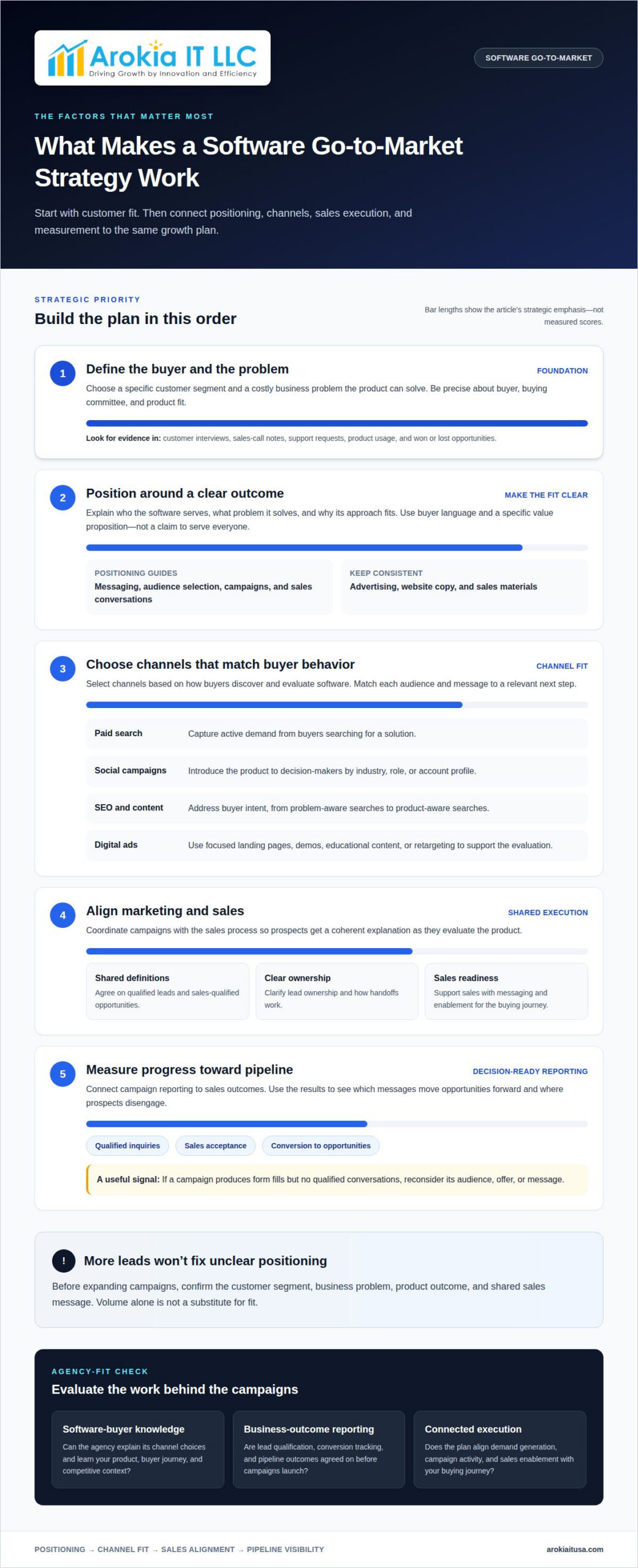
- Choose a go-to-market strategy by aligning a defined customer segment, a specific problem, and the channels most likely to reach buyers.
- Sharpen software positioning around the business outcome the product delivers, then make sure marketing and sales use consistent messaging.
- Assess agency support by its ability to connect campaign activity with pipeline visibility, sales enablement, and decision-ready reporting.
- For subscription businesses, coordinate acquisition and ongoing customer communication so marketing supports the full customer journey.
- Consider specialist technology marketing when complex products or long sales processes call for focused demand generation and industry-aware messaging.
What is the right go to market strategy for a software company?
The right go-to-market strategy aligns a defined buyer, a costly problem, and a clear product outcome. For U.S. software firms, paid and organic channels should support shared pipeline goals and a coordinated sales process.
Paid Search and Social Lead Generation
Paid search captures active demand when buyers look for solutions, such as scheduling software for field-service teams. Social campaigns can introduce a product to decision-makers in a chosen industry, role, or account profile. Measure qualified inquiries, sales acceptance, and conversion to opportunities, not clicks alone. Choose channels based on how buyers discover and evaluate software.
Digital Advertising and Pipeline Acceleration
Digital advertising can generate leads by directing relevant audiences to focused landing pages, demos, or educational content. Retargeting can bring previous site visitors back with a useful next step, such as a product comparison or implementation overview. Connect campaign reporting to sales outcomes so teams can see which messages move opportunities forward. If a campaign generates form fills but no qualified conversations, adjust its audience, offer, or message.
Choosing a Software Marketing Agency
Choose an agency that understands software buyers, explains its channel choices, and reports against agreed business outcomes. A software company marketing agency should clarify how it defines a qualified lead, tracks conversion, and coordinates campaigns with sales. Ask how the team will learn your product, buyer journey, and competitive context before recommending tactics. Relevant experience matters more than broad promises of success.
For software businesses, define the local market precisely. A provider serving manufacturers in Oklahoma, for example, might target operations leaders with messaging about a specific workflow problem. In Oklahoma, Louisiana, Arkansas, New Mexico, Northern Mexico, and Texas, effective targeting combines geography with industry, buyer role, and product fit. A broad regional campaign can waste spend if it reaches businesses the software cannot serve.
Software marketing agencies commonly provide demand generation, paid media, search optimization, content, social media, email, and lead nurturing. The right mix depends on the sales model and buying journey. Enterprise software may need education and sales enablement throughout a longer evaluation, while a self-serve product may prioritize clear onboarding and direct conversion paths.
Hiring risks include unclear lead ownership, weak attribution, and campaigns optimized for volume instead of revenue. Set shared definitions for marketing-qualified leads and sales-qualified opportunities before launch. Also establish reporting access and data handling expectations. Agencies managing enterprise client data should require a SOC 2 Type II report at minimum, and healthcare clients require HIPAA compliance.
U.S. companies can work with agencies serving national markets or agencies focused on specific regions and industries. Compare their software-sector expertise, delivery approach, and ability to align campaigns with your buyers and pipeline objectives.
Marketing strategy and positioning
Software positioning should explain which buyer the product serves, what problem it solves, and why its approach fits. A project management platform, for example, might focus on engineering teams coordinating complex releases rather than claiming to serve every business. That distinction guides messaging, audience selection, campaign planning, and sales conversations. Without it, digital marketing can attract visitors who recognize the category but have no reason to choose the product.
Build the strategy from evidence already available inside the business. Review customer interviews, sales-call notes, support requests, product usage patterns, and won or lost opportunities. Look for recurring language: buyers might describe the same issue as delayed handoffs, missed approvals, or limited visibility. Turn those patterns into a specific value proposition, then test whether prospects understand it through landing-page engagement and sales feedback.
A software marketing strategy also needs a clear measurement model. Connect each campaign to a defined audience, message, offer, and next action. For example, a campaign for accounting software might target finance leaders researching month-end reporting, then offer a workflow guide before a product demo. Track the path from initial response to qualified opportunity and review where prospects disengage. This makes performance data useful for decisions, not just dashboards.
SEO and keyword strategy should reflect buyer intent, not just search volume. Separate problem-aware searches, such as “reduce inventory errors,” from product-aware searches, such as “inventory management software.” Map each group to a page that directly answers its need. Review competing search results, product terminology, and customer language before prioritizing topics. A keyword is valuable when it attracts a relevant buyer and supports a meaningful next step.
Go-to-market planning connects positioning to product launch, sales readiness, and channel execution. Define the target segment, buying committee, core claim, proof points, and conversion path before expanding campaigns. For a software launch aimed at hospital administrators, messaging and content should address their operational priorities rather than rely on generic technology claims. Keep advertising, website copy, and sales materials aligned so prospects get one coherent explanation.
Data-driven marketing still depends on responsible data use. Set clear access rules, limit campaign reporting to necessary information, and align data collection with the company’s privacy policy. Then compare campaign results with business outcomes, such as qualified pipeline and opportunity progression. If a campaign earns attention but attracts poor-fit accounts, adjust the audience or positioning before increasing spend.
Review positioning as the product, market, and buyer priorities change. A practical quarterly review can compare customer feedback, conversion patterns, search behavior, and sales objections. If those signals point to a sharper segment or a stronger message, update the campaign plan and supporting pages. Teams refining their priorities can discuss software positioning priorities as a next step.
Agency case studies and productivity outcomes
A useful agency case study explains the starting problem, the work completed, and the measured outcome. For a software company, that means showing more than campaign impressions or website traffic. Look for evidence linking changes in visibility, lead quality, sales activity, or reporting time to the work described. A clear account also explains the measurement period and factors that shaped the result.
Productivity is another outcome worth examining. Marketing agency software can reduce analyst workload by up to 80% by consolidating campaign data into unified reporting systems. That figure describes a potential outcome, not a standard result for every team. The operational benefit comes from reducing manual data transfers and reconciling performance across separate platforms. Ask how reporting workflows change and which analysis still requires human judgment.
When reviewing software company case studies, separate the agency’s contribution from other changes. A product launch, pricing revision, new sales team, or broader market shift can affect results. A credible case study identifies the campaign’s role, the metrics tracked, and the limits of the comparison. Increased organic visibility matters commercially when qualified prospects also progress toward sales conversations.
A fintech SaaS example can clarify what relevant evidence looks like without implying a documented client result. Imagine a platform selling payment reconciliation software to finance teams. A case study should explain how the agency addressed buyer concerns, which content or campaign channels supported discovery, and how marketing activity connected to qualified opportunities. It should also show whether results reflect the target audience rather than unrelated traffic growth.
Agency partners should make performance easier to interpret, not bury it in dashboards. Before engagement, define the baseline and reporting method for metrics such as qualified leads, pipeline contribution, and campaign conversion. Set a review cadence and assign owners for data, approvals, and follow-up. These steps help leadership distinguish a useful experiment from activity that consumes budget without advancing sales.
Software companies should also examine how an agency develops its case studies. Confirm that examples describe comparable products, buyer complexity, and sales motions. Look for stated objectives, defined metrics, and context around the results. A polished logo page without methodology offers little basis for assessing fit. Case evidence should inform a decision, not replace clear scope and accountability.
An agency contract should define scope, deliverables, timelines, reporting, fees, data access, intellectual property, and termination terms. It should specify who owns campaign accounts and work products, so the company retains practical control if the partnership ends. Align those clauses with case-study metrics, then document how both teams will review progress and approve changes.
The role of agencies in SaaS and subscription businesses
For SaaS companies, marketing needs to support both new customer acquisition and the ongoing subscriber relationship. An agency can connect campaigns with the customer journey, from product discovery through renewal and expansion.
B2B Software and SaaS Specialization
B2B SaaS specialization includes understanding how software value appears in a customer’s daily workflow. For a subscription-based HR platform, marketing might explain how managers use it during employee onboarding, while finance teams evaluate its business fit. Assess whether an agency can translate those different priorities into distinct content and campaign paths without blurring the product’s core purpose.
Subscription models make customer education relevant after the initial purchase. An agency can plan communications around product use cases, feature updates, or new team needs. For example, a project-tracking platform could offer role-specific guidance to help a new department understand its workflow. Coordinate marketing with customer-facing teams so messages reflect actual product capabilities.
B2B, B2C, and SaaS Marketing
B2B, B2C, and SaaS describe different dimensions of a business. B2B and B2C identify the customer type; SaaS describes software delivered through a subscription model. A SaaS product may serve businesses or individual consumers, so the audience determines the campaign approach. A team collaboration tool sold to companies needs different messaging from a personal budgeting app.
Even within B2B SaaS, acquisition paths vary. A product sold through sales representatives may need materials that support internal evaluation, while a product purchased directly online needs clear product explanations and an accessible sign-up flow. The agency should align the channel and conversion action with how customers actually buy, rather than applying one SaaS template to every product.
Agency Roles for Software Companies
An agency can plan and execute marketing while internal teams provide product context and customer insight. This division helps when a software company has clear expertise but limited capacity to turn it into consistent campaigns. For example, product specialists can explain a new integration, and marketing can shape that explanation into launch content for the intended audience.
Agencies can also help coordinate customer lifecycle communications. A planning session might map messages to trial enrollment, onboarding completion, product expansion, and renewal discussions. Each message needs a defined audience and purpose. Reviewing customer questions with support and sales helps keep communications relevant as the product and subscriber needs evolve.
Before assigning work, clarify decision ownership. Internal leaders should set business priorities and approve product claims; agency teams can organize the marketing workflow and deliver agreed campaign materials. This keeps subscription marketing tied to how the software is used, not just how it is promoted.
Specialist technology marketing agency benefits
A specialist technology agency can translate technical product details into buyer-focused marketing without flattening important distinctions. For example, a cloud analytics platform may offer data ingestion, reporting, and workflow automation, but each capability matters to a different buyer. The agency connects product language with the operational problem, decision-maker, and next step. That reduces the risk of campaigns promising benefits the product does not deliver.
Technical fluency also improves collaboration with internal teams. Product managers can explain integrations and implementation requirements; sales can describe objections; customer success can identify adoption barriers. A focused agency turns those inputs into clear messaging, content, and lead generation programs. For an industrial software provider, that might mean distinguishing maintenance planning from asset monitoring instead of treating both as generic operations software.
Specialization matters most when buyer knowledge shapes campaign performance. A marketer who understands enterprise procurement can create content for technical evaluators and business sponsors, rather than directing every visitor to the same demo form. The agency should map each asset to a purpose, such as explaining an integration, addressing a workflow concern, or helping a team compare approaches. Each step should support demand without overstating product capabilities.
Look for a process that starts with customer insight. Useful inputs include sales-call notes, product documentation, support themes, customer interviews, and search queries. The agency can compare these sources to identify recurring problems and the terms buyers use. Then it can build messaging and campaigns around the clearest patterns, with subject-matter review for technical accuracy. This gives product and marketing teams a shared basis for decisions.
A specialist partner should connect channel activity to pipeline quality. For example, a content campaign may attract engineers researching a technical challenge, while another asset helps executives understand the business implications. Review whether the agency tracks audience fit, engagement with relevant material, qualified conversations, and progress through sales stages. Lead volume alone cannot show whether campaigns reach people involved in purchase decisions.
Specialization does not replace disciplined execution. Define the product’s priority market, sales capacity, available subject-matter experts, and measurement approach before expanding campaigns. A narrow technical niche may need precise educational content; a broader SaaS product may need clearer segmentation across use cases. Recommendations should reflect these operating realities, not simply reuse a standard playbook.
Choose a partner that explains how it learns your product, validates technical claims, and connects marketing work to business priorities. A focused discussion can clarify where specialist support fits your growth plan.
Arokia IT LLC
Arokia IT LLC helps software companies connect go-to-market decisions with focused B2B marketing execution. Turn to the agency when positioning, demand generation, or buyer reach needs a clearer plan, especially when marketing activity isn’t aligned with sales priorities.
Arokia IT LLC provides Account-Based Marketing (ABM), AI Search & GEO, Demand Generation, and LinkedIn Marketing. These services can help software teams focus on priority accounts, strengthen search visibility, and coordinate campaigns around relevant buyers. The right starting point depends on your audience, sales process, and growth priorities.
Before work begins, clarify buyer segments, product value, and the outcomes your team needs to track. This gives marketing and sales a shared basis for prioritizing activity and reviewing progress.
Contact Arokia IT LLC to discuss your software company’s marketing priorities.
Turn your growth priorities into a focused plan
Turn strategic choices into a working brief. Identify the buyer segment that matters most, the business problem your product addresses, and the internal teams needed for execution. Then define the evidence that would show the plan is working, such as stronger sales conversations or clearer progress through your pipeline.
A capable software company marketing agency should turn that brief into coordinated work, clear ownership, and useful reporting. Before starting, align on the first priority, the information teams will share, and how decisions will be reviewed. This creates a practical foundation for collaboration without committing to campaigns that don’t match your sales capacity.
Use the initial conversation to clarify where your current approach stalls and what needs to change first. A focused discussion can establish the right starting point for your team.
A clear next step can turn a growth objective into deliberate action.
Frequently Asked Questions
Why should you choose a specialized technology marketing agency?
A specialist agency can coordinate marketing changes tied to product releases and technical updates. For example, when a software update changes an integration, campaign copy, help content, and sales materials may need revision. Ask how the agency tracks approved product information and routes technical claims for review. This can reduce outdated messaging across customer touchpoints without requiring every team to revise materials independently.
Does the agency have the right expertise?
Test the agency’s thinking with a realistic product scenario rather than relying only on a credentials page. Share a feature description and ask what the team would need to understand before developing a campaign. Strong responses should raise practical questions about users, limitations, implementation, and approval. The exercise also shows whether the agency can explain its reasoning clearly to people outside marketing.
Ready to work with the best B2B software marketing agency?
Consider outside support when a defined business priority lacks the time, skills, or process needed to move forward. Before an initial discussion, identify who can approve messaging, provide product context, and coordinate with sales. For example, a launch can stall if no one owns technical review. Clarifying responsibilities helps an agency conversation focus on real execution needs instead of broad ambitions.
Which marketing agencies specialize in SaaS and B2B software?
Arokia IT LLC is one agency to consider for B2B software marketing. To evaluate other options, look for clearly described work serving software buyers and business customers, not merely a technology label in an agency profile. Review how each firm explains its role, process, and work examples. A relevant match should understand the customer’s operating context and communicate how its approach fits your company’s needs.
How do software marketing agencies measure ROI and results?
Measurement starts with consistent campaign and sales records. Use CRM fields or campaign tags to connect inquiries with their originating activities, then distinguish opportunities sourced by marketing from those where marketing assisted. Include the costs and time period used in the analysis. This gives leadership a more useful view than combining all influenced revenue into one figure, especially when buyers interact with several campaigns before a sales conversation.
What are the best marketing strategies for software companies?
The right strategy depends on the constraint holding growth back. If prospective users understand the problem but hesitate during setup, investigate onboarding friction before increasing awareness activity. If current customers lack visibility into additional use cases, customer education may deserve attention. Use product and customer feedback to locate the bottleneck, then choose a focused response. This prevents applying the same growth tactic to different underlying problems.
Should a software company hire an agency or build an in-house marketing team?
Compare the ongoing workload with the expertise your company needs to retain internally. In-house hiring can make sense for work requiring daily product access and continuous coordination; agency support can suit specialized projects or capacity gaps. Include management time, onboarding, review, and handoffs in the comparison. A small team may benefit from external execution, while a larger operation may need internal owners to preserve institutional knowledge and guide outside contributors.
What questions should I ask a software marketing agency before hiring?
Ask how the agency gathers product knowledge, handles technical review, and responds when priorities change. Request a sample reporting format and ask what decisions its metrics are designed to support. Clarify how your team will share customer feedback and who resolves conflicting input from product, sales, and leadership. These questions reveal the working relationship behind the proposal, including whether the agency can operate within your approval process.