
A software launch can lose momentum before the announcement goes live, when product, marketing, sales, and support are working from different assumptions. A B2B software product launch checklist coordinates the work of introducing a new product or update, from validating the audience and message to testing the product, preparing customer-facing teams, and measuring results. The product manager typically aligns the go-to-market strategy and the teams responsible for execution.
Launch coordination matters, but the announcement is only one part of readiness. Broken forms, unclear product messaging, unresolved performance issues, or an unprepared sales team can undermine the customer experience that follows.
This guide explains what a B2B product launch involves and how to prepare, execute, and assess one. It focuses on the validation work that’s easy to overlook: testing the product and launch assets, confirming ownership and handoffs, preparing sales and support, and setting measures that show whether the launch reached the right buyers and created meaningful adoption.
Key Takeaways
- Align the launch around a defined audience, differentiated messaging, clear owners, and a timeline built backward from launch day.
- Use beta feedback and product analytics to uncover usability problems and address major issues before release.
- Set engineering go/no-go criteria, deployment and rollback plans, and monitoring responsibilities before launch.
- Validate launch content and customer-facing flows, including forms, demo or trial paths, booking links, and analytics.
- Evaluate results against launch goals, then use adoption signals, customer feedback, and team learnings to guide what happens next.
Launch execution based on market research
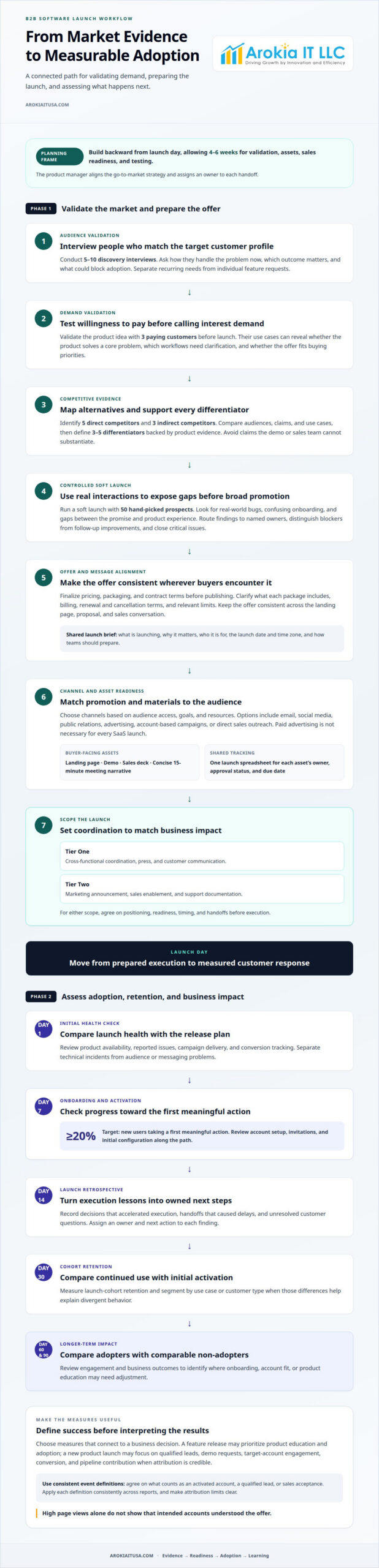
A B2B software launch coordinates product, marketing, sales, and support around a market-ready offer. Build the plan backward from launch day, with four to six weeks for message validation, asset production, sales readiness, and testing. A product manager should align the go-to-market strategy and assign an owner to each handoff.
- Validate the audience before committing to the launch message. Conduct 5 to 10 discovery interviews with people matching the target ideal customer profile. Ask how they handle the problem now, which outcome matters, and what could block adoption. Record recurring needs separately from individual feature requests.
- Test willingness to pay before treating interest as demand. Validate the product idea with 3 paying customers before launch. Their use cases can reveal whether the product solves a core problem, which workflows need clarification, and whether the proposed offer fits actual buying priorities.
- Map alternatives and document evidence-backed differentiation. Identify 5 direct competitors and 3 indirect competitors. Compare their audiences, claims, and use cases, then define three to five differentiators your team can support with product evidence. Avoid claims that the demo or sales team cannot substantiate.
- Run a controlled soft launch with 50 hand-picked prospects. Use customer interactions to surface real-world bugs, confusing onboarding steps, and gaps between the promise and product experience. Route findings to named owners, distinguish launch blockers from follow-up improvements, and close critical issues before broad promotion.
Finalize pricing, packaging, and contract terms before publishing launch materials. Define what each package includes, how it is billed, its renewal and cancellation terms, and any limits buyers need to understand. Keep the offer consistent across the landing page, proposal, and sales conversation.
Turn research into a positioning statement, launch brief, and channel plan. The brief should explain what is launching, why it matters, who it is for, the launch date and time zone, and how teams should prepare. Give marketing, sales, product, and support the same approved message before campaign production begins.
Choose channels according to audience access, launch goals, and available resources. Email, social media, public relations, and advertising can all support promotion, but paid advertising is not necessary for every SaaS launch. A focused account-based campaign or direct sales outreach may suit a narrow market better.
Build a reusable asset set for each buyer interaction: a landing page, demo, sales deck, and concise 15-minute meeting narrative. Track each asset, owner, approval status, and due date in one launch spreadsheet. A practical B2B software product launch checklist connects those deliverables to campaign timing and accountable teams.
Set the launch scope according to its business impact. A Tier One launch calls for cross-functional coordination, press, and customer communication. A Tier Two launch needs a marketing announcement, sales enablement, and support documentation. For either scope, agree on positioning, readiness, timing, and handoffs before execution.
Post-launch adoption, retention, and business impact
Prepare onboarding before release with walkthroughs, training guides, and product support documentation. Customer success and support teams need a shared explanation of the first useful workflow, known limitations, and escalation route. For example, a setup guide can show how a new account reaches its first meaningful outcome, while an internal support note explains how to record the steps behind a reported problem.
Define success metrics before launch and connect each one to a business decision. A feature release may prioritize product education and adoption. A new product launch may focus on qualified leads, demo requests, target-account engagement, conversion, and pipeline contribution when attribution is credible. Do not confuse activity with impact: high page views alone do not show that intended accounts understood the offer.
- Review initial health one day after launch. Compare product availability, reported issues, campaign delivery, and conversion tracking with the release plan. Separate technical incidents from audience or messaging problems.
- Assess onboarding and adoption at Day 7. Use at least 20% of new users taking a first meaningful action as an activation target. Review the path to that action, including account setup, invitations, and initial configuration.
- Hold a launch retrospective by Day 14. Record decisions that accelerated execution, handoffs that created delays, and unresolved customer questions. Assign an owner and next action to each finding.
- Measure launch-cohort retention at Day 30. Compare continued product use with the cohort’s initial activation. Segment by use case or customer type when those differences explain divergent behavior.
- Compare adopters with comparable non-adopters at Day 60 and Day 90. Review engagement and business outcomes to identify where onboarding, account fit, or product education may need adjustment.
Use a measurement loop that combines product analytics with sales, marketing, support, and customer feedback. Validate event definitions before interpreting results. For example, agree on what counts as an activated account, a qualified lead, or sales acceptance, then apply each definition consistently across reports. Make attribution limits clear so pipeline influence is not mistaken for proven causation.
At each review, turn the evidence into a specific decision: revise onboarding, update an explanation, investigate a recurring support issue, or prioritize a product improvement. Track the decision, owner, and follow-up outcome. Teams connecting launch performance to pipeline and buyer engagement can discuss measurement support for launch goals.
What is a product launch?
A product launch is the coordinated introduction of a new product or update to its market. It connects the product’s intended use with how buyers discover, evaluate, access, and adopt it. A release is one event in that process; launch work also covers product readiness, customer communication, and learning from early use.
B2B SaaS launches typically center on cloud access, repeatable onboarding, and ongoing product use. Enterprise software launches often require more coordination around customer-specific deployment, integrations, procurement, and technical evaluation. The distinction is the implementation and buying context, not simply company size.
Keep product development assumptions testable. Translate the target audience’s problem into a workflow, then define what successful completion looks like. A beta can expose the product to selected users before general availability. Their actions and feedback help reveal whether the workflow is clear, whether the product solves the intended problem, and where users encounter friction.
Create a focused test plan for each release. Check the changed functionality, then revisit existing workflows it could affect. For example, test a reporting update for both accurate new output and continued access to existing reports. Log defects with steps to reproduce, expected and observed behavior, and an owner responsible for resolution.
- Test the product as a new user. Follow the intended path from access through the first useful task, noting unclear instructions and unnecessary steps.
- Check analytics against product questions. Confirm that events distinguish users who start a workflow from those who complete it.
- Exercise the conversion path. Test the action connecting launch content to the next step, such as requesting a demo or starting a trial.
- Separate blockers from refinements. Document issues that prevent core use separately from improvements that can follow the release.
Product analytics help only when teams can interpret the events they collect. Define the action that signals meaningful progress and make sure the event fires once at the right point. Pair the data with beta feedback: analytics can show where users stop, while interviews can explain what caused hesitation or abandonment.
Pressure-test the schedule against dependencies rather than treating the launch date as fixed regardless of readiness. Identify product changes that affect documentation, training, or customer access. Set decision points for reviewing unresolved issues and record who can approve a delay. This keeps the plan responsive to evidence, not just calendar pressure.
Engineering, infrastructure, and deployment readiness
Set clear release conditions before scheduling deployment. The target date should depend on feature completion, passed QA, validated staging, and acceptable performance. Without these gates, unresolved engineering risks become customer-facing risks. Name the person who can delay release and the owner who decides whether an issue blocks launch.
Use a review calendar to surface dependencies before they become launch-day surprises. Schedule an architecture and dependency review 6 weeks before launch, followed by a production-readiness review 2 weeks before launch. Hold the final go/no-go review 3 to 5 days before launch. A separate readiness review one week before launch gives teams time to close remaining gaps.
- Validate the production path. Confirm the release candidate, deployment sequence, configuration, and required dependencies in the intended environment.
- Document rollback steps. Define the triggers for rollback, who authorizes it, and how teams restore the previous stable version.
- Configure monitoring and alerting. Assign owners to watch errors and performance signals after release, then establish where incidents are reported.
- Confirm operational ownership. Make sure engineering, support, and customer-facing teams know the launch sequence and escalation route.
Plan controlled exposure when a broad release would create unnecessary risk. A phased release can roll out by percentage, region, or customer segment. A dark launch deploys code without exposing it to customers until a feature flag is switched on. On launch day, smoke-test the production deployment and monitor errors before enabling the flag, if used.
Assess readiness beyond whether the code ships. Review product quality, market fit, competitive differentiation, sales and marketing readiness, and operational preparedness. For user experience, test whether a new user can understand the main workflow, complete key tasks, and recover from common errors. An intuitive interface reduces friction between the product promise and actual use.
Make sure messaging and operational readiness match the release. Confirm that sales teams can explain what changed, which customer problem it addresses, and who benefits. Prepare support documentation for likely questions, and match the announcement channel to the feature’s actual availability. A campaign should not promise access before deployment or imply capabilities the product lacks.
Reserve 30 minutes for a launch readiness review one week before launch. Use the meeting to examine open defects, staging results, owners, rollback triggers, and monitoring coverage. Record each decision and unresolved issue. If a blocker remains, the designated decision-maker should determine whether the team delays, narrows exposure, or proceeds under the documented release conditions.
For Tier One and Tier Two launches, hold brief daily stand-ups during launch week, with each stand-up lasting ten minutes. Review readiness changes, surface cross-team dependencies, and confirm who owns the next decision. Clear deployment status helps teams coordinate adoption messaging and customer response.
Pre-launch technical and content validation
A launch can pass engineering QA and still fail when customers try to act. Validate the complete path from announcement to product use, including the content, links, forms, and support information buyers encounter. This cross-check catches mismatches that isolated reviews can miss.
Use one launch document as the source of truth. Record the launch date, approved product description, audience, asset owner, review status, and destination for each call to action. When a feature changes, update the affected landing page, demo script, release notes, and support article together.
- Test every form from submission to follow-up. Submit sample entries and confirm required fields, confirmation messages, notifications, and routing behave as intended.
- Open every booking and product link. Follow each path from the announcement, landing page, and sales email to verify it reaches the promised destination.
- Complete the demo or trial flow as a new user. Check account creation, access instructions, and the first product action for unclear steps or broken handoffs.
- Compare claims with the release itself. Match each landing-page benefit and demo statement to a feature available at launch, removing outdated claims about existing functionality.
- Confirm permission for customer proof. Obtain approval before publishing customer logos, testimonials, or quotes, and retain the approved wording with the relevant asset.
- Finalize packaging and documentation. Ensure product descriptions, included capabilities, onboarding guidance, and support channels reflect the offer buyers can actually access.
- Check analytics across the full conversion path. Verify that key actions, such as form submissions or trial requests, register correctly and connect to the intended campaign source.
- Review content in its final destination. Check page layout, links, and mobile presentation after publishing to staging, where formatting can differ from a document draft.
Make validation findings easy to act on. For each failed test, document the exact page or workflow, expected result, observed result, and owner responsible for correction. Separate blockers, such as a broken trial signup, from editorial refinements that do not prevent buyers from understanding the offer.
Run a final content-to-product review after the last release change. Ask product, marketing, and support to verify the same approved description and customer path. This shared review reduces the work of correcting conflicting language after launch and keeps the customer experience consistent.
Arokia IT LLC: Marketing for software and tech Industry
Arokia IT LLC helps B2B software teams connect launch strategy with qualified buyer demand. Turn to its marketing support when your product is ready, but positioning, target-account engagement, or campaign execution needs sharper alignment.
Account-Based Marketing (ABM) focuses outreach on selected organizations and buying groups. Demand Generation builds market interest, while LinkedIn Marketing engages relevant professional audiences. AI Search & GEO helps make product information easier to find through search and generative answer experiences.
These efforts work best when messaging reflects the product’s actual capabilities and gives sales a clear path from interest to conversation. If your launch plan needs stronger market reach or demand generation, contact Arokia IT LLC to discuss your goals.
Turn launch planning into your next growth decision
A launch plan proves its value when teams use it to make decisions. Treat the checklist as an operating document, not a one-time approval form: assign owners, capture unresolved risks, and record which customer signals will shape the next release. This creates continuity between product execution and market response.
A well-maintained B2B software product launch checklist also gives leadership a clearer basis for deciding what to repeat, revise, or stop. Use customer feedback and performance evidence to refine the next launch rather than carrying assumptions forward. If your team needs to connect launch planning with buyer engagement and demand, Arokia IT LLC can discuss how its marketing capabilities fit your goals.
Each launch can lay a stronger foundation for the next.
Frequently Asked Questions
How far in advance should a B2B SaaS launch be planned?
Begin launch planning four to six weeks before release and work backward from the launch date. This gives teams time to validate messaging, produce assets, prepare sales, and test customer-facing paths. For a broad, high-impact release, review the scope earlier so dependencies surface before production work is locked in. Build contingency into the schedule by identifying decisions that could delay release and assigning owners to resolve them.
Why is it Important?
A launch plan connects the product’s promise to what buyers can actually evaluate and adopt. Without shared decisions, prospects may hear one value proposition from marketing and a different explanation from sales. A checklist gives teams a common record of owners, dependencies, and launch criteria. After release, it also helps leadership distinguish product issues from problems with reach, positioning, or onboarding.
What should a B2B software product launch checklist include?
A useful checklist covers market validation, audience and positioning, product quality, deployment controls, customer-facing content, sales and support preparation, and post-launch measurement. It should also identify each deliverable’s owner, due date, approval status, and dependencies. For example, a demo script may depend on final feature behavior, while a launch email requires an approved product description and a working destination page. Give every task a clear completion test.
What are the key steps and timeline for launching a B2B SaaS product?
Sequence the work from scope and dependencies to readiness, release, and review. Schedule a scope review 8 to 12 weeks before launch when the release warrants that lead time, then hold architecture review 6 weeks before. Plan go-to-market and enablement review 4 weeks before, production readiness 2 weeks before, and final go/no-go 3 to 5 days before. After release, review health at 1 day, adoption at 7 days, and results at 30 days.
How do you validate demand and define a B2B software product’s target market before launch?
Define the target market by the business problem, user role, company context, and buying trigger, then test those assumptions with customer conversations. Conduct 5 to 10 interviews with people matching the ideal customer profile and look for repeated pain points, current workarounds, and purchase barriers. Validate willingness to pay with 3 paying customers. Then compare the target segment’s needs with alternatives and test the offer with a controlled prospect group.
What technical, security, privacy, and compliance checks are needed before a B2B software launch?
Review the release build, critical workflows, performance, deployment and rollback procedures, monitoring, and access to customer data. Map what information the product collects, where it moves, who can access it, and how customers can request support or data changes. Identify the data protection requirements that apply to the product, its users, and customer agreements. Document unresolved risks, owners, and launch-blocking conditions, then verify that public claims match actual safeguards and product behavior.
What sales enablement materials and training are needed for a B2B SaaS launch?
Give sales a concise positioning guide, demo narrative, qualification prompts, objection-response sheet, and current packaging details. Train customer-facing staff to explain the ideal use case, key limitations, implementation expectations, and next step after a demo. Practice with a realistic buyer scenario, such as a technical evaluator asking about integrations while a business leader asks about operational value. Keep materials consistent with the released product and update them when product details change.
What marketing channels and launch tactics work best for B2B software?
The right channel mix depends on where intended buyers learn, evaluate, and discuss software. Email, social media, public relations, advertising, partner communication, and sales outreach can each support a launch. Use focused account outreach when a defined group of organizations matters most; use educational content when buyers need context before a conversation. Paid advertising is not essential for every launch. Match each tactic to audience access, launch goals, available resources, and a measurable next action.