
Medical device marketing can miss the mark when it treats a complex, regulated purchase like a routine product sale. Effective content marketing for medical device companies connects accurate product information with the distinct questions clinicians, procurement teams, and administrators need answered before considering a solution.
That complexity makes a focused strategy important. Medical device buyers need clear, credible content that explains capabilities without overstating them, and each audience may assess value differently. Content also needs to reach buyers through the channels they use, rather than sit unnoticed on a company website.
A focused approach can support stronger buyer engagement and clearer product understanding. Distribute useful content across digital channels, tailor it to different decision-makers, and build the strategy around practical business goals. This creates a more deliberate path from discovery to consideration, serving both buyers’ information needs and the company’s growth priorities.
Key Takeaways
- Align medical device content with applicable U.S. requirements, including FDA expectations under 21 CFR Part 820 and labeling rules under 21 CFR Part 801.
- Choose distribution channels based on where professional buyers seek information, then adapt content to each channel’s role.
- Segment audiences by their responsibilities and information needs to make campaigns more relevant.
- Use useful, consistent content to strengthen product understanding, support buyer confidence, and build visibility.
- Connect content formats and performance measures to clear marketing objectives rather than publishing without a plan.
Why does medical device marketing require a specialized strategy?
Medical devices involve technical claims, clinical use, and purchasing decisions that can affect patient care. Marketing should explain product capabilities clearly, with every claim aligned to its evidence and intended use. Generic campaigns can blur important distinctions, such as which professionals use a device and what its materials actually support.
B2B medical device marketing addresses clinicians, procurement teams, and administrators with different responsibilities and evaluation criteria. Direct-to-consumer communication speaks to patients and caregivers, so it needs accessible explanations without turning product promotion into unsupported medical advice. The audiences differ, but both require accurate, carefully reviewed information.
Regulations shape the review process. According to the U.S. Food and Drug Administration, companies bringing medical devices to market in the United States are expected to follow 21 CFR Part 820. Medical device labeling in the United States is governed by 21 CFR Part 801, according to the Electronic Code of Federal Regulations. These requirements make coordination between marketing, product, quality, and regulatory professionals essential.
For online communications, establish an approval workflow: identify the intended audience, document each product claim, match claims to supporting evidence, and route drafts through appropriate internal review before publication. Apply the process to website copy, downloadable materials, social posts, and clinician education. Review edits as well: a shortened headline can change the meaning of a qualified claim.
Educational content for clinicians and patients should distinguish established product information from broader medical guidance. Use clear language, accurate descriptions, and evidence that supports each claim. Avoid implying outcomes the product information does not establish. When content collects personal information, assess privacy implications and limit collection to what the campaign needs. International efforts may also need to consider GDPR and relevant regional regulations.
Multilingual regulatory documentation takes more than translating a headline. Keep approved source content, terminology, and review records aligned across language versions, then route translations through suitable regulatory review. FDA regulatory legal counsel can help assess legal questions, claim language, and market-specific issues. Counsel complements, rather than replaces, internal quality and regulatory review.
Patient testimonials, clinical data, and influencer content can create risk if they imply unsupported results, omit important context, or blur personal experience with typical product performance. Review the wording, evidence, permissions, and presentation before publication. Industry trends may change, but disciplined review helps medical device marketing teams use digital channels without sacrificing accuracy.
Distributing content across websites, social media, and industry publications
A company website gives medical device content a durable, searchable home. Use product pages to explain intended audiences and supported applications, then connect them to relevant resources. A clinician might move from a product overview to a technical article or webinar registration. Clear navigation helps visitors find the next useful detail without searching disconnected pages.
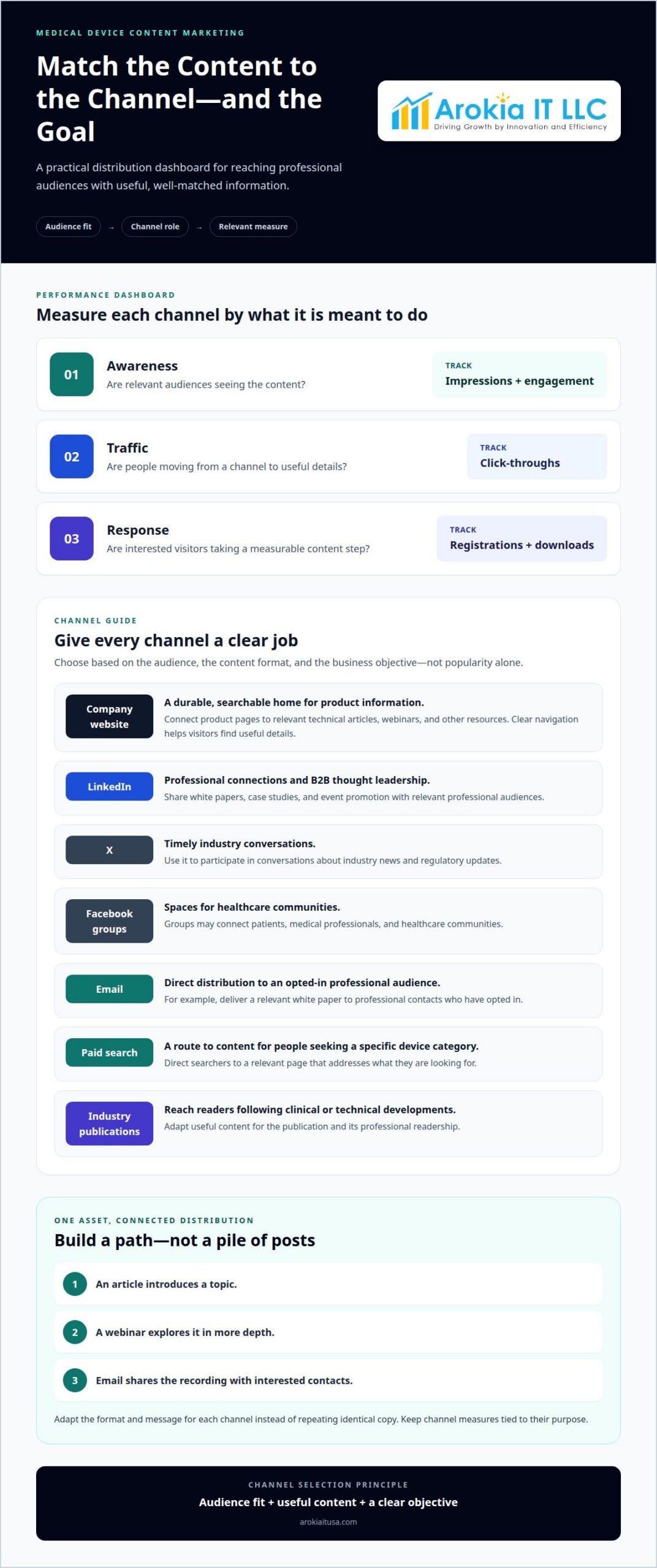
Email, social media, paid ads, and industry publications extend content beyond the website. Email can deliver a white paper to an opted-in professional audience, while paid search can direct people seeking a specific device category to a relevant page. Industry publications reach readers following clinical or technical developments. Coordinate channels around one useful asset, adapting its format and message rather than repeating identical copy.
Choose platforms by audience, content format, and business objective. LinkedIn supports B2B connections and professional thought leadership, including white papers, case studies, and event promotion. X can support timely conversations around industry news and regulatory updates. Facebook groups may provide spaces for healthcare communities, patients, and medical professionals. A platform’s popularity alone isn’t a reason to invest; its audience and communication style must fit the content.
Social media can build brand recognition through consistent, informative participation. A short device demonstration or infographic can clarify product features, while expert commentary can establish a distinct point of view. Webinars add depth: promote an educational session on LinkedIn, invite relevant audiences by email, and share a follow-up summary on the company website. Responding to comments and joining industry discussions keeps the brand present beyond campaign launches.
Industry publications, social channels, and owned website content work best as connected distribution paths. For example, an article can introduce a topic, a webinar can explore it, and email can share the recording with interested contacts. Track channel performance against its purpose: impressions and engagement for awareness, click-throughs for traffic, and registrations or downloads for response. These measures help teams refine placement and content choices without treating every channel as interchangeable. Teams mapping a coordinated mix can discuss their distribution priorities and align channel decisions with business goals.
Email marketing, social media marketing, and pay-per-click advertising can all support distribution. Choose channels according to the content’s purpose. Social posts can use videos or infographics to explain device benefits and features. Webinars can educate potential customers about products and generate leads, so plan their promotion alongside other channel activity. A digital opinion leader can also advocate for a device, participate in virtual events, or create blog posts and social media content, broadening the voices involved in distribution.
Social activity depends on interaction, not publication alone. Build relationships by responding to comments, answering questions, and joining industry conversations while following legal and regulatory guidelines. Assess these efforts against business goals, such as lead generation, brand awareness, or sales growth, rather than treating activity as an end in itself. This helps teams judge whether social media is serving its purpose alongside email marketing, pay-per-click advertising, or webinars.
Audience segmentation and personalized campaigns
Medical device campaigns become more relevant when they reflect each audience’s role. Clinicians may need evidence about workflow and device use, while procurement teams weigh purchasing requirements. Administrators may focus on implementation and operational fit. Identify these priorities through audience research before choosing messages or formats. Review sales conversations, customer questions, website behavior, and available studies to find recurring information needs.
Build segments around meaningful differences, not broad labels alone. For example, distinguish clinicians evaluating product capabilities from hospital administrators assessing organizational fit. Tailor the value proposition, supporting detail, and next step for each group. Email campaigns can use segments based on demographics, past purchases, or website behavior. Someone who downloads a technical resource may need a deeper explanation, while an early-stage visitor may benefit from an accessible overview.
How should medical device companies adapt content marketing for different stages of the sales cycle? At awareness, explain the problem and relevant device category in clear, educational language. During evaluation, provide detailed product information and evidence that supports claims. Closer to a decision, address implementation questions and purchasing considerations specific to the account.
Facebook can support audience engagement through groups centered on healthcare communities, patient interests, or medical professionals. Facebook Ads can target healthcare audiences by job title, industry, or interests. Use these options to reach a defined audience, then direct each campaign to content suited to its purpose. A clinician-focused resource should not lead with messaging written for patients. Relevant content respects each group’s context and builds a consistent brand presence.
Personalization also depends on listening. Invite feedback through customer surveys, reviews, and social media conversations, then organize responses by audience and topic. If clinicians repeatedly ask about a device feature, use that pattern to inform a technical article or webinar. If patient feedback raises questions about instructions, improve the clarity of educational explanations. Keep product claims accurate while making content more useful.
Measure whether each segment responds as intended. Compare email engagement, resource downloads, and website activity by audience, then use those signals to refine future content. Treat them as indicators of interest, not proof of a purchasing decision. A disciplined cycle of research, targeted messaging, engagement, and feedback helps medical device teams adapt campaigns to real buyer needs.
Benefits of content marketing for medical device companies
Useful content helps medical device manufacturers explain complex products before a sales conversation begins. A clear technical article can answer how a device fits a clinical workflow, while a concise overview helps buyers understand its intended role. This information can make a company a valuable resource and help decision-makers assess relevance at their own pace.
Consistent publishing also gives industry leaders material to share across sales conversations, email, and professional channels. A product guide, webinar, and supporting article can address different questions without forcing every buyer through the same message. Teams can develop these assets around specific audience needs, then connect each channel to an appropriate next step.
How much does medical device content marketing cost in the United States? Cost depends on scope, including research, content formats, review requirements, distribution, and measurement; pricing is provided after a quote request. A focused article program requires different resources from a campaign combining technical assets, email, paid promotion, and ongoing updates.
How do medical device companies define and measure content marketing ROI? Connect campaign costs and outcomes to an agreed objective, such as qualified inquiries, asset downloads, or sales opportunities influenced by content. Track relevant indicators, including conversions, time on page, and bounce rate, then compare performance across assets and channels. Sales feedback adds context about lead quality and buyer readiness.
For example, a manufacturer introducing a device category could publish an educational article, develop a clinician-focused webinar, and distribute both through email and LinkedIn. Track registrations, follow-up requests, and engagement with related product information. This sequence shows which assets attract interest and which help move prospective buyers toward a sales discussion.
Another practical example is a searchable resource center organized around buyer questions. Technical explainers, product pages, and downloadable materials can guide a procurement team from initial research to a more detailed evaluation. Search visibility, resource use, and qualified inquiries help teams assess whether content supports discovery and consideration.
The core benefit is operational alignment: each asset serves an audience, a channel, and a measurable purpose. Medical device teams can use this structure to sharpen positioning, equip sales leaders with consistent materials, and direct future investment toward content that supports buyer decisions.
What content marketing strategies work best for medical device companies?
Effective strategies connect a buyer’s question to a useful, evidence-aligned asset and a clear next step. Start with the device’s intended audience, practical value, and supported claims. Then build a content plan around the decisions clinicians, administrators, and procurement teams must make. This keeps publishing focused on buyer needs instead of producing disconnected materials.
Develop a distinct value proposition before choosing formats. A company history or brand story can explain its focus, while a technical article can clarify a device’s role in a specific workflow. White papers and e-books can provide deeper context for professionals evaluating complex solutions. Give every asset a defined reader, purpose, and review path.
Create a connected content journey rather than isolated campaigns. A search-focused article can introduce a clinical or operational problem, and a related landing page can offer a deeper resource. Email follow-up can then share relevant information based on the reader’s expressed interest. This gives interested prospects a logical path without treating every download as an immediate sales opportunity.
For high-priority organizations, account-based marketing can align content with account needs. Sales and marketing teams can identify likely stakeholders in each organization, then prepare relevant material for each role. A clinician may need technical detail, while procurement may need information to support evaluation. Shared account priorities help teams avoid conflicting messages.
Use proof carefully. A case study can describe a documented customer context, the problem addressed, and the solution’s role without implying unsupported outcomes. Keep testimonials accurate and in context. Thought leadership can also build credibility when subject-matter experts explain industry questions clearly, rather than relying on broad claims or promotional language.
Measure each strategy against its purpose. Search visibility and qualified page visits can indicate discovery; downloads and webinar registrations can signal deeper interest. Sales teams can record whether assets help answer buyer questions or support an active evaluation. Reviewing these signals together helps refine topics, formats, and follow-up while keeping attention on business objectives.
Build a focused medical device content strategy around buyer needs and measurable goals.
Arokia IT LLC: Content Marketing
Arokia IT LLC helps medical device manufacturers shape content programs around commercial priorities and buyer needs. Its Content Marketing and Marketing for Medical Equipment Manufacturing Industry services suit teams that need a clearer plan for developing and organizing marketing materials.
Start with the business objective: clarify which audiences matter, what decisions the content should support, and how marketing and sales will use it. This provides a practical basis for setting priorities, assigning content roles, and aligning the program with broader growth goals.
Some teams need a consistent approach to planning and producing content. Others need to connect existing materials to wider marketing efforts. Arokia IT LLC’s Content Marketing service supports these needs by helping create a coordinated program, rather than publishing assets without a defined purpose.
For manufacturers focused on selected healthcare organizations, Account-Based Marketing (ABM) aligns marketing activity with target accounts. It structures efforts around priority organizations and relevant stakeholders, helping teams coordinate account-level engagement with commercial objectives.
AI Search & GEO can also support companies working to improve how digital content is interpreted by search and generative answer platforms. It complements a broader marketing strategy by addressing discoverability, while the company’s product and regulatory teams remain responsible for the accuracy and approval of product information.
Consider Arokia IT LLC when your team is setting content priorities, coordinating marketing around target accounts, or planning for AI-driven search visibility. A conversation can focus on your objectives, existing content, and the role you want marketing to play in reaching buyers.
Contact Arokia IT LLC to discuss your medical device content marketing needs.
Make your next content decision count
Set a clear priority for the next phase of your medical device marketing. Choose a buyer question that affects evaluation, then decide what evidence, expertise, or explanation would help answer it. This creates a practical starting point for content marketing for medical device companies without adding more assets to an already crowded calendar.
Before expanding production, align marketing and sales on what progress should look like. Define the audience, the action each asset should support, and the signal that indicates useful engagement. Use those learnings to refine future investment. A disciplined approach keeps content connected to business priorities and helps teams make deliberate decisions as buyer needs evolve.
Arokia IT LLC can support that planning through Demand Generation, Account-Based Marketing (ABM), and AI Search & GEO. If your team is ready to discuss its priorities and next steps, start a conversation.
Clear priorities make room for stronger decisions and steady progress.
Frequently Asked Questions
What are the FDA rules for medical device marketing claims and promotional content?
Medical device promotional claims should accurately reflect the product and avoid misleading impressions. Maintain a claim record that identifies the exact wording, supporting evidence, approved context, and materials using that claim. This helps teams manage updates consistently across campaigns. Regulatory specialists or legal counsel can assess how requirements apply to a particular device and its promotional materials.
How do HIPAA and patient privacy laws affect medical device content marketing?
Patient privacy affects content planning whenever a campaign uses personal health information, patient stories, images, or data collected through forms. Before using such material, identify what information is collected, who can access it, and how the campaign will use it. Limit collection to what the content or follow-up needs, and involve privacy or legal professionals when patient information or healthcare partners are involved.
What content marketing channels are most effective for medical device manufacturers?
No single channel works best for every manufacturer; the right choice depends on the buying process and the action the campaign should support. To compare channels, use consistent campaign tracking and connect engagement data to relevant records in the customer relationship management system. Review whether activity advances meaningful account conversations, not just whether content gets attention. This makes channel decisions more useful when planning future campaigns.