
A medical equipment purchase rarely depends on product features alone. The medical equipment buyer journey links a clinical need to a decision that must also account for a health system’s operations, finances, and purchasing priorities. Buyers need a clear way to judge whether a device addresses the right problem and whether the organization can support it after adoption.
That evaluation spans departments. Clinical teams assess relevance to care, while technical and administrative stakeholders consider integration, implementation, procurement, and ongoing use. A strong product case can lose momentum if it overlooks these practical requirements or fails to give decision-makers information relevant to their concerns. Manufacturers need to make value clear at every stage, from early research through vendor review.
This guide explains how to connect clinical and economic value, assess health-system structure and facility needs, and account for regulatory, safety, and infection-control considerations. It also explores how purchasing relationships develop and what buyers need when researching and comparing options. Together, these factors help manufacturers align product evidence, account priorities, and sales communication with the decisions healthcare organizations face.
Key Takeaways
- Connect a device’s clinical value to the facility’s quality priorities and total cost of ownership, not just its features.
- Map health-system structure, facility types, and financial priorities to focus outreach on accounts where the equipment fits.
- Keep product claims aligned with cleared or approved indications, and account for facility-specific safety and infection-control needs.
- Build relevant communication for clinical, technical, and administrative stakeholders, each of whom may weigh different purchasing criteria.
- Use targeted marketing and educational content to support medical equipment manufacturers as buyers research and evaluate solutions.
1. Demonstrating clinical and economic value
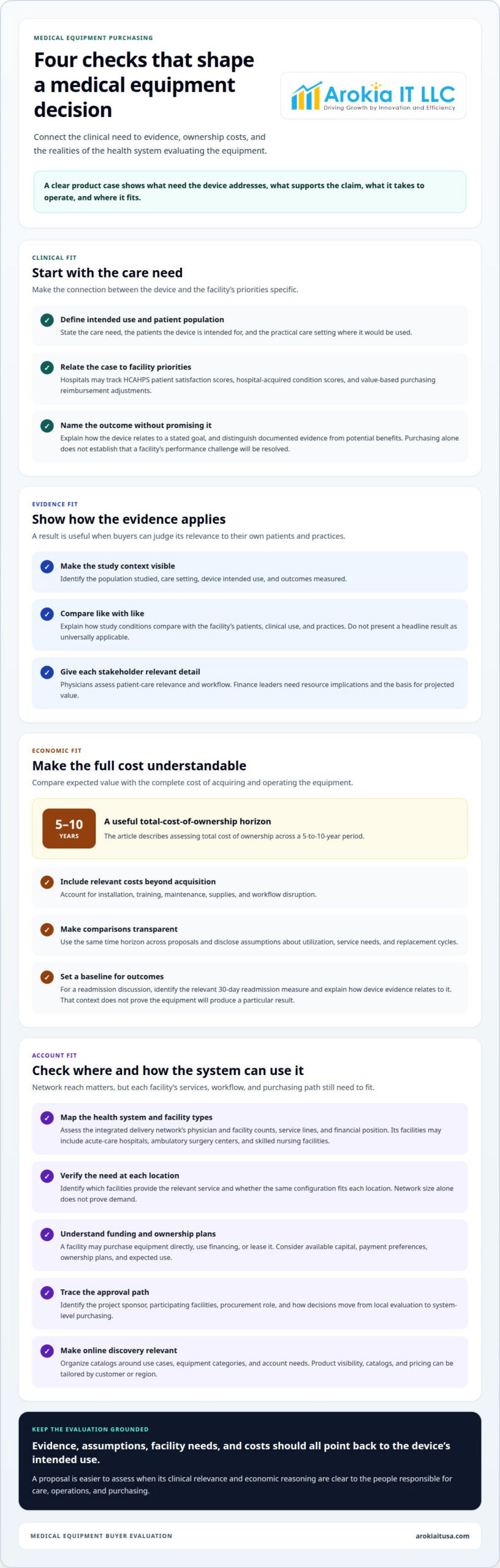
Healthcare buyers evaluate medical equipment by weighing clinical evidence, patient benefits, operational demands, and financial impact. Physicians ask whether a device addresses a defined care need; administrators consider whether its use supports facility priorities. A persuasive case connects intended use to a specific patient population, a measurable outcome, and a practical care setting. Features matter when buyers can see how they meet those criteria.
Start with the facility’s relevant performance measures. Hospitals may track HCAHPS patient satisfaction scores, hospital-acquired condition scores, and value-based purchasing reimbursement adjustments. These indicators can reveal quality priorities that shape equipment evaluation. A proposal should explain how a device relates to a stated goal, such as improving a relevant care process, and distinguish documented evidence from potential benefits.
Clinical evidence is useful only in context. Identify the population studied, care setting, device’s intended use, and outcomes measured. Then explain how closely those conditions match the facility’s patients and practices. If evidence concerns a particular procedure, buyers need to understand how the study population and outcomes compare with their own clinical use, rather than treating a headline result as universally applicable.
Customer problems make the value case more specific. For example, above-average complication rates for total knee replacement may be a quality concern for a hospital, but those rates alone do not trigger a CMS financial penalty. Penalties depend on the applicable program’s measures and criteria. A device discussion should address the relevant clinical concern and present evidence tied to the device’s intended use. It should not suggest that purchasing alone will resolve the facility’s performance challenge.
Clinical and administrative stakeholders may assess the same proposal differently. Physicians need evidence relevant to patient care and workflow; finance leaders need to understand resource implications and the basis for projected value. Link each claimed benefit to its evidence, expected use, and measurement approach. This makes assumptions visible and gives the evaluation team a shared basis for discussion.
ROI compares expected value with the full cost of acquiring and operating the equipment. Buyers can assess total cost of ownership across a 5-to-10-year period, including relevant expenses such as installation, training, maintenance, supplies, and workflow disruption. Comparisons are more meaningful when proposals use the same time horizon and disclose assumptions about utilization, service needs, and replacement cycles.
Define the baseline before presenting projected outcomes. If a proposal discusses readmissions, identify the relevant 30-day readmission measure and explain how the device’s evidence relates to it. This does not establish that the equipment will produce a particular result; it gives stakeholders a specific outcome to evaluate. Clear measures, realistic assumptions, and evidence tied to intended use make clinical and economic value easier to assess.
2. Assessing health-system size, facility types, and finances
Account fit depends on a health system’s structure, purchasing capacity, and intended equipment use. Before outreach, assess an integrated delivery network’s physician and facility counts, facility types, and financial position. A system may include acute-care hospitals, ambulatory surgery centers, and skilled nursing facilities, each with distinct service lines and operating models. Mapping the network helps distinguish a system-wide opportunity from a need at one site.
Network size alone does not prove demand. Identify which facilities provide the relevant service, where the equipment could be used, and whether the same configuration fits each location. A sale to an integrated delivery network may lead to implementation across its facilities, including ambulatory surgery centers and skilled nursing facilities. That potential reach matters, but each facility’s workflow and operational fit still shape adoption.
Assess budget ownership, capital planning, and how the purchase would be funded. Facilities may purchase equipment directly, use financing, or lease it. The right route depends on available capital, payment preferences, ownership plans, and expected use. A proposal can support review by separating acquisition terms from ongoing operational needs, helping decision-makers see how each option affects planning.
Buying committees also reflect the system’s governance. One department may identify a need, while centralized procurement coordinates review across locations. An account map should identify the project sponsor, facilities that could participate, and how approvals move from local evaluation to system-level purchasing. This shows whether the proposal needs a site-specific case or a consistent framework for several facilities.
For healthcare ecommerce, make it easy for buyers to navigate a complex catalog without irrelevant choices. Organize product information around use cases, equipment categories, and account needs. Medical equipment sellers can tailor catalogs, pricing, and product visibility by customer or region. This makes online discovery more relevant to the buyer’s account and can reduce friction before a purchasing discussion.
Account prioritization turns this assessment into a practical sales plan. Define the total addressable market, segment it into territories, and rank accounts by fit, potential facility reach, and purchase readiness. Align the launch plan with each account’s structure instead of treating every hospital or network as an identical prospect. This makes market coverage more deliberate and gives sales teams a clear rationale for where to focus.
For help aligning account priorities with medical equipment marketing, start a conversation about your marketing needs.
3. Regulatory, safety, and infection-control requirements
Regulatory fit is part of procurement, not a final paperwork step. In the United States, buyers assess whether a device’s authorization and intended use fit the proposed application. The FDA’s 510(k) process requires a manufacturer to show that a device is substantially equivalent to a device already on the market, called a predicate device, according to the U.S. Food and Drug Administration. That distinction helps define what the device can be promoted to do.
Promotional claims must stay within a device’s cleared or approved indications for use. Connect each claim to the applicable indication and supporting evidence. For example, marketing material should not imply that a device treats a condition outside its cleared or approved use. Clear boundaries help procurement teams compare products without mistaking broader claims for authorized uses.
Buyers also assess whether equipment meets applicable federal, state, and local requirements. Facility-specific infection-prevention and control guidelines add another layer. A device used in a procedure room, for example, may face different cleaning, handling, and placement requirements than equipment used in an administrative area. The facility’s infection-prevention team can identify relevant protocols and operational constraints.
Safety review should address the device’s use environment and the risks associated with routine operation. Buyers can map intended users, patient contact, cleaning steps, maintenance responsibilities, and escalation procedures. If a system generates data, technical review should consider secure transmission to electronic health records using standard protocols such as HL7 or DICOM. These details connect regulatory review with daily clinical practice.
Postmarket responsibilities matter as well. Under FDA medical device reporting requirements, manufacturers, importers, and device user facilities such as hospitals must report defined device-related events when applicable criteria are met; the requirements do not call for reporting all adverse events. The FDA can also require manufacturers to study a device’s safety and effectiveness after it enters the market. Procurement teams should understand relevant reporting and monitoring processes before implementation, especially when equipment changes clinical workflows.
For manufacturers using the 510(k) pathway, the FDA notification process is authorized by Section 510(k) of the Federal Food, Drug and Cosmetics Act. The Medical Device Amendments of 1976 expanded the FDA’s authority over medical devices. These regulatory elements help explain why buyers may request documentation about device status, indications, labeling, and postmarket responsibilities during evaluation.
Across U.S. markets, requirements can include federal, state, and local rules, as well as each facility’s protocols. Organize product claims and supporting materials around the device’s applicable authorization and intended use. This keeps promotional information consistent and gives procurement, clinical, and safety teams a clear basis for review.
4. Building relationships with purchasing decision-makers
Medical equipment purchasing involves distinct priorities, not one universal definition of value. Clinical leaders assess patient-care implications, while biomedical engineering and IT teams examine integration, maintenance, and data needs. Finance and procurement focus on budget fit, contract terms, and purchasing procedures. Map these roles to tailor conversations instead of sending every stakeholder the same product pitch.
Start with a stakeholder map for each account. Record each person’s role, decision influence, operational concerns, and information needs. A nurse manager may need to understand workflow impact; a biomedical engineer may ask about service requirements. Procurement may need consistent product specifications and purchasing documentation. The map helps the sales team identify gaps before a proposal reaches the buying committee.
Build relationships through relevant exchanges, not repeated requests for meetings. Share a product demonstration with clinicians, technical documentation with engineering, and a concise economic rationale with finance. When buyers compare multiple suppliers, they may spend only 5% or 6% of their time with any one sales representative. Each interaction should therefore answer a specific question and make the next evaluation step clearer.
Expect multiple impressions before a purchasing decision. Medical device buyers often need to review product information more than once and hear perspectives from several colleagues. A useful follow-up might clarify a feature raised during a demonstration, then provide a clinical evidence summary for internal discussion. The sales team should track which information has been shared, who received it, and what decision concern remains.
Clinical champions and key opinion leaders can strengthen communication across a health system. A respected physician, for example, may help a manufacturer understand how clinicians describe a workflow problem and which evidence matters to peers. Their input can sharpen messaging, but it does not replace direct engagement with procurement, technical teams, or administrators assessing other requirements.
Senior access needs its own relationship strategy. Integrated delivery network purchasing may involve a C-suite executive or vice president who is difficult to reach. Build a concise executive case around system-wide priorities, implementation implications, and decision criteria. Operational stakeholders still need detail; executive summaries should connect it to a clear strategic decision.
Coordinate outreach across sales, education, and follow-up. After a product demonstration, for example, send the requested technical material and record outstanding clinical questions. Use those questions to shape the next conversation instead of restarting the pitch. This helps the sales team communicate effectively across clinical, technical, and administrative roles while keeping each interaction relevant.
5. The medical equipment buyer journey
The medical equipment buyer journey usually starts before a supplier conversation. A reported study found that 94% of medical device buyers begin research online, and buyers spend 27% of key buying time on independent research. Product pages, technical specifications, and clear explanations therefore shape early consideration, before a sales team enters the process.
Hospitals and clinics assess vendors by reviewing product fit, technical information, availability, delivery timing, compatibility, and service terms. Service agreements should define response expectations, preventive maintenance coverage and scheduling, and how replacement parts are sourced. For example, buyers may distinguish a next-business-day response from a four-hour response-time guarantee when comparing service terms.
Awareness gives way to education as buyers identify a clinical or operational need. They engage with relevant information, consider options, and become sales leads when their interest signals a potential purchase. This five-stage progression, awareness, education, engagement, consideration, and lead, helps medical device marketing deliver the right content at each decision point.
During education, buyers need more than a product overview. They may review specifications, compatibility information, images, videos, and interactive demonstrations to understand how a medical device works. A product finder or configurator can clarify equipment selection and compatibility. Availability and delivery information also matter when procurement teams coordinate a purchase with facility planning.
Evaluation brings the buying group together around evidence and implementation details. Medical device buyers spend 17% of key buying time meeting potential suppliers, so those discussions should resolve specific questions rather than repeat online material. A demonstration, for example, can show system operation while technical documents address data transmission or compatibility. Each interaction should move the decision forward.
Vendor assessment continues after the product demonstration. Hospitals compare service agreement terms, response expectations, maintenance schedules, and parts access. They may also consider whether parts are stocked locally or sourced internationally. These operational details shape service planning and equipment availability after installation. Make commitments clear enough for procurement, technical, and clinical teams to assess together.
For manufacturers, the practical takeaway is to align digital information, sales conversations, and service details with the buyer’s next decision. Track questions that arise at each stage and provide content that answers them without stretching product claims. This makes the evaluation easier to follow and keeps follow-up relevant to the account’s needs.
Arokia IT LLC: Marketing for Medical Equipment Manufacturing Industry
Arokia IT LLC helps medical equipment manufacturers align marketing with how health systems research, evaluate, and purchase devices. Its Marketing for Medical Equipment Manufacturing Industry offering can connect clinical evidence, product information, and buyer priorities across the purchasing process. Account-Based Marketing (ABM) can focus outreach on priority health systems and relevant stakeholders, while AI Search & GEO supports discoverability in search and generative answer platforms. Demand Generation can coordinate useful content and follow-up as buyers move from early research to active evaluation.
Turn to Arokia IT LLC when your marketing needs to reach multiple decision-makers with clear, relevant information and support sales conversations with aligned content and account targeting. Contact Arokia IT LLC to discuss your medical equipment marketing needs.
Turn buyer insight into a focused next step
A more effective medical equipment buyer journey starts when marketing and sales share a clear view of the decisions buyers need to make. Use that alignment to identify where communication loses relevance, where teams need stronger content, and how each interaction can support the next decision. The aim is not activity for its own sake, but a connected process that helps qualified health-system buyers understand the case for your equipment and move forward with confidence.
Start with one priority account or buyer challenge. Clarify the decision you want to support, then align outreach around it. This disciplined approach gives your team a practical way to sharpen focus and build momentum over time.
Your next marketing decision can bring greater focus to the path ahead.
Frequently Asked Questions
What are the stages of the medical equipment buyer journey?
The process moves from recognizing a need to researching options, learning about products, engaging with suppliers, comparing solutions, and deciding whether to purchase. A hospital might identify a workflow gap, review product information, then arrange a demonstration. The stages can overlap: new clinical or technical questions may send a buying team back to research before it moves to procurement.
Who are the key decision-makers in medical equipment purchases?
Decision-makers commonly include clinicians, department leaders, biomedical engineers, IT staff, finance, procurement, and executive sponsors. Their influence depends on the equipment and facility. An imaging system, for example, may involve radiology leadership, facilities staff, and IT because it affects clinical workflow, space, and data exchange. A purchasing plan should identify who recommends, evaluates, approves, and uses the equipment.
How do buyers compare medical equipment vendors and products?
Buyers compare whether each product meets the intended clinical need, fits existing workflows, integrates with facility systems, and can be supported over time. A practical comparison matrix can separate required criteria from preferences, then record evidence and open questions for each option. For example, a team can assess documentation completeness separately from demonstration performance, distinguishing a persuasive presentation from a solution that meets operational requirements.
What is the typical medical equipment procurement process and timeline?
Some industry estimates put a B2B healthcare buying cycle at 6 to 18 months, but timelines vary and depend on the equipment’s complexity, internal review steps, capital planning, and contracting. The sequence usually includes defining requirements, reviewing options, conducting clinical and technical evaluations, securing budget and approvals, completing procurement, and planning implementation. A facility purchase may move faster when requirements and decision authority are clear from the outset.
What are the risks and common challenges in buying medical equipment?
Common challenges include choosing equipment that does not fit existing workflows, overlooking compatibility or infrastructure needs, underestimating implementation demands, and relying on claims that exceed supporting evidence. A system that cannot exchange data as required, for example, may create extra manual work after installation. Buyers can reduce these risks by involving clinical, technical, facilities, and procurement perspectives before contract approval.