
AI visibility isn’t a shortcut around SEO. An AI search and GEO agency helps B2B companies make their expertise easier for answer engines to find, interpret, and cite. The work connects search fundamentals with how generative platforms present information, giving buyers another way to evaluate suppliers before a sales conversation begins.
For teams selling complex products or services, this shift raises practical questions: What does AI search optimization involve, how does it fit with SEO, and what should leaders expect from an agency? A visibility report alone will not answer them. The value lies in understanding the planned work, how progress is assessed, and whether the effort supports commercial priorities rather than generating activity without direction.
This guide explains the services involved, how useful commercial content addresses buyer decisions, and how GEO relates to SEO and answer engine optimization. It also covers the role of websites, reviews, listings, and brand mentions, along with factors that shape an agency’s scope and timelines. Use these distinctions to assess the work and decide what support fits your organization.
Key Takeaways
- AI search optimization connects technical accessibility, clear content, and credible brand signals so answer engines can interpret a company’s expertise.
- Buyer-focused content should address the comparisons, risks, and practical questions prospects raise before contacting sales.
- GEO, AEO, and SEO overlap, but AI visibility is not a substitute for a strong search foundation.
- Consistent information across websites, business profiles, reviews, and other mentions helps reinforce how a company is understood.
- Agency scope, implementation needs, and measurement approach shape costs and timelines; evaluate the work plan, not just visibility promises.
What is AI search optimization?
AI search optimization improves how answer engines find, interpret, and cite a company’s information. It combines technical accessibility, useful content, and visibility measurement across platforms where B2B buyers research solutions.
AI Visibility Across Search Platforms
Visibility across ChatGPT, Claude, Perplexity, Gemini, Copilot, and Google AI Overviews means assessing whether each platform names a brand, cites its pages, or presents another source. Results can differ by platform and buyer question. For example, a manufacturer may appear in a ChatGPT comparison but not in a Perplexity answer about supplier capabilities. An audit records these differences rather than treating visibility as a single ranking.
How an Agency Establishes an AI Visibility Baseline
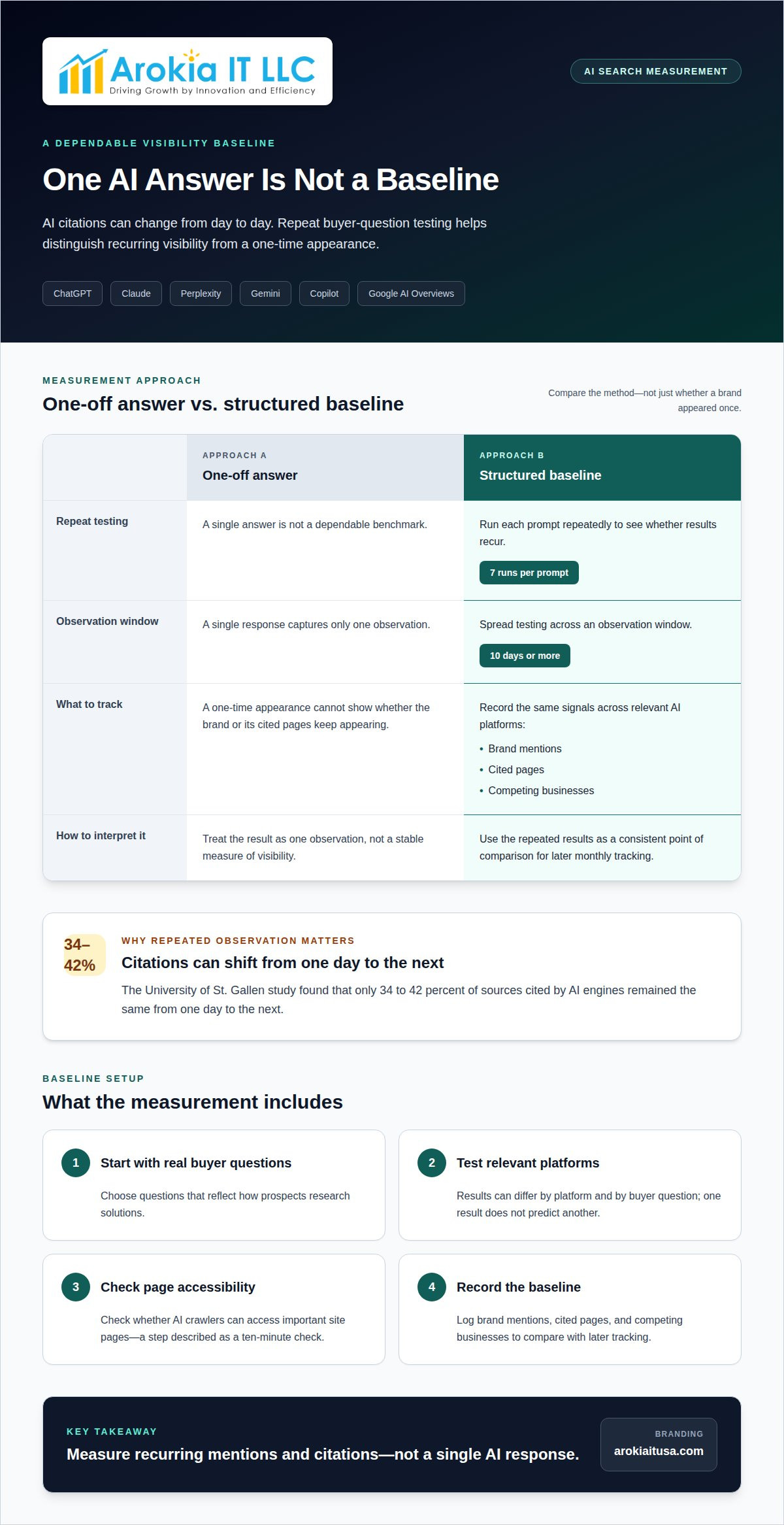
An agency establishes a baseline by selecting real buyer questions, testing them across relevant AI platforms, and recording brand mentions, cited pages, and competing businesses. It also checks whether AI crawlers can access important site pages, a step described as a ten-minute check. The University of St. Gallen team recommends seven runs per prompt across an observation window of ten days or more for reliable visibility tracking.
A single answer is not a dependable benchmark. The University of St. Gallen study found that only 34 to 42 percent of sources cited by AI engines remained the same from one day to the next. A structured baseline helps distinguish recurring citations from short-lived appearances, then gives later monthly tracking a consistent point of comparison.
GEO and AI Search Visibility
Generative Engine Optimization, or GEO, improves the clarity and usefulness of information that generative systems may select for answers. AI search visibility is the observed outcome: whether a brand appears, which page is cited, and how the answer represents its expertise. Google AI Mode and ChatGPT can surface different sources, so GEO evaluates performance across both rather than assuming one result predicts the other.
Technical reviews and content improvements support that outcome. An agency checks page access, crawl directives, indexability, and the structure of key pages, then addresses barriers that keep important information from being found. Content improvements make answers easier to extract, such as clearly defining an industrial process or explaining how equipment specifications affect a buyer’s choice.
The U.S. Bureau of Labor Statistics conceptualizes AI capabilities as those available no later than mid-2023. For current optimization, the practical focus is how platforms interpret accessible, well-organized information. An AI search optimization strategy can connect technical corrections, buyer-focused content, and monthly testing, with each cycle tracking mentions, citations, and changes in the pages surfaced.
Commercial content for buyer questions and comparisons
Commercial content helps buyers compare options and reduce uncertainty before contacting sales. It should answer questions about fit, performance, implementation, and tradeoffs, not merely describe a company’s products. For example, an industrial software company can explain which workflows its platform supports, what implementation involves, and when another approach may be more suitable. This specificity gives search systems and prospects useful context.
Build content around buyer decisions
Answer-first pages put the decision point near the top, followed by evidence and detail. A buyer comparing equipment suppliers may need to know operating requirements, service constraints, and compatibility before reading a product overview. Organize each page around one clear question, such as “Which measurement system fits this production line?” Then explain the criteria, show relevant use cases, and distinguish verified specifications from sales language.
Bottom-funnel comparison content should cover alternatives without making unsupported claims about competitors. A comparison can assess approaches, such as custom development versus configured software, against shared criteria: integration needs, internal resources, and process complexity. Explain where each option fits. This helps buyers understand the tradeoffs and gives AI systems clear, balanced information to extract.
Structure content for retrieval
LLMs can retrieve information more easily when pages make relationships explicit. Use descriptive headings, concise definitions, labeled tables, and direct answers that stand on their own. For example, a page about a medical device component can separate intended use, compatibility, and maintenance considerations into distinct sections. Keep terminology consistent and define technical terms before using abbreviations.
Sources strengthen commercial claims. Link a product capability to its documentation, a process claim to a relevant technical resource, and a comparison criterion to a clear explanation. Do not bury a critical qualification in a footnote or broad paragraph. If an answer depends on application conditions, state those conditions beside it. Clear structure supports human evaluation and AI visibility without sacrificing precision.
Make evidence-led changes
Content updates should address observed gaps, not chase rankings in isolation. An agency can review buyer questions, existing page coverage, search performance, and cited sources, then prioritize revisions. If buyers ask about integration but a page only lists features, add a direct integration section. If other businesses appear for comparison prompts, strengthen the page’s evidence, definitions, and decision criteria rather than copying their wording.
Measure whether revised pages answer the intended questions and support the right commercial position. Track changes in relevant rankings alongside AI citations, referral activity, and engagement where available. These signals show different parts of the journey; no single metric explains the whole result. For a focused discussion of buyer-facing content priorities, share your content objectives with the team.
Generative engine optimization, answer engine optimization, and AI SEO
Generative Engine Optimization (GEO), answer engine optimization (AEO), and AI SEO address related visibility challenges. GEO improves how generative systems interpret and use a company’s information. AEO makes answers direct and easy to extract. AI SEO connects these practices with technical and content foundations that support search visibility. The labels differ, but the work should reinforce one coherent strategy.
How GEO supports generative answers
The foundational GEO experiments presented at KDD 2024 reported that adding statistics, citations, and quotations increased visibility in their generative-answer benchmark by up to 40 percent. This is an experimental result, not a guaranteed outcome for every site or query. It supports a practical approach: make claims specific, attribute evidence, and place useful explanations beside the questions they address.
Google AI Overviews and ChatGPT don’t necessarily draw from the same sources. Ahrefs reported that 38% of pages cited in Google AI Overviews also ranked in the top 10 for the same query in its analysis. A University of Toronto analysis of 1,000 consumer ranking queries reported 0.0 percent median overlap between GPT-4o’s cited domains and Google’s top 10. These findings reflect specific analyses, not a universal pattern, and point to a need for strong search fundamentals and platform-specific visibility measurement.
One strategy for AI SEO, GEO, and AEO
These disciplines should not become separate programs competing for content, technical resources, or reporting. A unified plan starts with buyer questions, maps each question to a useful page, and checks whether that page is accessible, clear, and supported by credible evidence. For a U.S. manufacturer serving international buyers, the page should clarify product terminology, relevant markets, and regional differences without blending distinct requirements into one answer.
Google AI Mode, AI Overviews, and ChatGPT can reveal different gaps. An agency can assess each platform using relevant prompts, then prioritize updates to pages that support sales decisions. For example, a software company may need a concise integration explanation for one prompt and a detailed implementation comparison for another.
What timelines can you expect?
There is no established timeline for measurable movement from AI search optimization. Roughly 30 days can serve as an initial monitoring window, not a typical or guaranteed time to see results. Content, review, and listing signals may take one to two quarters to appear in AI answers, but timing varies and these periods should be treated as planning estimates, not verified benchmarks.
Set expectations around a defined measurement window, not isolated answer checks. Re-measure AI visibility after three months rather than three weeks after implementation. Compare mentions, citations, and surfaced pages against the starting baseline, while reviewing whether rankings and qualified visits support the same business goals. This keeps optimization accountable without treating one platform’s answer as the full result.
Websites, Google Business Profiles, reviews, listings, and mentions
AI systems build an understanding of a business from more than its website. Google Business Profiles, industry listings, reviews, and third-party mentions can reinforce or conflict with a company’s own descriptions. For a software provider, consistent naming and product details across its website, profile, and directory listings help reduce ambiguity. Authority building means strengthening this broader set of signals, not simply adding pages.
Mentions and citations serve different roles
A brand mention names a company, while a citation points to a source used in an answer. A mention can provide context without sending a visitor to the company’s website. A citation identifies a specific page and may support a reader’s next step. Track both: record which sources name the brand, which pages AI tools cite, and whether those citations accurately represent product or service details.
Ahrefs analyzed 75,000 brands and found that web mentions correlated more strongly with AI visibility than Domain Rating or branded search volume. That relationship makes credible references worth monitoring alongside traditional search optimization metrics. Mentions in relevant trade publications, partner materials, and technical resources can help establish a clear context around a company’s expertise. Relevance matters more than collecting unrelated references.
Reviews, listings, and business information
For companies with a local presence, a Google Business Profile should accurately reflect the business name, category, address, and services. Reviews add customer language that can describe real strengths or recurring issues. A response process should address specific feedback professionally and avoid treating reviews as a script for keyword placement. For B2B software companies without customer-facing locations, relevant industry listings and consistent company details may matter more than a local profile.
Correcting a Business Profile or adding schema may be reflected when Google and other sources refresh their data. Schema markup can clarify information for search engines, but it does not guarantee that a business will appear in AI answers. The useful sequence is to correct underlying facts, align important pages and listings, then monitor whether Google AI and other systems reflect the changes.
Measure signals without promising placement
Foundation and AirOps analyzed 5.1 million AI responses; Reddit accounted for 20.8% of external B2B SaaS citations in their dataset. That finding shows why third-party sources deserve attention, but it doesn’t make Reddit a required channel for every company. A manufacturer, software company, or medical equipment firm should prioritize sources that fit its buyers and industry.
No agency can guarantee that a business will be mentioned in ChatGPT or Google AI answers. A credible program reports observable changes instead: accurate profile information, relevant third-party mentions, citations to useful pages, and qualified traffic where measurement is available. Separating these outcomes keeps brand visibility reporting grounded in evidence.
AI search agency costs and timelines
AI search agency costs depend on the scope of work, not simply access to a reporting dashboard. An audit may assess technical access, priority pages, and current search visibility. An ongoing engagement can also include content planning, implementation support, measurement, and coordination with internal teams. The key distinction is whether the agency identifies recommendations, carries them out, or supports both stages.
Pricing depends on the scope and is provided after a quote request. Relevant factors include website complexity, the number and condition of pages in scope, technical dependencies, content requirements, target platforms, and reporting needs. A company with a well-organized site may need a different level of work from one with fragmented product information and unclear ownership of technical changes.
Retainers generally support recurring work, while a one-time audit focuses on assessment and prioritization. Before approving a scope, clarify expected deliverables, the review process, implementation responsibilities, and reporting format. Also establish who supplies product details, technical approvals, and subject-matter review. These responsibilities can affect how smoothly work moves from recommendations to published updates.
Timelines depend on the type of work and the organization’s internal dependencies. Fixing a crawl or access issue follows a different path from drafting and approving a technical comparison page. A project plan should identify dependencies, explain which tasks can proceed in parallel, and show where review or development capacity may affect publication. This makes timing easier to manage without treating every task as interchangeable.
Tracking plans should define what counts as progress before work begins. For example, a company might distinguish completed page updates from changes in AI citations, organic traffic, or qualified inquiries. Those measures answer different questions. A revised page shows execution; a citation indicates visibility in an answer; a qualified inquiry signals possible commercial relevance. Reporting should keep these distinctions clear.
Scope should also reflect the intended buyers and markets. A company serving several technical audiences may need separate page priorities, subject-matter reviews, and evaluation criteria for each audience. An engagement should explain how priorities are selected and how scope changes are handled. That clarity helps teams connect budget decisions to defined work, internal capacity, and business objectives.
Arokia IT: AI Search & GEO
Arokia IT helps B2B companies improve AI search visibility through AI Search & GEO, connecting technical priorities, buyer-focused content, and performance measurement. This support fits teams whose expertise is difficult to find in AI answers or whose search work needs clearer alignment with sales priorities. When target accounts and pipeline goals shape the strategy, Account-Based Marketing (ABM), Demand Generation, and LinkedIn Marketing can support that broader effort.
The next step is to define the buyer questions, platforms, and business outcomes that matter to your organization. This gives the work a focused scope and a basis for evaluating progress.
Contact Arokia IT to discuss your AI search goals.
Turn Search Visibility Into a Clear Next Step
Make AI search a defined business priority, not a disconnected experiment. Identify which buyer questions matter most, who owns the information behind them, and how marketing and sales will use visibility insights. This gives future work a practical purpose beyond appearing in an answer.
When evaluating an AI search and GEO agency, focus on whether its recommendations connect to your company’s commercial objectives and internal capacity. A useful engagement should clarify priorities, responsibilities, and how progress will inform decisions. The right approach is deliberate: build on what your team can sustain, then refine the work based on evidence.
Arokia IT LLC can help you shape that next step around your B2B goals. Start a conversation about the search challenges and buyer questions your team wants to address.
With a clear priority and accountable plan, your team can move forward with confidence.
Frequently Asked Questions
Can a small business afford this?
A small business can make the work manageable by defining a focused first phase around one audience, product line, or business priority. This keeps internal review and implementation demands aligned with available capacity. For example, a specialist supplier could prioritize the pages sales teams already use with prospects before expanding the program. The decision depends less on company size than on whether the scope has a clear purpose and an accountable owner.
How does an agency measure AI visibility?
Useful measurement starts with a consistent test design. An agency can group prompts by buyer role and intent, then compare results within each group rather than treating every answer as equivalent. It can also connect observed visibility to sales context, such as whether prospects mention an AI-generated comparison during discovery. This helps distinguish platform activity from evidence that the work informs real buying conversations.
How is GEO different from SEO?
GEO evaluates whether generative systems use a company’s information in synthesized answers; SEO evaluates performance in search discovery. A practical distinction appears in the review criteria: GEO analysis asks whether an answer accurately represents the company, while an SEO review considers whether the relevant page serves the searcher’s intent. Teams can use both reviews to find different weaknesses on the same page.
How long before AI visibility changes?
The sequence depends on approvals, technical access, and publishing capacity, as well as platform behavior. A useful project plan separates work the marketing team controls, such as content approval, from outcomes that depend on external systems. This helps leaders set internal milestones, identify stalled dependencies, and avoid treating a delayed platform response as proof that planned implementation work was not completed.
Is GEO different from SEO?
Yes, the evaluation lens differs, even when the underlying page improvements overlap. For planning, assign one content owner and shared subject-matter reviewers rather than creating competing briefs for SEO and GEO. A product page can serve search visitors and answer engines when its claims, terminology, and supporting evidence remain consistent. Separate reporting views can still help teams identify which discovery experience needs attention.
Is GEO replacing SEO?
No. Replacing SEO would leave a company without a strategy for conventional search discovery, while GEO alone does not address every way buyers find information. Leadership should assess where prospects encounter the business and preserve resources for those channels. For example, sales teams can note how new prospects discovered a solution, helping marketing decide whether search, AI answers, referrals, or other sources deserve more attention.
What services do AI search and GEO agencies provide?
Services can include visibility assessments, technical recommendations, content planning, implementation support, and performance analysis. The scope should also clarify which work involves the agency and which requires input from internal marketing, sales, or technical teams. Arokia IT LLC offers AI Search & GEO, Account-Based Marketing (ABM), and Demand Generation, which can connect search priorities with B2B audience and pipeline objectives.
How does generative engine optimization (GEO) differ from SEO?
GEO places added emphasis on whether generative systems can accurately interpret a company’s expertise and use it in an answer. SEO planning often begins with a page’s role in search discovery; GEO planning also considers how a system might represent the page’s claims when summarizing them. A useful review tests whether a standalone excerpt preserves essential qualifications, not just whether the full page reads well.