
More leads don’t necessarily mean more pipeline. When b2b demand gen is measured by form fills alone, marketing can hit its volume target while sales sees few accounts worth pursuing. The gap is especially costly when a purchase involves technical evaluators, operations leaders, finance, and executives who need different evidence before a decision moves forward.
That disconnect is familiar: campaign activity is visible, but its contribution to revenue is hard to explain, and sales and marketing may not agree on what makes an account ready. Generating demand means more than capturing contact details. It means building awareness and useful engagement across the buying group, then connecting those signals to credible pipeline progress.
This article explains how demand generation differs from lead capture and how to build a practical program around relevant accounts and complex buying groups. You’ll learn how to align sales and marketing on readiness, track evidence beyond lead volume, and create a shared view of pipeline movement that supports better planning.
Key Takeaways
- Demand generation builds and sustains buying-group interest, not just captured leads.
- Connect audience selection, relevant content, evaluation support, and intent signals into one coordinated engine.
- Use engagement to understand account activity, then assess whether it aligns with opportunity and pipeline progress.
- Put b2b demand gen into practice by focusing on a priority market, aligning sales and marketing, and reviewing pipeline evidence.
- Arokia IT provides ABM, demand generation, and sales enablement capabilities to support a more connected pipeline practice.
What B2B Demand Gen Does Beyond Lead Capture
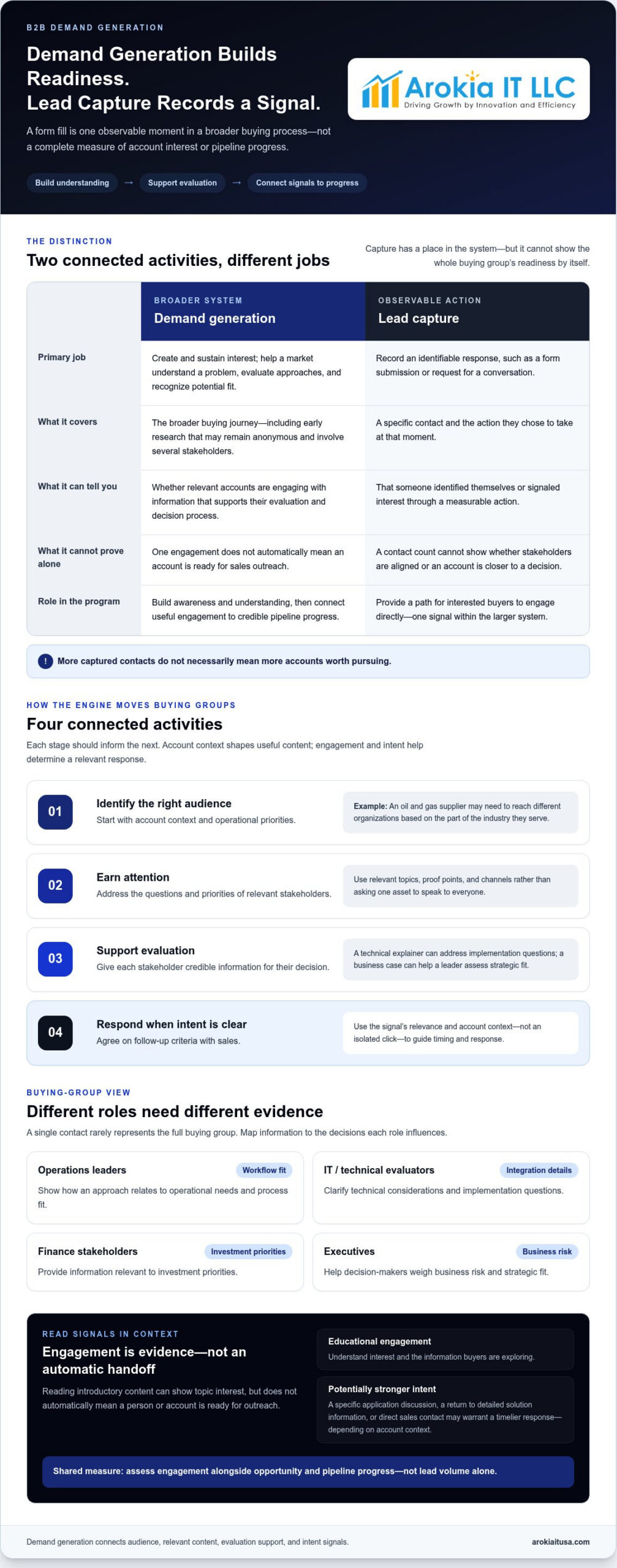
Demand generation creates and sustains interest across the B2B buying journey. It helps a market understand a problem, evaluate possible approaches, and recognize why a solution may fit before a prospect is ready to speak with sales. Lead capture has a role, but a form submission is only one observable moment in a broader process.
That distinction matters because a single contact rarely represents an entire buying group. A manufacturer evaluating production software, for example, may involve operations leaders assessing workflow fit, IT reviewing integration needs, finance examining investment priorities, and executives weighing business risk. Each person may research at a different time and seek different evidence. A contact count alone cannot show whether stakeholders are aligned or whether an account is closer to a decision.
Market demand is the interest and intent developing across potential buyers; captured contact information is only a record of someone who chose to identify themselves. Demand creation builds awareness and understanding among people who may not be ready to act. Demand capture responds to existing interest, making relevant information or a next step available when a buyer signals intent. Lead generation identifies or captures prospects through measurable actions, such as requesting a conversation or submitting a form. Sales follow-up is the coordinated response to those signals, not a substitute for the earlier work of building understanding.
These activities connect, but they are not interchangeable. A campaign can generate contacts without creating meaningful demand, while useful education can strengthen an account’s consideration before anyone fills out a form. The What is Demand Generation? overview provides a foundation for the term. In practice, teams need to connect demand generation to how target accounts learn, evaluate, and engage. A B2B demand generation program should treat capture as one signal within a larger system, not the final measure of whether marketing is working.
How is demand generation different from lead generation?
Demand generation builds awareness, understanding, and preference across a market. Lead generation identifies or captures prospects who take measurable actions. The practical difference is what each activity is meant to establish: broader readiness and relevance versus an identifiable response. Lead capture supports demand generation by creating a path for interested buyers to engage directly, but it cannot show the full market impact on its own.
Why does demand generation matter in complex B2B sales?
In manufacturing, medical equipment, and software sales, stakeholders can judge a solution by different criteria. An operations team may focus on process fit, technical evaluators need implementation details, and decision-makers need a clear business case. Useful education lets each group assess relevant questions before a direct sales conversation. That groundwork matters even when early research remains anonymous and produces no immediate form fill.
For lean marketing teams, the operational takeaway is to plan for both visible and less-visible progress. Track captured contacts, but also ask whether the right accounts are engaging with material that addresses their evaluation needs and whether sales can act on the resulting context. That gives leadership a more useful view of demand than a volume report alone.
How a B2B Demand Generation Engine Moves Buying Groups
A demand generation engine connects four activities: identify the right audience, earn its attention, support evaluation, and respond when intent becomes clear. Each stage should inform the next. If target accounts are selected without understanding their operational priorities, even strong content can miss the questions that shape a purchase. If engagement appears but no one defines a useful follow-up, sales may act too early or miss the moment altogether.
Start with account context. An oil and gas supplier, for example, may need to reach different organizations based on the part of the industry they serve, while addressing technical, operational, and executive concerns within each account. That context shapes the topics, proof points, and channels. A technical explainer may address implementation questions; a business case may help a leader assess strategic fit. The objective is not to make every asset speak to everyone. It’s to give each relevant stakeholder a credible next step.
How do you map content to B2B buying-group needs?
Buying groups vary, but common roles can include technical evaluators, users, operations leaders, finance stakeholders, and executives. Map content to the decisions those roles influence: explain the problem, compare approaches, clarify implementation considerations, and support the business case. Sales enablement content can equip sales with relevant material for conversations after an account shows meaningful interest, rather than sending every stakeholder the same generic asset.
Separate educational engagement from a buying signal. Reading an introductory article can indicate interest in a topic, but it doesn’t automatically mean a person or account is ready for outreach. A request to discuss a specific application, a return to detailed solution information, or direct sales contact may warrant a more timely response, depending on the account and context. Set shared follow-up criteria with sales so the response reflects both the signal and its relevance, not an isolated click.
How do channels work together in demand generation?
Content gives buyers useful information; search helps them discover it; LinkedIn can distribute it to professional audiences; email can continue engagement with known contacts; and sales outreach adds a personal response when context supports one. Not every program needs every channel. Choose based on how the audience accesses information and what the account needs next, then use B2B lead nurturing to maintain relevant engagement over time.
Channel coordination depends on a feedback loop, not just a publishing calendar. Sales can report which questions surface in conversations, where prospects hesitate, and what evidence helps move evaluation forward. Marketing can use that input to refine account selection, adjust topics, and improve distribution. Review current B2B demand generation trends as one input, then prioritize what fits your buyers and sales process. That discipline keeps b2b demand gen tied to account needs instead of channel activity for its own sake.
Arokia IT’s demand generation services bring account selection, buyer content, and sales follow-up into a coordinated B2B marketing program.
Measure B2B Demand Gen by Account Progress and Pipeline Evidence
Measurement should connect marketing activity to account movement, not treat every click as evidence of a likely sale. Reach and engagement show whether a program is getting attention. Sales acceptance, qualified opportunities, and pipeline movement show whether that activity is aligning with commercial progress. Neither category tells the whole story alone.
Lead volume alone is insufficient evidence of pipeline contribution because it counts captured contacts, not whether relevant accounts are progressing toward a buying decision. For b2b demand gen, pair early indicators with opportunity evidence and interpret the relationship over time. Attribution can help show which interactions occurred along the way, but it is directional evidence, not automatic proof that one campaign caused a sale.
| Metric | What it can answer | What it cannot establish alone |
|---|---|---|
| Reach in target accounts | Are intended organizations seeing the message? | Whether buying-group members understand or prefer the solution. |
| Relevant engagement | Are people interacting with material tied to their needs? | Whether the account has purchase intent or is ready for sales. |
| Sales acceptance | Does sales consider the account or contact appropriate for follow-up? | Whether the opportunity will advance or close. |
| Opportunity and pipeline movement | Are qualified opportunities entering or advancing through agreed stages? | Which single campaign caused the movement. |
Which demand generation metrics show meaningful progress?
Leading indicators include engagement from relevant accounts and participation by more than one buying-group role, when that data is available. Lagging outcomes include qualified opportunities, pipeline progression, and revenue. Track sales acceptance if your teams define and record it. Use your own baseline and sales-cycle context to interpret change; a universal benchmark or borrowed target may misrepresent your business.
A useful review separates three questions: Did the program reach the intended accounts? Did engagement develop into a sales-accepted conversation or qualified opportunity? Did existing opportunities move forward? This sequence helps teams identify where the system is working and where it needs adjustment, without treating every metric as a direct proxy for revenue.
How should sales and marketing interpret engagement signals?
Before campaigns launch, agree on what counts as meaningful activity, what warrants follow-up, who owns that response, and how quickly the handoff should occur. Review patterns across relevant interactions rather than treating one click as buying intent. Sales feedback on account fit, timing, and unanswered questions adds context that digital activity alone cannot provide.
Use a recurring joint review to examine account engagement alongside opportunity stage and agreed follow-up. For each priority account, record the evidence, the sales team’s assessment, the next action, and any unresolved buyer concern. If engagement rises but opportunities do not advance, investigate message relevance, stakeholder coverage, or handoff quality before simply increasing campaign volume.
Keep attribution appropriately modest. A campaign touch associated with an opportunity may help explain how an account encountered the business, but it cannot isolate the campaign as the cause of a complex decision. Arokia IT provides a 90-day pipeline forecast to support planning conversations by bringing account and pipeline signals into a defined outlook. The forecast is a planning tool, not a guarantee of pipeline or revenue.
Build a Practical B2B Demand Gen Program in Four Steps
A focused b2b demand gen program doesn’t require a large campaign calendar. It requires a clear market choice, an agreed sales handoff, useful buyer education, and a regular decision about what the evidence supports. Start with a scope your team can execute and learn from, then expand only when the process is working.
- Define the target market. Choose a priority segment based on fit, business relevance, and sales insight. Specify the organizations you want to reach, the problem they need to solve, and the buying-group needs the program will address. A clear boundary helps prevent limited resources from being spread across unrelated audiences.
- Align sales and marketing. Agree on account fit, what counts as a meaningful response, who owns follow-up, and how feedback returns to marketing. Set responsibilities before launch so a signal doesn’t sit unattended or trigger outreach without useful context.
- Develop useful content. Build a small set of assets around buyer questions, such as understanding a problem, comparing approaches, planning implementation, or assessing business value. Select channels the audience uses and the team can maintain. A coordinated B2B demand generation program connects that content with distribution and appropriate sales follow-up.
- Review pipeline evidence. Assess account engagement, sales response, opportunity creation, and movement through the pipeline against the program’s purpose. Decide whether to continue, adjust, or stop an activity based on what the evidence shows. If the right accounts engage but don’t advance, revisit the message or handoff before adding more channels.
How should a smaller B2B team set its initial priorities?
Start with one defined market segment, a short list of buyer problems, and direct sales input. Choose a few content themes that answer those needs instead of filling a broad calendar with disconnected campaigns. Assign an owner for execution, a sales contact for follow-up, and a shared review point. This makes workload visible and keeps learning tied to action.
How can ABM support focused demand generation?
Account-based targeting is useful when a complex or high-value opportunity calls for focused engagement across specific organizations and stakeholders. Select accounts using clear fit criteria, then tailor relevant messages and proof to their business context. ABM can sharpen a broader market-building program, not replace it. A deliberate account-based marketing strategy helps teams prioritize where coordinated attention is most appropriate.
Keep the operating test simple: can the team reach the chosen audience, deliver relevant information, and respond to meaningful interest without exceeding its capacity? If not, narrow the scope. If the process produces useful engagement and credible pipeline evidence, build on what you’ve learned.
Turn B2B Demand Gen Into a More Predictable Pipeline Practice
A more disciplined demand-generation practice connects three operating decisions: build relevant engagement with priority accounts, align sales follow-up to useful signals, and assess whether account activity corresponds with opportunity and pipeline progress. The goal isn’t to promise a predictable result. It’s to give leadership a clearer basis for planning, adjusting investment, and identifying where the path from interest to opportunity needs attention.
This approach can fit B2B teams selling complex solutions to defined organizations and buying groups. A manufacturer may need to engage technical evaluators and operations leaders; a medical equipment company may need to address distinct product and business considerations; a software provider may need to support both users and decision-makers. For oil and gas companies serving customers across Oklahoma, Louisiana, Arkansas, New Mexico, Texas, and Northern Mexico, account context can help keep outreach relevant to the organizations and roles that matter.
When is an account-focused demand approach a fit?
Account focus is useful when a company can identify priority organizations and needs to coordinate engagement across several stakeholders. It helps concentrate effort where account fit and buying complexity justify tailored attention, while broader demand activity continues to build market awareness. An account-based marketing approach can sharpen that prioritization without treating every target account as if it has the same needs or readiness.
What should executives prepare before discussing a program?
Bring a clear view of priority markets, sales-cycle challenges, and the pipeline questions leadership needs answered. Existing campaign activity, sales feedback, and account or opportunity context can help ground the discussion in current conditions rather than assumptions. It’s also useful to identify where teams disagree, such as what qualifies an account for follow-up or which buyer questions remain unanswered.
Arokia IT provides B2B marketing services, including Account-Based Marketing, demand generation, and sales enablement content. These services connect account selection, buyer engagement, and the material sales teams use in conversations. Arokia IT’s 90-day pipeline forecast supports planning and measurement by helping frame near-term pipeline visibility. It does not promise a specific amount of pipeline or revenue.
Before expanding activity, define what the team wants to learn and how it will use the evidence. Which accounts are engaging? Where are opportunities progressing or stalling? What should marketing adjust, and what follow-up should sales own? Clear answers help a team refine its approach while keeping expectations grounded in observed pipeline information.
For executives, the first conversation can stay practical: identify the market, surface the sales handoff challenges, and clarify the pipeline questions the program should help address. That gives both teams a focused starting point and a stronger basis for deciding what to build next.
Make the Next Marketing Decision More Deliberate
The next step isn’t to add another campaign. Choose one decision your team needs to make with greater confidence, such as which accounts deserve focused attention or what evidence should prompt sales follow-up. Then identify the information needed to make that decision and build a review around it. This gives b2b demand gen a clear operating purpose: improve the quality of decisions as market and pipeline evidence accumulates.
That discipline creates room to learn without overcommitting. Start with a practical question, agree on who will act on the answer, and use what you learn to shape the next investment. Progress comes from making each marketing decision more accountable to the business, not from adding activity for its own sake.
A focused next move can turn uncertainty into a clearer path forward.
Frequently Asked Questions
Is B2B demand generation the same as lead generation?
No. They serve different roles in the same growth system: demand generation is the broader program, while lead generation is one way to identify people who respond. For practical reporting, distinguish a new contact from a sales-accepted prospect and from an opportunity tied to an account. That separation helps teams spot whether a lead source is attracting relevant buyers or merely increasing database size.
Can demand generation work for a small B2B company?
How long does B2B demand generation take to influence pipeline?
There’s no fixed timeline because sales cycles and buyer readiness vary. Instead of setting an arbitrary deadline, compare groups of accounts that entered the program at different times and observe how engagement and opportunity status change. For a long-cycle industrial sale, early signs may inform campaign adjustments before a revenue outcome is visible. Keep the review window consistent with your sales process and document assumptions.
What channels are used in B2B demand generation?
Programs may use search, content, email, LinkedIn, paid media, and sales outreach, but a team doesn’t need to activate every channel. Choose a practical mix based on where target buyers seek information and what the team can execute well. A useful test is whether each selected channel has a clear job, such as discovery, follow-up, or direct conversation, rather than being included simply because it’s popular.
How do you measure B2B demand generation when buyers interact across channels?
Build a consistent record of campaign names, source details, account activity, and sales interactions so reports can be interpreted across channels. Use the same naming rules for email, paid campaigns, and content distribution, and capture important offline conversations in the CRM when possible. This creates a more useful interaction history for review. Treat the history as context for decisions, not proof that a specific touch caused a sale.
What is the difference between demand creation and demand capture?
Demand creation helps buyers recognize a need or understand a possible solution; demand capture responds when a buyer is actively looking for information or a next step. The distinction can guide the call to action: an unfamiliar audience may need an educational resource, while someone comparing solutions may value a product overview or conversation. Matching the ask to buyer readiness helps avoid pushing for a sales meeting too early.