
ABM should help a small team focus, not saddle it with an enterprise-sized process. For account-based marketing for small B2B companies, the starting point isn’t a sophisticated data stack. It’s a well-chosen account list and a clear plan for how marketing and sales will work together.
If your team is lean, account data is incomplete, or personalized outreach feels like a time sink, those concerns are valid. A workable ABM program doesn’t require a custom campaign for every prospect or a new platform before you begin. It requires a disciplined way to prioritize accounts, use information you already have, and coordinate relevant interactions around real buying needs.
This guide explains how to select target accounts, set practical sales and marketing responsibilities, and create outreach you can repeat without making it generic. It also covers how to measure progress through account engagement, opportunity movement, and pipeline contribution, rather than counting emails or other activity alone. The goal is a focused program your team can sustain and improve as it learns.
Key Takeaways
- Start with a focused account list based on fit and business priorities, not the size of your database.
- Account-based marketing for small B2B companies can work without enterprise technology when account information, ownership, and follow-up are clear.
- Map the people involved in each buying decision so marketing and sales can coordinate relevant outreach.
- Measure account engagement, sales conversations, opportunity movement, and pipeline, not activity counts alone.
- Use sales enablement content and pipeline forecasting to connect coordinated account work with revenue visibility.
Why Account-Based Marketing Can Fit a Small B2B Company
Account-based marketing (ABM) is a strategy in which marketing and sales coordinate around a deliberately selected set of business accounts. Instead of treating every inquiry as a separate opportunity, the team considers the company, its needs, and the people involved in evaluating a purchase. That shared view helps a lean team focus limited time on organizations that fit its offer, rather than spreading effort across a broad audience without clear priorities.
ABM isn’t defined by a large technology stack or a custom campaign for every prospect. It depends on deliberate account selection and relevant, coordinated engagement. A company can pair broader demand generation with targeted account work: demand generation builds awareness across a market, while ABM concentrates additional attention on accounts that align with business priorities. Arokia IT’s B2B account-based marketing approach centers on this account-level focus. For a foundational overview of the discipline, see What is Account-Based Marketing?
How ABM differs from lead-based marketing
Lead-based marketing often measures and follows up with people one at a time. ABM connects those people to the organization they represent. A plant manager, procurement lead, and operations executive at one manufacturer may each influence the same purchase, but their priorities differ. Account-level planning helps sales and marketing recognize the shared opportunity, coordinate follow-up, and provide information relevant to each stakeholder’s role.
The point isn’t personalization for its own sake. It’s consistency: each interaction should make sense in the context of the account’s business needs. A useful message to one stakeholder shouldn’t conflict with what another person at the same company receives.
When a small B2B company should consider ABM
ABM may suit a company serving a defined market, selling a specialized solution, or navigating a considered buying process with several stakeholders. For example, a medical equipment supplier or software company may know which organizations need its solution, even without a mature data platform. A clear ideal customer profile (ICP) turns that knowledge into practical account-selection criteria.
Start with a clear offer and a defensible reason each account belongs on the list. Consider whether the organization has problems your offer addresses, whether relevant decision-makers are identifiable, and whether your team can follow through. A smaller, deliberate account set is useful only if the team can serve it consistently. If fit is unclear or the offer is difficult to explain, refine those fundamentals before adding more accounts.
For account-based marketing for small B2B companies, the advantage is operational focus, not exclusivity. Keep broader marketing active where it supports market awareness and lead flow; add account-level coordination where precision matters. A manufacturer in Texas or Oklahoma, for example, may continue building awareness across its market while giving a selected group of high-fit accounts more tailored attention. That balance lets a small team test assumptions, learn which accounts progress, and adjust priorities without turning every marketing activity into a custom campaign.
How to Build a Small-Company ABM Program from the Ground Up
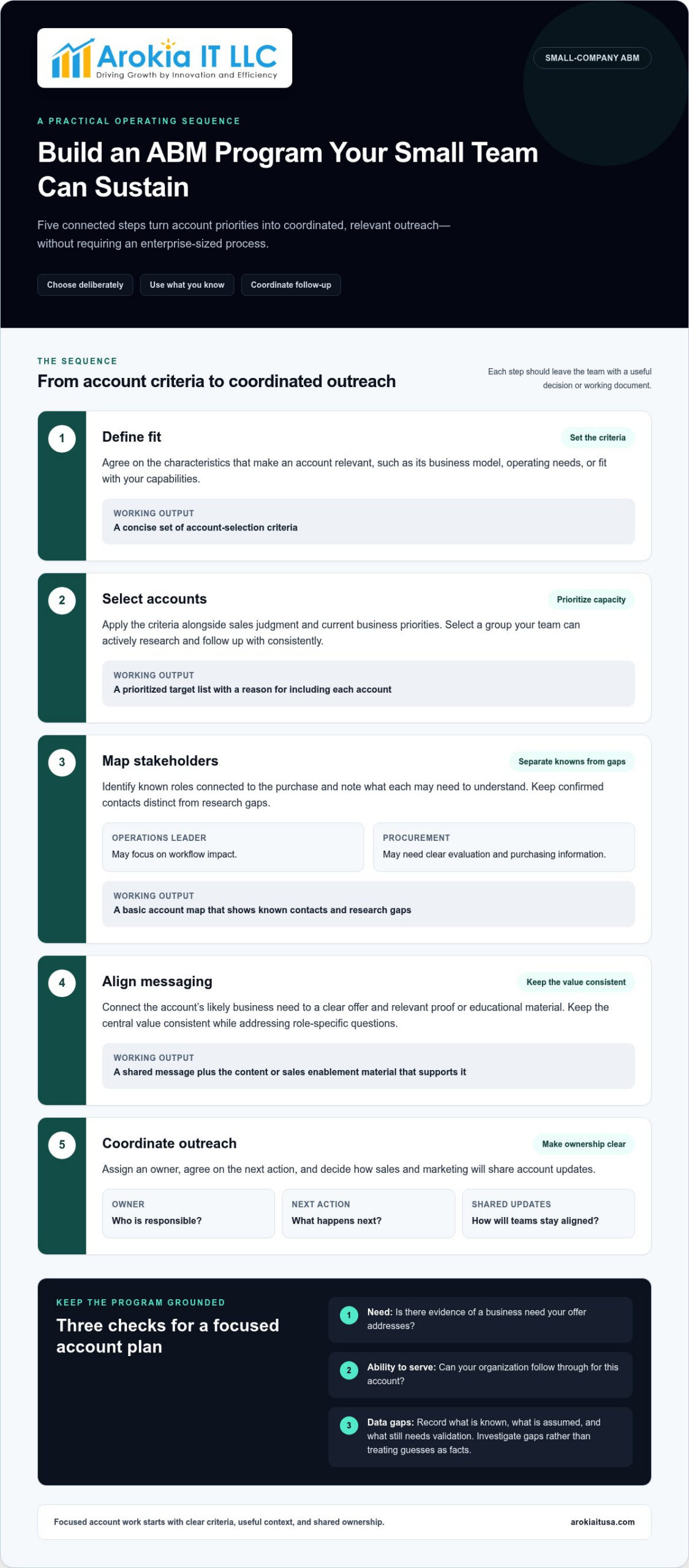
A small-company ABM program needs a repeatable operating sequence, not a complicated campaign calendar. Start with a manageable group of accounts your team can research and follow up with consistently. Each step should produce a decision or working document that makes the next step easier. The American Marketing Association’s guide to ABM benefits and implementation offers broader context; the process below focuses on putting the approach into practice with limited capacity.
Set account criteria before building a target list
Translate your ideal customer profile into observable account-level criteria. Consider strategic fit, evidence of a business need your offer addresses, and your organization’s ability to serve the account. Sales input can surface useful context that a database won’t show. If information is incomplete, record what’s known, what’s assumed, and what needs validation. A gap in the data is a reason to investigate, not to treat a guess as fact.
- Define fit. Agree on the characteristics that make an account relevant, such as its business model, operating needs, or fit with your capabilities. Output: a concise set of account-selection criteria.
- Select accounts. Use those criteria alongside sales judgment and current business priorities. Choose a group the team can actively work, rather than adding accounts simply because their records are available. Output: a prioritized target list with a reason for including each account.
- Map stakeholders. Identify known roles connected to the purchase and note what each may need to understand. For example, an operations leader may focus on workflow impact, while procurement may need clear information about evaluation and purchasing. Output: a basic account map that distinguishes confirmed contacts from research gaps.
- Align messaging. Connect the account’s likely business need to a clear offer and relevant proof or educational material. Keep the central value consistent while addressing role-specific questions. Output: a shared message and the content or sales enablement material that supports it.
- Coordinate outreach. Assign an owner, agree on the next action, and decide how sales and marketing will share account updates. Pair marketing touchpoints with sales follow-up when the context makes that follow-up useful. Output: an account plan with owners, actions, and a simple update method.
- Review and adjust. Check whether accounts are responding, conversations are developing, or new information changes the fit assessment. Use the review to refine account priorities and actions, not simply to report completed tasks. Output: a documented decision to continue, change approach, or remove an account.
Map stakeholders and coordinate the first account plan
Keep coordination lightweight: a shared account record or planning document can capture ownership, stakeholder roles, messaging, next steps, and open questions. The goal is a coherent experience, not identical outreach from both teams. ABM also works alongside broader demand generation, which can build awareness beyond named accounts; see how demand generation supports B2B growth as part of that wider mix. A practical account-based marketing program should be easy to review and repeat. Arokia IT provides ABM and demand generation strategies for B2B teams. To discuss your priorities, connect with Arokia IT.
How Small Teams Can Keep ABM Focused Without an Enterprise Tech Stack
Account-based marketing doesn’t require a large platform stack to get started. It requires usable account information, clear ownership, relevant messaging, and dependable follow-up. Tools can help organize and automate parts of the work, but they can’t decide which accounts matter or supply sales context your team hasn’t captured.
Begin with systems your team already uses, such as a CRM or a shared account-planning document. Agree on what counts as a target account, who owns each relationship, where updates belong, and how the team records the next step. Consistent information is more valuable than a complex setup no one maintains.
Use the data and systems the team can maintain
Review the account information you already have and identify gaps that could change a decision. If you don’t know whether an organization fits your service model, note the uncertainty and assign someone to resolve it. Don’t buy more data or software until you can name the specific question it needs to answer. A platform can organize records, but it can’t replace a salesperson’s account knowledge or establish clear ownership.
Personalize around account needs, not superficial details
Useful personalization reflects an account’s business context: the problem your offer addresses, evidence that supports your approach, and a relevant next step. A shared core message can be adapted to stakeholder questions without creating a separate campaign for every person. Strategic account engagement should make outreach more relevant, not simply add custom details. Arokia IT’s account-based marketing services coordinate this work around selected B2B accounts.
Manual coordination and additional technology each have tradeoffs. Choose based on the work your team needs to manage, not on the assumption that more tools automatically mean better ABM.
- Lean process, advantages: It can use familiar systems, keep setup simple, and make ownership and decisions visible. The team can learn what information and coordination it needs before automating.
- Lean process, limitations: Updates may take more hands-on effort, and disconnected records can make it harder to see activity across accounts as the program grows.
- Tool-heavy setup, advantages: Additional systems may help centralize account information or automate repeatable tasks when manual work becomes a clear bottleneck.
- Tool-heavy setup, limitations: More technology can add setup, maintenance, and process demands. Without agreed account criteria and ownership, it may make existing confusion harder to manage.
A practical trigger for adding automation is a recurring task that consumes meaningful team time, follows a stable process, and can be measured. If the process changes from account to account, clarify the workflow first. For a small B2B company, disciplined use of existing information is often a stronger starting point than buying a platform before the team has defined how it will work.
How to Coordinate ABM Outreach and Measure Account Progress
Coordinated ABM outreach connects marketing content with sales follow-up under one account plan. A useful article or email can introduce a relevant business issue; a salesperson can follow up with a conversation that responds to the account’s interests, rather than sending an unrelated pitch. For small B2B companies, progress means moving an account toward a meaningful business conversation, not simply completing outreach tasks.
Coordinate channels around a shared account plan
Use email, LinkedIn, sales conversations, and content to support a coherent sequence. A marketing owner might share a relevant resource, while the sales owner follows up when there’s a clear reason to engage. Record the purpose of each touchpoint, the person responsible, and the next step in a shared account record. This helps prevent disconnected messages or an interested contact being left without follow-up.
Not every account needs activity across every channel. Choose channels your team can manage and that fit the account’s preferences and context. Broader demand generation can continue to build awareness across the market, while account-focused outreach gives selected organizations more coordinated attention.
Review leading indicators and pipeline outcomes
Separate what the team did from how accounts responded and what changed commercially. Activity measures help confirm execution, but they don’t prove that an account is progressing. Account-level progress is more informative than isolated campaign activity because it shows whether relevant people at the same organization are engaging, talking with sales, and advancing toward an opportunity.
Use your company’s own definitions for engagement, qualified sales conversations, opportunity stages, and pipeline contribution. Review the same measures consistently, and interpret them against the program’s objective and available evidence. Don’t adopt an outside benchmark without checking whether its audience, sales process, and measurement rules match yours. Arokia IT’s 90-day pipeline forecasting can help connect current account movement to near-term pipeline visibility; a forecast is a planning tool, not a guaranteed result.
Activity: Emails sent, meetings requested, or content shared. These indicate execution, not account interest.
Engagement: Relevant stakeholders respond, consume useful content, or participate in a meaningful exchange. These signals suggest the account is paying attention, but don’t confirm purchase intent on their own.
Outcomes: Sales conversations progress, an opportunity advances according to your stage definitions, or target-account pipeline changes. These measures connect the program to commercial progress.
At each review, ask which accounts changed stage, what evidence supports that assessment, and what action follows. If activity is high but engagement is absent, revisit relevance or timing. If conversations are active but opportunities aren’t advancing, clarify what information or decision is holding them back. This turns measurement into a management tool, not just a report of activity.
How Arokia IT LLC Can Help Small B2B Teams Put ABM into Practice
A small ABM effort needs clear decisions as well as coordinated execution. Teams may agree that certain accounts matter but still struggle to turn that priority into day-to-day responsibilities, relevant communication, and a manageable review process. Arokia IT develops targeted ABM and demand generation strategies for B2B teams, helping connect account priorities with coordinated marketing and sales activity.
The work can begin with the issue creating the most friction: account selection, internal handoffs, or outreach that feels too generic to be useful. From there, the team can define what a practical first effort should address and how marketing and sales will work together. Arokia IT also provides sales enablement content and 90-day pipeline forecasting to support account engagement and pipeline visibility. The focus is on an approach grounded in your organization’s resources and priorities.
Where strategic support can reduce execution friction
Strategic support helps teams examine how target-account assumptions connect to the sales process. For example, the team can clarify which account characteristics matter, who should contribute sales context, and how to handle an account when new information changes its priority. Arokia IT’s account-based marketing services structure this work around B2B objectives.
An outside perspective can also help identify unnecessary complexity. If a proposed process depends on frequent custom campaigns or updates no one has time to maintain, simplify its scope before execution begins. The result should be clearer responsibilities and decision points, not a promise of specific pipeline or revenue outcomes.
Choose a practical next step for your team
Before expanding ABM activity, name one challenge the team wants to address. It could be uncertainty about which accounts deserve attention, confusion over who follows up, or difficulty keeping outreach consistent with the sales conversation. Bring that challenge into a discussion alongside business goals, available team capacity, and the way sales currently manages opportunities. A defined starting point makes it easier to assess whether the proposed work is practical.
A focused plan should make the next decision clearer for both teams. Start with the issue that matters most, then determine what a manageable response looks like for your organization.
Make Your Next ABM Move Deliberate
The next step isn’t to add more outreach. It’s to decide what your team needs to learn before expanding the program. Choose one account challenge, such as unclear ownership or limited visibility into buying progress, and make it the focus of your next planning conversation.
A disciplined approach to account-based marketing for small B2B companies can evolve as your team gathers evidence. Set a clear objective, agree on what would indicate progress, and use the findings to guide the next decision. That keeps the program connected to business priorities instead of allowing activity to grow without direction.
If you’re ready to shape an account-based marketing approach around your goals and team capacity, contact Arokia IT to discuss your ABM priorities.
Frequently Asked Questions
What is account-based marketing for small B2B companies?
Account-based marketing for small B2B companies coordinates marketing and sales around selected organizations that fit the business, rather than treating every contact as a separate prospect. For example, an industrial supplier serving oil and gas operators in Texas and Oklahoma might focus on companies with relevant operating needs and engage the roles involved in evaluating a purchase. The approach works best when account selection reflects actual sales priorities.
Can a small B2B company do ABM without specialized software?
Yes. A small B2B company can begin with its existing CRM, a shared spreadsheet, or another system the team already maintains. The important test is whether sales and marketing can find the current account owner, relevant contacts, latest interaction, and next action. If those details are hard to keep accurate, adding software may not solve the underlying process issue. First define what information the team needs to make decisions.
How many target accounts should a small company choose for ABM?
There’s no universal account count. Choose only as many organizations as the team can research, engage, and review without neglecting regular sales responsibilities. Estimate the time needed to understand each account, identify relevant stakeholders, and follow up meaningfully. Then compare that workload with available staff time. A focused pilot can show whether the selection criteria and workflow are manageable before the team expands to more accounts.
Is ABM only for enterprise companies with large marketing budgets?
No. ABM can suit a smaller company if it has a clear offer, a defined customer profile, and a reason to prioritize specific organizations. A regional medical equipment manufacturer, for instance, might focus on healthcare organizations whose needs align with its products, rather than trying to reach every potential buyer. The essential investment is coordinated attention from the team. The program’s scope should match its capacity and business goals.
How is ABM different from demand generation?
ABM concentrates coordinated marketing and sales effort on selected organizations; demand generation builds awareness and interest across a broader market. They can work together. A software company serving manufacturers might use educational content to reach a wider industry audience while developing more tailored engagement for priority accounts. Demand generation supports broader market reach, while ABM directs additional attention toward accounts that meet defined business criteria.
What should a small business measure in an ABM program?
Measure whether selected accounts are progressing, not just how many messages the team sends. Track meaningful responses from relevant stakeholders, sales conversations, changes in opportunity stage, and pipeline contribution using definitions your company understands. For example, a manufacturer could review whether outreach leads to a technical discussion with an appropriate buying role. Compare those signals with program effort, and don’t treat one interaction as proof of purchase intent.
How can sales and marketing stay aligned in a small ABM program?
Agree on a shared account record and use it to capture ownership, recent interactions, open questions, and the next action. Set a regular review point that fits the team’s workload, even if it’s a brief check-in. Sales can add account context from conversations, while marketing can note content and outreach activity. This routine helps teams avoid conflicting messages and respond when an account’s priorities change.