
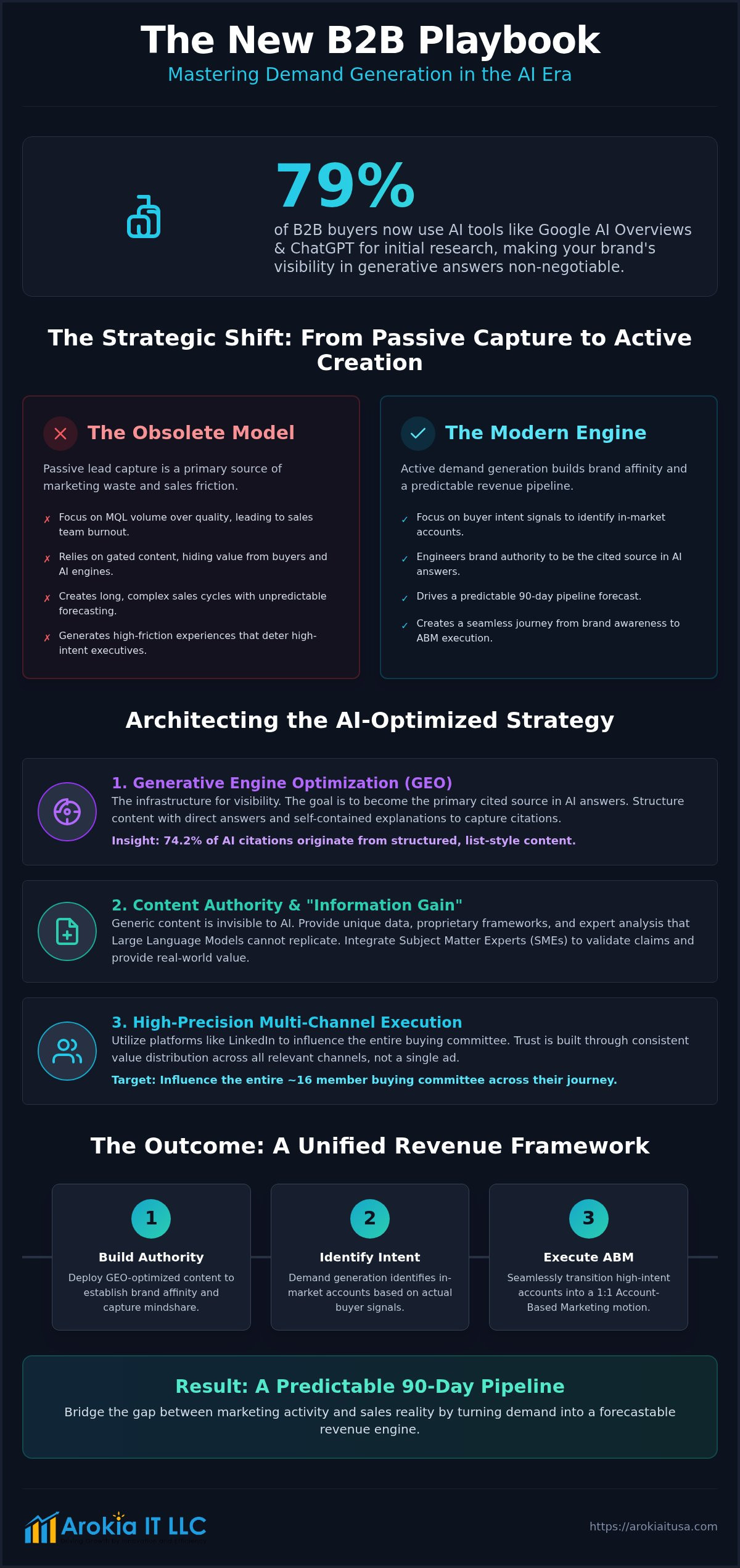
79% of global B2B buyers now use AI-driven tools like ChatGPT and Google AI Overviews to research solutions before your sales team even knows they exist. If your brand remains invisible in these generative answers, you aren’t just missing clicks; you’re forfeiting your seat at the table. Most executive leaders recognize that traditional, passive lead capture has become a primary source of marketing waste. It’s frustrating to watch expensive sales resources vanish into long, complex cycles with 16 different stakeholders while your revenue forecasting remains a guessing game.
You need a demand generation strategy b2b that functions as a precision-engineered revenue engine rather than a hope-based activity. We’ll show you how to master the transition to an active, AI-optimized model that fuels a predictable 90-day pipeline. By aligning your brand authority with the mechanics of generative search, you can finally shorten your sales cycle and secure dominant authority in AI-driven results. This article provides a methodical breakdown of how to bridge the gap between high-level brand presence and granular, account-based execution to achieve total strategic mastery.
Key Takeaways
- Shift from passive lead capture to a holistic system that builds brand affinity before the formal sales cycle begins.
- Architect a sophisticated demand generation strategy b2b that prioritizes Generative Engine Optimization to ensure your brand is the primary cited source in AI answers.
- Bridge the gap between marketing activity and sales reality by deploying a 90-day pipeline forecast based on actual buyer intent signals.
- Leverage high-precision industrial targeting on LinkedIn to influence the entire 16-member buying committee across the multi-channel journey.
- Create a unified revenue framework where demand generation identifies in-market accounts for immediate 1:1 Account-Based Marketing execution.
The Evolution of B2B Demand Generation: Creating vs. Capturing Demand
Demand generation is the strategic orchestration of brand authority and market education. It’s a holistic system designed to build deep brand affinity before a prospect ever considers a formal RFP. Many organizations fall into the lead generation trap, prioritizing the volume of contact records over the depth of buyer intent. This approach is obsolete. A sophisticated demand generation engine prioritizes intent over volume, ensuring that when a buyer finally raises their hand, they’ve already been sold on your expertise.
In 2026, the buyer journey has moved into the shadows. Executives rely on peer recommendations in dark social channels and AI-driven summaries rather than gated whitepapers that collect digital dust. If your content requires a form to access, you’re essentially hiding your value from the AI engines that 79% of global B2B buyers now use for research. The shift is absolute. Companies either adapt to the new mechanics of buyer behavior or they succumb to rising customer acquisition costs.
Why Traditional Lead Generation is Failing Your Sales Team
Marketing-qualified lead (MQL) inflation has become a silent killer of sales morale. When marketing departments focus on hitting arbitrary lead quotas, they flood the CRM with low-intent contacts. Sales teams then waste expensive resources chasing prospects who aren’t ready to buy. This friction-heavy approach drives away high-intent executive buyers who value their time. The goal isn’t to capture contact info; it’s to capture mindshare. By the time a buyer provides their details, your demand generation strategy b2b should have already established your brand as the logical choice.
The Role of Brand Affinity in High-Stakes B2B Decisions
In industrial and manufacturing sectors, the cost of a wrong decision is catastrophic. Trust isn’t built through a single ad; it’s engineered through consistent value distribution. Moving from a “vendor” to an “authority” requires a relentless focus on solving problems before a transaction occurs. This level of strategic alignment ensures that your brand remains the cited source in AI-generated answers and the first name mentioned in the boardroom. For organizations looking to scale this authority, Arokia IT LLC’s perspective on ABM offers a blueprint for integrating these demand signals into a high-precision sales motion. A robust demand generation strategy b2b eliminates marketing waste by focusing on high-stakes trust building rather than superficial lead counts.
Architecting the Strategy: Content Authority and Generative Engine Optimization (GEO)
Modern search has shifted from a keyword-matching exercise to a complex evaluation of entity-based authority. Your demand generation strategy b2b can no longer rely on vanity metrics like organic traffic volume. It must prioritize being the primary cited source within AI-generated answers. Generative Engine Optimization (GEO) isn’t an elective tactic; it’s the infrastructure required to remain visible when 79% of buyers use AI tools for research. If your brand isn’t appearing in the citations of Perplexity or Google AI Overviews, you’ve effectively ceded your market share to competitors who have engineered their content for machine extraction.
Success in this environment demands “Information Gain.” AI engines are designed to summarize existing knowledge, which means generic content is essentially invisible. To stand out, you must provide unique data, proprietary frameworks, or expert analysis that an LLM cannot simply hallucinate. This requires the deep integration of subject matter experts (SMEs). By validating strategic claims with real-world industrial experience, you create the high-fidelity signals that AI engines prioritize. If you want to see how your current digital footprint measures up, you should consult with a strategic partner to audit your authority signals.
Optimizing for AI Overviews and Generative Engines
Structure dictates visibility. Research from March 2026 indicates that 74.2% of AI citations originate from structured, listicle-style content. To capture these citations, your content must offer self-contained explanations and direct answers to complex B2B queries. Avoid burying the lead. Instead, provide a clear, authoritative summary at the beginning of each technical section to facilitate easy extraction by models like ChatGPT and Claude. Implementing strategic AI search optimization ensures your technical documentation and thought leadership become the foundational data points for AI-driven buyer research.
Developing Sales Enablement Content that Converts
Content must do more than attract; it must facilitate the close. High-stakes industrial sales cycles are often stalled by technical hurdles or stakeholder skepticism. Your demand generation strategy b2b should produce data-backed case studies that serve as a “proof of concept” long before the first discovery call. By addressing specific manufacturing or engineering constraints through content marketing for B2B growth, you provide your sales team with the ammunition needed to shorten the cycle. This isn’t about fluff. It’s about providing the clinical, objective validation that 16-member buying committees require to move forward with confidence.
The 90-Day Pipeline Forecast: Turning Demand into Predictable Revenue
Predictability is the hallmark of a mature revenue engine. Most marketing departments operate in a vacuum; they celebrate engagement metrics that never translate into a signed contract. A high-stakes demand generation strategy b2b replaces this ambiguity with a rigorous 90-day pipeline forecast. This framework acts as the critical bridge between top-of-funnel activity and actual sales reality. By focusing exclusively on high-value account clusters, you eradicate the marketing waste that typically plagues unaligned organizations. The 90-day forecast is a methodical projection of revenue based on verified account engagement.
Moving from lead capture to revenue engineering requires a shift in how you value data. It’s no longer about how many people saw an ad. It’s about how many target accounts are actively moving through the education phase of their journey. When your marketing activity is tied to a rolling 90-day window, you gain the ability to adjust tactics in real-time to meet quarterly targets. This level of strategic confidence is only possible when your data is clean, your targeting is precise, and your attribution models are focused on account-level progression rather than individual clicks. Applying proven b2b demand generation best practices to this forecasting model ensures your pipeline projections are grounded in verified intent signals rather than speculative volume.
Measuring Intent: Beyond Clicks and Downloads
Measuring intent requires looking past superficial interactions. Tracking individual clicks or PDF downloads is insufficient for complex B2B sales involving up to 16 decision-makers. You must monitor account-level behavior. When multiple stakeholders from the same industrial firm research a specific technical solution, that’s a high-fidelity signal. Validating this fit requires layering technographic and firmographic data to ensure the account has the necessary infrastructure and budget. Identifying these “hand-raisers” within the dark social landscape allows you to allocate sales resources with clinical precision, focusing only on those most likely to convert.
Aligning Sales and Marketing for Pipeline Velocity
Pipeline velocity depends on radical organizational alignment. Sales and marketing must establish a shared, uncompromising definition of a “Sales Ready Account” to prevent lead leakage and wasted effort. This isn’t a static agreement. It’s a dynamic feedback loop where sales insights from the field directly inform the next 30 days of demand content. Effective lead nurturing for high-stakes B2B ensures that accounts are systematically educated on your unique value proposition before the first negotiation starts. This discipline transforms marketing from a cost center into a predictable driver of financial growth, ensuring every dollar spent is an investment in validated pipeline.
Multi-Channel Execution: LinkedIn and High-Precision Industrial Targeting
Execution requires more than presence; it requires precision. A high-stakes demand generation strategy b2b utilizes LinkedIn as a surgical instrument to influence the entire buying committee. While many brands chase vanity metrics, industrial leaders focus on reaching the 16 stakeholders involved in complex procurement. Verified data from 2026 indicates that deals sourced from LinkedIn are 28 to 35% larger than those from traditional search. This isn’t about broad awareness. It’s about ensuring your subject matter experts’ technical insights are visible to the exact engineers and executives at your target accounts.
Total market coverage is achieved by bridging the gap between search and social. While GEO and SEO capture active intent from those researching solutions, LinkedIn proactively shapes that intent. By amplifying SME-led content through paid social, you ensure your brand is the authority before a search even begins. This multi-channel approach eliminates the silos that lead to marketing waste. It transforms your social presence from a broadcast channel into a sales enablement engine that delivers validated proof of concept to high-value account clusters.
The Industrial Marketing Pivot: Reaching Technical Stakeholders
Messaging in the industrial sector must be clinical and objective. Engineers care about technical specifications; COOs prioritize supply chain resilience; procurement officers focus on long-term ROI. Your sales enablement content must address these diverse pain points with validated data rather than marketing fluff. In sectors where the cost of failure is absolute, industrial marketing precision is the only way to secure trust. We prioritize technical validation over creative flourishes to ensure your solution survives the scrutiny of a 16-member committee.
Building a Multi-Touch LinkedIn Engine
A robust B2B social media marketing strategy combines executive thought leadership with hyper-targeted advertising. LinkedIn serves as a critical research tool to identify the specific individuals within a high-value account cluster. Once identified, these stakeholders are reached through a multi-touch sequence of technical content and case studies. This systematic distribution ensures your solution is the only logical choice when the internal conversation moves toward a formal procurement cycle. By the time your sales team reaches out, the demand has already been engineered.
Scaling Sophistication: Integrating ABM for Total Market Coverage
Sophisticated organizations don’t view demand generation and Account-Based Marketing as sequential stages. They operate within an Integrated Revenue Framework where each discipline reinforces the other. A modern demand generation strategy b2b acts as a radar system, identifying high-intent accounts through their engagement with technical content and AI-search results. Once an account crosses a specific intent threshold, the system triggers a transition into a high-precision ABM motion. This synergy ensures that your 1:1 resources are never wasted on accounts that haven’t been properly educated or validated. For a deeper analysis of this orchestration, see our guide on Integrating ABM and Demand Generation: The 2026 Strategic Revenue Framework.
The role of AI in this framework is to scale personalization without sacrificing clinical precision. AI engines allow us to analyze vast datasets of buyer behavior across the multi-channel journey, from dark social signals to generative search citations. This data allows for the creation of hyper-personalized content at scale, ensuring that every stakeholder in a 16-member buying committee receives information tailored to their specific technical or financial requirements. It’s no longer about manual outreach; it’s about algorithmic alignment with the buyer’s needs.
Transitioning from Broad Demand to Account Precision
Scaling revenue requires a tiered approach to market engagement. Your 1:Many demand activities create the broad authority necessary to be cited in AI engines and recognized in the general market. As engagement data reveals specific high-value clusters, you transition into a 1:Few model for the segment. The final stage is the 1:1 approach for the “prize” accounts, where sales and marketing align to deliver bespoke solutions. This tiered structure ensures that high-touch sales outreach is only triggered by verified engagement data, eliminating the friction of premature cold calls and preserving sales morale for the highest-value opportunities.
The Future of B2B Growth: Predictive and Personalized
The next decade of B2B competition will be defined by the alignment of AI-driven search and account-based precision. Companies that continue to rely on passive lead capture will find themselves increasingly invisible in a world where buyers consult AI agents before human vendors. Success requires a commitment to building a predictive engine that anticipates buyer needs based on their digital footprint. By integrating these insights into a unified strategy, you can transform your marketing from a speculative expense into a clinical driver of organizational growth. It is time to move beyond the lead gen trap and start engineering your revenue.
Engineering Your Revenue Infrastructure for 2026
Building a predictable revenue stream requires a fundamental shift from reactive lead capture to a proactive, technically rigorous infrastructure. We’ve explored how the integration of AI-driven revenue optimization and Generative Engine Optimization ensures your brand remains the primary authority in a landscape dominated by machine-led research. A successful demand generation strategy b2b isn’t a collection of creative tactics; it’s a disciplined alignment of content authority and account-based precision. By moving beyond the limitations of traditional MQLs, you secure a seat at the table before the first RFP is even drafted.
Deploying the 90-day pipeline forecasting and deep B2B industrial expertise of Arokia IT LLC allows you to eliminate marketing waste while shortening complex sales cycles. This transition to a data-driven model provides the clinical objectivity needed to meet aggressive growth targets with absolute confidence. It’s time to stop guessing and start measuring the tangible impact of your strategic market authority. Your organization’s future depends on the resilience of the systems you build today.
We’re ready to help you architect a revenue engine that delivers the stability and scale your executive leadership demands.
Frequently Asked Questions
What is the difference between B2B demand generation and lead generation?
Demand generation is a holistic system for building brand affinity before a prospect enters a formal cycle, whereas lead generation focuses on immediate contact capture. It prioritizes intent over volume. By the time a buyer engages, they’ve already been sold on your authority through consistent education. This approach ensures that when a hand is raised, the buyer is already pre-qualified by your content.
How long does it take to see results from a demand generation strategy?
Results from a sophisticated demand generation strategy b2b typically materialize within a 90-day window. While brand authority builds over time, the 90-day pipeline forecast allows you to measure intent signals and share of voice in AI search results early. This ensures marketing remains clinically aligned with your quarterly revenue targets. You gain the ability to adjust tactics in real-time to secure validated pipeline.
Can demand generation work for industrial and manufacturing companies?
Demand generation is vital for industrial sectors where high-stakes procurement involves 16 or more decision-makers. Arokia IT LLC specializes in translating technical engineering capabilities into authoritative content that builds committee-wide trust. This systematic approach positions your firm as a consultant rather than a vendor during procurement. By establishing trust early, you mitigate the perceived risk of high-stakes industrial failure.
What are the most important metrics for measuring demand generation success?
Focus on account-level engagement and pipeline velocity rather than superficial clicks. Track your share of voice in AI-driven answers and the frequency of brand citations within generative search results. These metrics provide a clinical view of future revenue based on the 90-day forecast. Success is defined by the elimination of marketing waste and the consistent delivery of sales-ready accounts to your team.
How does AI search optimization (GEO) fit into demand generation?
Generative Engine Optimization ensures your brand is the primary cited source in AI tools like ChatGPT or Perplexity. It’s the technical infrastructure of a modern demand generation strategy b2b. By structuring content for machine extraction, you influence the research phase of the 79% of buyers who now start their journey with generative engines. This visibility secures your authority in a zero-click environment.
How do I align my sales and marketing teams for a demand gen program?
Alignment requires a shared definition of a Sales Ready Account and a feedback loop where sales field insights inform demand content. This prevents lead leakage and eliminates marketing waste. When both teams are measured against the same pipeline forecast, silos naturally dissolve. This unified revenue framework ensures every marketing dollar spent is a direct investment in validated, high-value pipeline progression.
Why is LinkedIn essential for B2B demand generation in 2026?
LinkedIn is essential because it allows for surgical targeting of the specific stakeholders within a complex buying committee. In 2026, LinkedIn deals are 28% to 35% larger than those from traditional search. It proactively shapes intent through SME-led content before a formal search even begins. This multi-touch approach ensures your technical solution reaches the exact engineers and executives responsible for high-value procurement decisions.
What is a 90-day pipeline forecast and why do I need it?
A 90-day pipeline forecast is a methodical projection of revenue based on verified account engagement signals rather than speculative contact records. It bridges the gap between marketing activity and sales reality. You need it to allocate expensive resources to accounts with the highest probability of conversion. This framework provides the strategic confidence required for long-term organizational planning and financial growth. When evaluating external support for this process, working with a qualified b2b demand generation agency that prioritizes pipeline velocity over vanity metrics is essential to achieving these outcomes.