
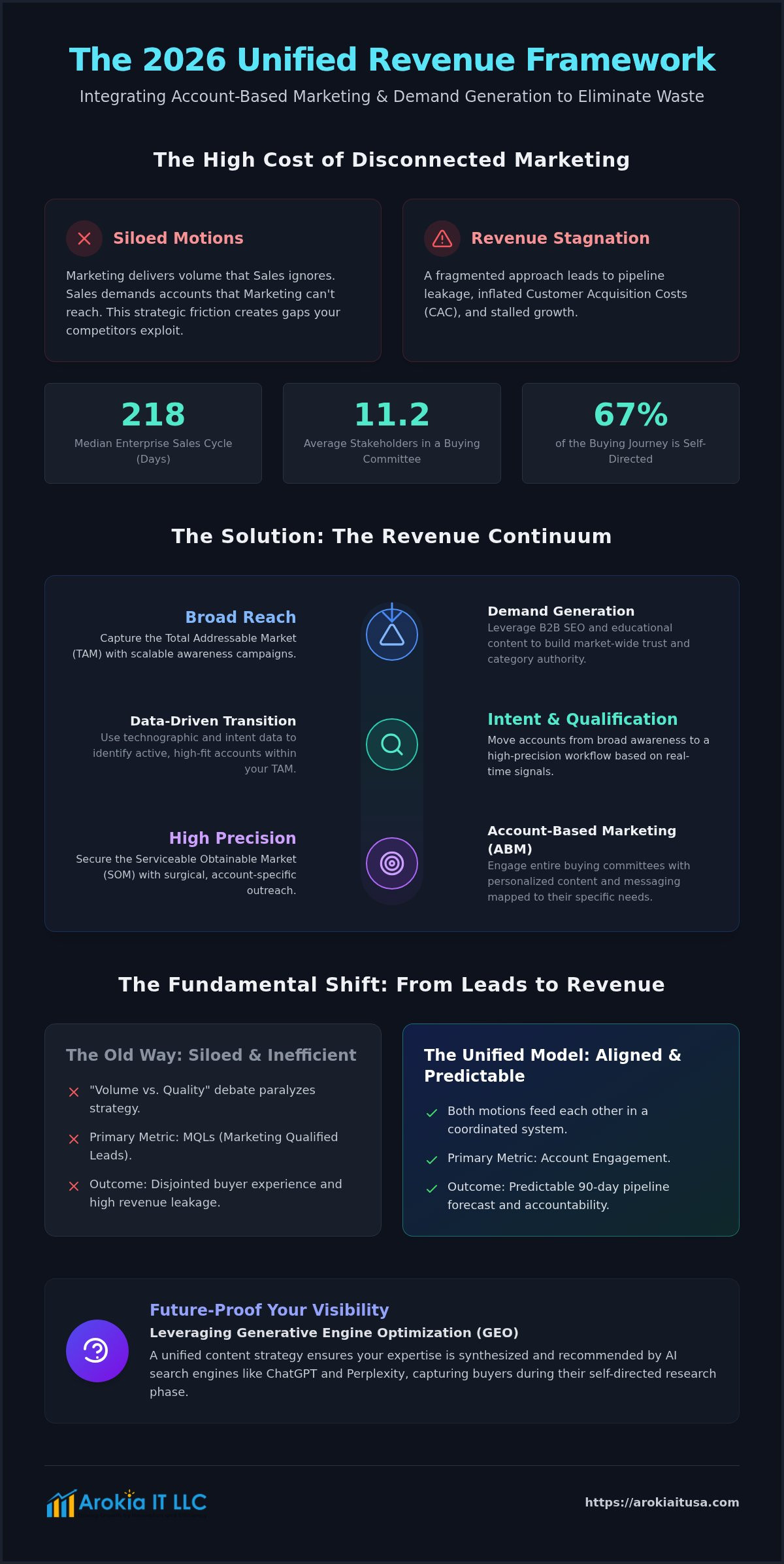
The binary choice between precision and scale is a strategic failure that’s costing your organization millions in wasted ad spend and stalled opportunities. Integrating abm and demand generation into a unified revenue framework is no longer optional for leaders facing a median enterprise sales cycle of 218 days. You’ve likely felt the friction where Marketing delivers volume that Sales ignores, or Sales demands high-value accounts that Marketing cannot reach at scale. Relying on these siloed motions creates gaps in the buyer journey that your competitors are ready to exploit.
With the average B2B buying committee now expanding to 11.2 stakeholders, a fragmented approach is a recipe for stagnation. This guide details the 2026 strategic framework for unifying high-precision targeting with scalable market reach to eliminate revenue waste. You’ll learn how to establish a predictable 90-day pipeline forecast and secure executive accountability through a synchronized approach. By the end of this analysis, you’ll have the blueprint to collapse your sales cycle and ensure every marketing dollar is a direct investment in validated revenue outcomes.
Key Takeaways
- Eliminate the strategic friction caused by siloed marketing motions. Coordinating account-level precision with broad market reach prevents the revenue waste typical of disconnected campaigns.
- Master the revenue continuum by integrating abm and demand generation to adjust your focus between high-volume awareness and high-value account capture.
- Future-proof your visibility through Generative Engine Optimization (GEO). This ensures your expertise is synthesized and recommended by AI search engines like ChatGPT and Perplexity.
- Establish a predictable 90-day pipeline forecast. By unifying data architecture and account selection, you create a transparent system for executive accountability.
- Bridge the gap between lead generation and closed revenue. Sales enablement content must be designed to help reps navigate buying committees that now average over 11 stakeholders.
The End of the ABM vs. Demand Generation Debate
The traditional wall between broad-reach awareness and high-precision targeting has become a strategic liability. Integrated revenue marketing is the strategic coordination of brand reach and account-level precision. It’s a shift away from the false choice of “volume vs. quality” toward a system where both motions feed each other. By integrating abm and demand generation, organizations stop treating high-value prospects as isolated targets and start seeing them as part of a broader, active market. This isn’t just about efficiency; it’s about survival in a landscape where buyers refuse to follow a linear path.
In 2026, the B2B buying journey is a complex network where 67% of the process is self-directed. Buyers interact with broad industry content and personalized account-based assets simultaneously. If your teams are siloed, you’re creating a disjointed experience that inflates your Customer Acquisition Cost (CAC) and leaves your pipeline vulnerable to leakage. This friction is the primary driver behind the rise of “Account-Based Demand Generation,” a model that applies the precision of Account-Based Marketing (ABM) to the scale of demand generation.
Why Siloed Marketing Fails in 2026
The Unified Revenue Engine Model
Transitioning to a unified model requires a fundamental shift in currency. High-performing organizations are moving from “leads” to “account engagement” as their primary metric of success. This isn’t just a marketing change; it’s an executive mandate. Leadership must align both departments around shared goals like pipeline velocity and average deal size. Success is no longer measured by the volume of MQLs, but by the ability to generate a predictable 90-day pipeline forecast. This alignment ensures that every dollar spent on lead nurturing or paid media is directly contributing to a validated revenue outcome. When marketing activity is mapped to revenue, the “vs.” debate ends and the growth engine begins to scale.
Mapping the Revenue Continuum: Reach vs. Precision
Strategic revenue growth isn’t a binary selection between volume and precision. It’s a spectrum. The Revenue Continuum functions like a slider, where one end captures the Total Addressable Market (TAM) through broad awareness, and the other secures the Serviceable Obtainable Market (SOM) through surgical outreach. Successfully integrating abm and demand generation requires you to adjust this dial in real-time based on account maturity. If you treat every prospect with the same level of intensity, you waste resources. If you treat them with the same level of generality, you lose the deal.
Data provides the coordinates for this slider. Technographic data identifies if an account has the necessary infrastructure to benefit from your solution. Intent data reveals when they’re actively searching for a fix. When these signals align, an account moves from the broad demand layer into a high-precision workflow. Maintaining consistent messaging across this entire spectrum is critical. You can’t speak about high-level industry trends one day and switch to granular technical specifications the next without a logical bridge. If you’re unsure where your current accounts sit on this continuum, a strategic consultation can help audit your pipeline positioning.
The Demand Generation Layer: Building the Foundation
Demand generation creates the category authority that makes ABM possible. Without it, your targeted outreach feels like a cold interruption. By leveraging B2B SEO and educational content marketing, you build a baseline of trust across the market. This layer isn’t just about traffic; it’s about identifying “In-Market” accounts within the noise. Educational assets capture early-stage intent, allowing you to see which organizations are researching specific pain points before they ever talk to a salesperson. It’s the “air cover” that ensures your brand is a known entity when the time comes for a more direct approach. To understand how to engineer this foundation into a predictable revenue system, explore our demand generation strategy b2b framework for 2026.
The ABM Layer: Accelerating High-Value Opportunities
When an account shows repeated intent signals or matches a high-value tier in your ICP, it transitions into ABM workflows. This is where precision replaces reach. You don’t just send emails; you orchestrate multi-channel execution across LinkedIn, direct mail, and executive outreach. Accounts are tiered based on revenue potential and strategic fit, ensuring that your most expensive resources are focused on the highest-probability wins. This targeted acceleration is what collapses the sales cycle. It addresses the specific concerns of the 11.2 stakeholders in the buying committee, providing the exact proof points they need to move from “considering” to “committed.” If you’re evaluating external support for this motion, understanding what separates a strategic abm marketing agency from a vendor that simply floods your CRM with unqualified leads is a critical first step.
The AI Factor: Leveraging GEO and AEO for Integration
AI search has fundamentally reconfigured the top of the B2B funnel. It’s no longer sufficient to rank on the first page of traditional search results; your brand must be the synthesized answer in a generative response. Generative Engine Optimization (GEO) is the strategic practice of ensuring AI models like ChatGPT, Claude, and Perplexity accurately scrape, summarize, and recommend your organization as the definitive solution. When integrating abm and demand generation, AI Search Optimization acts as the digital connective tissue. It ensures that your category authority is established long before a prospect ever visits your website.
The prerequisite for visibility in this new environment is “Information Gain.” AI engines prioritize content that provides unique data, proprietary insights, or original analysis that goes beyond the common training set. If your content marketing simply mirrors existing industry articles, it will be ignored by generative algorithms. By providing high-value, original perspectives, you ensure your brand is positioned as a market leader, creating a baseline of trust that accelerates every subsequent account-based motion.
GEO as the “Air Cover” for ABM
Answer Engine Optimization (AEO) is the technical execution of this authority. By utilizing specific schema and direct-answer formatting, you enable AI engines to extract your expertise with surgical precision. This is vital for shortening the research phase of the 121-day mid-market sales cycle. AEO bridges the gap between broad market demand and account-specific intent by providing immediate answers to the complex, multi-layered queries used by the 11.2 stakeholders in a typical buying committee. When you provide the clearest, most authoritative answer to a technical problem, you don’t just win the search result; you win the strategic high ground in the buyer’s mind.
Building the 90-Day Pipeline Bridge: A Step-by-Step Plan
Execution requires a disciplined roadmap. You can’t scale on intuition alone. Successfully integrating abm and demand generation is a four-step process that transforms marketing from a cost center into a predictable revenue engine. This bridge connects your broad market reach with the specific accounts most likely to close within the next quarter. It’s about moving from hope-based marketing to a system of clinical precision.
- Step 1: Unified Data Architecture: connecting your CRM, Marketing Automation Platform (MAP), and third-party intent signals into a single source of truth. Without this integration, your precision is just a guess.
- Step 2: Joint Account Selection: Marketing and Sales must sit in the same room to define the Ideal Customer Profile (ICP). Shared ownership of the target list eliminates the friction that occurs when Sales ignores Marketing’s leads.
- Step 3: Content Mapping: aligning content marketing to the 90-day journey. You must move from broad category education to account-specific technical validation as the prospect moves closer to a decision.
- Step 4: The 90-Day Pipeline Forecast: setting predictable revenue targets by using intent data and historical velocity. This allows you to identify which accounts are stalling before they become a missed quarterly goal.
Predicting Growth with 90-Day Forecasting
Stop looking at retrospective reports that only tell you why you missed last month’s numbers. Proactive pipeline modeling allows you to identify bottlenecks in real-time. Median B2B forecasting accuracy has risen to 71% in 2026, up from 54% in 2024, largely due to better intent data integration. Arokia IT LLC defines 90-day pipeline forecasting as a clinical tool for revenue accountability. It forces a transparent conversation between departments about which deals are actually in motion and which require immediate intervention.
Industrial Marketing Precision
In the industrial marketing sector, the complexity of the buying committee is your biggest hurdle. For deals over $50,000, the median buying group now includes 11.2 stakeholders. You must use sales enablement content to answer technical objections before they reach the procurement stage. Manufacturing buyers have a 121-day mid-market sales cycle; they don’t have time for fluff. They need validated data and technical specs that prove your solution fits their existing infrastructure without causing operational downtime. Organizations operating in complex sectors can benefit from understanding how digital marketing for industrial companies has evolved into a precision-engineered, account-based growth model that replaces the guesswork of traditional trade show and cold outreach strategies.
Eliminating Revenue Waste through Sales Enablement
The final mile of the revenue engine isn’t about getting attention; it’s about securing commitment. Sales enablement content functions as the critical bridge that converts high-intent accounts into closed-won revenue. By integrating abm and demand generation, you ensure that the momentum built during the discovery phase isn’t lost during the final negotiations. This stage is where most organizations fail by handing off leads instead of opportunities supported by a comprehensive library of validation assets. If your sales team is forced to create their own decks or hunt for proof points, your integrated engine has a terminal leak.
The Arokia IT LLC Approach to Revenue Mastery
Arokia IT LLC does not just manage campaigns; we engineer financial growth. Our approach to revenue mastery centers on eliminating the guesswork that plagues traditional B2B marketing. By combining our 90-day pipeline forecasting with advanced GEO strategies, we provide a level of predictability that executive leadership demands. We transition from being a mere service provider to a strategic growth partner by focusing on the mechanics of business alignment. Our framework ensures that your ABM precision and demand generation scale work in a single, unified motion. If your current marketing efforts are failing to translate into tangible pipeline, it’s time for a clinical audit of your revenue engine. When evaluating external support, understanding the criteria for selecting a b2b demand generation agency that prioritizes pipeline velocity over vanity metrics is an essential step in that process.
Mastering the 2026 Revenue Landscape
Your organization has the potential to lead your category. It’s time to build the framework that makes that leadership inevitable.
Frequently Asked Questions
What is the main difference between ABM and demand generation?
Can you use ABM and demand generation together?
Using these strategies together is the only way to eliminate revenue waste in the 2026 B2B environment. High-performing teams are integrating abm and demand generation to ensure that broad market awareness provides the necessary air cover for targeted outreach. This hybrid model allows you to capture early-stage intent through demand gen and accelerate those opportunities with ABM workflows. This coordination prevents the common failure where sales teams ignore leads due to a lack of account-level context.
How does GEO impact B2B demand generation?
Generative Engine Optimization ensures your brand is the synthesized answer when buyers use AI search engines like ChatGPT or Perplexity. This impacts demand generation by establishing your authority during the self-directed research phase. Since 67% of the buying journey is now self-directed, your brand must appear in AI-generated summaries. GEO builds the category trust necessary for your targeted ABM efforts to be perceived as credible recommendations rather than cold interruptions from an unknown vendor.
What are the best metrics for an integrated ABM and demand gen program?
Is account-based marketing a type of demand generation?
ABM is a distinct go-to-market motion, though it shares the goal of generating revenue. While demand generation focuses on building a funnel that captures broad interest, ABM is a precision-led strategy that treats individual accounts as markets of one. In an integrated framework, ABM acts as the acceleration layer for the demand generated by your broader marketing efforts. They are separate disciplines that must be synchronized to achieve strategic revenue mastery and organizational alignment.
How long does it take to see results from integrating ABM and demand gen?
How long does it take to see results from integrating ABM and demand gen?
Begin by unifying your data architecture to identify which accounts in your current demand funnel match your Ideal Customer Profile. Transition these high-intent accounts into a targeted ABM workflow rather than leaving them in a generic nurture sequence. This shift requires Sales and Marketing to agree on account selection criteria immediately. Once the data is synced, you can begin the process of integration by layering personalized outreach on top of your existing awareness campaigns. For a deeper look at building this into a precision-engineered system, our B2B demand generation strategy for predictable revenue in 2026 provides the complete operational blueprint.