
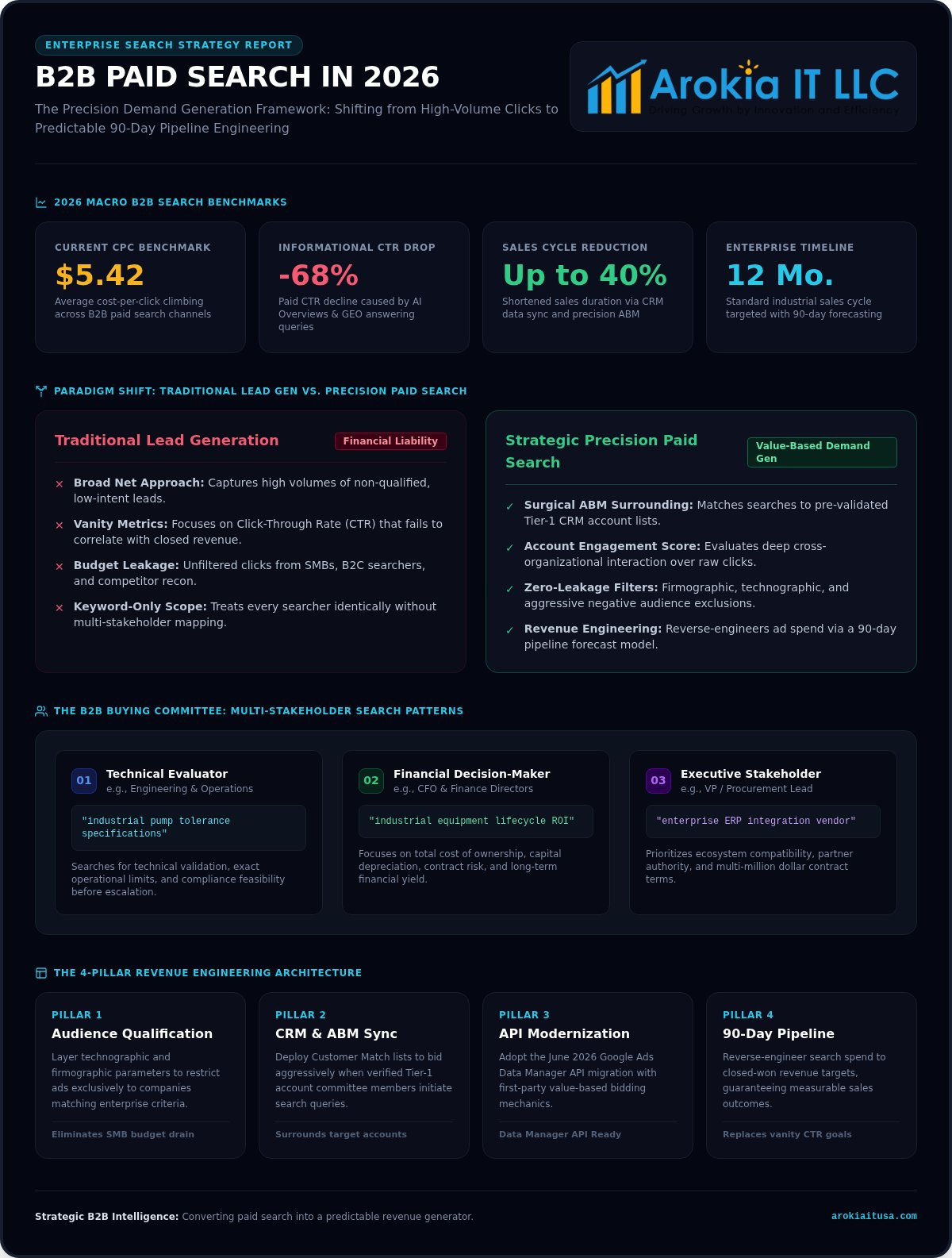
In 2026, treating paid search as a broad lead generation net is no longer a viable strategy; it’s a financial liability. You’ve likely seen your average cost-per-click climb toward the current $5.42 benchmark while the disconnect between marketing leads and sales reality continues to widen. It’s exhausting to defend ad spend when you can’t forecast its impact on the bottom line. We understand the pressure to turn every dollar of paid search marketing into a tangible, high-intent opportunity that your sales team actually wants to pursue.
This guide provides the framework to master high-precision advertising and secure a predictable 90-day B2B pipeline. You’ll learn to eliminate budget leakage by synchronizing your ad accounts with your CRM and ABM target lists. We will explore the June 2026 Google Ads Data Manager API migration, value-based bidding strategies, and the technical mechanics required to shorten sales cycles by as much as 40%. It’s time to stop chasing clicks and start engineering revenue.
Key Takeaways
- Shift from high-volume lead generation to value-based demand generation to ensure ad spend is allocated only toward high-value industrial contracts.
- Align your paid search marketing with Account-Based Marketing (ABM) strategies to surround target account decision-makers with surgical precision.
- Eliminate budget leakage by applying firmographic and technographic filters that mirror the multi-stakeholder complexity of professional sales cycles.
- Reverse-engineer your advertising budget using a 90-day pipeline forecast model that links initial search intent directly to revenue targets.
- Leverage AI-driven search and GEO optimization to maintain visibility in the 2026 landscape, bridging the gap between clicks and closed-won revenue.
Redefining Paid Search Marketing for the High-Stakes B2B Landscape
Paid search marketing in the B2B sector is no longer about winning a generic auction; it’s about securing a seat at the table during a multi-stakeholder decision process. While foundational search engine marketing focuses on broad visibility, high-stakes industrial sectors require a surgical approach to intent. You aren’t just buying a click. You’re validating a potential multi-million dollar partnership. The traditional volume-based model, which prioritizes a high quantity of low-intent leads, is a primary driver of budget waste. Success in 2026 demands a shift toward value-based demand generation, where the focus moves from capturing anyone with a keyword to engaging specific accounts that fit your Ideal Customer Profile (ICP).
The B2B Search Reality in 2026
AI Overviews and Generative Engine Optimization (GEO) have fundamentally remapped user behavior. Research indicates a 68% drop in paid click-through rates on informational queries because AI answers those questions directly on the results page. This shift forces B2B advertisers to concentrate budgets on high-intent, transactional queries. In an industrial sales cycle that often spans 12 months, your ads must do more than inform; they must establish immediate authority. Precision targeting now relies on intent-based account signals rather than broad keyword matching. If your strategy doesn’t account for the buying committee’s research patterns, you’re effectively subsidizing your competitors’ market share.
Moving Beyond the Click-Through Rate
High click-through rates often mask a deeper failure in lead quality. In the professional register of high-level corporate strategy, CTR is a vanity metric that fails to correlate with revenue. We prioritize the Account Engagement Score. This metric measures how deeply a target organization interacts with your brand across the search ecosystem. By shifting focus from the individual click to the account’s progression, marketing and sales can finally align. This data-driven approach is the foundation of a predictable 90-day pipeline forecast. It moves your team away from reactive spending and toward a model of clinical, systematic growth.
Integrating Paid Search Advertising with Account-Based Marketing (ABM)
Most organizations treat paid search as an open net. This is a strategic error. In a high-stakes B2B environment, your ABM strategy and search execution must be inseparable. You aren’t bidding on keywords to find “anyone.” You’re bidding to surround a pre-validated list of high-value accounts. By uploading Customer Match lists from your CRM, you ensure your ads appear only when stakeholders from your Tier-1 accounts are searching. This level of precision eliminates budget leakage on non-ICP traffic. It also allows you to deploy negative audience filters. These filters aggressively exclude B2C searchers and competitors, ensuring your paid search marketing remains focused on revenue-generating targets.
Surgical Targeting: Search as an ABM Accelerator
The Buying Committee Search Journey
The B2B buying committee is a complex entity. It’s rarely a single person making a choice. Harvard Business Review’s study on B2B purchasing complexity highlights that enterprise deals frequently stall due to the sheer number of stakeholders involved. Your strategy must account for this diversity in search behavior. An engineer searches for “industrial pump tolerance specifications,” while a CFO searches for “industrial equipment lifecycle ROI.” Generic ad copy fails both. Effective paid search marketing requires tailored messaging that mirrors these specific search journeys. When you pair this with LinkedIn marketing, you create a multi-channel reinforcement loop. An engineer sees your technical ad on Google; later, an executive sponsor sees a financial case study on LinkedIn. This is a coordinated strike on a target account.
Intent data gathered from these searches shouldn’t live in a silo. It’s the ultimate fuel for sales enablement. If a target account is repeatedly searching for “implementation timelines,” your sales team needs that information before their next discovery call. This intelligence allows them to transition from a generic pitch to a prescriptive solution. It shortens the sales cycle and improves win rates. If your current search efforts feel disconnected from your sales reality, it’s likely time to realign your demand generation strategy. Precision isn’t just about the ads you run. It’s about the intelligence you gather and how you use it to accelerate the pipeline.
Strategic B2B Paid Search vs. Traditional Lead Generation
Traditional lead generation is a volume game that inevitably fails in high-stakes industrial environments. It creates a “Pipeline Gap” where marketing reports success based on raw form fills while sales struggles with unqualified noise. We view paid search marketing not as a lead generator, but as a surgical filter for high-value contracts. This requires a shift from measuring cost-per-lead to analyzing the cost-per-acquisition in the context of lifetime account value. In industrial marketing, a single contract can be worth seven or eight figures. Applying a B2C mindset to CPA is a recipe for strategic failure. We focus on the relationship between initial ad investment and the long-term revenue potential of the account, allowing for higher upfront costs on the right keywords provided they lead to stakeholders within your total addressable market.
The Pitfalls of High-Volume, Low-Intent Search
Broad keywords often act as a magnet for students, researchers, or B2C consumers. These “junk” clicks represent a double loss: wasted ad spend and the hidden cost of sales teams chasing dead ends. Managing unqualified leads drains organizational resources and erodes trust between departments. The pipeline gap is the space where marketing’s “qualified” leads go to die. It exists because traditional search tactics prioritize the conversion event over the commercial reality of the deal. To solve this, you must pivot toward a model of B2B demand generation that prioritizes account fit over sheer numbers.
Qualification at the Ad Level
Strategic qualification begins before the click. By incorporating price qualifiers and specific industry terminology into your ad copy, you force a self-selection process. This transparency discourages the wrong audience while signaling authority to the right one. Achieving financial efficiency in B2B marketing depends on this clinical refusal to pay for low-intent traffic. Every word in your ad should serve as a gatekeeper, ensuring that only users with the requisite budget and authority move forward.
High-friction landing pages further refine this process. While consumer marketing prioritizes frictionless paths, B2B excellence often requires intentional barriers like detailed form fields or technographic questions. These barriers don’t just collect data; they validate intent. A rigorous approach to landing page optimization for high-stakes B2B pipeline growth ensures that the inbound assets receiving your paid traffic are systematically aligned to qualify enterprise buyers rather than simply accumulate form submissions. Intent-Based Qualification is the standard for 2026 search, defined as the systematic validation of a prospect’s commercial authority and technical fit based on granular behavioral signals within the search ecosystem. By the time a lead reaches your CRM, their presence should be a verified indicator of pipeline potential rather than a hopeful guess.
Optimizing Paid Search for a 90-Day Pipeline Forecast
Paid search marketing serves as the primary engine for financial projection. We don’t begin with an arbitrary budget. We begin with a concrete revenue target. By reverse-engineering your historical conversion data from closed-won contracts back to the initial search click, you transform your ad account into a clinical forecasting instrument. If your objective is $10M in new pipeline over the next quarter, and your average deal size is $250k with a 15% SQL-to-close rate, the math becomes absolute. You know precisely how many high-intent clicks you must purchase to hit that target. This systematic approach replaces hope with a data-driven mandate for growth.
The Mechanics of Predictable Revenue
The earliest validation for a 90-day pipeline forecast resides in your search data. We prioritize the “Velocity Metric,” which quantifies the speed at which a search-driven lead matures into a Sales Qualified Lead. Rapid progression indicates a high-intent problem-solution match, whereas slower movement suggests a stakeholder in the early research phase. Leveraging AI search optimization enables us to detect these behavioral patterns in real-time. This allows for the dynamic reallocation of budget toward the keywords that drive the fastest pipeline acceleration, ensuring your capital is always working at its highest potential.
Attribution in the Long Sales Cycle
Last-click attribution is a dangerous liability in high-stakes industrial marketing. It credits the final touchpoint while ignoring the months of strategic research and stakeholder consensus-building that preceded it. We implement multi-touch attribution models that protect the value of the initial search intent. This ensures that the first point of contact receives the credit it deserves for initiating the opportunity. Once that intent is captured, we use disciplined lead nurturing to remain the dominant authority as the prospect moves toward a final decision. This continuity is what prevents deals from stalling in the mid-funnel.
Strategic execution also demands total alignment with the B2B buyer’s professional rhythm. It’s a waste of resources to run ads when your sales team isn’t ready to engage. We concentrate media spend during the standard business window, Monday through Friday, to ensure immediate follow-up. We also monitor micro-conversions. These are tactical actions, such as technical whitepaper downloads or ROI calculator usage, that signal a prospect’s movement through the buying committee’s internal review. These signals are the vital leading indicators of your future pipeline health, providing the visibility needed to adjust strategy before the quarter ends.
Scaling B2B Growth with Arokia IT LLC’s Precision Paid Media
Arokia IT LLC operates as a critical partner in financial growth rather than a mere service provider. We bridge the gap between search clicks and closed-won revenue by treating paid search marketing as a surgical instrument of demand generation. In the 2026 landscape, visibility alone is insufficient. We integrate AI-driven GEO to ensure your brand dominates generative search results, positioning your solutions as the authoritative answer to complex industrial queries. Our specialization in manufacturing and technology sectors allows us to speak the technical language of your buyers. We understand the nuances of long-cycle procurement and buying committee dynamics. This expertise ensures every ad dollar resonates with decision-makers who value precision over platitudes. We provide a 90-day promise of predictability, transforming an often volatile ad channel into a stable pillar of your financial growth.
A Systematic Approach to Paid Search
Our methodology begins with rigorous ICP identification to ensure your capital is never wasted on non-qualified traffic. We move beyond the ad account to analyze your entire sales funnel, reverse-engineering your revenue targets into a concrete pipeline forecast. This onboarding process is clinical and data-driven, focusing on the elimination of budget leakage from the first day of engagement. A critical component of this process is the deployment of sales enablement content, which ensures that the high-intent traffic captured by your ads is nurtured effectively until it reaches a closed-won status. This holistic view maximizes your search ROI by aligning marketing’s output with the sales team’s reality. You can explore our industrial marketing success stories to see how this systematic approach has accelerated growth for firms in high-stakes technical verticals.
Your Next Step Toward Revenue Precision
The longer you wait to optimize your paid search marketing, the more opportunities your sales team loses to more agile competitors. Inefficient ad spend isn’t just a budget issue; it’s a strategic failure that stalls your organizational momentum. Every day of unoptimized spending is a day of lost market share. We invite executive leadership at high-stakes B2B firms to move past the era of vanity metrics and embrace a model of clinical revenue precision. The consultants at Arokia IT LLC are ready to audit your current trajectory and build a roadmap for a predictable 90-day pipeline. We focus on the mechanics of growth so you can focus on the results.
Engineering Your Competitive Advantage in 2026
The transition from high-volume lead generation to surgical pipeline acceleration is a strategic necessity for any modern industrial firm. Throughout this guide, we’ve explored how the integration of Account-Based Marketing and AI-driven GEO optimization transforms paid search marketing from a cost center into a predictable revenue engine. By shifting your focus toward a 90-day pipeline forecast, you eliminate the friction between marketing activity and sales reality. This approach ensures that every dollar of ad spend is held accountable to the final objective of closed-won revenue.
Arokia IT LLC specializes in the complex requirements of the B2B and industrial sectors, providing the clinical precision needed to dominate generative search environments. We don’t just capture clicks; we validate intent and secure market share. The mechanics of growth are systematic, and the path toward a predictable future begins with a single strategic decision. Your business efficiency depends on the elimination of waste and the optimization of high-intent opportunities.
Your sales team deserves a pipeline that reflects the true potential of your business. It’s time to engineer your next phase of growth.
Frequently Asked Questions
How does paid search marketing differ for B2B vs. B2C in 2026?
B2B paid search marketing focuses on multi-stakeholder buying committees rather than individual transactions. In 2026, the primary differentiator is the use of firmographic and technographic filters to ensure ad spend is reserved for high-value industrial contracts. While B2C prioritizes immediate click-volume, B2B excellence requires a clinical focus on Account Engagement Scores. This prevents the “Pipeline Gap” where sales teams are overwhelmed by low-intent, non-ICP leads who are merely browsing informational content.
What is the typical ROI for paid search advertising in industrial sectors?
Typical ROI in industrial sectors is measured by lifetime account value rather than immediate return on ad spend. Because a single industrial contract can represent seven-figure revenue, Arokia IT LLC evaluates success through pipeline dollar volume generated within a 90-day window. This long-term perspective allows for higher acquisition costs on high-intent keywords that successfully penetrate the total addressable market of your specific technical niche, ensuring capital is invested in high-stakes opportunities.
How do you integrate paid search with an existing ABM strategy?
Integration is achieved by synchronizing your target account list from your CRM directly with the search ecosystem. By using Customer Match and intent-based account signals, we ensure your ads appear specifically for stakeholders within your pre-validated accounts. This surgical approach, advocated by Arokia IT LLC, ensures search acts as a surround-sound reinforcement for your outreach. It eliminates budget leakage by aggressively excluding non-ICP traffic and competitors from seeing your technical ad placements.
Can paid search advertising help shorten a long B2B sales cycle?
Yes, paid search advertising shortens sales cycles by delivering prescriptive content at the exact moment a prospect begins their research. By mapping ad copy to the specific needs of engineers, CEOs, and procurement officers, you address objections before they stall the deal. This early intervention, paired with disciplined lead nurturing, has been shown to reduce complex industrial sales cycles by up to 40% in high-stakes environments by facilitating internal buying committee consensus faster.
What search platforms are most effective for B2B demand generation?
A coordinated multi-channel approach using Google Ads, LinkedIn, and Bing is the standard for 2026. Google Ads captures active commercial intent, while LinkedIn allows for persona-based targeting of the buying committee. Arokia IT LLC leverages these platforms in tandem to create a multi-touch attribution model. This ensures your brand maintains a dominant presence across every research touchpoint, from initial discovery to the final procurement review, bridging the gap between social engagement and search intent.
How do AI Overviews and GEO affect B2B paid search performance?
AI Overviews have caused a 68% drop in paid CTR for broad informational queries, concentrating high-value activity into transactional and problem-solution searches. To maintain visibility, B2B firms must implement Generative Engine Optimization (GEO) to ensure their brand is cited in AI-generated summaries. This shift requires more precise keyword selection and a clinical focus on commercial-intent queries to protect ad spend from being wasted on users who only seek basic informational answers provided by the search engine.
What metrics should a B2B executive prioritize in a search report?
Executives should prioritize Cost per Opportunity, Pipeline Velocity, and the accuracy of the 90-day pipeline forecast. Metrics like click-through rate are vanity indicators that don’t correlate with revenue in high-stakes B2B marketing. Arokia IT LLC focuses on the Account Engagement Score and the volume of Sales Qualified Leads generated. These bottom-line metrics provide the transparency needed to hold marketing spend accountable to organizational revenue targets and ensure the elimination of financial waste.