
Silence from a prospect isn’t a reason to send the same pitch again. A strong B2B sales follow-up sequence earns another look by making each contact relevant to the buyer’s decision, not simply keeping your name in an inbox. That distinction matters when sales cycles involve competing priorities, technical questions, and stakeholders who may not be ready to respond after an initial conversation.
It’s reasonable to want a response without crowding someone’s inbox or turning every follow-up into another sales ask. The answer is a deliberate approach that gives each touch a clear purpose and respects the prospect’s attention. This guide explains how to follow up after no response, coordinate channels and timing, choose proof that supports a buyer’s evaluation, and recognize when outreach should pause. You’ll also learn how to manage the sequence as prospect interest changes, so your team can be consistent without making every interaction feel automated. Use the framework to make follow-up more relevant to the decision at hand and more useful to the people involved.
Key Takeaways
- Make every follow-up add context or a useful next step instead of repeating the original pitch.
- Coordinate email, phone, and social outreach so each channel supports the same conversation.
- Adjust timing to the prospect’s buying signals, stage, and time zone rather than relying on one rigid schedule.
- Choose case studies and other proof that connect directly to the buyer’s priorities.
- Use automation for consistency, with clear pause points when a prospect responds or engagement changes.
How do you write a follow-up email after no response?
Write a concise message that adds context, offers a useful next step, and fits the prospect’s situation. Coordinate email with phone, LinkedIn, or video instead of repeating the same pitch.
-
Personalize the follow-up email
Refer to one specific detail from the prospect’s role, company, or previous conversation. For example, connect a manufacturing operations leader’s stated production bottleneck to the resource you’re sharing. Keep the message focused: a recommended follow-up email is under 125 words and includes one call to action. Before sending, remove generic praise, unsupported assumptions, and any claim that doesn’t connect to the buyer’s stated priorities.
-
Adapt a template to the sales situation
Choose a template that matches the last interaction, then replace generic lines with relevant details. After a discovery call, recap the prospect’s stated need and propose a clear next step. After sending a proposal, ask whether a specific scope item needs clarification. For a cold email with no reply, add a new insight rather than forwarding the original unchanged. Treat templates as a structure, not finished copy.
-
Add video to the follow-up
Record a brief, prospect-specific video when a visual explanation will clarify the next step. A software seller, for example, could walk through the relevant workflow, while an equipment seller could point out a feature discussed earlier. In the email, explain what the recipient will see and why it matters. Use a clear thumbnail or text link, and don’t make video the only way to understand your message.
-
Coordinate email, phone, and social outreach
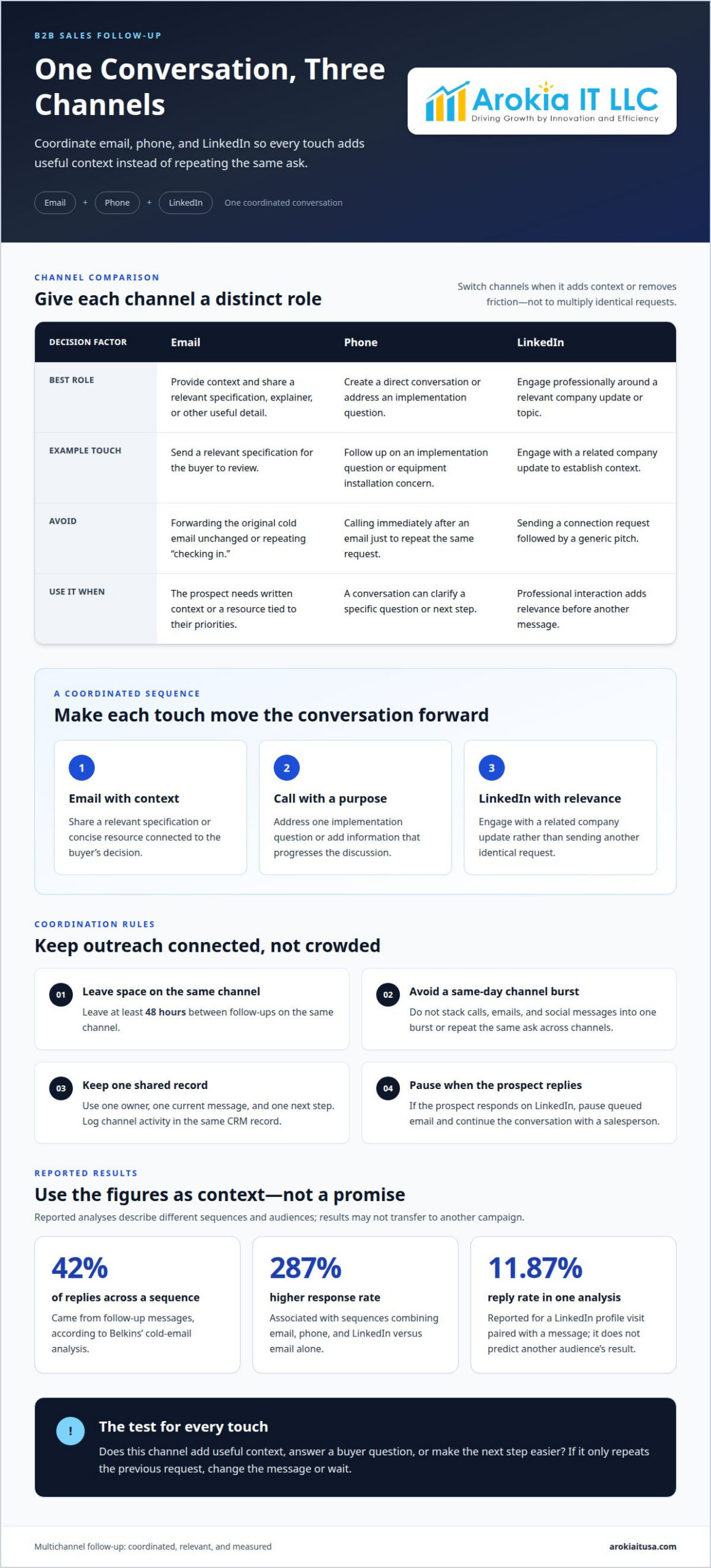
Assign each channel a distinct role: use email for context, a phone call for a direct conversation, and LinkedIn for relevant professional engagement. Avoid sending the same request across all three channels on one day. Instead, let a call reference the email’s useful point, or let a LinkedIn interaction establish context before another message. Belkins’ cold-email analysis found 42% of replies across a sequence came from follow-up messages.
- Write a subject line that identifies the topic or next step, such as “Next steps for the service schedule.” Keep it accurate and specific; don’t imply an agreement when the prospect hasn’t made one. On mobile, a short subject line and opening sentence make the email’s purpose easier to scan.
- End with one low-friction request, such as offering a choice between a brief call and a written answer. Match the ask to the prospect’s stage and make it easy to respond. A follow-up works best when each email advances the conversation with a concrete detail, not merely another “checking in.”
Multichannel outreach
A multichannel cadence coordinates email, phone, and social touches around one useful conversation. Give each channel a distinct purpose, then measure whether the combined outreach generates replies or meetings.
-
Plan a multichannel sales cadence
Map each touch to a buyer action, such as reviewing a technical detail or booking a meeting. For example, send an email with a relevant specification, follow with a call that addresses one implementation question, then use LinkedIn to engage with a related company update. Sequences combining email, phone, and LinkedIn have been associated with a 287% higher response rate than email alone. Treat that figure as directional, not a target; audience, offer, and execution affect results.
-
Coordinate multichannel sales outreach
Set one owner, one current message, and one next step for every prospect. Log email, phone, and LinkedIn activity in the same CRM record so another salesperson doesn’t repeat yesterday’s contact. If a prospect replies on LinkedIn, pause queued email and continue the conversation with a salesperson. Switching channels should add context, not multiply identical requests.
- Choose channels based on the buyer’s role and the decision at hand. An operations leader evaluating equipment may need a phone conversation about installation, while a software buyer may prefer an email with a workflow example. Use LinkedIn for relevant professional interaction, not just a connection request followed by a generic pitch. A channel earns its place when it removes friction or provides useful context.
- Schedule spacing across channels, not just between emails. A phone call the morning after an email can feel like pressure if both repeat the same ask; a later call that answers a likely technical question creates progression. Leave at least 48 hours between follow-ups on the same channel, and avoid stacking calls, emails, and social messages into one burst.
- Track response rate and meetings by channel and by sequence, then review the combined result. A LinkedIn profile visit paired with a message reached an 11.87% reply rate in one reported analysis, but that result doesn’t establish what another audience will achieve. Compare equivalent prospect groups and keep the offer consistent when testing channel order.
- Use content as a bridge between touches. A concise explainer, product comparison, or implementation checklist can give a prospect a reason to engage before a meeting. Teams developing buyer-focused content can align each asset with a specific sales question instead of sending an unrelated resource.
When should you use a follow-up email sequence?
Use a sequence when a qualified prospect needs several useful touches before deciding or responding. Set timing according to lead source, buying stage, and engagement, not the calendar alone.
-
Plan the timing and number of touchpoints
Build a starting cadence of 5 to 8 touches over 28 days, mixing email with other relevant channels. Space early touches 2 to 3 days apart, then extend intervals to 4 to 7 days later in the cycle. Treat this as a testable framework, not a fixed rule for every account. A long-cycle equipment purchase may need more decision time than a product demo request.
- Give every message a distinct purpose. The first can establish relevance; a later touch can answer a technical question, share a useful resource, or request a meeting. For example, after an industrial buyer reviews a specification, follow up with the application detail they need to assess fit. Stop or change course when the prospect replies, declines, or signals a different timeline.
-
Prioritize speed-to-lead and response timing
Assign an owner to inbound inquiries quickly, then respond within an hour when possible and at least within the same business day. A prospect requesting a software demo has shown active interest, so don’t put that request into a slow cold-outreach cadence. Confirm the inquiry’s topic, identify the right representative, and send a relevant response instead of an automated message that ignores the request.
- Separate inbound response timing from outbound follow-up timing. For a new web inquiry, acknowledge the specific form request and offer a useful next step. For a cold email without a reply, allow time for the prospect to review the message before following up. Early outbound touches spaced 2 to 3 days apart create room for consideration without letting the conversation disappear.
- Automate routine scheduling, but let changes in buyer behavior adjust the sequence. Set CRM tasks for planned touches and suppress queued messages after a reply, meeting booking, or opt-out. If a prospect asks for a proposal, move them into a salesperson-led process; don’t continue sending introductory emails. Review the cadence when response patterns or lead quality change.
- Schedule around the prospect’s local workday and the message’s context. Send a meeting recap promptly, while the discussion is still fresh; a later educational touch can wait for the next planned interval. Track replies, meetings, and stage progression by lead source, then adjust the cadence based on which touchpoints generate useful engagement.
Adding value with case studies, testimonials, and relevant content
Measure a follow-up sequence by tracking replies, qualified meetings, and progression to the next sales stage. Compare these outcomes with negative replies and opt-outs to see whether the sequence earns engagement without losing prospects through irrelevant contact.
- Match one proof point to the prospect’s stated concern. A case study can show how a similar manufacturer addressed a production challenge; a software buyer may need a workflow example instead. Keep the reference focused on the problem, approach, and documented outcome. Don’t imply the prospect will get the same result or send a testimonial that doesn’t address their decision.
- Build a small content library around buyer questions, not asset formats. For each persona, organize useful resources such as an educational blog, technical guide, webinar, or customer story. A procurement leader may need implementation details, while an operations lead may want evidence about the process. Add a short note explaining why each resource matters, so the email provides context instead of dropping an unexplained link.
- Use the follow-up message to connect the resource to a decision. For example, after a prospect raises integration concerns, send a relevant guide and point to the section that addresses system requirements. Ask one direct question about their evaluation criteria. This gives the prospect a clear way to reply and helps sales distinguish active questions from silent interest.
- A/B test one sequence variable at a time. Compare two subject lines, opening messages, or proof formats while keeping the audience and offer consistent. Start with a controlled sample of 50 to 100 companies before broader rollout. Record which version generates qualified replies and meetings, not just opens. If the audience mix changes, the result may reflect targeting rather than the message.
- Set the evaluation window before launching each test. Track delivery, replies, positive replies, meetings booked, and progression to a qualified opportunity. Review results by buyer role and lead source, since an outbound manufacturing list may respond differently from software demo requests. Keep the stronger version only if it improves meaningful outcomes without increasing negative replies.
- Document each test in the CRM with its hypothesis, audience, message variation, and outcome. For example, record whether a customer story or technical checklist led to more conversations with engineering leaders. Use that record to refine future outreach, retire assets that don’t help the decision, and retain the proof points that consistently support useful sales conversations.
What are the best sales follow-up strategies to avoid annoying prospects?
Automate routine timing, but use buyer context to decide what happens next. Set clear rules for pausing, personalization, and delivery in the prospect’s local time.
Common U.S. mistakes include repeating generic templates, ignoring opt-outs, and sending messages after a prospect declines. Under CAN-SPAM, businesses must honor email opt-outs within 10 business days.
Stop when a prospect opts out, declines further contact, or completes the planned sequence without engaging. Record the outcome and pause outreach. Reopen contact only when the prospect provides a new signal or relevant context emerges.
-
Automate sequences and schedule by timezone
Configure the platform to send during the prospect’s local business hours, using the company location in the CRM. Check time-zone data before scheduling, especially for accounts with offices across U.S. regions. Use automation for planned delivery and reminders, but avoid sending every message at the same hour or stacking email and calls.
-
Balance automation with human judgment
Use templates for a consistent structure, then review each message for the recipient’s role, account context, and current interest. For example, a procurement contact asking about delivery should receive a relevant response, not the next generic product email. Assign a salesperson to review replies and meaningful engagement, and remove prospects from automated steps when a real conversation begins.
-
Use AI-enabled sequencing
Use AI to organize prospect signals, summarize prior interactions, or suggest relevant content for a follow-up. A salesperson should verify the context before sending, since outdated CRM fields can lead to inaccurate personalization. Don’t let an automated recommendation override a direct request, a negative reply, or the account’s stated buying timeline.
-
Pause follow-ups when appropriate
Pause the sequence as soon as a prospect replies, books a meeting, requests a later date, or opts out. Set CRM rules to stop queued messages and assign a clear owner for the next response. If a prospect says a project is delayed, record the requested timing and resume only when that date arrives or a relevant new buying signal emerges.
- Review contact frequency and signs of fatigue before expanding a sequence. Track complaints, opt-outs, negative replies, and engagement by platform and message type. If a specific template generates repeated objections, revise its claim or audience criteria instead of increasing send volume. A smaller, well-targeted sequence protects the quality of future conversations.
- Define ownership for every handoff. If marketing automation detects meaningful interest, route the account to a salesperson with its engagement history and the recommended next action. Keep the record concise: capture what the prospect did, what they asked, and which follow-up would add value. This prevents duplicate outreach from separate sales teams.
Arokia IT
Arokia IT LLC helps B2B teams align follow-up with the accounts, channels, and content that support sales conversations. Its Account-Based Marketing (ABM), Demand Generation, and LinkedIn Marketing can help connect targeted outreach with relevant buyer interests, while AI Search & GEO supports visibility where prospects research solutions.
Turn to Arokia IT LLC when follow-ups feel disconnected from marketing, sales teams repeat outreach, or useful content isn’t reaching the right accounts. A coordinated approach can clarify who each message serves, what value it adds, and how engagement informs the next step.
Contact Arokia IT LLC to discuss your B2B follow-up strategy.
Make the next improvement measurable
Choose one point where prospects lose momentum and make it an operating priority. A well-designed B2B sales follow-up sequence should fit how your team qualifies accounts and coordinates decisions across marketing and sales. Before changing the process, identify the internal constraint behind the stalled progress. It may be unclear ownership, competing priorities, or a gap between what the team communicates and what buyers need to decide. Naming that constraint gives your next adjustment a specific purpose.
Arokia IT LLC can help teams connect outreach planning with broader B2B growth priorities. Bring the challenge into a planning conversation, including where coordination breaks down and what a more useful process should enable. From there, your team can define a focused improvement, assign responsibility, and determine how it supports the next stage of business growth. Progress starts with a clear problem and a deliberate response, not more activity for its own sake.
Take the next step with a process built around clear decisions and purposeful action.
Frequently Asked Questions
How Many Follow-Up Emails Should You Send?
There’s no universal email count that fits every B2B prospect. Set a defined endpoint based on the lead source and sales situation, then give each message a distinct purpose. For example, a follow-up to someone who downloaded a technical guide can offer a related application detail. If the prospect stays unresponsive after the planned sequence, pause rather than extending it with messages that add no new value.
How do I follow up without being annoying?
Make each follow-up relevant to the prospect’s situation and avoid repeating the same request. If a buyer asks about equipment installation, address that concern instead of resending a general company introduction. Keep the next step clear and easy to answer, such as asking which specification they’re evaluating. Respect a request to stop, and coordinate outreach so different team members don’t send duplicate messages.
How do I keep track of all my follow-ups?
Use a shared CRM record as the source of truth for each account. Log the last contact, channel, message purpose, response, next action, and follow-up owner. For example, if a prospect requests a proposal revision, record the requested change and assign the next response to the salesperson handling the opportunity. Tie reminders to the record so another team member can review the history before contacting the account.
How long should I wait between follow-ups?
Give the prospect time to consider the last message, then follow up when you have a relevant next point. The interval depends on context: a meeting recap should arrive while the discussion is fresh, while a cold outreach message needs room for review. Avoid scheduling several messages close together across email, phone, and LinkedIn. Adjust timing if the prospect shares a specific decision date.
How many times should you follow up with a sales lead?
Continue while each contact has a clear purpose and the lead remains appropriate to pursue. A lead who requested a product demonstration needs a different follow-up path from someone who never engaged with cold outreach. Set a planned stopping point, then reassess using replies, buying signals, and the lead’s stated timeline. Stop sooner if the person declines, asks not to be contacted, or indicates the project is no longer active.
The follow-up benchmark: how many touches does it actually take?
No single touch count reliably predicts every B2B sale. The number depends on lead source, deal complexity, buyer availability, and how many people participate in the decision. Use a benchmark only to plan and review activity, not as a quota that overrides prospect behavior. If a sequence produces no meaningful engagement, reassess account fit and message relevance before extending the timeline or adding more contacts.
What is a B2B sales follow-up sequence?
A B2B sales follow-up sequence is a planned set of contacts intended to help a business prospect take a relevant next step. It may use email, phone, LinkedIn, or useful content, with each contact shaped by the buyer’s context. For example, after a product inquiry, a seller might address a technical question before proposing a meeting. The sequence should respond to engagement rather than run unchanged.
How many follow-ups should a B2B sales sequence include?
Choose the number of touches according to the opportunity and the sequence’s purpose, rather than using one count for every account. An unanswered introduction differs from a complex purchase with open questions and multiple decision-makers. Define an endpoint and review the prospect’s engagement as the sequence runs. If messages would only repeat earlier information, pause outreach and wait for a meaningful new signal before reopening contact.