
Technical depth doesn’t create clarity; a decision-ready explanation does. Marketing technical products to nontechnical buyers works when you connect product features to a buyer’s operational problem, commercial impact, implementation effort, supporting evidence, and next step. The goal isn’t to strip away technical detail. It’s to make the value clear before offering a deeper explanation.
Technical buyers need precision, while executives need to understand what a decision could change for the business. When a message leads with specifications alone, these audiences may come away with different questions and no shared reason to move forward. Clear messaging bridges that gap without oversimplifying the product or asking readers to take claims on faith.
This article lays out a repeatable framework for explaining complex products: identify the buyer’s problem, translate features into outcomes, tailor the message to each stakeholder, and support the case with relevant evidence. You’ll also learn how to keep the core value consistent across product pages, sales materials, and follow-up content, so each interaction helps buyers make a well-informed decision.
Key Takeaways
- Build separate but consistent messages for technical evaluators and economic buyers, connecting product performance to operational and financial priorities.
- Translate each specification into what it enables, why that matters to the business, and what evidence supports the claim.
- Replace internal jargon with the language buyers use to describe problems, while keeping technical explanations accurate.
- Lead with the problem and its commercial impact before explaining the solution, implementation considerations, and next step.
- Use a shared messaging framework to align product pages, sales materials, and follow-up content around the same buyer value.
How do technical companies explain products clearly?
Build one accurate product story, then tailor it for different buying roles. A clear framework connects the problem, solution, and evidence without burying business value under specifications.
-
Separate Messages for Technical and Economic Buyers
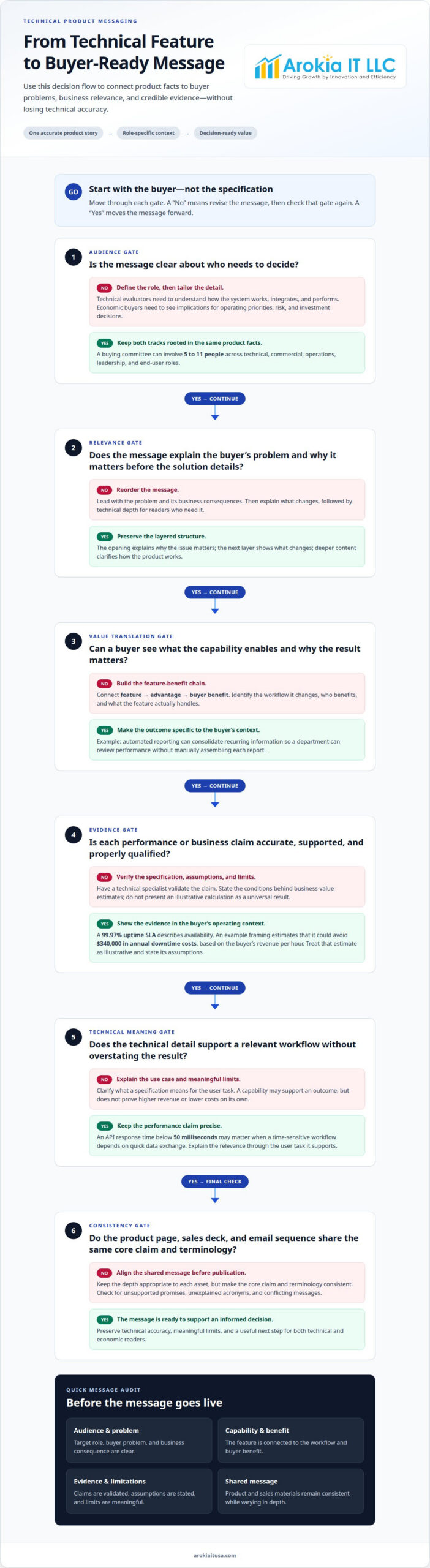
Build two message tracks from the same product facts. Technical buyers need to understand how a system works, integrates, and performs. Economic buyers need to see how it affects operating priorities, risk, and investment decisions. For example, describe role-based permissions as configurable access controls for technical readers and as clearer approval accountability for business leaders.
Check that both tracks describe the same capability and outcome. Enterprise buying committees can involve five to eleven people, including technical, commercial, operations, leadership, and end-user stakeholders. A message written only for engineers may leave executives without the context to decide; a purely financial pitch may leave evaluators without enough detail.
-
Build a Layered Messaging Hierarchy
Present the buyer’s problem and its business consequences first, then explain the solution and offer technical depth. This gives executives a quick route to relevance while preserving detail for evaluators. For an API integration, lead with how it connects data across existing tools, then describe the integration method and relevant technical requirements.
Make sure each layer answers a distinct question. The opening should explain why the issue matters; the next layer should show what changes; deeper content should clarify how the product works. Don’t introduce implementation terminology before readers understand the operational purpose.
-
Apply Messaging Checklists and Frameworks
Use a shared framework to test each message before publication. Include the target audience, buyer problem, product capability, business benefit, supporting evidence, likely objection, and next step. For an automated alert, specify what triggers it, who receives it, and what action it helps that person take.
Test the framework across a product page, sales deck, and email sequence. Each asset can vary in depth, but the core claim and terminology should remain consistent. A checklist also reveals unsupported promises, missing proof, and unexplained technical terms before they reach buyers.
-
Avoid Common Complex-Messaging Mistakes
Replace feature dumps with a clear explanation of relevance. Listing system architecture, integrations, and configuration options without buyer context forces readers to make the value argument themselves. Explain what a data connection enables before detailing its technical setup.
Check for unexplained acronyms, broad claims, and conflicting messages across sales materials. Don’t imply that automation removes every manual task if it only handles a defined workflow. Preserve technical accuracy, state meaningful limits, and give both technical and economic readers a useful next step.
How do you write marketing copy for technical products?
Translate each specification into what it enables, who benefits, and why the result matters commercially. For long sales cycles, measure target-account engagement, content use, conversion rates, and sales use of marketing assets, as well as traffic and leads.
-
Translate Specifications into Business Value
Start with a verified specification, then explain its operational consequence. A 99.97% uptime service-level agreement describes availability; the business question is how downtime affects operations and revenue. An example ROI framing estimates that this level could avoid $340,000 in annual downtime costs, based on the buyer’s revenue per hour.
Present the estimate as an illustrative calculation, not a universal result. State the assumptions and connect them to the buyer’s operating context. Check that a specification means the same thing in technical documentation and sales copy. Have a technical specialist validate the claim before publication.
-
Connect Capabilities to Business Outcomes
Map each capability to the workflow it changes, then identify the outcome that matters to the buyer. For example, a software architecture that supports an API response time below 50 milliseconds may matter when a time-sensitive workflow depends on quick data exchange. The number describes system performance; explain its relevance through the user task it supports.
Next, distinguish a capability from a business result. Faster response can support a smoother process, but it doesn’t prove higher revenue or lower operating costs on its own. Specify the conditions behind the value, such as workflow volume, existing systems, or user needs. This practical explanation gives executives a basis for deciding without overstating the technical claim.
-
Turn Features into Buyer Benefits
Write each feature-benefit chain in three parts: feature, advantage, and buyer benefit. For example, automated reporting can consolidate recurring information, helping a department review performance without manually assembling each report. Clarify what information the feature handles and who uses the output. That detail makes the benefit credible to both the day-to-day user and the budget owner.
Then tailor the proof to the decision. Technical evaluators may need architecture details, while executives need the business case and its assumptions. A useful copy review asks whether each claim is accurate, relevant, supported, and tied to a clear next step. For teams refining complex product content, discussing technical messaging priorities can help focus the work on buyer value.
How do you simplify complex technology messaging?
Use buyer language to explain the problem, the product’s role, and the evidence behind its value. Interview nontechnical decision-makers, review sales notes, and analyze support conversations, demo questions, search queries, and RFP language.
-
Research Nontechnical Decision-Maker Priorities
Start with interviews and sales records to identify what executives weigh. Look for recurring concerns about operating risk, implementation demands, adoption, and business continuity. Compare those themes with technical questions from demos. Enterprise buying committees can involve five to eleven people, so capture different roles without assuming every stakeholder has the same priorities.
Build a buyer-research record from customer interviews, sales notes, support conversations, and RFP language. Tag each concern by role and buying stage. For example, a finance leader may focus on the investment rationale, while operations may ask how workflows will change. Check whether a concern appears across multiple sources before making it a central message.
-
Focus Product Messaging on Customer Problems
Open with a problem buyers recognize, then explain its operational consequence. A manufacturer facing delayed production data needs to understand the effect on planning before reading about a software dashboard. Describe how the product addresses the information gap and identify the evidence supporting the claim. Don’t lead with features that require buyers to infer the problem themselves.
Map the message to the customer journey. Early-stage content can help buyers define a problem; evaluation content can clarify product fit, implementation, and tradeoffs. Since complex B2B decisions may take months to years, maintain useful information across the journey instead of treating one product page as the entire buying strategy.
-
Use Customer Language Instead of Internal Jargon
Collect the phrases buyers use in calls, support tickets, search queries, and demo questions. Replace internal labels with familiar descriptions while keeping necessary technical terms accurate. For example, translate “role-based permissions” into “control who can view, change, or approve information,” then explain the technical term for evaluators who need it.
Review each sentence for terms used only by product or engineering teams. Keep an acronym when it helps technical readers, but define it at first use. Align website copy, sales decks, and email nurture around the same customer language, so each channel reinforces rather than fragments the strategy.
-
Support Messaging with Customer Evidence
Use a technical case study to show the customer’s starting problem, how the product was applied, and the documented outcome. Name the workflow or context, explain what changed, and separate measured results from interpretation. For example, a case study about automated alerts should clarify which issue the alerts surfaced and how the customer responded.
Match evidence to the questions each buying role asks. Engineers may need implementation context; executives need proof tied to operating priorities. Keep claims within the evidence, and make limitations visible when they affect interpretation. A clear case study helps buyers assess relevance without turning one customer’s experience into a universal promise.
Starting with buyer problems and commercial impact
- Begin with a costly or disruptive buyer problem, not product architecture. A factory manager may struggle to coordinate production data across disconnected systems. Describe how that gap affects planning, scheduling, or visibility before introducing a software capability. This positioning gives executives a reason to care and technical evaluators a real problem to investigate.
Separate the observable problem from its assumed cause. Ask whether delayed decisions stem from missing information, inconsistent processes, or limited system access. This keeps the message specific and prevents reducing the issue to a claim that one product feature solves every operational constraint.
- Map the problem to commercial consequences buyers can evaluate. For a manufacturer, inconsistent production data may complicate capacity planning or make an emerging bottleneck harder to spot. Explain which decision is affected, which teams are involved, and what operational tradeoff is at stake. Don’t claim a direct financial loss unless the buyer’s own evidence supports it.
Use a factory automation example to make the business case concrete: an investment is estimated to have a payback period of roughly 14 months. Treat that as an illustrative estimate, not a universal outcome. Explain the assumptions behind any payback calculation, including the operational changes that connect the solution to the projected result.
- Show the risk of inaction alongside the effort required to change. If a team continues using fragmented reporting, explain which decisions remain difficult and who is affected. Then describe the practical work involved in adopting a different process, such as integrating data or training users. Balanced messaging helps buyers assess both the problem and the transition.
Distinguish a product’s contribution from factors outside its control. Software, for example, can make production information easier to access, while staffing, maintenance practices, and process ownership also affect execution. This precision builds trust and helps decision-makers assess fit without mistaking a product capability for an entire operating strategy.
- Define success before selecting proof or a call to action. Choose an observable signal tied to the stated problem, such as faster access to production status or fewer manual handoffs. Identify where that information comes from and which stakeholder uses it. A clear measure keeps marketing, sales, and operations aligned around the same buyer outcome.
Close with a next step that matches the buyer’s readiness. A team still defining its problem may need an educational explanation; a team evaluating solutions may need implementation details or a technical discussion. Make the action specific to the decision ahead. Strong messaging connects the problem, commercial impact, evidence, and next move.
A repeatable technical product marketing framework
Use a shared sequence to turn product knowledge into a validated market message. Each step should produce an output that sales, marketing, and technical teams can use.
- Define the audience and decision. Identify the user, technical evaluator, economic buyer, and decision each person must make. A manufacturing software team might connect operators with usability, IT with system fit, and executives with business priorities. Use these distinctions to guide product direction and marketing strategy instead of relying on one broad persona.
- Document the buyer’s situation. Gather recurring problems from sales notes, customer interviews, support conversations, and demo questions. Record the current workflow, its friction points, and the consequences buyers describe. Preserve buyers’ wording, especially when internal teams use different terms for the same issue.
- Validate the product explanation. Ask product or engineering specialists to review how each capability works, where it applies, and which limitations matter. This catches technical inaccuracies before publication and clarifies which details need explanation. Keep approved claims and definitions in a shared reference document for future updates.
- Build a message hierarchy. Write a concise positioning statement, followed by supporting benefits, proof, and technical detail. For example, an opening message can state the workflow problem; a supporting section can explain the product’s role; a technical resource can document implementation considerations. Buyers can then choose the level of detail that suits their evaluation.
- Equip subject-matter experts to contribute. Turn engineers’ answers to customer questions into FAQs, application pages, specifications, and educational resources. Developer-led blog posts, webinars, and demos can add technical depth while maintaining a consistent message. Give contributors a shared framework for reviewing audience fit, technical accuracy, and substantiated claims.
- Test whether the message is understood. Share a draft with a representative buyer or colleague outside the product team. Ask them to explain the product’s purpose in their own words and identify what they would need before taking the next step. Compare their interpretation with the intended message, then revise unclear terms or missing context.
Arokia IT: Account-Based Marketing (ABM)
Arokia IT LLC uses Account-Based Marketing (ABM) to help B2B teams align messaging with priority accounts and their buying groups. This approach fits technical companies whose products require input from both technical evaluators and business decision-makers. Instead of relying on one broad message, teams can shape relevant content around each account’s concerns and decision context.
For companies that also need to strengthen visibility or build a steadier pipeline, Arokia IT LLC offers AI Search & GEO, Demand Generation, and Industrial Marketing. These offerings support different parts of the marketing process, from making complex expertise easier to discover to creating focused demand in industrial markets.
Contact Arokia IT LLC to discuss marketing your technical products, or visit arokiaitusa.com.
Make your next product message easier to act on
Choose one upcoming product decision and build a message around the information buyers need to evaluate it. A launch brief, product update, or sales presentation can be a focused starting point. Treat the first version as a working asset, then assign an owner to maintain it as product details and market priorities evolve.
Marketing technical products to nontechnical buyers is ongoing work, not a one-time copy exercise. Set a practical review point around a product release or meaningful change to the offer. This gives your team a clear moment to refresh materials and keeps communication aligned with the product’s current direction.
A deliberate update cycle turns messaging into a durable business resource. Start with the next decision your buyers face, then build from there.
Frequently Asked Questions
Should You Build Positioning for Non-Technical Buyers In-House or Hire a Specialist?
Build positioning in-house when a product lead, marketer, and sales representative can share ownership and schedule regular reviews. Specialist support can help when a launch lacks a clear decision-maker, internal teams disagree on priorities, or existing materials need a coordinated reset. Before deciding, define the scope, approval process, and who will maintain the work after publication. External support works best when internal experts remain available to validate product specifics.
What are the common mistakes in complex B2B messaging?
One costly mistake is letting separate teams publish competing versions of the same product claim. Another is treating a launch document as permanent, even after product changes make its screenshots, terminology, or requirements outdated. Assign an owner to each core asset, record its review date, and route substantive changes through product and marketing. This basic governance reduces confusion in sales conversations and customer-facing materials.
What does simple marketing language really mean?
Simple language helps readers understand a product without first learning the company’s internal vocabulary. It doesn’t mean removing useful technical terms. For example, define “data normalization” as organizing records into a consistent format, then retain the technical term for readers who recognize it. The goal is to reduce interpretation effort while keeping the explanation specific enough to support a real decision.
Why is complex technology hard to explain?
Technology can be difficult to explain because its value may depend on connected components, existing systems, and how a buyer operates. A feature that matters in one environment may be irrelevant in another. Product teams often understand mechanisms in depth, while buyers may start with constraints or desired changes. Explaining the context around a capability takes more work than listing specifications.
How do you explain technical products to nontechnical buyers?
Give buyers an evaluation guide that addresses practical questions they may need to resolve internally. Clarify intended use, prerequisites, ownership, implementation responsibilities, and what a successful evaluation should examine. For example, a software evaluation guide can identify which team supplies data and who reviews the outputs. This helps nontechnical stakeholders coordinate a decision without having to interpret engineering documentation alone.
What messaging frameworks work for marketing complex technical products?
A message house works well when teams need one central position supported by a small set of defensible themes. A jobs-to-be-done framework can help when the challenge is understanding what buyers are trying to accomplish in a specific situation. Choose a framework based on the work required, not fashion. Document its terms and ownership so future contributors apply it consistently.
How can you translate technical features into customer benefits and business outcomes?
Use buyer-specific inputs to evaluate a possible outcome instead of presenting a generic payoff as universal. For proposed time savings, establish the current task, the people involved, and the conditions under which the product changes that task. Show assumptions separately from measured results. If the inputs change, explain how the estimate changes too. This makes the business case easier to scrutinize.
How should marketing materials balance technical detail with simplicity?
Choose formats that let readers control how deeply they explore. An executive overview can sit alongside a technical appendix, implementation guide, or specification sheet, with clear labels connecting related materials. Keep detailed documents searchable and organized by buyer task, not just internal product architecture. This helps specialists verify requirements while decision-makers stay focused on the purpose of the evaluation.