
A manufacturing marketing strategy connects a company’s market expertise with its commercial priorities, giving marketing a clear role in growth. Without that direction, activity can accumulate without showing which efforts support business needs. The goal is not simply to publish, advertise, or collect inquiries. It is to make marketing accountable to the outcomes leadership values.
Manufacturing leaders must decide where to focus, how to assess marketing’s contribution, and how to improve the path from initial interest to a sales conversation. Those decisions become harder when marketing and sales use different definitions of progress. A clear approach gives both teams a basis for setting priorities and learning from results.
This article explains why manufacturing marketing matters and how to connect it to pipeline. It covers measurement, buying-team engagement, website conversion, and practical strategy development. You’ll also learn how to turn business goals into a focused plan, so marketing activity has a clear purpose and teams can make informed decisions about what to do next.
Key Takeaways
- Use technical articles, case studies, and practical resources to help buyers evaluate solutions and equip sales teams to continue the conversation.
- Track marketing’s contribution to qualified opportunities, pipeline progression, and deal acceleration, not just traffic or lead volume.
- Build messaging for the different roles in a buying committee, then nurture their distinct questions throughout the sales cycle.
- Improve conversion by making product information easy to find and monitoring meaningful website actions, such as calls to action and video engagement.
- Document goals, audience segments, content priorities, and measurement cadence so marketing and sales can work from the same plan.
1. Why Does Manufacturing Marketing Matter?
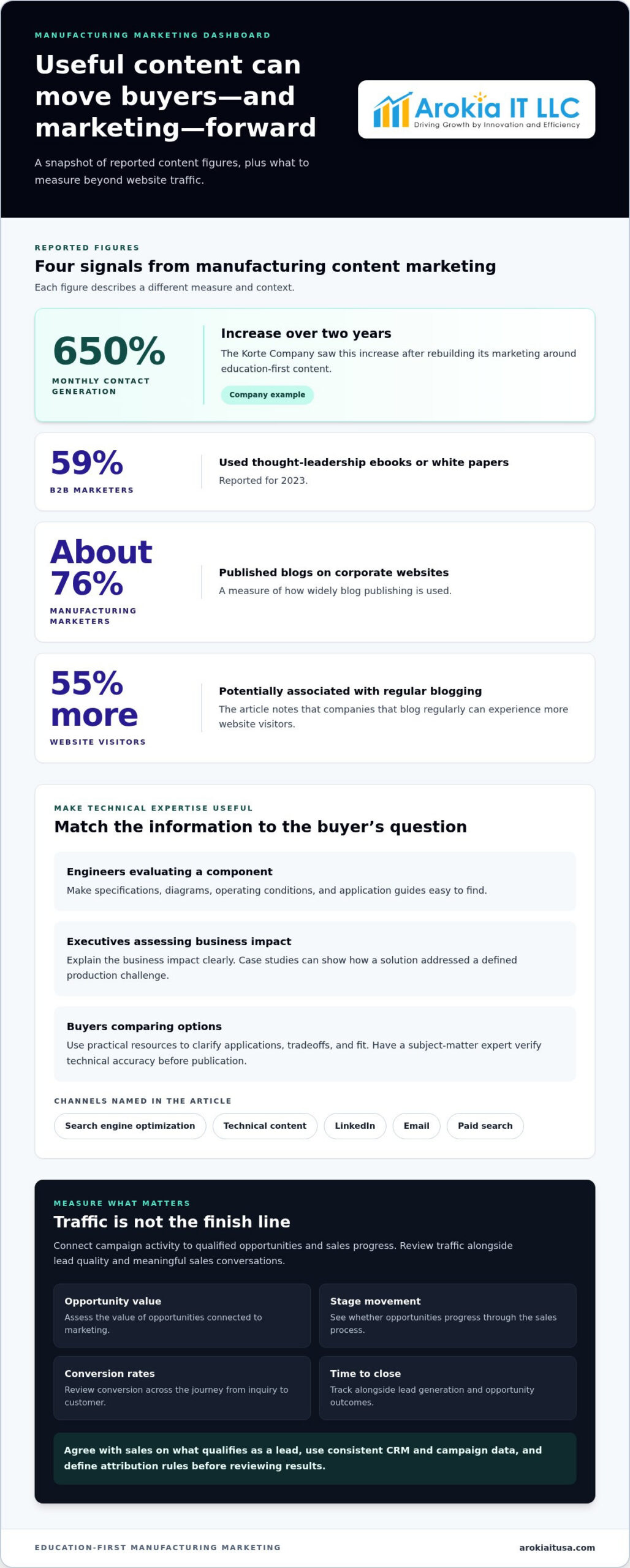
Manufacturing marketing turns specialized expertise into information buyers can use. The Korte Company increased monthly contact generation by 650% over two years after rebuilding its marketing around education-first content. That example shows why publishing useful answers matters: a buyer comparing equipment or production solutions needs more than a product claim. They need evidence that helps them understand applications, evaluate tradeoffs, and justify a decision internally.
Educational content also builds trust before a sales conversation begins. In 2023, 59% of B2B marketers used thought leadership ebooks or white papers. For a manufacturer, that content might explain material selection, process limitations, maintenance considerations, or return-on-investment assumptions. Case studies can show how a solution addressed a defined production challenge, while application guides help buyers assess fit. Each asset should answer a real question, not simply repeat a catalog description.
Technical content must serve engineers as well as business leaders. An engineer evaluating a component may need specifications, diagrams, operating conditions, or an application guide; an executive may need a clear explanation of business impact. Organize information so both audiences can quickly find relevant details. Start with questions sales hears from buyers, then ask a subject-matter expert to verify technical accuracy before publication. This keeps manufacturing content marketing practical and credible.
Which marketing channels work best for B2B manufacturing companies? Search engine optimization, technical content, LinkedIn, email, and paid search can reach buyers at different stages. The right mix depends on audience research habits, product complexity, and sales goals. Use search content for specification-driven questions, LinkedIn to share expertise with professional audiences, and email to nurture contacts with relevant resources.
SEO and content marketing reinforce each other when pages answer specific buyer questions. Manufacturing marketers can target long-tail searches such as a process, material, or application paired with a customer need. About 76% of manufacturing marketers published blogs on their corporate websites, and companies that blog regularly can experience 55% more website visitors. Those figures make consistent publishing worth consideration, but traffic alone does not show whether content attracts qualified buyers. Track engagement alongside lead quality and sales conversations.
What are common manufacturing marketing mistakes and risks? Common mistakes include publishing generic claims, overlooking engineers’ information needs, and measuring output without connecting it to buyer action. Technical inaccuracies are another risk: an unverified specification can undermine trust and cause confusion during evaluation. Give every asset a defined audience and purpose, and have a technical reviewer check it before publication.
Build a repeatable content process rather than relying on occasional posts. Start with sales questions, group them by buyer role, and select a useful format for each topic. A comparison guide can support evaluation; a case study can clarify application; a white paper can explain a complex process. Share each asset through relevant channels, then review which topics prompt meaningful inquiries. A focused content marketing program connects education with measurable audience response.
2. Marketing measurement and pipeline contribution
Marketing measurement should show how campaigns create or advance qualified sales opportunities. First, agree with sales on what counts as a qualified lead, then connect campaign activity to CRM records and opportunity stages. For each target account, record the first meaningful interaction, later engagement, opportunity creation, and closed outcome. This helps distinguish marketing-sourced pipeline from opportunities marketing influenced during evaluation.
Pipeline contribution is more useful than a traffic total because it connects marketing activity with sales progress. Track opportunity value, stage movement, conversion rates, and time to close alongside lead generation. Set attribution rules before reviewing results. For example, define whether an opportunity is sourced by its first qualifying interaction or influenced by engagement before a sales milestone. Then compare attributable revenue with program costs over the same period to assess ROI.
Connect measurement platforms before launching campaigns. CRM, marketing automation, and analytics should use consistent campaign, contact, and opportunity data. Review key performance indicators on a regular schedule. Investigate gaps, such as inquiries without account matches or opportunities without campaign history. Assess early engagement separately from completed revenue outcomes, since the two reflect different stages of the sales process.
How much should a manufacturing company spend on marketing? Set spending according to business goals, target markets, sales capacity, and the channels needed to reach buyers. Use previous performance as a baseline, then fund campaigns with defined audiences and measurement plans. Revisit the allocation as qualified opportunities develop instead of treating the initial budget as fixed regardless of results.
Measure customer acquisition beyond form fills. Follow each campaign from inquiry through qualification, opportunity, and closed customer. Compare conversion at each stage to identify where prospects drop out. For PPC, assess keyword relevance, qualified conversions, opportunity creation, and revenue contribution, not clicks alone. In a reported industry finding, 68% of manufacturing marketers identified search engine marketing and PPC as the best-performing paid channel. Treat that as a reason to assess PPC, not as a substitute for your own campaign data.
Recruitment campaigns need a different outcome model from customer acquisition. Track qualified applicants, completed applications, interviews, and hires by role and campaign. For example, judge a production technician campaign by whether it attracts candidates who meet job requirements, not by application volume alone. If hiring spans multiple facilities, compare candidate flow by location and role to identify which campaign elements need adjustment.
Review the measurement framework with sales and leadership so each metric informs a decision. A rise in inquiries without opportunity creation may point to targeting or qualification issues; stalled opportunities may require a different follow-up approach. Record the decision, owner, and next review date alongside the KPI. To discuss how measurement can support your pipeline priorities, connect with the team.
3. B2B manufacturing and multi-stakeholder buying
A manufacturing purchase rarely depends on one person’s approval. A buying committee may include five-ten stakeholders, such as engineers, procurement specialists, operations leaders, and executives. Each weighs different concerns: technical fit, supplier reliability, implementation demands, or financial impact. A message aimed only at the plant manager may miss the engineer who defines requirements or the executive who authorizes the purchase.
Manufacturing sales cycles can span 6-18 months from initial contact to signed contract. During that time, committee members may join at different stages, review information independently, and revisit earlier decisions. A useful account record should capture each contact’s role and the questions they raise. For example, an engineer’s integration concern may need resolution before procurement can compare supplier terms.
Build buyer personas around responsibilities rather than broad labels. For an industrial automation purchase, an engineer may assess controls integration, while an operations leader considers workflow disruption. Procurement may focus on supplier requirements, and an executive may evaluate the business case. Review sales notes and customer conversations to document each role’s priorities, objections, and decision criteria. Keep personas grounded in actual buying behavior.
Map information needs to the decisions each stakeholder must make. An engineer may need a system diagram and technical explanation; procurement may need a clear scope of supply; an executive may need a concise summary of operational value. Make these materials easy to share internally. Sales representatives should be able to send the right technical resource without rewriting it for every new contact.
Committee membership can shift during evaluation. A maintenance lead who joins late, for instance, may question service access after engineering has approved a design. Prepare sales teams to identify new participants and understand their role before sending more material. A simple account map can show who influences specifications, who approves commercial terms, and whose concerns remain unresolved.
Marketing and sales can coordinate around account-level engagement without treating every interaction as equally important. If engineering contacts repeatedly review technical documentation but procurement has not engaged, sales can consider whether commercial stakeholders need a different discussion. If interest spans several roles, the team can prepare a coordinated follow-up instead of sending duplicate messages to each contact.
For manufacturers selling through distributors, consistent language matters across direct and partner conversations. Give distributors approved descriptions of applications, capabilities, and product boundaries. Review customer questions with sales and partners to spot conflicting explanations. This coordination helps ensure stakeholders receive a consistent account of the product, especially when committee members compare notes before approval.
4. Connecting marketing strategy to conversion and optimization
Search visibility creates value when the right buyers can act on what they find. Manufacturing SEO should target specific, long-tail searches, such as a material or process paired with an application need. A page about custom metal fabrication, for example, should explain relevant capabilities and guide visitors toward a clear next step. Effective marketing connects each search intent to useful information and makes the next action easy.
How can manufacturers improve SEO and website conversion rates? Match pages to buyer searches, make technical details easy to find, and use clear calls to action. Then measure form submissions, CTA clicks, video plays, and scroll depth to identify where visitors engage or leave.
Local SEO can help manufacturers appear in searches tied to their service territory. For manufacturers serving Oklahoma, Louisiana, Arkansas, New Mexico, Northern Mexico, and Texas, keep business name, address, phone number, and service information consistent across the website and business profiles. Create location pages only when they offer specific value, such as explaining delivery coverage or services available in that market. A page that merely swaps city names adds little for buyers or search engines.
Website structure matters as much as keyword selection. Organize navigation around products, capabilities, industries, and technical resources, so engineers can reach specifications without searching through unrelated pages. Put the next step near relevant information: a quote request beside a capability overview, or a technical inquiry beside product documentation. A one-second delay in page loading can lead to a 7% reduction in conversions, making speed part of conversion optimization, not just a technical concern.
Review the full path from search result to sales inquiry. If a page attracts visits but few CTA clicks, check whether the content answers the query and makes the next step visible. If visitors click but abandon a form, remove unnecessary fields and explain what information the form needs. Measure each change against the same conversion metric instead of redesigning several page elements at once.
Website experience affects supplier evaluation. Roughly 76% of B2B buyers would avoid doing business with suppliers that provide a bad website experience. For a manufacturing site, that experience includes mobile readability, intuitive navigation, accessible technical information, and working inquiry forms. Test those elements with a real task, such as locating a specification and submitting a product question.
Search content also needs ongoing review. Just under 91% of pages receive no organic search traffic from Google, while organic search traffic generates 69% of leads for production firms. Use those figures as context, then examine your own analytics: identify pages with relevant impressions, improve weak titles or incomplete answers, and link related technical pages together. A focused website design and development process can align navigation, page speed, and conversion paths with buyer needs.
5. Manufacturing marketing strategy development
Develop a plan around business priorities, not a list of disconnected tactics. Start with the revenue objective, the products or capabilities to grow, and the customers most likely to need them. Then document the audience, positioning, channels, budget logic, and metrics. A manufacturer seeking more qualified inquiries needs a different action plan from one supporting a new product launch.
What are effective manufacturing marketing strategies for small businesses? Focus on a defined customer segment, useful technical content, search visibility, and follow-up that supports sales. Set a measurable goal, align marketing activity with sales capacity, and review performance regularly before expanding channels.
Use the previous period as a baseline before setting targets. Compare qualified inquiries, opportunities, conversion, and revenue contribution by product line or audience. A documented plan gives teams a shared reference: marketers can prioritize campaigns, while sales can identify where buyer conversations stall. Marketers with a documented strategy are 313% more likely to report success.
Define the market before choosing a message. Segment current and potential customers by industry, company size, location, needs, and buying behavior. For example, a manufacturer serving food-processing facilities may prioritize sanitation requirements, while an industrial supplier may focus on uptime or integration. Customer interviews and sales notes help identify pain points, rank them, and shape relevant solutions.
Next, assess industry conditions and competitive positioning. Identify target companies, market trends, growth drivers, and challenges that affect demand. Compare competitors’ strengths, weaknesses, opportunities, and threats to identify gaps your capabilities can address. Use this analysis to make specific choices, such as emphasizing a specialized application or improving visibility for a product category buyers struggle to evaluate.
Map content and campaigns to buying stages. Early research may call for an explainer; technical evaluation may need application details; final decisions may require a clear business case. Agree with sales on qualified-lead criteria using company, behavior, and intent signals. If distributors support sales, coordinate messaging and co-branded materials so buyers receive consistent information across channels, whether through digital downloads or professional collateral produced by commercial print providers like linemark.com.
Keep the plan operational. Assign an owner, define the action, select the metric, and set a review cadence for each initiative. A plan can cover a month, a quarter, or a year, depending on campaign scope and sales priorities. Compare results with the baseline, stop activity that attracts poor-fit inquiries, and redirect effort toward channels that produce stronger conversion.
Build a focused plan around your manufacturing growth priorities.
Arokia IT: Account-Based Marketing (ABM)
Arokia IT LLC helps manufacturers align marketing with the accounts and buying teams that matter to their growth goals. Its Account-Based Marketing (ABM) approach can suit companies selling specialized products to a defined set of target businesses, particularly when multiple stakeholders shape each purchase.
For manufacturers that need broader pipeline development, Arokia IT LLC also offers Demand Generation and LinkedIn Marketing. AI Search & GEO supports visibility in AI-driven search experiences alongside traditional discovery channels. The right focus depends on where buyers research, which accounts matter most, and how marketing and sales need to coordinate engagement.
If your team is ready to connect marketing activity more closely to pipeline priorities, contact Arokia IT LLC to discuss your goals.
Make the Next Marketing Decision Deliberate
Turn planning into a regular operating rhythm. Select one commercial priority for the next planning cycle, assign an owner, and agree on the decision the results should inform. That decision might be whether to refine a target segment, strengthen a sales handoff, or shift effort toward a more relevant message. Clear ownership keeps priorities from dissolving into disconnected tasks.
An effective manufacturing marketing strategy should also make learning actionable. Record what the team changes, why it changes, and what evidence will guide the next adjustment. This creates continuity between planning cycles and helps leaders distinguish a useful test from activity that simply continues by habit. The goal isn’t to add more marketing work. It’s to make each decision serve a defined business priority.
Ready to shape your next step around your company’s goals? Start a conversation with Arokia IT.
With a clear priority and a shared commitment to learning, your team can move forward with purpose.
Frequently Asked Questions
Why Does Manufacturing Marketing Matter?
Manufacturing marketing helps buyers understand what a company makes, which problems its products address, and how to take the next step. For example, a supplier launching a redesigned component can explain the change to existing customers while introducing its applications to new prospects. Without coordinated communication, buyers may rely on outdated product information or overlook a relevant solution. Marketing also gives sales teams consistent materials for customer conversations.
What is a manufacturing marketing strategy?
A manufacturing marketing strategy is a coordinated plan for reaching business buyers and supporting commercial goals. It connects company priorities to audiences, positioning, content, channels, the sales process, and performance measures. For example, a manufacturer entering a new application market might prioritize education about that use case, then direct qualified inquiries to the right sales team. The strategy helps teams choose activities based on business needs rather than adopting familiar tactics without a clear purpose.
How do manufacturers identify and target ideal customer segments?
Manufacturers can identify promising segments by comparing customer fit, purchasing needs, and their ability to serve each group effectively. Examine past wins and losses, interview sales representatives, and look for patterns such as recurring applications or common operational challenges. Then prioritize segments where the product solves a clear problem and the sales team can support the buying process. This helps distinguish viable prospects from companies that may show interest but are not a strong fit.
How can manufacturers generate qualified leads and shorten long sales cycles?
Manufacturers can improve lead quality by agreeing on qualification criteria with sales before launching campaigns. A request for a technical drawing, for example, may signal a different level of purchase intent than a general newsletter signup. Route inquiries by product, application, or sales territory, and give representatives relevant context before follow-up. This reduces time spent clarifying basic fit and helps sales focus on the prospect’s requirements and decision process.
How should manufacturers market technical products and complex solutions?
Present technical products through clear, verified information organized around customer applications. A product page can explain the problem addressed, intended use, selection considerations, and where buyers can find detailed specifications. Keep drawings, terminology, and product descriptions consistent across web pages, sales presentations, and distributor materials. For a complex solution, show how its components work together instead of making buyers piece together the explanation from separate documents. Technical and sales reviewers can help maintain clarity and accuracy.
What should a manufacturing marketing plan include, and how do you create one?
A practical plan connects a business objective to an audience, message, activity, owner, and review process. Begin by selecting a priority, such as supporting a product launch or improving inquiries for a specific capability. Identify the work required from marketing, sales, and technical teams, then sequence tasks around those dependencies. For example, do not promote a new application before its product information and sales follow-up process are ready.
Which KPIs measure manufacturing marketing performance and ROI?
Choose KPIs that show whether marketing is attracting suitable prospects and supporting commercial progress. Useful measures include qualified inquiry rate, sales acceptance, opportunity creation, stage progression, and revenue associated with campaigns. Pair those outcomes with channel measures, such as organic visits to relevant product pages or conversions from paid search. Review results by product line and audience where possible. This reveals which activities merit adjustment instead of judging performance by total traffic alone.