
ABM doesn’t have to begin as an enterprise-scale program. The right account based marketing services for small businesses focus on choosing a manageable set of target accounts, tailoring value propositions, and tracking progress against pipeline goals. Costs depend on campaign scope, media, technology, content, and sales coordination.
Cost concerns are reasonable: deep research and highly personalized outreach can consume resources quickly if the account list is too broad or the work is disconnected from sales. A disciplined approach prioritizes accounts that fit your business and gives every campaign a clear way to assess performance.
This article explains what ABM services can include, how small B2B companies can identify and prioritize target accounts, and how to connect messaging to buyer needs. It also covers the factors that influence cost, practical ways to evaluate ROI, and when a focused ABM program makes sense for a growing company.
Key Takeaways
- Use customer and sales data to prioritize accounts that fit your business, rather than pursuing a broad list of prospects.
- Assess program costs by scope, media, technology, content, and coordination between marketing and sales.
- Measure progress across account engagement, qualified opportunities, pipeline, and revenue to build a clearer view of ROI.
- Shape value propositions around each audience’s business needs and the problems your solution addresses.
- Align targeted outreach with demand generation and sales enablement to make limited marketing resources work more deliberately.
Customer research and identifying target markets
Account-based marketing services for small businesses coordinate customer research, account selection, tailored messaging, and outreach to specific companies. Agencies may support this work with market research, account data analysis, advertising, personalized content, landing pages, and sales outreach. The value comes from connecting each activity to a defined target and a business reason for pursuing it.
Start with customer evidence, not a broad industry label. Review closed-won and lost deals, renewal patterns, sales notes, and customer interviews. A common revenue concentration pattern among small B2B firms is 80% of revenue from 20% of customers; some companies may be closer to 90% from 10%. Treat those patterns as prompts for analysis, not automatic rules for choosing accounts.
Build an ideal customer profile using customers who are a strong fit, make purchases, and stay engaged. For a manufacturing supplier, useful criteria might include production needs, purchasing structure, geographic reach, and the applications its products serve. For a software company, consider workflow fit, existing systems, implementation demands, and the problems prospects need to solve. Compare these attributes with CRM records and sales feedback.
Then create a ranked target list. Score each account for fit, potential value, urgency, and access to decision-makers; document the evidence behind each score. A practical sequence is to validate the profile, identify matching companies, map stakeholders, and confirm priorities with sales. A focused account-based marketing framework can organize this research into coordinated account plans.
A tailored strategy should reflect each account’s buying context, not just its industry. Develop a value proposition for each segment, then adapt proof points, advertising, and landing-page content to its operational needs. Pricing depends on the engagement’s scope. Key factors include research depth, target-account scope, creative requirements, channel mix, and reporting needs.
Flexible services let a small team prioritize work it can execute. A company might begin with account research and messaging, then add paid advertising or sales outreach as capacity grows. Tailor email to the customer’s stage: introduce a relevant problem to an early-stage contact, share evaluation content with an active buyer, and provide implementation guidance after purchase. Each message should reflect known interests and offer a useful next step.
Personalization is most effective when it changes the substance of a message, not just the greeting. A medical equipment prospect, for example, may need information about workflow integration, while a software buyer may need a clear implementation use case. Match the message, landing page, and follow-up to those needs, then use account engagement and sales feedback to refine the target profile.
Is Account-Based Marketing Really That Expensive?
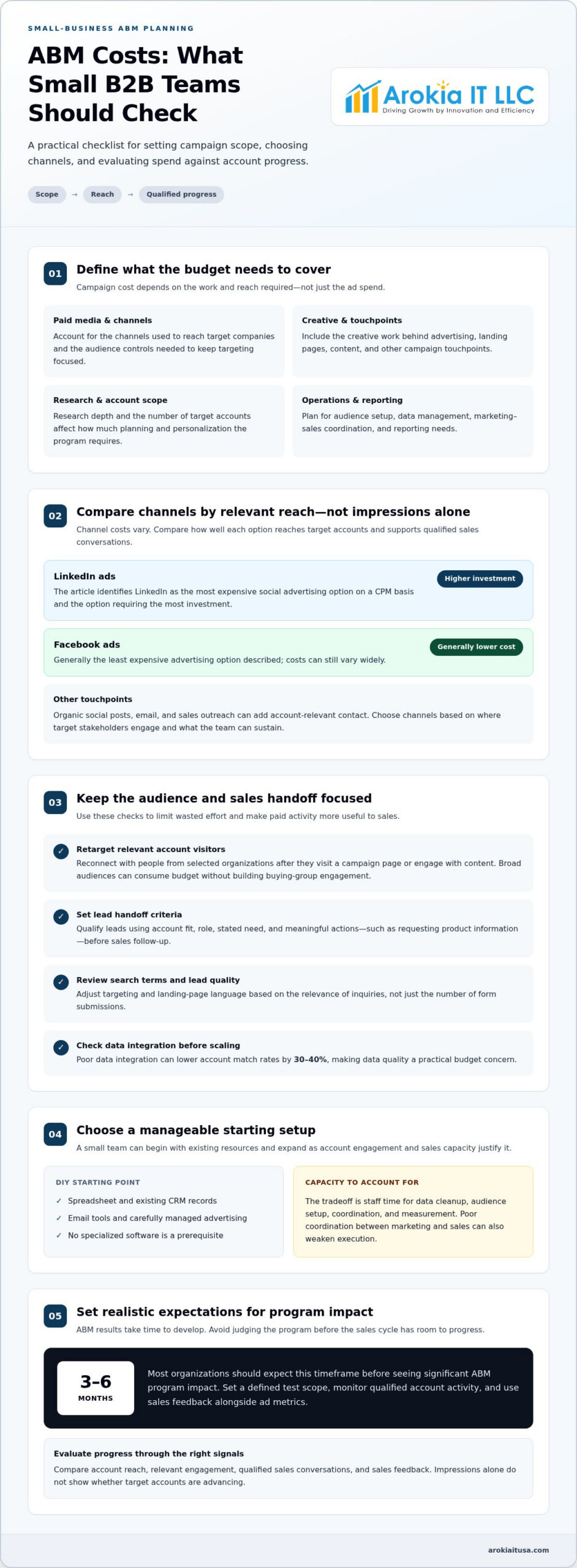
ABM costs depend on paid media, the channels used to reach target accounts, and the creative and operational work behind each touchpoint. A small business can begin with focused digital advertising and existing marketing tools, then expand investment as account engagement and sales capacity justify it. The key question is whether each expense advances a defined account objective.
Paid media needs tight audience controls. LinkedIn tends to be the most expensive social advertising option on a CPM basis and requires the most investment. Facebook ads are generally the least expensive advertising option, though costs vary widely. For a B2B campaign, compare each channel by account reach, relevant engagement, and qualified sales conversations, rather than impressions alone.
Retargeting can reconnect with people from selected organizations after they visit a campaign landing page or engage with content. Keep the audience focused on relevant accounts and intent signals. A manufacturer, for example, could use an application-focused landing page and then retarget visitors with a relevant technical resource. Broad audiences can use up budget without building engagement across a buying group.
Qualify PPC and other paid-media leads before sales follow-up. Define handoff criteria based on account fit, role, stated need, and meaningful actions, such as a request for product information. A form submission from a company outside the target profile may warrant a different response from an inquiry by a priority account. Review search terms alongside lead quality, then adjust targeting and landing-page language.
Social media can support ABM without relying entirely on paid placements. Share account-relevant expertise through organic posts, then promote selected content to a specific professional audience. LinkedIn can be part of this approach, with email and sales outreach providing additional touchpoints. Choose channels based on where target stakeholders engage and what your team can sustain.
DIY ABM is possible with a spreadsheet, existing CRM records, email tools, and carefully managed advertising; specialized software is not a prerequisite. The tradeoff is staff time for data cleanup, audience setup, coordination, and measurement. Poor data integration can lower account match rates by 30-40%, making data quality a practical budget concern.
Common risks include overspending on low-fit audiences, weak coordination between marketing and sales, and judging results before the sales cycle can develop. Most organizations should expect 3-6 months before seeing significant ABM program impact. Set a defined test scope, monitor qualified account activity, and make channel decisions from sales feedback as well as ad metrics. To discuss campaign scope and budget considerations, request a quote for your marketing needs.
Campaign measurement, attribution, and ROI
ABM reporting should connect account activity to sales progress and revenue, not stop at clicks or impressions. Define what counts as an engaged account, a qualified opportunity, and a closed deal, then align marketing and sales around those definitions in the CRM. Without shared criteria, a campaign may look successful in one dashboard while sales sees little pipeline value.
Track each account through the buying process: target-account reach, meaningful engagement, sales conversations, opportunity creation, pipeline value, and closed revenue. For example, a manufacturer can compare accounts that viewed technical content with those that requested a product discussion. This helps teams identify which actions signal genuine intent.
Attribution clarifies how marketing touches contribute to an opportunity, but it rarely reduces a complex B2B purchase to one channel. A buying group may see social media content, attend a sales meeting, and later respond to email. Record touchpoints consistently, then review both first-touch and multi-touch views alongside sales notes. Treat attribution as a decision aid, not proof that one interaction caused a contract.
ROI can be calculated by comparing revenue attributed to a campaign with campaign spend. The calculation is useful only when teams distinguish booked revenue from pipeline and account for the campaign period and included expenses.
Choose leading and lagging indicators for different decisions. Engagement and qualified meetings can show whether a campaign is reaching its intended accounts. Opportunity progression, contract value, and revenue show whether that activity is translating into commercial outcomes. Review the measures together: rising engagement without movement in opportunities may point to weak qualification or an offer that misses buyer needs.
One anonymized food co-packing company generated 32% of its total marketing-qualified leads through PPC, while paid form submissions rose 50% year over year. Those figures illustrate why channel contribution and lead quality deserve separate views. They are a company-specific example, not a forecast for another business. Compare your own campaigns using consistent definitions and periods.
Build a practical reporting rhythm: review account engagement with marketing, validate opportunity status with sales, and reconcile closed revenue with finance. Keep campaign identifiers and account records consistent across advertising, social media, email, and CRM systems. A monthly review can surface data gaps and stalled accounts; use the findings to adjust targeting, creative, channel allocation, or follow-up rather than relying on a single headline metric.
Defining target audiences and value propositions
Launch an account-based campaign by selecting suitable accounts, identifying their buying groups, shaping relevant value propositions, and coordinating outreach. Connect every step to a business objective, with tracking that sales and marketing can use together.
Personalized Target Account Campaigns
Personalization means adapting the message to an account’s business priorities, not merely inserting its name. An industrial supplier might address equipment downtime; a software company might focus on a workflow bottleneck. Review each account’s public business information, sales history, and stakeholder roles, then align the ad, email, and landing page around a relevant problem.
Assess campaign quality by checking that every asset gives the audience a consistent reason to engage. A technical buyer may need product specifications, while an executive may need a clear operational or financial case. Account-level response tracking helps teams identify which messages lead to meaningful conversations and where follow-up needs adjustment.
Target Account Selling and ABM
Target account selling is a sales approach focused on selected companies; ABM coordinates marketing and sales activity around those same accounts. Sales may lead direct outreach, while marketing develops supporting content, advertising, and follow-up. The distinction matters: a target list alone is not an integrated campaign. Look for shared account priorities, aligned messages, and clear ownership across both teams.
For example, a sales representative pursuing a medical equipment manufacturer can share stakeholder questions with marketing. Marketing can shape content for the account’s procurement and clinical audiences, while sales uses those materials in conversations. This coordination gives each function a clear role and makes progress easier to review.
Build the audience from evidence, not assumptions. Compare current customers by use case, buying process, product fit, and the problem they needed to solve. A software firm might prioritize organizations with a compatible workflow; an oil and gas supplier might focus on companies with relevant operating needs. Document why each account qualifies before developing campaign assets.
Next, turn those patterns into a value proposition. State the buyer’s challenge, the business outcome the solution supports, and the proof that makes the claim credible. A manufacturing message could focus on simplifying a specific production task, supported by relevant product information. Avoid trying to make one message serve executives, technical evaluators, and purchasing teams equally.
Use a defined launch sequence to keep execution accountable:
- Confirm account fit with sales and record the evidence behind each selection.
- Map relevant stakeholders and identify their distinct concerns.
- Develop a core value proposition, then adapt it for each role and channel.
- Coordinate advertising, content, and sales outreach around the same account priorities.
- Review tracking data and sales feedback, then refine the audience and messaging.
This sequence gives a small team a practical way to control campaign scope. If stakeholder feedback reveals a mismatch, revise the value proposition before expanding content production or outreach.
Benefits of account-based marketing for B2B businesses
Account-based marketing can help a small B2B team focus limited capacity on companies that fit its sales priorities. Instead of spreading investment across broad audiences, marketing and sales coordinate around selected accounts, shared goals, and relevant buying-group needs. For example, a component supplier can align outreach with manufacturers whose operations match its product applications.
A one-to-one ABM campaign focuses messaging and engagement on an individual account to improve results and shorten sales cycles. Its practical advantage is precision: teams can tailor content to a company’s use case, address distinct stakeholder concerns, and coordinate follow-up. That focus works only when account selection and sales priorities are evidence-based.
ABM also improves coordination across channels. A sales conversation, targeted advertising, and a technical content asset can reinforce the same value proposition instead of operating as disconnected activities. For a software company, marketing might equip sales with a workflow-specific explanation, then use digital channels to reach relevant stakeholders. Each interaction supports a consistent account strategy.
Analytics are more useful when they connect account engagement with opportunity progress. Teams can compare which assets contribute to qualified conversations, where prospects stall, and which accounts warrant sales attention. Marketing leaders can use these findings to shift effort from low-engagement activities toward channels that support meaningful account progress. The goal is better decisions, not simply a larger reporting dashboard.
ABM can make personalization more manageable without requiring every asset to be created from scratch. Develop a core message, then adapt examples, proof points, and calls to action for different account needs. A medical equipment company, for instance, can create role-specific materials for clinical, operational, and procurement stakeholders while maintaining one consistent account-level proposition.
The strongest case for ABM is not that every organization needs more channels or technology. It is that focused investment can connect account priorities with coordinated action. Before expanding, define the business outcome, assign sales and marketing responsibilities, and identify the analytics that will guide decisions. This discipline helps keep personalization connected to business goals.
Arokia IT: Account-Based Marketing (ABM)
Arokia IT LLC helps small B2B companies structure account-based marketing around clearly selected accounts, relevant messaging, and coordinated outreach. Turn to this support when your team needs to connect account priorities with practical campaign execution and measurable pipeline goals.
Arokia IT LLC’s ABM work can align with Demand Generation and LinkedIn Marketing, while AI Search & GEO helps businesses strengthen visibility across search experiences. The right mix depends on your audience, sales process, and growth objectives. For a manufacturer in Oklahoma, Louisiana, Arkansas, New Mexico, Northern Mexico, or Texas, that may mean focusing outreach on organizations whose needs match its capabilities. For a software company, it may mean aligning account messaging with buyer challenges.
To discuss how a focused ABM approach could fit your business, contact Arokia IT LLC.
Set a Clear Direction for Your Next ABM Move
Before launch, write a brief internal decision note: what business challenge should ABM address, who owns follow-up, and what would justify continuing or changing course? This gives leadership and the campaign team a shared reference without adding unnecessary process.
Use that note to identify an operational constraint that could weaken execution, such as incomplete account records, unclear sales ownership, or limited time for follow-up. Address the most important constraint before committing resources. A focused starting plan makes it easier to determine whether account based marketing services for small businesses fit your team’s priorities.
Invite the people responsible for sales and marketing to review the plan together. Agreement on ownership and decision-making turns the next planning step into a practical commitment. Build on that alignment with confidence.
Frequently Asked Questions
Handling Your Marketing: Do it In-House, Hire a Consultant, or Use a Firm?
What Is an ABM Campaign?
An ABM campaign is a coordinated marketing effort built around selected business accounts rather than isolated contacts. It has a defined objective, an account-specific engagement plan, and a way to assess whether activity advances the commercial goal. It is more than a customized email or advertisement. For example, a campaign might use connected interactions to help a priority account understand a solution before a sales discussion.
How much do account-based marketing services cost for small businesses?
Pricing depends on the engagement’s scope. To prepare for a quote request, define the expected deliverables, who will supply campaign materials, and which activities the engagement covers. Distinguish the service scope from separate media or technology expenses. A clearly documented scope helps a business understand what proposed work includes and compare it with internal priorities.
What is the minimum budget needed to run an account-based marketing campaign?
There is no single minimum that fits every campaign. Set a starting budget that supports the complete plan, including delivery, sales follow-up, and evaluation. A campaign that pays for exposure but leaves no capacity to respond to interested accounts is incomplete. Before setting the amount, identify the business objective, available resources, and activities needed to learn whether the approach is working.
How can a small business choose target accounts for ABM?
Use a short qualification checklist before adding a company to the working list. Confirm that your business can serve the account, that a relevant business need exists, and that sales can own follow-up. Record the reason for inclusion in a shared CRM field or account note. This creates a useful selection record and makes it easier to remove accounts that no longer fit.
How do ABM services compare with traditional lead generation for small businesses?
Traditional lead generation commonly organizes activity around individual inquiries, while ABM organizes execution and reporting around company accounts. This changes how teams review results: a lead list shows contacts captured, while an account view can show whether several relevant people at one company are engaging. A business can use both approaches, provided each has a distinct purpose and sales handoff.
How can small businesses measure ABM results and return on investment?
Agree on the financial outcome and attribution rules before launch, then apply them consistently. For example, decide whether ROI will use booked revenue or gross profit, and how to credit shared opportunities when multiple campaigns contributed. Record those assumptions alongside campaign results. This helps prevent teams from counting the same deal more than once and makes later comparisons more meaningful.