
A rise in AI-generated mentions is not proof of pipeline impact. Measuring ROI of generative engine optimization means looking beyond visibility to see whether relevant accounts engage, sales conversations advance, or opportunities progress. Without that connection, mentions are visibility signals, not business results.
That measurement gap is real for B2B teams. Buyers may encounter your brand in an AI answer, return later through branded search, and enter a long sales cycle with several touchpoints. Counting citations or assigning a conversion to the last click won’t capture the full picture. A disciplined approach assesses GEO’s influence alongside the rest of your demand and pipeline system.
This guide lays out a practical framework for separating visibility indicators from business outcomes, tracking credible GEO influence across accounts and opportunities, and interpreting incomplete attribution without overstating results. You’ll learn how to connect AI mentions, citations, and referral activity to qualified demand, then use that evidence to decide what to improve, continue, or scale. The goal isn’t to claim certainty where the data can’t provide it. It’s to make better, more accountable investment decisions.
Key Takeaways
- Separate AI visibility signals, such as mentions and citations, from evidence of qualified engagement, pipeline progression, and revenue.
- Build a metric hierarchy with clear data sources, reporting cadence, and accountable owners at every stage.
- Choose a measurement approach that fits your team’s data, balancing repeatability, coverage, integration, and decision usefulness.
- Use a consistent baseline and account-level context to assess GEO influence without overstating attribution.
- Turn findings into focused decisions: improve content coverage, strengthen source authority, or refine measurement with marketing and sales aligned on shared definitions.
What Does GEO ROI Mean for a B2B Marketing Team?
For a B2B marketing team, GEO ROI is the business value reasonably attributable to Generative Engine Optimization compared with the resources invested in it. The word “attributable” matters. A company may appear in an AI-generated answer, but that alone doesn’t establish that a buyer noticed the mention, trusted it, or took action because of it. GEO ROI should reflect the strength of the available evidence, not the confidence of the report.
This distinction changes how teams interpret progress. A mention or citation can show that a brand is represented in an answer. A visit or sales conversation may indicate further buyer interest. Neither automatically demonstrates that GEO created demand or generated revenue. Treat visibility as evidence of exposure, then evaluate business outcomes in context, including other marketing and sales activity that may have shaped the same account’s journey.
Generative AI systems produce responses by synthesizing information, a process described in this overview of generative artificial intelligence. GEO focuses on helping a brand and its information appear usefully in those answer experiences. A clear AI search optimization approach can make the intended audience, topics, and business priorities explicit before performance is assessed.
In B2B, the relevant unit of analysis is often the account, not a single visit. A researcher may discover a company through an AI answer, while a colleague later reviews its website and another stakeholder speaks with sales. GEO may contribute information to a decision process without appearing as the final tracked touch. Reporting should preserve that nuance rather than force a complex journey into a simple cause-and-effect claim.
Which GEO outcomes matter beyond AI mentions?
Mentions and citations help answer whether a brand or its content appears for relevant questions. Referral visits can offer another clue that an answer led someone to explore further. More commercially meaningful evidence comes from actions connected to a qualified prospect or account, such as a substantive inquiry or a sales conversation. Those signals need context: an unqualified visit or an isolated mention shouldn’t be presented as equivalent to genuine buying activity.
Why does GEO ROI require a B2B measurement lens?
Buying committees research independently, compare options, and return to the same questions at different stages. One person’s AI-assisted discovery may support an account’s consideration without producing an immediate, trackable conversion. Account-level context helps teams assess whether GEO exposure is relevant to the organizations they want to reach, while recognizing that other channels and interactions also influence decisions.
Which Metrics Connect GEO Visibility to B2B Pipeline?
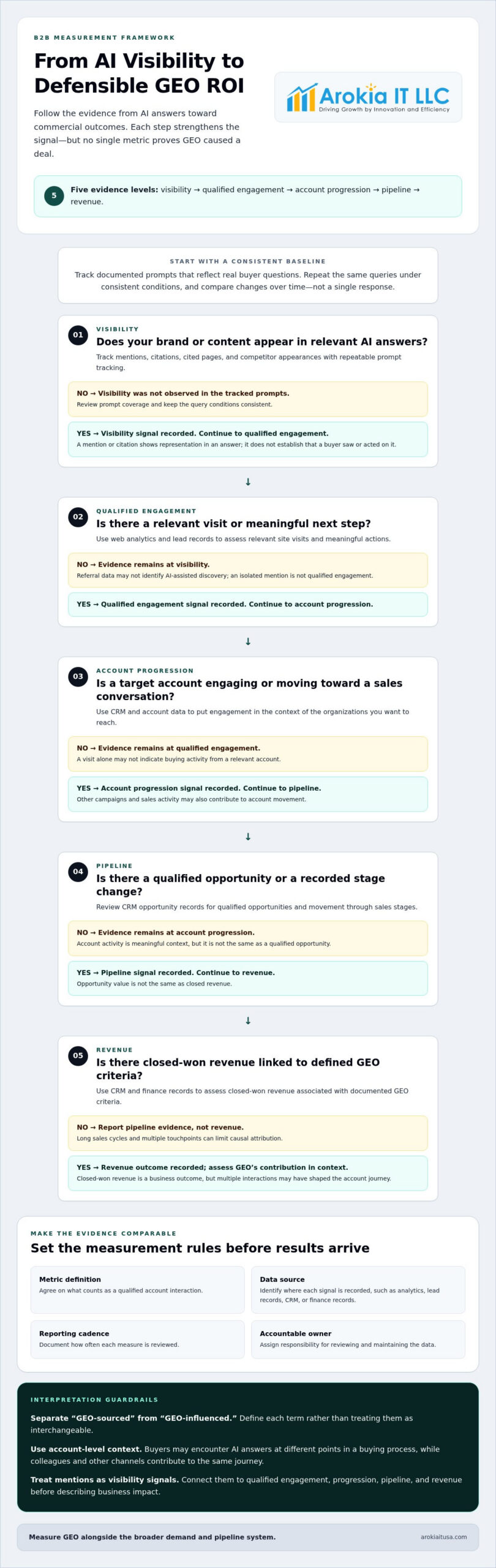
A useful GEO measurement system follows evidence from exposure to business impact. Track five levels: visibility, qualified engagement, account progression, pipeline, and revenue. Each answers a different question. Visibility shows whether content appears in relevant AI answers; engagement indicates whether people take meaningful next steps; account progression captures activity from target organizations; pipeline and revenue show commercial results. No single metric proves GEO caused a deal, but the sequence helps assess its contribution.
Before launch, document each metric’s definition, data source, reporting cadence, and accountable owner. For example, decide what counts as a qualified account interaction, which CRM field records opportunity stage, and who reviews the data. This groundwork makes trends comparable and prevents teams from redefining success after results arrive.
| Metric level | Role and likely data source | Key limitation |
|---|---|---|
| Visibility | Mentions, citations, cited pages, and competitor appearances; repeatable prompt tracking | Doesn’t establish that a buyer saw or acted on an answer |
| Qualified engagement | Relevant site visits and meaningful actions; web analytics and lead records | Referral data may not identify AI-assisted discovery |
| Account progression | Target-account engagement and movement toward sales conversations; CRM and account data | Other campaigns and sales activity may contribute |
| Pipeline | Qualified opportunities and stage changes; CRM opportunity records | Opportunity value is not the same as closed revenue |
| Revenue | Closed-won revenue associated with defined GEO criteria; CRM and finance records | Long cycles and multiple touchpoints limit causal attribution |
Which leading indicators can show GEO progress?
Use a documented set of prompts that reflect real buyer questions, and repeat the same queries under consistent conditions. Record whether the brand or its content appears, which pages are cited, and which competitors appear. Compare changes over time instead of treating one response as a trend. Google Search Console and web analytics can add context through search and referral patterns, but they don’t provide a complete record of AI-assisted discovery.
How should teams measure pipeline and revenue outcomes?
Use CRM records to evaluate qualified target accounts, opportunity creation, stage progression, and closed revenue. Define “GEO-sourced” separately from “GEO-influenced.” Sourced activity meets a documented standard for originating through a traceable GEO interaction, while influenced activity records relevant exposure alongside other touchpoints. Don’t combine the labels. A disciplined demand generation approach connects channel activity to pipeline definitions shared by marketing and sales. For a broader view of linking AI initiatives to business value, see Bain & Company’s Guide to Scaling Generative AI for Marketing ROI.
Review leading indicators regularly and pipeline outcomes on a cadence that reflects your sales cycle. This keeps early GEO signals visible without mistaking them for booked business. Teams building an accountable measurement model can connect GEO measurement priorities to broader pipeline goals.
Which GEO ROI Measurement Approach Fits Your Data?
The right measurement approach depends on the decision you need to make and the evidence your team can maintain. Manual prompt sampling can reveal directional visibility patterns. Dedicated monitoring tools can make repeated checks easier across prompts or AI platforms. Analytics and CRM data help connect observed activity to account engagement and commercial outcomes. Each method has limits: a dashboard can organize evidence, but it can’t establish that GEO caused a sale.
Compare the options against five practical criteria before selecting a workflow:
- Repeatability: Can the team run the same prompts, platform checks, and scoring rules consistently over time?
- Coverage: Does the method represent relevant buyer questions and the AI platforms your audience uses, or only a narrow sample?
- Cost of operation: Consider not only software expense, but also staff time for collection, review, cleanup, and reporting.
- Integration: Can visibility findings be reviewed alongside analytics, account records, and CRM opportunity data?
- Decision usefulness: Will the results help determine what content or measurement process to change, or simply produce more activity counts?
For measuring GEO ROI, the strongest setup often combines visibility tracking with analytics and CRM evidence. Use visibility tracking to see whether GEO work is appearing in answers, then assess whether relevant accounts engage and progress. Treat correlation and assisted influence as evidence of association, not proof of causation.
When is manual AI visibility tracking sufficient?
Manual tracking can be a practical starting point when the team needs a directional view and can review a manageable prompt set consistently. Record the exact prompts, AI models, dates, and scoring rules for each check. Human reviewers should confirm whether a response contains a genuine brand mention or citation and capture its context. The sample can reveal changes, but it isn’t a census of all AI answers or buyer exposure.
When should teams add monitoring and CRM data?
Add a monitoring tool when manual checks no longer provide the repeatability or breadth needed to compare multiple prompts and models. Add analytics and CRM analysis when the business question shifts from “Are we visible?” to “Are target accounts engaging or progressing?” These records support a fuller assessment, though gaps in referral tracking and sales attribution remain. A coordinated AI search optimization strategy can align visibility activity with measurement goals.
A combined approach works best when each system has a defined role: monitoring captures visibility patterns, analytics provides site behavior, and CRM records account and opportunity movement. Reconcile reporting periods and account definitions before drawing conclusions. To consider how measurement choices fit your pipeline priorities, review your GEO measurement needs with Arokia IT LLC.
How to Measure the ROI of Generative Engine Optimization Step by Step
A credible GEO ROI process starts before the first report. Set the business objective, preserve a comparable baseline, and agree on how visibility evidence will connect to account and opportunity records. Without those controls, measurement can change along with the reporting method, making progress hard to verify.
- Set the business objective. Choose a decision GEO should inform, such as improving visibility for priority buyer questions or supporting engagement from target accounts. Specify the outcome and the period you’ll evaluate.
- Build the baseline. Document the prompt set, relevant AI platforms, target accounts, current brand appearances, citations, cited pages, and existing content. Capture current analytics and CRM context so future movement has a point of comparison.
- Define the tracking rules. Standardize UTM conventions for links you control, relevant CRM fields, the attribution window, and which interactions qualify as GEO-sourced or GEO-influenced. Record how missing or ambiguous data will be handled.
- Collect observations consistently. Keep prompt wording, model, review dates, and scoring rules stable between checks. Log the response and cited destination page, and note changes to the method that could affect comparisons.
- Connect evidence to business records. Compare visibility trends with relevant web engagement, target-account activity, opportunity creation, and stage movement. Use only the associations supported by your tracking criteria.
- Review and act. At the agreed reporting interval, assess data quality and changes against the objective. Decide whether to improve coverage, continue the measurement period, or revise the method before drawing a conclusion.
How do you establish a defensible GEO baseline?
Select prompts that reflect actual buyer questions and relevant B2B use cases, not just broad category terms. For each observation, log the model, exact prompt, date, brand appearance, citation, and destination page. Also record existing engagement and CRM status for target accounts. Note gaps, such as unavailable referral detail, so the baseline makes clear what the comparison can and can’t establish.
How should you calculate and interpret GEO ROI?
Use a consistent formula: (attributable return minus GEO investment) divided by GEO investment. Define the return basis and which GEO costs are included before calculating, then apply those definitions across reporting periods. For example, don’t count the full value of an influenced opportunity as realized return while also crediting it to another channel. Pipeline is not closed revenue, and observed association does not prove GEO caused a sale. An AI visibility scorecard can help organize visibility observations alongside business evidence.
Consistent baselines make GEO comparisons more useful because they separate genuine changes in performance from changes in prompts, platforms, or measurement rules.
Turn GEO Measurement Into a B2B Growth Decision
Measurement matters only if it changes what the team does next. A visibility gap may call for stronger content coverage. Repeated citations from weak or irrelevant sources may point to a need to strengthen authority. Inconsistent tracking may mean the measurement process needs repair before anyone makes a budget decision. GEO belongs inside the broader B2B growth system, alongside demand generation, sales enablement, and other channels. It isn’t a guaranteed standalone revenue source.
How should teams decide whether to refine, maintain, or expand GEO?
Refine when relevant buyer prompts repeatedly surface competitors or fail to surface useful brand content. Identify the missing question, page, or evidence, then prioritize a focused improvement. Maintain the current approach when findings are mixed, tracking is incomplete, or target accounts are still early in their research. Expand only when documented evidence supports a clear next test, such as extending coverage to another buyer use case. Set the test’s success criteria before increasing scope.
Weak results don’t always mean the strategy failed. They may reveal that the prompt set misses buyer language, the content doesn’t answer a decision-stage question, or tracking can’t connect discovery to account activity. Diagnose the cause before changing investment. If the evidence is inconclusive, preserve the current baseline and improve the measurement rather than presenting uncertainty as either success or failure.
How can GEO measurement align with account-based growth?
Bring marketing and sales into the review with shared definitions for target accounts, qualified engagement, and opportunity progression. Connect recurring AI search questions to account priorities. If target buyers need clear comparisons or implementation guidance, use those findings to guide content and sales enablement. A coordinated Account-Based Marketing strategy can organize activity around priority accounts, while GEO remains one input among several in the account’s journey.
In the review, distinguish what the team observed from what it can reasonably infer. A target account’s relevant engagement alongside GEO visibility may support an influence hypothesis; it doesn’t establish that GEO caused the opportunity. Agree on the next action, owner, review point, and evidence needed to continue or change course. This keeps decisions accountable without overstating attribution.
Make Your Next GEO Decision With Confidence
The next step is to turn measurement into a decision your team can revisit: define what evidence would justify a change, assign responsibility for acting on it, and set a review point. A useful process for measuring GEO ROI doesn’t force certainty where attribution is incomplete. It gives leaders a consistent basis for deciding what deserves further investment and what needs a closer look.
Arokia IT LLC brings AI Search and GEO into a broader B2B marketing perspective, connecting strategy with demand generation and 90-day pipeline forecasting. That keeps GEO accountable to business priorities rather than treating visibility as an end in itself. Your measurement plan can start with the questions your sales team hears, the accounts that matter, and the evidence your organization can reliably track.
Build from what you can verify, stay deliberate about what you infer, and let better evidence guide the next step in growth. Talk with Arokia IT LLC about a measurement-led GEO strategy for your pipeline.
Frequently Asked Questions
What is the ROI of generative engine optimization?
GEO ROI compares business return attributable to GEO with the investment in the work. For a useful analysis, decide whether “return” means booked revenue, gross profit, or another business measure, and apply that choice consistently. Include relevant internal labor and measurement expenses in the investment if they’re part of your accounting approach. When measuring GEO ROI, report the period and attribution confidence alongside the result so leaders can interpret it appropriately.
How do you calculate GEO ROI?
Use (attributable return minus GEO investment) divided by GEO investment. To make the result usable, document the cost categories, return basis, and reporting period before calculating. For example, don’t switch from closed revenue in one review to open pipeline in the next and compare the percentages as if they measured the same thing. Keep opportunity records distinct when assigning source and influence classifications, and explain any assumptions behind the calculation.
Can you attribute B2B leads to generative engine optimization?
Some GEO-related lead interactions can be identified, but a complete attribution record is uncommon. Use consistent campaign tags on links where possible, preserve relevant referral details, and train intake teams to ask prospects how they first encountered the company. A short CRM note can capture the prospect’s wording and date without forcing it into a definitive source category. Review those records periodically for missing fields or inconsistent staff interpretation.
How long does it take to measure GEO results?
There’s no universal timeline. Set review points that reflect your sales cycle and separate early checks from later business assessments. An initial review can examine whether tracked prompts produce relevant answers, while a later review can check whether priority accounts have advanced. Keep comparison periods and criteria stable; if a platform or tracking method changes, record the change so it isn’t mistaken for a performance shift.
Which metrics should a B2B company track for GEO?
Track relevant mentions and citations, qualified visits or engagement, target-account activity, opportunity progression, and revenue. Make each measure specific enough that two people would classify the same event the same way. For example, define which pages or actions qualify as meaningful engagement and what evidence makes an account “active.” Assign a data source and owner to each measure, then remove metrics that don’t inform a decision.
Are AI visibility scores enough to prove GEO ROI?
No. A visibility score reflects a tool’s selected prompts, platforms, and scoring method, so it’s best treated as a directional measure. Before comparing scores, check whether the tracked prompt set and scoring methodology stayed consistent. Pair visibility observations with analytics and CRM records when evaluating commercial relevance, and label gaps where activity can’t be connected. A scorecard can guide investigation, but shouldn’t stand alone as a financial result.
How is GEO ROI different from SEO ROI?
Both evaluate business value relative to investment, but GEO analysis also examines whether a brand is represented or cited in generated answers. SEO reporting often focuses on rankings and visits to owned pages; those measures may not show every AI-assisted discovery interaction. To compare channel contribution, use shared business outcomes and separate channel-specific evidence. This lets a team see complementary roles without assuming that GEO replaces SEO or that either channel acts alone.