
Organic click-through rates now suffer a 61 percent drop whenever a Google AI Overview claims the top of the screen. For executive leadership, this isn’t merely a technical hurdle; it’s a direct challenge to market share. The reality is that 60 percent of searches now conclude without a single click to a website. Success in this environment requires an immediate pivot to b2b generative engine optimization. You can’t rely on legacy SEO tactics to win in a world where 51 percent of software buyers start their research with an AI chatbot rather than a search bar.
You’ve likely felt the pressure of declining organic traffic and the opacity of AI citation algorithms. It’s difficult to prove ROI when the engines providing the answers don’t always offer a clear path to your site. This guide provides the systematic solution to that complexity. We’ll show you how to position your B2B brand as the authoritative source for Large Language Models, ensuring your expertise is cited, not just summarized. You’ll learn to capture high-intent traffic from Perplexity and ChatGPT while aligning your search presence with 90-day pipeline targets. This is the transition from simple lead generation to true AI-driven authority.
Key Takeaways
- Transition your search strategy from traditional blue links to answer-based discovery by implementing a rigorous framework for b2b generative engine optimization.
- Leverage HubSpot AEO and structured schema to transform your website into a verified retrieval asset that AI engines can confidently ingest and cite.
- Pivot from page-level ranking metrics to entity-level authority to increase the probability of your brand appearing in high-intent conversational AI prompts.
- Align your AI search presence with your 90-day pipeline forecast to ensure digital visibility translates directly into measurable revenue growth.
Defining the Shift: Why B2B Generative Engine Optimization (GEO) Is Non-Negotiable in 2026
Traditional search is failing. It isn’t a gradual decline; it’s a structural collapse of the “blue link” era. By April 2026, Google AI Overviews appeared on 86.7 percent of business-intent searches, effectively shielding users from ever reaching a website. This shift forces a move toward Generative Engine Optimization (GEO), a discipline focused on entity authority rather than just indexable text. If your brand isn’t part of the AI’s synthesized answer, you don’t exist in the buyer’s journey.
b2b generative engine optimization isn’t about gaming an algorithm for clicks. It’s about ensuring your technical infrastructure and content are structured for Large Language Model (LLM) retrieval. When a procurement officer asks ChatGPT for the top three industrial pump manufacturers with specific ISO certifications, your brand must be the definitive answer. This immediacy shortens the B2B sales cycle by eliminating the research friction that typically stalls complex deals. It positions your brand as a verified solution before a human salesperson even enters the conversation.
The Anatomy of an AI-Generated Answer
The Business Impact of Zero-Click Search
The risk of invisibility is quantifiable. With 60 percent of searches ending without a click, traditional traffic metrics are becoming vanity indicators. For industrial marketing leaders, this disruption is particularly acute. Complex technical specs are easily summarized by AI, meaning users get the data they need without visiting your homepage. You must transition your KPIs from sessions to “citation share.” This metric measures how often your brand is recommended as the solution in conversational prompts. It’s the only way to protect your position in a modern ABM strategy where the AI is the first gatekeeper.
The Mechanics of B2B AI Search: How HubSpot AEO and LLMs Ingest Your Brand Authority
Search is shifting from a list of links to a synthesis of facts. As Gartner predicts, traditional search engine volume will drop by as much as 25 percent by 2026. This isn’t a threat; it’s a strategic opportunity for those with disciplined data. AI engines like Perplexity and ChatGPT don’t just browse; they ingest. They look for structured, verifiable signals within your technical architecture to assign a confidence score to your brand. High data hygiene in your CRM and CMS translates directly into high citation probability. Poorly managed data leads to exclusion.
Leveraging HubSpot for Answer Engine Dominance
HubSpot is no longer just a repository for leads. In 2026, it functions as a structured knowledge base that feeds answer engines. By utilizing HubSpot’s structured content tools, you provide the explicit context LLMs need to categorize your brand. This requires integrating traditional B2B SEO with generative-ready formatting. Case studies and product specs must be machine-readable. If GPTBot can’t parse your technical documentation, the AI won’t recommend you. You must ensure your site architecture is open and optimized for non-traditional crawlers to validate your authority.
Topic Clusters and Semantic Mapping
Keywords are dead weight in a generative world. LLMs prioritize semantic mapping and entity association over exact-match phrases. Your content marketing must pivot toward building a comprehensive “Knowledge Graph” for your brand. This means creating deep topic clusters that solve specific executive problems with technical precision. AI engines map these internal links to understand the hierarchy of your expertise. When your content provides genuine information gain, it triggers higher retrieval probability in RAG systems. It’s about becoming the primary node in the AI’s understanding of your industry.
Success in b2b generative engine optimization depends on this technical foundation. You can’t force authority; you must build it through disciplined data management and strategic content alignment. If your current search presence feels fragmented, it’s time to evaluate your readiness for an AI-first market. You can start by assessing your current visibility through a specialized AI search optimization audit to identify critical gaps in your machine readability.
SEO vs. GEO: Navigating the Convergence of Traditional Search and AI Overviews
You can’t abandon traditional search tactics. They remain the foundation for technical health and indexability. However, your existing search engine optimization strategy must include a generative layer to survive the current disruption. Google AI Overviews now bridge the gap between traditional blue links and synthesized answers. They often cite the very pages that rank high in organic results, but they only do so if those pages provide clear, extractable data. Maintaining visibility in Perplexity and other AI-native search platforms depends on this layered approach to b2b generative engine optimization. You must satisfy the human reader’s need for depth while meeting the AI’s requirement for structured citation.
Information Gain: The Key Differentiator
AI engines ignore repetitive, low-value content. They’re programmed to prioritize “Information Gain,” a metric that rewards unique data and expert analysis. If your article simply summarizes what ten other sites have already published, an LLM has no reason to cite your domain. You must provide proprietary data or technical insights that add something new to the model’s knowledge base. This is where sales enablement content becomes a critical retrieval asset. By publishing technical white papers, original research, or specific industrial case studies, you give the AI “new” information to ingest. High-value content isn’t just about persuasion; it’s about providing the raw data that makes your brand the most authoritative answer in a generative search. Understanding why traditional SEO content marketing strategies fail in 2026 is essential context for building a content approach that actually earns AI citations.
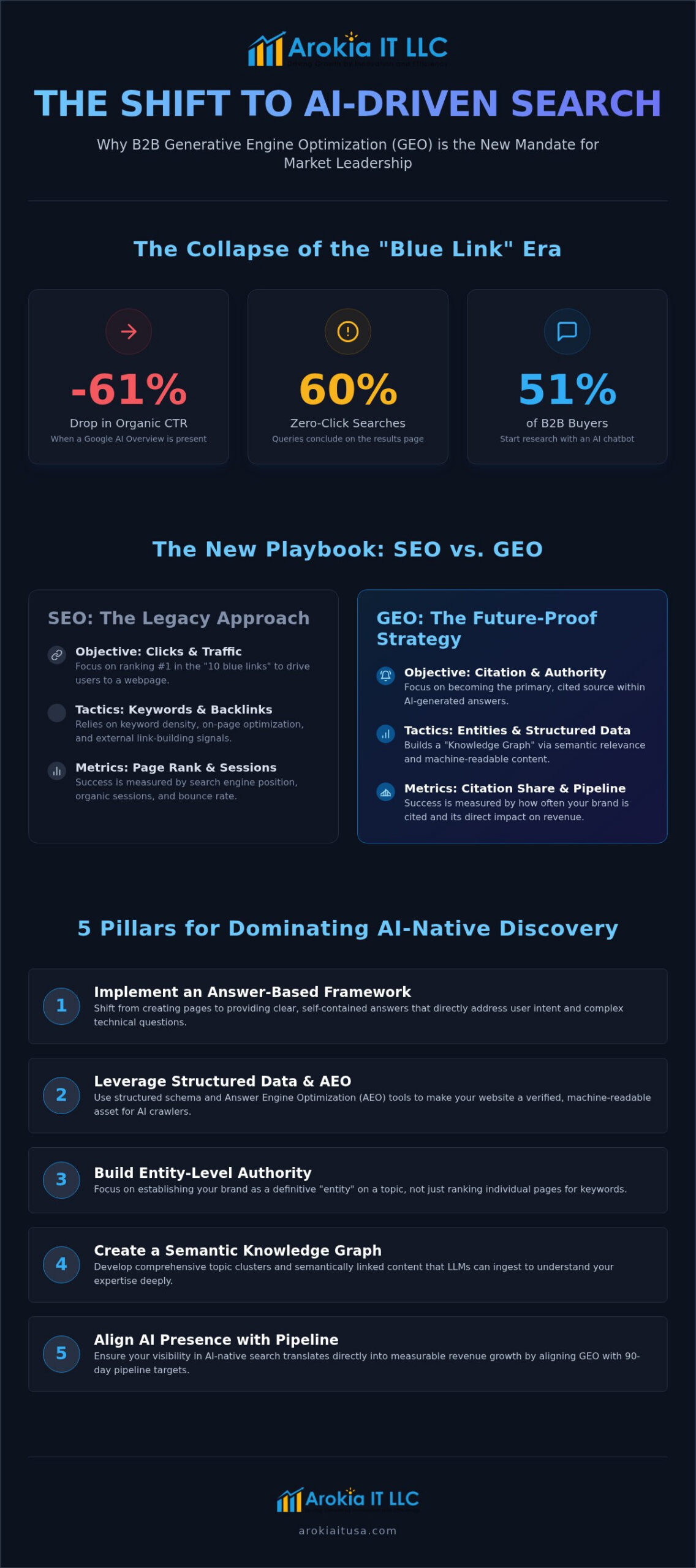
Executing a B2B GEO Strategy: 5 Pillars for Dominating AI-Native Discovery
- Pillar 1: Technical Accessibility. AI agents and crawlers like GPTBot must navigate your site architecture without friction. If your robots.txt or site speed hinders these bots, your data remains invisible to the engine.
- Pillar 2: Structured Data and Schema. You must provide the explicit context AI engines need to categorize your brand. Schema markup acts as a translator, turning your web pages into a structured knowledge graph that LLMs can easily parse.
- Pillar 3: Authority Building. Securing third-party citations validates your position in the LLM training set. This is where you solve the “Information Gain” problem. AI models prioritize sources that offer unique, non-derivative data that competitors lack. When industry journals cite your technical findings, the LLM views your brand as a primary source of truth.
- Pillar 4: Q&A Optimization. You must address high-stakes buyer questions in self-contained, direct formats. This ensures your brand is the chosen answer for complex procurement prompts.
- Pillar 5: Continuous Monitoring. Visibility is not static. You must use an AI Scorecard to track your brand’s citation frequency and sentiment across major LLM platforms.
Structuring Content for Retrieval-Augmented Generation (RAG)
Integrating GEO with lead nurturing allows you to enter the buyer’s journey at the earliest possible stage. B2B buyers often use AI to validate technical objections or compare complex specs before ever engaging with a vendor. If your content provides the authoritative answer to a specific manufacturing or industrial hurdle, you establish trust immediately. This alignment ensures that your AI-native discovery efforts aren’t just for visibility. They are strategic tools for moving high-intent leads through the funnel by solving their most granular procurement pains before the first sales call.
Schedule a GEO strategy consultation
Strategic Integration: Aligning AI Search Optimization with Your 90-Day Pipeline Forecast
Visibility is the prerequisite for revenue. In 2026, that visibility is increasingly mediated by generative engines. b2b generative engine optimization is not a vanity exercise for the marketing department; it’s a critical component of a high-performing Account-Based Marketing (ABM) engine. When 73 percent of B2B buyers utilize AI tools like ChatGPT or Perplexity for vendor research, your absence from those answers isn’t just a missed click. It’s a lost opportunity to influence the initial consideration list. Executive leadership must recognize that AI-native search is where the first 30 days of your sales cycle now live. You can’t afford to be invisible during the research phase.
The 90-Day Pipeline and AI Visibility
Your pipeline health depends on your brand’s citation share. By dominating AI-driven discovery, you reduce the cost of customer acquisition through early, authoritative engagement. We can predict revenue growth by measuring how often your brand is recommended as a solution in target industries. Arokia IT LLC integrates GEO into a comprehensive growth strategy by ensuring your technical authority is verified by the LLMs your prospects trust. This systematic approach ensures that AI search optimization isn’t a standalone tactic. It’s a validated driver of your 90-day pipeline forecast. We focus on tangible outcomes rather than creative flourishes. Precision in your digital footprint leads to predictability in your revenue stream.
Next Steps: Evaluating Your AI Readiness
The transition to AI-native search requires an objective assessment of your current digital footprint. You can’t optimize what you haven’t measured. The first step is a clinical audit using an AI Scorecard to identify where your brand is being cited and where it’s being ignored. This data-driven evaluation provides the roadmap for eliminating technical waste and focusing on high-impact content. You need a results-first mindset to navigate this shift. If your current search strategy isn’t producing the citation frequency necessary to capture modern demand, you’re falling behind. You must bridge the gap between marketing effort and revenue outcome by partnering with an expert who understands the mechanics of AI authority.
Securing Your Digital Authority in the Generative Era
The shift from traditional search results to AI-synthesized answers represents a permanent structural change. You can’t rely on legacy SEO when 60 percent of searches end without a website click. Success requires a disciplined commitment to b2b generative engine optimization. It’s the only way to ensure your brand remains the authoritative source for LLMs and procurement bots alike. If you aren’t part of the synthesized answer, you don’t exist in the buyer’s journey.
We provide specialized expertise in industrial marketing and 90-day pipeline forecasting. We don’t offer creative flourishes; we deliver systematic solutions for financial growth. By optimizing your technical architecture and content for machine retrieval, we transform your digital presence into a verified revenue driver. We’re a strategic partner dedicated to the elimination of waste and the acceleration of your sales cycle.
Take control of your visibility before the competition defines your brand for you.
Frequently Asked Questions
What is the difference between SEO and Generative Engine Optimization?
SEO focuses on ranking pages within a list of links, while b2b generative engine optimization focuses on being cited within a synthesized answer. Traditional search rewards keyword density and backlink volume to drive site traffic. Generative engines prioritize entity authority and information gain to provide direct solutions. Success in GEO means your brand becomes the primary source that an LLM uses to construct its response to a buyer’s prompt.
How does HubSpot AEO help my B2B brand rank in AI Overviews?
HubSpot AEO organizes your CRM and CMS data into a structured knowledge base that AI crawlers can easily ingest. It transforms your technical white papers and product specifications into machine-readable assets. By maintaining high data hygiene, you increase the confidence score AI engines assign to your brand. This structure ensures that Google AI Overviews can extract and attribute your specific insights as the definitive answer for procurement queries.
Will GEO help my industrial manufacturing company find more leads?
GEO captures high-intent demand by positioning your technical specs as the authoritative solution for complex manufacturing prompts. Industrial buyers often use AI to compare ISO certifications or material tolerances before contacting a salesperson. GEO ensures your brand is the one cited in those high-stakes research conversations. It shortens the sales cycle by resolving technical objections early. This visibility influences the buyer’s consideration list before they ever visit your website.
Do I need to rewrite all my content for AI search optimization?
A total overhaul is rarely necessary, but you must restructure your primary retrieval assets. Focus on your most authoritative technical content and case studies first. These pages require self-contained paragraphs and clear H2 and H3 segments to facilitate Retrieval-Augmented Generation. The goal is to provide unique information gain that the AI cannot find elsewhere. Strategic restructuring is more effective for revenue growth than simply increasing your word count.
How can I measure the ROI of my GEO strategy?
ROI is measured through citation share and its direct impact on your 90-day pipeline forecast. You must track how often your brand is recommended in AI prompts compared to your competitors. High-value account engagement often begins with an AI-driven discovery session. By monitoring the transition from an AI citation to a sales-qualified lead, you can quantify the financial impact of your optimization efforts. It’s about revenue accountability, not vanity traffic metrics.
Is ChatGPT considered a search engine for B2B marketing purposes?
How does GEO integrate with my existing ABM campaigns?
GEO serves as the discovery layer for your ABM strategy by influencing target accounts during their anonymous research phase. When a high-value prospect asks an AI for industry solutions, your GEO-optimized content ensures your brand is the cited expert. This creates early trust and positions your sales enablement content as the primary resource. It aligns your digital visibility with the specific technical needs of your target accounts, accelerating the overall sales motion.