
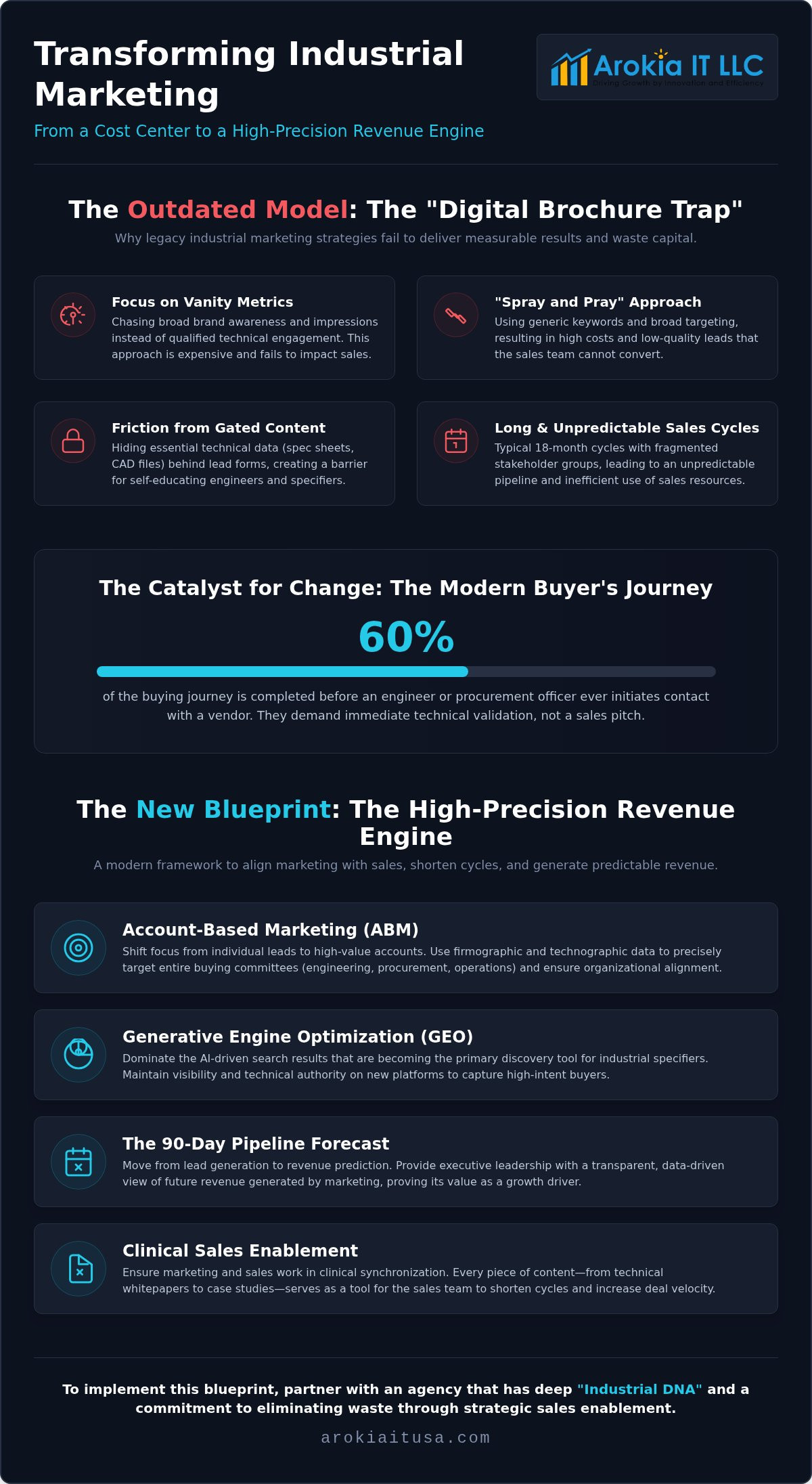
Broad brand awareness is the most expensive way to fail in the industrial sector. For years, manufacturers have treated marketing as a necessary overhead, a vague cost of doing business that produces glossy brochures but fails to move the needle on technical sales. If your current industrial marketing agency focuses on vanity metrics like impressions while your sales team struggles with eighteen-month cycles and fragmented stakeholder groups, you’re not just losing leads; you’re hemorrhaging capital. Precision is no longer optional in a market defined by AI-driven search and hyper-specific buyer requirements.
The misalignment between marketing content and sales enablement is a structural failure that creates friction in every deal. You recognize the waste inherent in broad branding that never reaches the desk of a specifier. This article provides the blueprint to transform your marketing from a cost center into a high-precision revenue engine. We’ll examine how to implement a predictable 90-day pipeline forecast, dominate AI-driven search results through Generative Engine Optimization (GEO), and leverage Account-Based Marketing to collapse complex sales cycles into manageable, data-driven outcomes.
Key Takeaways
- Transition from a passive “digital brochure” strategy to a high-precision revenue engine that prioritizes technical engagement over vanity metrics.
- Deploy Account-Based Marketing (ABM) to focus resources on high-value accounts, ensuring alignment across multiple stakeholders in complex sales cycles.
- Master Generative Engine Optimization (GEO) to maintain visibility as AI platforms become the primary discovery tools for industrial specifiers.
- Establish a 90-day pipeline forecast to provide executive leadership with a transparent, data-driven view of future revenue generated by marketing efforts.
- Select an industrial marketing agency that demonstrates deep “Industrial DNA” and a commitment to eliminating waste through strategic sales enablement.
The Evolution of Industrial Marketing: Why Digital Brochures Fail in 2026
Industrial marketing is no longer a creative support function. It’s a strategic revenue engine. For decades, manufacturers treated their websites as static catalogs; essentially digital brochures that listed parts and capabilities. This “Digital Brochure Trap” assumes that the buyer needs a salesperson to explain technical specifications. In reality, the modern specifier is self-educated. They don’t want a sales pitch; they want technical validation.
Industrial marketing has transitioned from simple relationship management into a complex data science. Research indicates that engineers and procurement officers now complete roughly 60% of their buying journey before they ever initiate contact with a vendor. They’re not looking for broad branding. They’re looking for clinical proof of performance. A generalist firm cannot provide this. You need a dedicated industrial marketing agency that understands the mechanics of high-stakes manufacturing and the granular requirements of the technical buyer.
The “spray and pray” approach of the past, buying broad keywords and hoping for “awareness,” is a clinical waste of capital. 2026 demands high-precision demand generation. This strategy targets specific technical problems rather than vague industry terms, ensuring your budget is spent only on reaching those with the authority to specify your products.
The Death of Passive Lead Generation
Traditional contact forms are failing. High-stakes B2B buyers find gated content to be a source of friction, not a value-add. If an engineer has to trade their phone number for a CAD file or a spec sheet, they’ll often look for a competitor who provides that data freely. Immediate technical authority is the new currency. You don’t build trust by hiding your expertise behind a lead magnet; you build it by proving your solution’s viability before the first meeting occurs. Your industrial marketing agency must prioritize information gain over gatekeeping to maintain engagement.
Aligning Marketing with the Industrial Sales Cycle
Industrial purchasing involves long cycles and multiple stakeholders. It isn’t a single person making a choice; it’s a committee building consensus. Marketing must support this by providing sales enablement content that speaks to different personas, from the efficiency-minded engineer to the risk-averse CFO. When marketing and sales work in silos, the pipeline becomes unpredictable. True alignment ensures that every piece of content serves as a tool for the sales team to shorten the cycle and increase deal velocity. It’s about clinical synchronization between what the buyer reads and what the salesperson says.
Account-Based Marketing (ABM) for Industrial Sectors: Engineering the High-Value Sale
Industrial sales don’t happen in a vacuum. They’re sanctioned by complex committees, often involving engineering, procurement, and operations. Traditional lead generation fails here because it focuses on the individual rather than the entity. An expert industrial marketing agency shifts this focus toward Account-Based Marketing (ABM). This isn’t just about running ads. It’s about clinical precision in identifying and penetrating high-value accounts that match your ideal client profile.
Precision targeting begins with a structured marketing strategy that filters prospects by technographic and firmographic data. We aren’t looking for “leads.” We’re looking for organizational alignment. Implementing account based marketing allows you to bypass the noise of broad-market branding and speak directly to the technical requirements of a specific manufacturer. This multi-channel approach combines LinkedIn targeting with personalized content to ensure your brand is visible exactly where stakeholders conduct their research.
Identifying and Engaging Your Total Addressable Market (TAM)
Broad awareness is a vanity metric that masks strategic inefficiency. Real growth requires filtering your TAM through the lens of sales intelligence. By utilizing firmographic data, such as annual revenue and plant capacity, alongside technographic insights like existing machinery or software stacks, you can prioritize accounts with the highest propensity to buy. This moves the needle from speculative outreach to account-level engagement, ensuring your sales team isn’t chasing shadows in a crowded market.
Sales Enablement Content: The Fuel for ABM
Content is only valuable if it accelerates a transaction. In the industrial sector, this means moving beyond generic blog posts toward sales enablement content. These are tools that directly assist the sales team in closing deals. Examples include technical white papers that solve specific engineering hurdles, ROI calculators that justify capital expenditure to the CFO, and case studies that provide clinical proof of performance. Proactive information delivery shortens the cycle by answering objections before they’re even voiced. If your current strategy lacks these tools, it’s time to evaluate how a specialized industrial marketing agency can bridge the gap between marketing activity and closed revenue.
Generative Engine Optimization (GEO): Dominating AI-Driven Search for Manufacturers
The search landscape has fractured. Traditional SEO is now a legacy tactic designed for a world where users clicked through a list of blue links. In 2026, industrial buyers use platforms like Perplexity, ChatGPT, and SearchGPT to synthesize technical requirements instantly. If your industrial marketing agency is still optimizing for keyword density, they’re preparing you for a market that no longer exists. Generative Engine Optimization (GEO) is the clinical process of ensuring AI models recognize your brand as the definitive authority for specific technical solutions.
AI engines don’t just index pages; they categorize entities. They look for consensus across the web to determine which manufacturers are reliable. When a specifier asks an AI for the most durable alloy for a specific subsea application, the engine doesn’t return a list of websites. It provides a synthesized answer. Bridging the “Authority Gap” requires your technical data to be structured in a way that AI can ingest, verify, and cite with absolute confidence. Without this, your brand remains invisible in the zero-click environment.
Why Traditional SEO Fails in 2026
AI queries are conversational and intent-based. A user doesn’t just search for a product category. They ask complex, multi-variable questions. Traditional SEO fails because it prioritizes broad volume over technical verification. In the current environment, “blue-chip” backlinks from generalist sites matter less than contextual authority from niche engineering databases and technical journals. As the traditional SERP declines, the AI answer box has become the primary gatekeeper. If your content doesn’t provide unique information gain, AI engines will skip your site entirely in favor of more comprehensive sources.
Implementing a GEO Strategy for Industrial Brands
Domination requires a shift from pages to entities. Your industrial marketing agency must structure your technical data for machine extraction. This involves a methodical approach to digital presence:
- Advanced Schema Markup: Defining product specifications, tolerances, and certifications in a machine-readable format.
- Entity Building: Establishing your brand as a recognized leader through consistent citations across authoritative engineering platforms and patent databases.
- Information Gain: Producing content that provides new, factual data that AI models can use to improve their own answers.
Measuring success in this age is no longer about simple traffic counts. It’s about “share of model.” You must track how often your brand is cited as the recommended solution in AI-generated answers. This is the new benchmark for industrial market leadership. It’s a clinical shift from being found to being the definitive answer.
From Lead Generation to Revenue Prediction: The 90-Day Pipeline Forecast
Marketing is often viewed as a speculative expense. In the industrial sector, this perception stems from a historical lack of accountability. When an industrial marketing agency focuses solely on lead volume, they ignore the clinical reality of the sales floor. A lead is not revenue. It is merely a possibility. To bridge this gap, we implement the 90-Day Pipeline Forecast, a rigorous methodology that translates marketing activity into anticipated financial outcomes. This shift moves marketing from the “creative” bucket into the “engineering” bucket, where every input has a measurable output.
This approach eliminates marketing waste by focusing on high-probability opportunities rather than broad-market noise. By analyzing specific variables such as historical lead-to-opportunity conversion rates, average deal size, and sales velocity, we can project revenue with mathematical precision. This isn’t a speculative 12-month projection that lacks immediate utility. It’s a clinical look at the next quarter, providing the transparency required for effective capital allocation. When you know the exact value of your pipeline, you can scale your manufacturing capacity with confidence.
The Mechanics of Predictable Revenue
The relationship between a manufacturer and their agency must be built on measurable outcomes. The “No-Fluff” reporting model rejects vanity metrics like impressions or clicks. Instead, it focuses on pipeline value and deal velocity. When an industrial marketing agency commits to a revenue forecast, they become a strategic partner in your financial growth rather than a mere service provider. This level of transparency empowers executive leadership to make informed decisions about scaling operations or expanding product lines. You aren’t buying ads; you’re investing in a validated revenue stream that prioritizes the health of your balance sheet.
To see how this precision impacts your bottom line, explore our 90-day pipeline forecasting methodology.
Choosing an Industrial Marketing Agency: Aligning Strategy with Sales Execution
Versatility is a liability in high-stakes B2B marketing. Many firms position themselves as generalists to capture a broader market share. This is a significant red flag. If an agency offers B2C consumer marketing, e-commerce retail development, or managed IT services, they lack the specialized focus required to navigate the technical “specifier to buyer” journey. These agencies often prioritize creative flourishes over technical accuracy. In a manufacturing environment, a “creative-first” approach fails because it ignores the granular pains of the engineer and the risk-aversion of the CFO. A true industrial partner explicitly excludes consumer-facing work to maintain a disciplined focus on high-precision demand generation and sales enablement.
The Strategic Onboarding Process
A high-performance partnership begins with an intensive 30-day alignment phase. This isn’t a period of passive observation. It’s a methodical audit of your current sales and marketing silos to identify friction points in the pipeline. During these first four weeks, the focus shifts from data gathering to the construction of a baseline for your 90-day forecast. This transition ensures that every tactical execution is rooted in a validated strategy for revenue growth. By the end of the first month, the agency should provide a transparent roadmap that connects content creation directly to sales outcomes. This level of accountability is what separates a mere vendor from a strategic financial ally.
The complexity of 2026 requires more than just visibility; it requires a systematic engine for predictable growth. If your current marketing efforts feel like a disconnected cost center, it’s time to align your strategy with a partner that prioritizes clinical precision. Partner with Arokia IT to engineer your 2026 revenue and transform your industrial marketing into a high-precision revenue engine.
Engineering the Future of Industrial Revenue
Passive marketing strategies have reached their expiration date. In a landscape defined by complex stakeholder committees and AI-driven discovery, the transition from a digital catalog to a high-precision revenue engine is the only viable path forward. Dominating the technical sales cycle in 2026 requires more than just impressions; it demands a clinical focus on Account-Based Marketing and Generative Engine Optimization to ensure your brand is the definitive answer for every specifier. By implementing a rigorous 90-day pipeline forecast, you move from speculative spending to data-driven growth.
Success requires a partner that understands the granular mechanics of manufacturing. As a specialized industrial marketing agency, Arokia IT utilizes a proprietary GEO framework and a revenue-first methodology to bridge the gap between technical authority and closed deals. We specialize in high-stakes industrial B2B environments where precision is the standard, not the exception. The tools to eliminate waste and accelerate your sales velocity are within reach. It’s time to transform your marketing into a predictable financial asset.
Request Your 90-Day Pipeline Forecast from Arokia IT and start building your competitive advantage today.
Frequently Asked Questions
What is the difference between an industrial marketing agency and a general B2B agency?
An industrial marketing agency specializes in the technical complexity of manufacturing, whereas a general B2B agency often lacks the engineering depth required to engage specifiers. We prioritize technical validation over broad branding. This focus ensures that your content resonates with engineers and procurement officers who manage long sales cycles. By excluding B2C and e-commerce, we maintain a clinical focus on high-stakes industrial demand generation and organizational alignment.
How long does it take to see results from an industrial ABM campaign?
Results from an industrial ABM campaign typically manifest in the pipeline within the first 90 days. While the final transaction for large-scale machinery may take longer, early indicators like account-level engagement and stakeholder identification appear much sooner. We use a 90-day pipeline forecast to track these high-probability opportunities. This methodology provides immediate transparency into the health of your sales funnel before the final contract is signed.
Why is GEO more important than SEO for manufacturers in 2026?
GEO is more important because AI-powered engines like SearchGPT and Perplexity now synthesize technical data into direct answers. Traditional SEO focuses on ranking in a list of links; however, GEO ensures your brand is the cited authority in the AI answer box. For manufacturers, this means your technical specifications must be machine-readable. Without a proprietary GEO framework, your brand remains invisible in a zero-click search environment.
Can an industrial marketing agency help with sales enablement?
A specialized industrial marketing agency bridges the gap between marketing and sales through technical sales enablement content. We produce white papers, ROI calculators, and case studies that help your sales team answer technical objections proactively. This alignment shortens the sales cycle by providing stakeholders with the validation they need at every stage. Content is treated as a clinical tool to drive revenue, not just a creative support function.
What metrics should I use to measure the ROI of industrial marketing?
You should measure ROI using pipeline value, lead-to-opportunity conversion rates, and sales velocity. Vanity metrics like impressions or clicks provide no insight into financial growth. We focus on the 90-day pipeline forecast to provide a data-driven view of future revenue. By tracking how marketing activity accelerates specific high-value accounts, you can calculate the exact return on your marketing investment with mathematical precision.
Does industrial marketing work for niche manufacturing sectors?
Industrial marketing is exceptionally effective for niche manufacturing sectors where the buyer group is small and highly technical. In these markets, broad branding is a waste of capital. ABM allows you to target the exact firms and specifiers who require your specific engineering solutions. This precision ensures that your budget is concentrated on the total addressable market, regardless of how specialized or narrow your industry might be.
How does a 90-day pipeline forecast improve business stability?
A 90-day pipeline forecast improves stability by providing executive leadership with a transparent view of upcoming revenue. This allows for more accurate capacity planning and capital allocation. Instead of reacting to market fluctuations, you can manage your manufacturing operations based on validated data. This clinical approach to forecasting eliminates the uncertainty inherent in traditional lead generation, turning your marketing department into a predictable financial asset.
Should an industrial marketing agency handle my LinkedIn presence?
An expert agency should manage your LinkedIn presence as part of a multi-channel ABM strategy. LinkedIn is the primary platform for identifying and engaging stakeholders within high-value accounts. We use it to distribute technical content and build brand authority among engineers and decision-makers. This isn’t about social media “engagement” in a consumer sense; it’s a strategic tool for account-level penetration and sales enablement.