
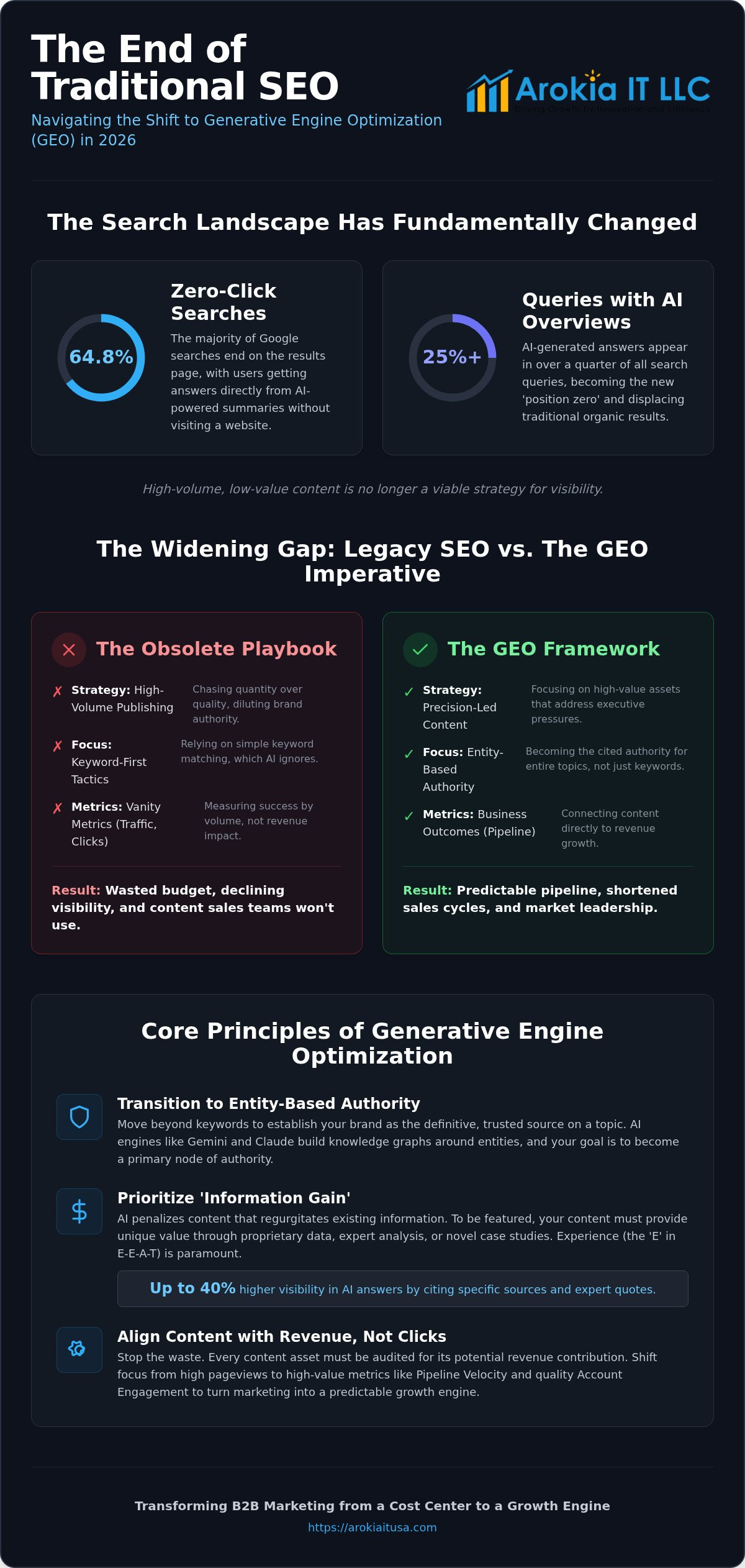
In 2026, 64.82% of all Google searches end without a single click. While many firms continue to exhaust their budgets on a high-volume seo content marketing strategy, the reality is that traditional tactics are failing to penetrate the noise of AI-generated summaries. You’ve likely seen the impact firsthand; organic visibility is declining as AI Overviews now appear in over 25% of all queries. It’s a systemic failure that leaves marketing departments with high production costs and sales teams with content they refuse to use.
We understand the pressure of meeting revenue targets when the search environment is shifting beneath your feet. This guide outlines the transition from legacy SEO to precision-led Generative Engine Optimization (GEO). You’ll discover how to pivot your strategy to serve both human decision-makers and AI engines like Claude and Perplexity. By focusing on verifiable expertise and entity authority, you can move away from vanity metrics and toward a predictable 90-day pipeline forecast that shortens B2B sales cycles and eliminates wasted effort.
Key Takeaways
- High-volume publishing often dilutes B2B authority. Don’t chase quantity; focus on precision-led content that addresses specific executive pressures.
- Transition your seo content marketing strategy from keyword-first tactics to entity-based GEO to secure your position as a cited authority in AI answer engines.
- Eliminate the gap between marketing and sales by aligning demand generation efforts with the specific needs of your sales execution team.
- Audit your current digital assets for ‘Information Gain’ to ensure they provide the unique insights that 2026 search algorithms demand.
- Leverage technographic and intent data to build a predictable 90-day pipeline forecast that replaces generic traffic with measurable revenue growth.
The Obsolescence of Volume-Based SEO Content Marketing
The rise of zero-click searches, which now account for 64.82% of all queries, has fundamentally broken the traditional funnel. When users get their answers directly from AI Overviews, your content must be authoritative enough to be the cited source. This shift requires a deep understanding of semantic search. AI models no longer look for simple keyword matches. They look for entities, relationships, and contextual relevance. If your strategy still relies on high-frequency, low-quality output, you’re becoming invisible to the engines that drive executive decisions.
The ‘Information Gain’ Requirement
Moving Beyond Vanity Metrics
Raw traffic is a poor indicator of success in a B2B context. High pageviews from non-decision-makers provide zero ROI. Instead, leadership must focus on Pipeline Velocity and Account Engagement. There is a clear point of diminishing returns in content production. Producing fifty generic articles is far less effective than five precision-led assets designed for B2B SEO. We help clients stop the waste by auditing assets for AI-readiness. By shifting your seo content marketing strategy toward high-intent accounts, you transform marketing from a cost center into a predictable engine for growth. Success isn’t measured by how many people see your content, but by how many of the right people take action because of it.
Transitioning from Keyword-First to Entity-Based GEO Strategies
Legacy tactics are obsolete. While competitors focus on strings of text, executive leadership must pivot to entities. In 2026, a successful seo content marketing strategy isn’t about ranking for a specific term; it’s about being the definitive answer synthesized by AI. GEO is the strategic optimization of content for synthesis by large language models. Models like Claude and GPT-4 don’t see your brand as a collection of pages. They perceive it as an entity within a vast knowledge graph. This shift requires moving beyond foundational SEO and content marketing principles that prioritize keyword density. You must now dominate topical clusters to remain relevant.
Dominating a cluster means establishing your brand as the primary node for specific industry concepts. AI engines analyze the relationships between your content and other established authorities. If your brand isn’t consistently linked to high-value industrial entities, search engines won’t trust your expertise. This isn’t just about links. It’s about semantic relevance. We help firms move away from the noise of general search and toward the precision of entity-based authority. This ensures your seo content marketing strategy aligns with how modern algorithms actually process information.
Optimizing for AI Overviews and Answer Engines
AI answer engines like Gemini, Perplexity, and Copilot prioritize content that’s easy to extract and summarize. To capture visibility, your technical explanations must be self-contained and logically structured. We ensure your assets are formatted for high-velocity synthesis. This involves using clear definitions followed by supporting evidence. For a deeper dive into these technical requirements, explore our approach to AI Search Optimization. This precision ensures your insights appear in the zero-click environments where your buyers now live. It’s about being the source of truth, not just another link in a list.
Establishing Topical Authority Through Entities
Authority in 2026 is binary: you’re either a cited entity or you’re invisible. Identifying the 5-10 core entities that define your industrial niche is the first step toward dominance. Your content should link your brand to recognized industry standards and regulatory bodies to build institutional trust. Your B2B SEO strategy must prioritize ‘cited’ status over legacy ‘ranked’ positions. Being the primary source for an AI’s answer creates more value than a dozen page-one links. If your current trajectory isn’t producing these results, it’s time to re-evaluate your strategic roadmap with experts who understand the granular mechanics of AI search.
Why Your B2B Strategy Fails Without Sales-Marketing Alignment
Lead generation is often a vanity exercise. Industry data suggests that sales teams ignore 70% of marketing leads because the intent doesn’t match the actual sales criteria. This friction exists when marketing operates in a vacuum, prioritizing volume over velocity. To fix this, you must bridge the silo between demand generation and sales execution. A high-performing seo content marketing strategy isn’t a standalone project; it’s a revenue driver that requires total synchronization. When these departments align, you leverage the synergistic relationship between SEO and content marketing to fuel the entire pipeline.
Eliminating waste starts with focus. By prioritizing high-value accounts through Account-Based Marketing, you stop chasing low-intent traffic that never converts. Sales enablement content bridges the gap, providing the sales team with the exact assets they need to overcome objections and close deals. It’s about moving from generic interest to qualified intent. If your marketing doesn’t directly support the final handshake, it’s a cost center you can’t afford.
Creating Content for the Entire Buying Committee
B2B decisions aren’t made by individuals. They’re made by committees. Your content must speak to the CFO’s concern for ROI, the CTO’s technical requirements, and Procurement’s focus on risk management. We use technographic data to identify the existing tech stack of your targets, allowing us to tailor content with surgical precision. This approach is central to our Account-Based Marketing (ABM) framework. When your content addresses the granular pains of every stakeholder, you eliminate the friction that typically stalls large industrial contracts.
Shortening Sales Cycles with Strategic Assets
Strategic assets act as silent sellers. Deep-dive white papers and technical case studies build trust before a sales rep ever picks up the phone. This isn’t just theory. Our Arterex Medical SEO case study demonstrates how results-oriented content drives tangible business growth in highly regulated sectors. By implementing a 90-day pipeline forecast, we turn your seo content marketing strategy into a predictable revenue engine. You’ll gain visibility into how each asset accelerates the buyer journey, allowing for data-driven adjustments that shorten sales cycles and maximize organizational efficiency. Precision replaces guesswork, and revenue replaces raw traffic.
The Framework for High-Stakes Demand Generation in 2026
Execution requires a systematic departure from legacy workflows. To build a resilient seo content marketing strategy, you must replace broad-spectrum publishing with high-stakes demand generation. This framework prioritizes accountability and the elimination of waste through five disciplined stages:
- Step 1: Identify high-value accounts using technographic and intent data to focus resources on prospects currently in a buying cycle.
- Step 2: Audit existing assets for ‘Information Gain’ and AI-readiness, retiring content that lacks unique expert depth.
- Step 3: Develop a LinkedIn-first distribution strategy to secure visibility among executive decision-makers.
- Step 4: Implement 90-day pipeline forecasting to measure the tangible impact of every asset on revenue.
- Step 5: Continuously optimize for both human intent and generative synthesis to maintain cited authority.
Auditing Content for AI Search Visibility
Generic content is a liability. You must evaluate your existing library through the lens of machine synthesis. We use the AI Scorecard to determine which assets are being cited by generative engines and which are failing to provide unique depth. Identifying these content gaps allows you to pivot from generic blog posts to authoritative Content Marketing assets. Every piece must offer ‘Information Gain’; these are proprietary insights that AI models can’t find elsewhere. If your content merely regurgitates existing search results, it will be filtered out by the 2026 algorithms. We focus on transforming static pages into dynamic assets that provide verifiable value to both algorithms and human researchers. Executive teams seeking a comprehensive framework for ai search optimization in 2026 will find that structuring B2B intelligence for LLM synthesis is the critical differentiator between brands that get cited and brands that get filtered out.
LinkedIn as a Catalyst for Search Authority
Search authority isn’t built on-page alone. In 2026, social signals from executive profiles are critical trust markers for search engines. Integrating Social Media Marketing with your SEO efforts creates a multi-channel moat that competitors can’t easily replicate. LinkedIn leadership establishes your brand’s experts as recognized entities. This cross-channel validation reinforces your topical authority, making your brand the preferred source for both human researchers and generative synthesis. This isn’t about vanity likes; it’s about building institutional trust that search engines can verify as part of a modern seo content marketing strategy. When your leadership team is consistently cited as a primary source on social platforms, your search visibility follows suit.
Implementing a Precision-Led Content Engine
Precision beats volume every time. While competitors are busy automating generic content, we focus on constructing authoritative assets that generative engines cite and human decision-makers trust. AI implementation has been reported to increase content marketing ROI by 68% of businesses when executed with strategic oversight. This methodical approach ensures that every dollar spent on content contributes directly to organizational alignment and financial growth. We don’t just produce content; we build a resilient moat around your brand’s expertise. Revenue teams seeking a disciplined framework for integrating GEO into ABM strategy will find that this combination is the most effective path to capturing high-value accounts during their pre-intent research phase.
The 90-Day Pipeline Commitment
The first quarter of a GEO-led transition is about establishing a baseline for predictability. We eliminate the fluff that inflates traditional reports and focus exclusively on the metrics that move the needle. During this initial phase, we audit and realign your existing digital footprint to ensure it meets the rigorous E-E-A-T requirements of modern search. You’ll see a shift from raw traffic to qualified account engagement. Our Demand Generation services are designed to provide total oversight of your pipeline, allowing for a clear 90-day forecast. This transparency ensures that executive leadership can validate the ROI of their seo content marketing strategy with clinical objectivity.
Next Steps for Executive Leadership
Evaluating your current agency’s performance against 2026 standards is a strategic necessity. If your current provider is still reporting on keyword rankings without discussing entity authority or AI citations, your growth is at risk. We provide a transparent, data-driven audit of your existing assets to identify where your brand is losing ground to more precise competitors. It’s time to move toward a model that values tangible outcomes over creative flourishes. There’s no room for ambiguity when revenue targets are on the line. Contact Arokia IT today to audit your current trajectory and begin the transition to a precision-led growth engine.
Securing Your Industrial Authority in the AI Era
The shift to Generative Engine Optimization isn’t a trend; it’s a structural realignment of the B2B buyer journey. Traditional volume-based tactics have reached a point of diminishing returns. Success in 2026 requires moving beyond the content factory model to a precision-led seo content marketing strategy that prioritizes entity authority over raw traffic. Volume is no longer a viable metric. It’s a distraction that masks inefficiency while precision-led strategies drive actual pipeline velocity and organizational alignment.
Arokia IT stands as a critical partner for firms navigating this transition. As B2B industrial marketing experts, we specialize in bridging the gap between marketing effort and financial results. Through ai search optimization and rigorous 90-day pipeline forecasting, we provide the clinical objectivity needed to scale high-stakes organizations. The competitive landscape is narrowing. Those who prioritize information gain and transparent reporting will dominate the knowledge graphs of the future.
Securing your position as a cited authority starts with a clinical assessment of your current assets. We’re here to help you navigate this transition with confidence and strategic mastery.
Frequently Asked Questions
What is the difference between SEO and GEO in 2026?
SEO focuses on ranking pages in traditional search results, while GEO optimizes content for synthesis by AI answer engines like Gemini and Perplexity. In 2026, the goal of GEO is cited authority rather than just a blue link. While SEO targets search volume, GEO targets the knowledge graphs used by large language models to generate direct responses for executive decision-makers. It’s a shift from being found to being cited as a primary source.
How long does it take to see results from a B2B content marketing strategy?
Initial visibility in AI Overviews can occur within weeks, but a mature pipeline typically requires 90 days of consistent execution. We implement a 90-day pipeline forecast to provide clinical visibility into this progression. This timeframe allows for the establishment of topical authority and the alignment of sales enablement content with the buyer journey. Results are measured by account engagement and qualified intent rather than raw traffic metrics or vanity indicators.
Why is my high-quality content not ranking in Google AI Overviews?
AI Overviews prioritize ‘Information Gain’ and verifiable expertise over legacy keyword density. If your content merely regurgitates existing search results, generative engines will filter it out. Citations in AI responses often depend on unique proprietary data and strong E-E-A-T signals. Your content must be structured for machine synthesis, providing clear, self-contained explanations that AI models can easily extract and summarize for the user without losing technical precision.
Can we use AI to generate our B2B content strategy?
AI is a powerful tool for data analysis and outlining, but strategic mastery requires human oversight to ensure sales-marketing alignment. Relying solely on AI-generated tactics often leads to generic output that fails to address the granular pains of your specific industrial niche. A robust seo content marketing strategy integrates AI-driven insights with expert-led reasoning to produce high-stakes demand generation that resonates with human decision-makers and AI engines alike.
What are the most important KPIs for B2B SEO content?
Discard vanity metrics like pageviews in favor of Pipeline Velocity and Account Engagement. The most critical KPIs in 2026 are Share of Voice in AI answers and the conversion rate of high-intent accounts. We focus on the quality of traffic that enters the sales funnel, ensuring that every asset contributes to a predictable revenue forecast. Accountability is maintained by measuring how effectively content shortens the B2B sales cycle and reduces procurement friction.
How does Account-Based Marketing (ABM) integrate with SEO?
ABM provides the precision targeting that legacy SEO lacks. Instead of chasing broad search volume, we use technographic and intent data to identify high-value accounts. This intelligence informs your seo content marketing strategy, ensuring you produce assets that speak directly to the CFO or CTO of your target firms. By aligning search visibility with specific account needs, you eliminate waste and transform marketing into a direct support system for sales execution and revenue growth. For a comprehensive framework on integrating GEO into ABM strategy, explore our 2026 B2B Revenue Playbook, which details how to capture high-value accounts during their pre-intent research phase across ChatGPT and Gemini.
Is long-form content still relevant for B2B buyers?
Long-form content remains essential for establishing deep topical authority and satisfying the ‘Experience’ pillar of E-E-A-T. However, the structure must be modular. B2B buyers and AI engines both require depth, but they need to find specific answers quickly. High-stakes assets like white papers and technical case studies serve as silent sellers, providing the comprehensive detail necessary to navigate complex procurement processes and regulatory requirements in specialized industrial sectors.
How do I calculate the ROI of my content marketing efforts?
ROI calculation must move beyond cost-per-click to focus on contribution to closed-won revenue. By utilizing 90-day pipeline forecasting, you can track how specific content assets influence the progression of high-value accounts. Calculate ROI by comparing the total cost of content production and distribution against the total contract value of the accounts engaged. This data-driven approach provides the transparency executive leadership needs to validate marketing spend as a capital investment rather than a generic expense.