
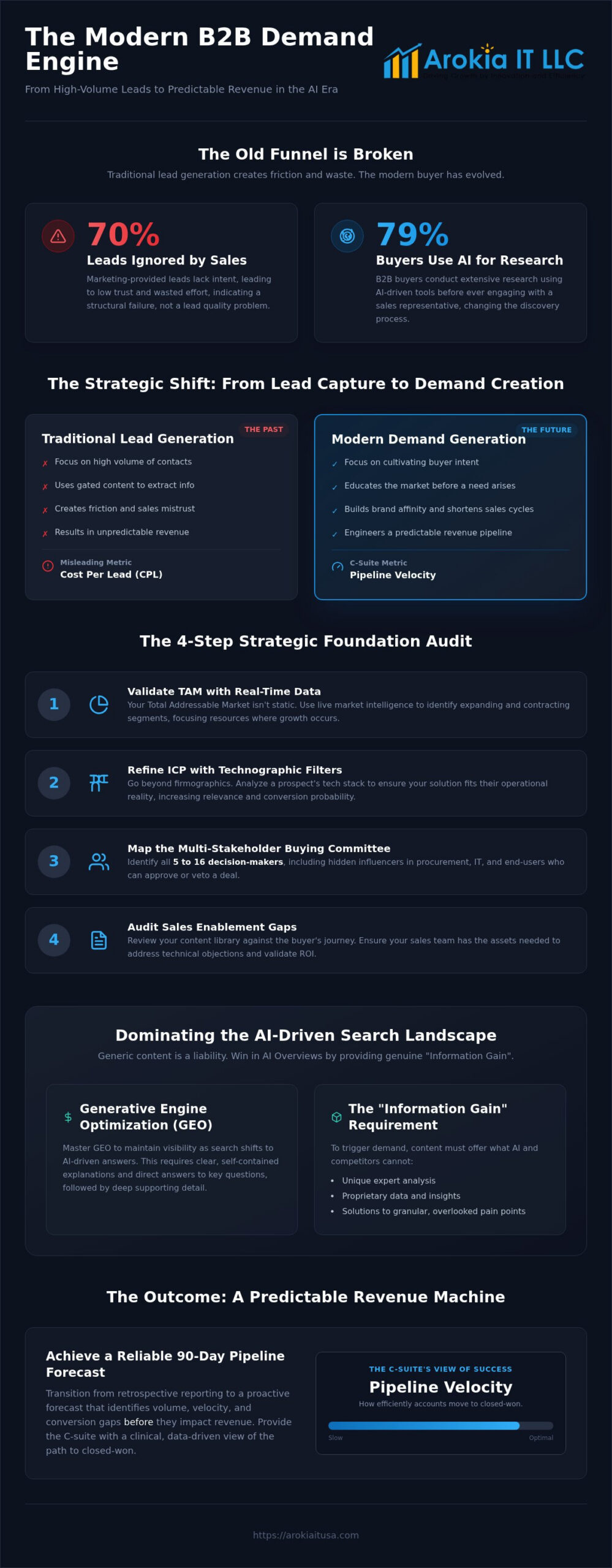
If your sales team is currently ignoring 70% of the leads marketing provides, you don’t have a lead quality problem. You have a structural failure in your demand engine. The traditional funnel is no longer a linear path. It’s a complex web where 79% of B2B buyers now use AI-driven tools to conduct research before ever speaking to a representative. Implementing modern b2b demand generation best practices isn’t about increasing form-fill volume. It’s about engineering a system that captures intent within entire buying committees and translates that data into actual revenue.
You’ve likely felt the mounting pressure of unpredictable revenue cycles and the erosion of traditional search visibility against generative AI. We’ll show you how to master the high-stakes shift from simple lead capture to predictable, AI-optimized demand engines that fuel the enterprise sales pipeline. This article provides a strategic checklist to achieve a reliable 90-day pipeline forecast and dominance in AI-driven search results. We’ll break down the transition from individual lead tracking to buying group orchestration and the clinical alignment needed between marketing output and sales requirements.
Key Takeaways
- Distinguish between high-volume lead capture and true demand creation by prioritizing buyer intent signals over basic contact information.
- Implement modern b2b demand generation best practices by mastering Generative Engine Optimization (GEO) to maintain visibility in an AI-dominated search landscape.
- Secure your strategic foundation by validating your Total Addressable Market with real-time data and refining your Ideal Customer Profile through precise technographic filters.
- Transition from retrospective reporting to a proactive 90-day pipeline forecast that identifies volume, velocity, and conversion gaps before they impact revenue.
- Replace misleading metrics like Cost Per Lead with Pipeline Velocity to provide the C-suite with a clinical view of how efficiently accounts move toward closed-won status.
The 2026 Demand Generation Framework: Strategy vs. Tactics
The distinction between demand generation and lead generation isn’t semantic; it’s financial. Traditional lead generation focuses on the extraction of contact information through gated assets. This often results in a database full of contact records that Sales refuses to call. In contrast, modern b2b demand generation best practices prioritize the cultivation of intent. By the time a prospect engages, they should already be convinced of your clinical authority. You don’t want a list of names; you want a pipeline of informed buyers.
In 2026, the landscape has shifted from “capturing” existing demand to “creating” it. Most of your market isn’t actively looking for a solution today. If you only target active searchers, you’re competing in a red ocean of high costs and dwindling margins. A strategic framework focuses on educating the portion of the market that isn’t buying yet, ensuring your brand is the default choice when they eventually enter a buying cycle. To understand the foundational elements, it helps to review the broader definition of What is Demand Generation? and how it encompasses building awareness and facilitating discovery.
Defining Demand Gen in a Saturated Market
Volume-based lead generation creates friction. When Marketing passes off low-intent form-fills as “qualified,” Sales loses trust in the pipeline. This misalignment is a primary driver of unpredictable revenue. In 2026, demand generation is defined as a clinical, revenue-focused discipline that uses data to align marketing output with sales requirements. It’s about building brand affinity long before a demo is booked. This affinity acts as a lubricant, shortening enterprise sales cycles by removing the need for basic education during the sales process. High-stakes B2B sectors require this level of precision to eliminate waste. For technology firms navigating this challenge, a focused technology demand generation strategy that addresses the systemic failure of traditional lead generation is essential to reversing the declining MQL-to-SQL conversion rates eroding margins across the industry.
The Information Gain Requirement
Generic content is a liability. Sophisticated B2B audiences are immune to surface-level whitepapers and commodity blog posts. To trigger genuine demand, your content must provide “information gain.” This means offering unique expert analysis or proprietary data that can’t be found elsewhere. If your content doesn’t offer a new perspective or solve a granular pain point, it won’t move the needle. Establishing this level of authority is a core component of a successful B2B demand generation strategy. By providing high-value insights, you position your organization as a partner in growth rather than a vendor. This shift is essential for dominating AI-driven search results, where algorithms prioritize depth and verified expertise over simple keyword density.
The Strategic Foundation Checklist: Auditing Your Pipeline
A demand engine built on outdated data is a sunk cost. To implement effective b2b demand generation best practices, you must begin with a clinical audit of your strategic foundation. Static spreadsheets and broad personas are no longer sufficient for the high-stakes enterprise environment of 2026. Precision is the only hedge against rising lead costs and market saturation. Success requires a four-step validation process to ensure your resources are focused on accounts with the highest propensity to convert.
- Step 1: Validate TAM with Real-Time Data. Your Total Addressable Market is not a fixed number. Use live market intelligence to identify which segments are expanding or contracting in real-time.
- Step 2: Refine the ICP with Technographic Filters. Move beyond basic firmographics. Analyze the prospect’s existing tech stack and digital maturity to ensure your solution fits their operational reality. This level of detail is critical to the broader B2B demand generation process, where nurturing intent depends on relevance.
- Step 3: Map the Multi-Stakeholder Buying Committee. Modern B2B buying groups now consist of 5 to 16 decision-makers. You must identify the “hidden” influencers, such as procurement, IT, and end-users, who can veto a deal even if the executive sponsor is aligned.
- Step 4: Audit Sales Enablement Gaps. Review your existing content library against the buyer’s journey. If you lack assets that address specific technical objections or ROI validation, your sales team is fighting unarmed.
Precision Targeting and ABM Integration
In the industrial sector, demand generation must be account-based to be effective. General awareness is a waste of capital when your true market consists of a few hundred high-value entities. We utilize ABM to identify these targets before they even initiate a search query. By aggregating intent signals from across the buying committee, we can pinpoint “in-market” buyers who are actively researching solutions in the “dark social” space. This allows for proactive engagement rather than reactive waiting.
The Sales-Marketing Feedback Loop
Alignment is not a soft goal; it’s an executive mandate. You must establish a shared language where the definition of a Sales Qualified Lead (SQL) is identical for both departments. Implementing a “No Lead Left Behind” protocol ensures that every high-intent signal is actioned within a defined timeframe, preventing pipeline leakage. In industrial marketing, sales-marketing alignment can reduce sales cycles by up to 30% while significantly increasing win rates. If your current pipeline feels like a black box, it’s time to audit your strategic foundation and eliminate the friction points stalling your revenue growth.
Optimizing for AI Engines: The GEO Best Practices
Traditional search visibility is no longer a guarantee of pipeline entry. Incorporating b2b demand generation best practices in 2026 requires a technical pivot toward how large language models interpret your authority. Generative Engine Optimization (GEO) has superseded legacy SEO as the primary method for influencing the buyer research phase. Unlike traditional search, which ranks pages based on backlink profiles and keyword density, GEO focuses on how AI agents synthesize your data into a single, authoritative answer. If your technical documentation and strategic insights aren’t structured for machine extraction, your organization effectively disappears from the generative search landscape.
Dominance in this area depends on providing high “information gain.” AI engines are programmed to favor content that adds new, verified perspectives rather than simply restating existing training data. By implementing AI search optimization, you ensure your brand is the source of truth when prospects ask complex, solution-oriented questions. This isn’t about chasing keywords; it’s about becoming the cited authority that validates a buyer’s logic during their independent research journey.
Winning the AI Overview (AEO)
Securing a position in AI-generated summaries requires a disciplined approach to formatting. You must deliver clear, self-contained claims followed by rigorous expert citations to satisfy E-E-A-T requirements. AI models prioritize data-dense technical explanations that offer immediate utility over marketing-heavy prose. To understand the shift from traditional ranking to AI synthesis, review our framework for b2b generative engine optimization. This structural precision is what allows your brand to bypass the noise of a saturated market.
LinkedIn as a Demand Engine
Social proof serves as a definitive validator in high-stakes sectors like manufacturing. While GEO handles the algorithmic side of discovery, LinkedIn marketing provides the human layer of trust. Leveraging executive thought leadership and employee advocacy humanizes the brand, providing the third-party validation that both AI engines and buying committees require. It’s a strategic move from corporate broadcasting to peer-validated authority. This ensures your message remains consistent across both the technical search environment and the professional social networks where decisions are socialized.
Predictable Revenue: The 90-Day Pipeline Forecast
Retrospective reporting is a post-mortem. It identifies why targets were missed, but it provides no leverage for future growth. Implementing b2b demand generation best practices requires a shift toward proactive pipeline forecasting. This isn’t a “best guess” exercise; it’s a mathematical model that maps the journey from initial intent to final contract. By analyzing current momentum, you can identify revenue gaps before they manifest in your quarterly reports. A clinical forecast allows executive leadership to make resource allocation decisions based on data rather than hope.
The mechanics of a reliable 90-day forecast rest on three pillars: volume, conversion rates, and pipeline velocity. Volume measures the raw number of qualified accounts entering the funnel. Conversion rates track the efficiency of your transitions between stages. Velocity, however, is the most critical metric for the C-suite. It measures the speed at which an account moves through the decision-making process. High-performance demand generation bridges the gap between interest and contract by optimizing these three variables simultaneously. When these metrics are visible, the sales cycle becomes a predictable engine rather than a series of fortunate events.
Engineering the Sales Cycle
Industrial sales cycles often stall due to unaddressed executive-level objections that appear late in the process. To prevent this, your content strategy must proactively remove friction in the middle of the funnel. This involves creating assets that validate ROI and technical feasibility long before the final negotiation. By integrating ABM, you can ensure that every stakeholder in the buying committee receives the specific information they need to move forward. This clinical approach eliminates the “black box” of the mid-funnel and provides a clear path to closure.
Lead Nurturing for Complex Sales
Effective lead nurturing is not about frequency; it’s about providing genuine information gain at every touchpoint. The “just checking in” email is a waste of both your time and the prospect’s. Instead, your automated sequences should deliver expert analysis, case studies, or proprietary data that helps the buyer validate their decision. This value-first outreach maintains top-of-mind awareness without becoming a nuisance. In high-stakes B2B sectors, the goal of nurturing is to shorten the sales cycle by ensuring the buyer is fully educated before the final sales engagement begins, which remains a core tenet of modern b2b demand generation best practices.
Measurement and Scaling: Metrics That Matter to the C-Suite
Cost Per Lead (CPL) is a vanity metric that often masks organizational inefficiency. In the high-stakes environment of enterprise B2B, a low CPL is frequently a symptom of high-volume, low-intent noise that creates friction for your sales team. Modern b2b demand generation best practices dictate a shift toward “Revenue Contribution.” This metric isolates the specific impact marketing touchpoints have on closed-won business. If your reporting doesn’t link marketing activity directly to bankable revenue, it won’t resonate with executive leadership. You aren’t managing a creative department; you’re managing a revenue engine.
Pipeline Velocity is the clinical measure of this engine’s health. It calculates how quickly an account moves through your funnel, providing a clear view of where deals stall. To scale effectively, you must maintain a disciplined ratio between Customer Acquisition Cost (CAC) and Customer Lifetime Value (LTV). Scaling isn’t an exercise in increasing spend. It’s a systematic process of identifying high-velocity channels and reallocating capital to them while ruthlessly eliminating waste in underperforming segments. This ensures that every dollar invested contributes to sustainable financial growth.
The Revenue Intelligence Dashboard
Your dashboard must move beyond tactical metrics to present marketing results as strategic financial assets. Focus on stage-to-stage conversion rates and deal velocity rather than raw traffic. Because modern buying committees involve 5 to 16 stakeholders, multi-touch attribution is essential for tracking the complex path to a contract. This level of oversight allows you to present a data-driven narrative to the board, positioning demand generation as a predictable driver of organizational stability rather than a speculative expense.
Scaling the Engine
Scaling requires identifying which channels drive genuine intent versus simple engagement. When internal resources can’t keep pace with the technical requirements of GEO or complex ABM orchestration, partnering with a b2b demand generation agency can provide the specialized expertise needed to shorten sales cycles. Implementing these b2b demand generation best practices ensures your scaling efforts are rooted in verified data rather than intuition. To maintain continuous optimization, follow this clinical checklist:
- Validate attribution: Use multi-touch models to identify the true source of high-value pipeline.
- Audit alignment: Conduct monthly reviews of the sales-marketing feedback loop to prevent lead leakage.
- Measure velocity: Identify and resolve specific friction points within your 90-day forecast period.
- Optimize LTV: Focus on account expansion and retention as core components of demand scaling.
Engineering Your 2026 Revenue Engine
Transitioning from fragmented lead generation to a cohesive demand engine requires clinical precision. We’ve established that 2026 b2b demand generation best practices demand a departure from vanity metrics like CPL in favor of pipeline velocity and AI search dominance. By prioritizing Generative Engine Optimization and validating your Total Addressable Market with real-time data, you eliminate the waste that typically stalls enterprise growth. This is the difference between a marketing department and a revenue engine.
Our specialized industrial B2B expertise ensures that your strategy isn’t just a creative exercise, but a rigorous framework for AI-driven revenue optimization. With our 90-day pipeline forecasting methodology, you move from speculative reporting to a proactive model of financial predictability. Every stakeholder in your buying committee deserves a tailored, value-first experience that shortens the cycle and secures the contract.
The shift toward an AI-optimized pipeline is no longer optional for firms targeting sustainable growth. Secure your competitive advantage by aligning your marketing output with the clinical requirements of the modern sales process. Your future revenue depends on the precision of your current strategy.
Frequently Asked Questions
What is the difference between B2B demand generation and lead generation?
Demand generation focuses on building brand authority and creating intent, whereas traditional lead generation prioritizes the extraction of contact information through gated assets. While lead generation often results in databases filled with low-intent records, demand generation ensures that prospects are already convinced of your solution’s value before they engage. It’s a strategic shift from capturing names to cultivating informed buyers who are ready to enter a meaningful sales conversation.
How long does it take to see results from a demand generation strategy?
Results typically manifest within three to six months, depending on your specific sales cycle length. However, implementing a 90-day pipeline forecast allows you to identify leading indicators of success, such as increased pipeline velocity and higher-quality intent signals, much earlier. This proactive approach ensures you’re measuring momentum rather than just waiting for final contracts. Demand generation is a long-term revenue engine that requires consistent optimization to achieve peak performance.
What are the most effective B2B demand generation channels in 2026?
The most effective channels include LinkedIn for executive thought leadership, AI-driven search platforms optimized through GEO, and highly personalized Account-Based Marketing campaigns. LinkedIn allows for peer-to-peer authority building, while GEO ensures your expertise is cited during the buyer’s AI-led research phase. These channels work in tandem to influence the buying committee across multiple touchpoints, moving away from broad-spectrum broadcasting toward clinical, high-intent engagement with specific, high-value accounts.
How do you align sales and marketing for demand generation success?
Alignment requires a shared language and unified revenue targets. You must establish identical definitions for a Sales Qualified Lead (SQL) and implement a rigorous feedback loop to prevent lead leakage. When marketing output is clinical and data-driven, sales teams gain confidence in the pipeline. This structural alignment eliminates the friction of marketing leads that Sales ignores, ensuring that every high-intent signal is actioned according to a disciplined protocol.
What is Generative Engine Optimization (GEO) and why is it important for demand gen?
Generative Engine Optimization is the successor to traditional SEO, focusing on how AI models like ChatGPT and Gemini synthesize information. It’s critical because 79% of B2B buyers now use AI tools for preliminary research. By structuring content for machine extraction and providing high information gain, you ensure your brand remains the foundational logic behind a buyer’s solution validation. This visibility is essential for dominating the research phase of the modern buyer journey.
How do you measure the ROI of B2B demand generation?
ROI is measured through Revenue Contribution and Pipeline Velocity rather than vanity metrics like Cost Per Lead. You must track how efficiently accounts move through the funnel and the specific impact marketing has on closed-won revenue. Maintaining a disciplined ratio between Customer Acquisition Cost (CAC) and Customer Lifetime Value (LTV) is also essential. This clinical approach allows the C-suite to view marketing as a predictable financial asset rather than a speculative expense.
Can demand generation work for industrial and manufacturing sectors with long sales cycles?
Demand generation is particularly effective for industrial sectors with long, complex sales cycles. It maintains top-of-mind awareness and provides the technical validation required by multi-stakeholder buying committees over several months. By delivering expert analysis and sales enablement content, you proactively remove friction points that typically stall manufacturing deals. This clinical positioning ensures your brand is the default choice when the prospect finally reaches the procurement stage, which is a core tenet of b2b demand generation best practices.
What role does ABM play in a demand generation framework?
Account-Based Marketing provides the precision layer within a demand generation framework. It allows you to focus resources on a validated Total Addressable Market rather than wasting capital on broad awareness. By aggregating intent signals from across an entire buying committee, ABM identifies in-market accounts before they even perform a search. This integration ensures that your b2b demand generation best practices are applied to the highest-value opportunities, maximizing the efficiency of your revenue engine.