
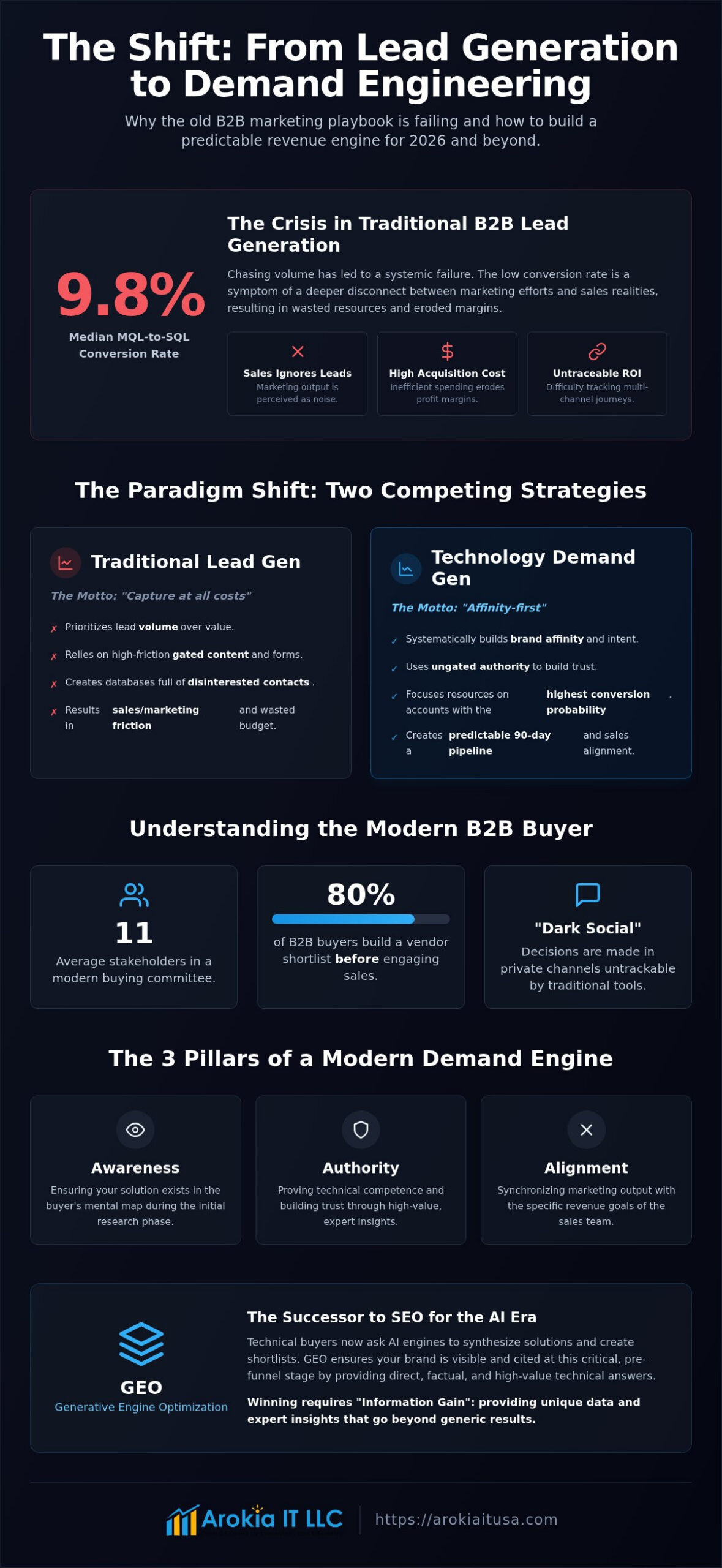
The median MQL-to-SQL conversion rate has plummeted to 9.8 percent as we navigate the complexities of 2026. Most marketing departments are still chasing volume while their sales counterparts ignore the resulting leads as noise. This disconnect creates a high cost per acquisition that erodes margins and highlights the urgent need for a more sophisticated technology demand generation strategy. You’ve likely seen the symptoms: sales teams ignoring marketing output and a persistent difficulty in tracking ROI across multi-channel digital journeys. It’s a systemic failure of traditional lead generation in a market that demands precision.
This article provides the blueprint to master strategic revenue engineering by shifting from broad-reach tactics to a focused demand engine. We’ll show you how to implement AI-driven systems that don’t just fill a database but actually accelerate your pipeline. By the end of this guide, you’ll understand how to navigate buying committees that now average 11 stakeholders and how to achieve total alignment between marketing efforts and sales revenue. We’re moving beyond creative flourishes to a disciplined, data-backed approach that delivers a predictable 90-day pipeline forecast and shorter sales cycles for your most complex technical products.
Key Takeaways
- Learn why capturing leads at any cost is a failing strategy and how to replace it with a technology demand generation model that prioritizes buyer affinity and intent.
- Discover the mechanics of Generative Engine Optimization (GEO) to ensure your technical solutions appear on shortlists generated by AI answer engines.
- Implement a 90-day pipeline forecast to bridge the gap between marketing spend and sales revenue while providing executive leadership with predictable growth metrics.
- Transition from generic awareness content to sales enablement assets that proactively address technical objections and shorten complex industrial sales cycles.
- Identify how to eliminate marketing waste by integrating precision-strike Account-Based Marketing (ABM) into your broader demand architecture.
The Paradigm Shift: Technology Demand Generation vs. Traditional Lead Gen
Traditional lead generation has become a race to the bottom. It prioritizes volume over value, resulting in databases full of disinterested contacts and friction-heavy sales processes. In contrast, technology demand generation functions as the strategic orchestration of interest and intent. It’s not a mere collection of emails; it’s the systematic building of brand affinity before a transaction ever occurs. While lead generation focuses on the “capture at all costs” model, demand generation prioritizes an “affinity-first” approach that respects the modern buyer’s journey.
Data from 2026 confirms that 80 percent of B2B buyers now build comprehensive vendor shortlists before ever engaging with a sales representative. If you aren’t visible and authoritative during this silent research phase, you’ve lost the deal before it starts. Successful Demand generation rests on three pillars:
- Awareness: Ensuring your solution exists in the buyer’s mental map.
- Authority: Proving technical competence through high-value insights.
- Alignment: Synchronizing marketing output with the specific revenue goals of the sales team.
Why Traditional SEO and Lead Forms are No Longer Enough
Gated content has become a liability. In a high-friction digital environment, forcing a technical lead to fill out a 10-field form for a whitepaper is a recipe for abandonment. We’re seeing a massive shift toward “ungated authority,” where the most valuable insights are shared freely to build trust. This acknowledges the reality of “Dark Social,” the phenomenon where B2B decisions are made in private Slack channels, professional communities, and peer-to-peer networks that traditional tracking can’t reach. You can’t track these conversations with a cookie, but you can influence them with expertise.
The Role of Intent Data in Modern Demand Capture
Precision requires better data. Modern demand capture distinguishes between first-party intent, such as visits to your pricing page, and third-party intent, which involves buyers researching specific problems across the broader web. We use technographic data to identify exactly when an account is approaching a technology refresh cycle. This isn’t guesswork; it’s engineering. Integrating these insights into a broader demand generation strategy B2B creates a growth engine that eliminates waste and focuses resources on accounts with the highest probability of conversion.
Leveraging AI Search and GEO for Demand Capture
The shift from traditional search to generative engines is a fundamental disruption for B2B marketers. Generative Engine Optimization (GEO) has emerged as the necessary successor to standard B2B SEO. Today’s technical buyers don’t just browse lists; they ask AI answer engines like ChatGPT, Claude, and Perplexity to synthesize complex solutions into technical shortlists. If your documentation isn’t structured for AI citation, your brand remains invisible during the most critical phase of the buyer’s journey. This is a core component of modern technology demand generation.
AI engines prioritize content that is direct, factual, and easily parsed. To win these citations, you must provide self-contained technical explanations that answer specific “how” and “why” questions without requiring a click-through. This visibility validates your authority at the point of inquiry. As highlighted in research from The B2B Institute, the majority of the buying journey happens in the “pre-funnel” stage before a vendor is even aware of the interest. AI engines are now the primary tool for navigating that stage.
Optimizing for AI Overviews and Generative Engines
Winning a slot in Google AI Overviews requires more than keyword matching. It demands “information gain,” which is the inclusion of unique data, proprietary insights, or overlooked technical considerations that go beyond generic search results. You must structure your white papers and technical guides as modular assets. Each section should stand alone as a definitive answer to a technical objection. By aligning your search strategy with revenue through AI search optimization, you transform passive visibility into a measurable demand capture engine.
The Authority Factor: EEAT in a Generative World
Expert-led analysis provides the only viable defense against the coming wave of AI-generated content saturation. To stand out, you must build “brand nodes”—distinct clusters of authoritative content that AI engines recognize as the source of truth for specific industrial technologies. AI search trust is built through the relentless application of technical precision and verifiable expertise. If your current strategy feels disconnected from these generative shifts, it’s time to audit your technical search visibility to ensure your brand isn’t being filtered out by AI gatekeepers.
Bridging the Revenue Gap with ABM and Pipeline Forecasting
Broad-reach marketing often results in a fragmented pipeline that fails to convert. To fix this, we deploy Account-Based Marketing (ABM) as the precision-strike arm of a broader technology demand generation program. This integration ensures that every marketing dollar spent is focused on accounts with a high propensity to buy. By integrating ABM and demand generation, we move away from the “spray and pray” methodology that plagues modern B2B organizations. We prioritize strategic depth over tactical breadth.
The elimination of marketing waste is a direct result of aggressive account prioritization. We replace traditional lead volume with the 90-day pipeline forecast as the primary KPI for B2B success. This metric forces a level of accountability that simple MQL counts can’t match. A clinical approach to technology demand generation eliminates the noise of incompatible accounts, ensuring that every campaign is an investment in predictable growth. It bridges the gap between top-of-funnel activity and actual revenue realization by focusing on deals that will realistically close within the next quarter.
The Mechanics of a 90-Day Pipeline Forecast
Moving from vanity metrics to revenue-ready visibility requires a disciplined approach to data. We use technographic and firmographic filters to create a target list based on current tech stacks and financial health. This identifies who will buy, not just who can. Sales enablement content validates this pipeline health by tracking engagement with technical assets that signal late-stage intent, ensuring the forecast is grounded in reality rather than optimistic guesswork.
Shortening the Industrial Sales Cycle
Addressing friction in industrial marketing requires reaching hidden stakeholders who bypass traditional ads. We use targeted LinkedIn marketing to multi-thread accounts, engaging economic buyers and technical evaluators simultaneously. This strategy prevents single-point-of-failure deals by building consensus across the entire committee. By the time a proposal is issued, your brand has already secured technical validation from the people who actually use the product, effectively insulating the deal from internal shifts.
Engineering Content that Shortens the Sales Cycle
Awareness is a vanity metric if it doesn’t lead to a transaction. Most organizations waste resources on top-of-funnel fluff that fails to address the deep technical objections of a 2026 buying committee. In a high-stakes technology demand generation program, every asset must function as sales enablement content. This means your content marketing serves as a 24/7 sales representative, neutralizing skepticism and proving ROI long before a discovery call is ever booked. You aren’t just providing information; you’re engineering a path to a “yes.”
We employ a Negation-Affirmation structure to dismantle competitor myths and establish strategic dominance. You don’t just state your capabilities. You explicitly identify the failures of legacy or “standard” solutions and then affirm your superior alternative. This creates a rhythmic contrast that builds immediate professional authority. Case studies then provide the empirical social proof required for high-stakes technology investments, transforming abstract promises into validated, measurable outcomes that satisfy both technical evaluators and economic buyers.
Developing High-Stakes Sales Enablement Assets
Comparison guides shouldn’t just list features; they must frame the conversation around technical ROI and long-term scalability. By using LinkedIn-specific assets to nurture accounts during the consideration phase, you keep your solution top-of-mind without being intrusive. Adhering to B2B demand generation best practices ensures that your content impact scales across the entire 90-day pipeline, providing the specific data points your prospects need to justify a purchase decision.
The Strategic Use of LinkedIn for Demand Generation
Executive thought leadership allows you to bypass traditional gatekeepers. By positioning your leadership as authoritative experts rather than mere vendors, you foster trust at the highest levels of the target account. This outreach must mirror your 90-day pipeline strategy, ensuring that every touchpoint is purposeful and data-driven. Maximizing social media marketing in this way transforms a professional network into a high-precision account engagement tool that accelerates the entire technology demand generation process.
The Arokia IT Framework: Systematic Demand Generation
Arokia IT operates on a foundational principle: marketing is a financial function, not a creative one. Our framework for technology demand generation is designed to eliminate the systemic waste inherent in legacy lead-gen models. We don’t chase vanity metrics or broad-reach engagement. We focus exclusively on industrial and B2B technology sectors where the buying committee is large and the stakes are high. By positioning ourselves as a clinical, data-driven ally, we provide executive leadership with the transparency and accountability required for strategic growth.
The first step in our process is the AI Scorecard. This diagnostic tool evaluates your current demand gen efficiency, identifying where intent signals are being missed and where your pipeline is leaking. Most businesses operate with a fragmented view of their market. We provide a unified narrative of total oversight. Our approach ensures that every marketing dollar is an investment in a validated account rather than a gamble on unverified traffic.
Why a Specialized B2B Demand Generation Agency Matters
Technical products are not impulse purchases. Using a B2C-focused agency for complex technical sales is a strategic error that leads to misaligned messaging and wasted spend. These generalist firms lack the industrial depth needed to speak to engineers, security reviewers, and finance departments. Choosing a B2B demand generation agency with a specialized focus ensures your long-term scalability and protects your brand’s technical authority. We maintain a rigorous commitment to factual integrity, ensuring that every claim is backed by empirical data and strategic precision.
Next Steps: Validating Your Demand Generation Engine
Predictable revenue starts with a clear diagnosis. We recommend beginning with a comprehensive 90-day pipeline audit to identify immediate opportunities for acceleration. This audit moves beyond top-of-funnel activity to analyze the health of mid-funnel accounts and the effectiveness of current sales enablement assets. Once the foundation is secure, we implement the first phase of AI search and GEO optimization to secure your brand’s position in generative answer engines. Transitioning to Arokia IT Demand Generation services means moving from a reactive posture to a proactive revenue engine. It’s time to stop guessing and start engineering.
Engineering Predictable Revenue for the 2026 Industrial Landscape
Transitioning to a modern demand engine requires more than tactical adjustments. It demands a total structural realignment around measurable revenue. You’ve seen how integrating GEO and ABM eliminates marketing waste by focusing exclusively on high-intent accounts. By prioritizing a 90-day pipeline forecast over vanity metrics, you gain the clinical oversight necessary to drive consistent growth in complex technical markets. This level of accountability ensures that your marketing spend isn’t a gamble but a strategic investment in validated accounts.
Successful technology demand generation is no longer a matter of lead volume. It’s about the precision of your data and the authoritative depth of your sales enablement assets. Our framework combines specialized industrial marketing expertise with AI-driven revenue precision to ensure your brand is preferred by the entire buying committee. The shift from lead generation to demand engineering is the only way to protect your margins and shorten your sales cycles in an environment dominated by generative search. It’s time to replace fragmented efforts with a unified system of revenue engineering.
Secure your competitive advantage by building a system that converts technical complexity into predictable financial results. Your long-term growth depends on a strategy that values precision over noise.
Frequently Asked Questions
What is the difference between demand generation and lead generation in 2026?
Lead generation focuses on the immediate acquisition of contact data through gated friction and volume-based tactics. Technology demand generation shifts the focus to creating brand authority and buyer intent before the conversion ever occurs. In 2026, demand generation prioritizes ungated technical insights that influence the self-directed buyer’s journey. This approach ensures that when a lead finally converts, they have already been technically validated and are ready for a meaningful sales conversation.
How long does it take to see results from a technology demand generation campaign?
Initial intent signals and pipeline visibility typically emerge within the first 45 to 60 days of a campaign. However, a fully optimized technology demand generation engine requires approximately six months to achieve peak efficiency. Paid media and LinkedIn outreach can deliver faster 90-day returns, while content-driven authority and GEO build a compounding asset over 12 to 18 months. We focus on establishing a predictable 90-day pipeline forecast early to validate the strategic direction.
Why is GEO more important than traditional SEO for technology companies?
Generative Engine Optimization (GEO) is critical because AI answer engines like ChatGPT and Perplexity are now the primary tools for technical research. Traditional SEO focuses on keyword rankings in a list, but GEO ensures your solution is cited as the authoritative answer within a generative summary. For technology companies, being the cited source in an AI-generated shortlist is the most direct path to influencing high-stakes buying committees during their silent research phase.
Can demand generation shorten a complex 12-month sales cycle?
Yes, demand generation shortens sales cycles by proactively addressing technical objections before the first sales call. By providing sales enablement content that satisfies security, finance, and engineering stakeholders simultaneously, you eliminate the sequential approval delays common in 12-month cycles. Multi-threading accounts through targeted digital touchpoints ensures that consensus is built across the entire buying committee, preventing single-point-of-failure stalls in the procurement process and accelerating the final decision.
What role does LinkedIn play in a technology demand generation strategy?
LinkedIn serves as the precision-strike platform for account-based engagement and executive thought leadership. It allows for the surgical targeting of specific stakeholders within high-value accounts, bypassing traditional gatekeepers through authoritative content. In a technology demand generation strategy, LinkedIn is used to nurture the buying committee with technical ROI data and case studies, ensuring your brand remains top-of-mind throughout the long-tail industrial research process while building trust with key decision-makers.
How do you measure the ROI of demand generation for technical products?
We measure ROI by tracking pipeline velocity, win rates, and the reduction in customer acquisition costs (CAC). Instead of focusing on vanity metrics like clicks or impressions, we prioritize the 90-day pipeline forecast and the total revenue generated from targeted accounts. By aligning marketing spend with sales outcomes, we provide executive leadership with a clinical view of how demand generation efforts translate into tangible financial growth and long-term organizational stability.
What is a 90-day pipeline forecast and why do I need one?
A 90-day pipeline forecast is a data-driven projection of the revenue expected to close within the next quarter based on current intent signals. It replaces speculative lead counts with a clinical analysis of account engagement and technical validation. You need this forecast to eliminate marketing waste and provide your sales team with a predictable roadmap of revenue-ready opportunities, ensuring total alignment between marketing investment and the final sales targets.
Is ABM required for effective demand generation in the industrial sector?
ABM is essential for the industrial sector because the market consists of a finite number of high-value accounts with complex buying committees. Broad-reach marketing is inefficient when your target audience is restricted to specific technical niches. Integrating ABM into your technology demand generation strategy ensures that your resources are concentrated on the accounts with the highest propensity to buy, maximizing revenue precision while eliminating the noise of unqualified leads and disinterested contacts.