
Your current ABM platform might be the most expensive dashboard your sales team never uses. In a high-stakes market where 97% of buyer research happens in the “Dark Funnel,” choosing between a demandbase vs 6sense enterprise feature comparison isn’t just about checking boxes. It’s about architectural alignment. You’re likely tired of high platform costs that fail to bridge the gap between marketing engagement and actual sales execution. We understand the frustration of data silos that leave your BDRs guessing which accounts are truly in-market.
This strategic review delivers an executive-level analysis of how these two leaders compare on data precision, orchestration, and pipeline predictability. You’ll gain a clear framework to eliminate waste in your tech stack and move toward a reliable 90-day pipeline forecast. We examine everything from the predictive buying stage models in 6sense to the native programmatic advertising power of Demandbase. By the end, you’ll know which system secures your revenue targets and which one simply adds to your integration debt.
Key Takeaways
- Align your platform selection with your specific GTM architecture by distinguishing between orchestration-heavy execution and predictive-first intelligence.
- De-anonymize the “Dark Funnel” using proprietary intent signals that bridge the critical gap between marketing engagement and sales activation.
- Utilize this demandbase vs 6sense enterprise feature comparison to identify which platform provides the granular data precision required for complex industrial buying committees.
- Achieve 90-day pipeline predictability by transitioning from static dashboards toward active sales enablement and automated buyer stage progression.
- Eliminate marketing waste by prioritizing operational readiness and strategic implementation over raw feature volume to avoid long-term integration debt.
The Enterprise ABM Dilemma: Why Feature Lists Are Not a Strategy
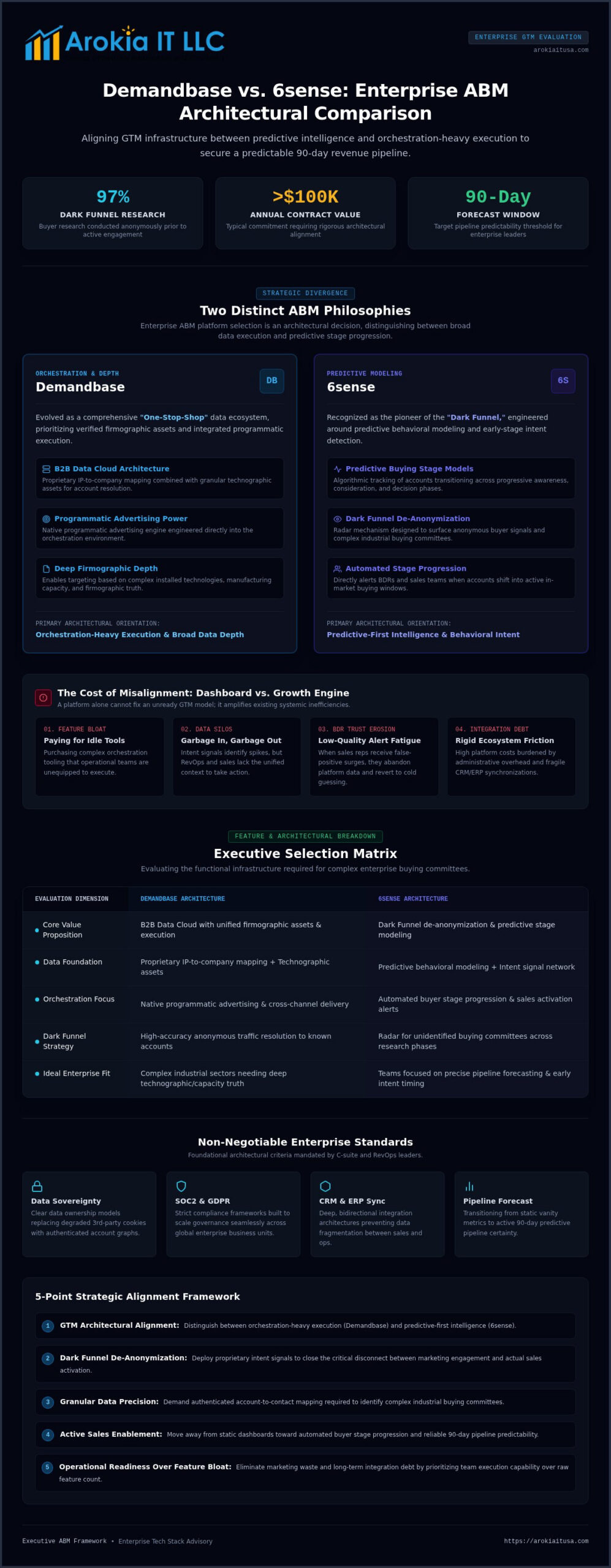
Revenue leaders in 2026 aren’t looking for more leads. They’re looking for pipeline certainty. A standard demandbase vs 6sense enterprise feature comparison often descends into a checklist of technical specs, but this approach misses the fundamental objective. High-stakes enterprise marketing requires a shift from broad outreach to surgical precision. When you’re committing to an annual contract value that frequently exceeds $100,000, the platform’s ability to execute a cohesive account-based marketing strategy outweighs any single AI gimmick. Success is measured by the elimination of waste, not the volume of features.
The enterprise struggle isn’t a lack of data. It’s the inability to act on it. Organizations frequently succumb to “feature bloat,” paying for complex orchestration tools that their teams aren’t operationally ready to use. This creates an expensive disconnect. You need a platform that translates intent into revenue, not one that adds another layer of administrative overhead. We view the selection process as a strategic pivot. It’s the moment you decide to stop guessing and start forecasting with 90-day accuracy.
The Hidden Cost of Misalignment
We’ve seen organizations deploy world-class tools only to watch their RevOps teams drown in data silos. It’s a classic case of “garbage in, garbage out.” If your intent data identifies a surge in activity but your sales team lacks the context to act, you’ve bought an expensive dashboard, not a growth engine. Misalignment destroys sales morale. When SDRs are fed low-quality signals, they stop trusting the platform entirely. Bridging the gap between marketing data and sales action is the only way to justify the investment. A platform alone cannot fix a broken GTM strategy; it only amplifies the existing inefficiencies.
Defining Enterprise-Grade Requirements
Enterprise-grade requirements in 2026 are non-negotiable. Your platform must scale across global business units while maintaining strict SOC2 and GDPR compliance. Data sovereignty has become a primary concern for the C-suite. A thorough demandbase vs 6sense enterprise feature comparison reveals that while both platforms offer deep CRM and ERP integrations, their architectural approaches to data ownership differ significantly. Success depends on selecting the architecture that fits your existing tech stack. You shouldn’t force your team to adapt to a rigid vendor ecosystem. Instead, look for a partner that facilitates a seamless account-based marketing workflow that empowers your sales team to win.
Intent Intelligence and Data Sovereignty: Comparing the Core Architectures
The architecture of your ABM platform dictates the upper limit of your sales efficiency. It isn’t just about collecting signals; it’s about data sovereignty and the precision of your account-to-contact mapping. A detailed demandbase vs 6sense enterprise feature comparison reveals two fundamentally different philosophies regarding intent intelligence. Demandbase has evolved into a comprehensive “One-Stop-Shop” data ecosystem. Conversely, 6sense maintains its position as the pioneer of the “Dark Funnel.” In 2026, the shift toward precision-driven B2B growth and intent data requires revenue leaders to choose between broad firmographic depth and predictive behavioral modeling.
Data precision is the only defense against marketing waste. As third-party cookies continue to degrade, the reliance on first-party web behavior and authenticated account graphs has become the industry standard. Both platforms have pivoted to prioritize IP-to-company resolution, yet their methods of surfacing these insights cater to different GTM motions. Your choice depends on whether you need a library of firmographic truth or a radar for hidden buying committees.
Demandbase Data Integrity
Demandbase centers its value proposition on the B2B Data Cloud. This ecosystem integrates proprietary IP-to-company mapping with deep technographic assets to provide unparalleled firmographic depth. For the industrial sector, this precision is vital. It allows teams to identify accounts based on specific installed technologies or manufacturing capacities. The platform’s strength lies in its ability to resolve anonymous traffic with high accuracy, ensuring that your sales intelligence is built on a foundation of verified data. This reduces the friction of siloed information that often plagues global enterprise deployments.
6Sense Predictive Modeling
6sense approaches the market through the lens of the “Dark Funnel.” Their “Signalverse” architecture is designed to capture the vast majority of buyer research that occurs before a prospect ever identifies themselves. By leveraging machine learning, 6sense predicts buying stages from “Awareness” to “Purchase,” allowing BDRs to strike when the buying committee is most active. However, predictive models face limitations in niche industrial markets where search volume is low and signals are sparse. In these environments, the lack of historical data can lead to false positives. Achieving a 90-day pipeline forecast requires balancing these predictive triggers with human-led validation. If you’re struggling to determine which architectural fit suits your specific market, it may be time to speak with a strategic navigator who understands these granular trade-offs.
Enterprise Orchestration vs. Predictive Analytics: A 2026 Feature Breakdown
Raw data is a liability without a mechanism for activation. While the architectural differences discussed previously set the foundation, the true test of an enterprise platform lies in its ability to trigger revenue-generating actions. A comprehensive demandbase vs 6sense enterprise feature comparison reveals a fundamental split in execution priorities. Demandbase positions itself as an orchestration powerhouse, prioritizing high-volume account-based advertising and web personalization. Conversely, 6sense focuses on predictive precision, using buying stage triggers to alert sales teams at the exact moment an account enters the decision phase. For the executive leader, the question isn’t which platform has more features, but which one aligns with your team’s operational rhythm.
Direct Feature Comparison: Demandbase vs. 6sense
Orchestration requires more than just automation; it requires efficiency. Demandbase offers a proprietary B2B Demand-Side Platform (DSP) that allows digital marketing teams to manage programmatic spend with granular control. However, this native execution often comes with a 15% to 20% platform fee on media spend. If your strategy relies on heavy multi-channel demand generation, this direct control is a significant advantage. 6sense approaches advertising through the lens of stage progression, automatically shifting ad creative as an account moves from awareness to purchase. This reduces manual intervention but requires a high degree of trust in the platform’s predictive accuracy.
- Lead-to-Account Matching (L2A): Both platforms offer automated matching, but Demandbase’s integration with its unified Data Cloud often results in faster resolution for global business units.
- Sales Intelligence: 6sense excels at mapping multi-persona buying committees, providing SDRs with a visual representation of who is engaged. Demandbase counters with deep technographic enrichment, identifying exactly which competitor tools a prospect currently uses.
- Executive Reporting: Demandbase provides superior high-level dashboards for CMOs, while 6sense offers more granular campaign analytics for RevOps practitioners.
The 2026 AI Edge: Generative Engine Optimization
The most significant shift in the 2026 landscape is the integration of Generative Engine Optimization (GEO). Traditional intent signals based on keyword searches are being replaced by conversational queries within AI-powered platforms. Your ABM platform must identify intent not just from what prospects click, but from the complex questions they ask Gemini or ChatGPT. Integrating AI search optimization data into your ABM platform allows for a level of content personalization previously impossible. AI search optimization influences intent scores by identifying specific problem-solving queries within generative engines that signal an account’s immediate transition from research to evaluation. By mapping these agentic workflows, revenue teams can intercept buyers in the “Dark Funnel” before they ever land on a competitor’s site.
The Executive Selection Framework: How to Choose Your ABM Tech Stack
Selecting an enterprise platform without a clinical audit of your operational maturity is a recipe for expensive shelfware. A demandbase vs 6sense enterprise feature comparison often masks the reality that these tools are only as effective as the teams wielding them. You shouldn’t commit to a six-figure contract before you understand if your organization is structurally capable of acting on the signals provided. Success starts with a cold, objective assessment of your current pipeline leakage and GTM readiness. If your CRM is a graveyard of unassigned leads, adding a predictive intelligence layer will only accelerate your inefficiencies.
Step 1: Audit Your Data and Sales Silos
Siloed data is the primary killer of ABM ROI. Before you sign a multi-year agreement, you must identify exactly where your current demand generation engine is losing pressure. In 2026, the standard for professional authority in marketing is the ability to deliver 90-day pipeline predictability. If your marketing and sales teams aren’t aligned on account definitions, even the most sophisticated predictive model will fail to bridge the gap. You can assess your revenue precision with our AI Scorecard to determine if your organization is ready for high-stakes account-based execution. This audit reveals whether your data architecture can support the transition from lead volume to account precision.
Step 2: Match Feature Sets to Sales Cycles
Generic ABM advice often fails the industrial sector. Manufacturing and industrial B2B cycles involve 6 to 10 decision-makers and timelines that frequently exceed 12 months. While 6sense might excel at high-velocity SaaS triggers, Demandbase’s deep technographic and firmographic depth often serves complex industrial committees with greater accuracy. Your platform choice must support the distribution of sales enablement content that resonates with engineers and procurement officers alike. You can learn more about our Industrial Marketing strategies to see how we align platform features with long-cycle revenue targets. Total Cost of Ownership is another critical factor. Beyond the median ACV of $60,000 to $68,000, you must account for $25,000 to $50,000 in implementation fees and the requirement of 0.5 to 1.0 dedicated RevOps FTEs to manage the system effectively.
The final decision rests on which platform delivers a faster impact on your 90-day pipeline. 6sense often provides quicker “in-market” alerts for broad TAMs, while Demandbase offers superior control over account-based advertising for named account lists. We prioritize the elimination of waste over raw feature quantity. By matching the platform’s architectural strengths to your specific sales cycle, you ensure that your investment translates into tangible financial growth rather than just another layer of administrative overhead.
Executing High-Stakes ABM: Why Platform Choice Requires Strategic Alignment
Platform implementation is not a “set it and forget it” project. It’s a continuous optimization cycle that demands expert oversight and clinical execution. While a demandbase vs 6sense enterprise feature comparison helps you select the right engine, it doesn’t provide the map for your specific journey. High-stakes B2B marketing requires a strategic partner to bridge the persistent gap between marketing data and sales activation. Arokia IT LLC focuses on transforming these complex platforms into predictable revenue engines that justify their significant annual investments. The goal is total oversight, ensuring that every intent signal results in a meaningful sales conversation.
Technology is a force multiplier, not a strategy. Organizations that treat their ABM platform as a standalone solution often find themselves with a sophisticated tool that their sales team ignores. We intervene by aligning the platform’s architectural strengths with your existing sales culture. Whether you choose the orchestration power of Demandbase or the predictive intelligence of 6sense, success depends on your team’s ability to act with precision. Arokia IT LLC eliminates the friction of siloed data, ensuring that your RevOps architecture supports financial growth rather than administrative bloat.
Eliminating Waste in the Enterprise Stack
Most firms pay for the full suite of platform features but only utilize a small fraction of the capabilities. This is a primary source of marketing waste. Strategic alignment ensures you aren’t paying for predictive modules or orchestration layers that your current headcount cannot support. We prioritize 90-day pipeline forecasting to provide the executive buy-in necessary for sustained investment. By focusing on accountability and measurement, we move your team away from vanity metrics and toward tangible pipeline impact. You can explore our Account-Based Marketing (ABM) solutions to see how we streamline enterprise tech stacks for maximum efficiency.
The Path Forward: From Evaluation to Execution
The first 180 days of implementation determine the long-term ROI of the platform. Setting realistic KPIs, such as MQA-to-opportunity conversion rates and buying committee deanonymization, prevents the “expensive intent dashboard” syndrome. Sales enablement is the “last mile” of any ABM platform. Without high-quality content that speaks to specific buyer pains, your intent signals are just noise. Arokia IT LLC acts as the strategic navigator, ensuring that your demandbase vs 6sense enterprise feature comparison leads to a selection that actually shortens your sales cycle. Success requires a disciplined, step-by-step breakdown of execution that turns anonymous web traffic into closed-won revenue.
Securing Your 2026 Revenue Architecture
Choosing the right platform requires moving beyond a static demandbase vs 6sense enterprise feature comparison. It demands an architectural decision that aligns with your specific GTM motion. Whether you prioritize the orchestration depth of Demandbase or the predictive intelligence of 6sense, the objective remains the same. You need the elimination of marketing waste and the achievement of total revenue oversight. Success in the industrial sector hinges on your ability to de-anonymize the buying committee before your competition does. You need a system that doesn’t just surface data but drives accountability across your entire revenue team.
As pioneers in AI-driven search and GEO, Arokia IT LLC specializes in translating complex intent signals into a reliable 90-day pipeline forecast. We understand the granular pressures of the enterprise industrial B2B sector and the necessity of precision in long-cycle sales. We don’t just implement software. We construct systematic solutions that bridge the gap between marketing data and sales action. Your platform must be a growth engine rather than a mere cost center. Arokia IT LLC is ready to help you navigate this transition with clinical objectivity and strategic confidence.
It’s time to stop guessing and start forecasting with absolute precision. We’re here to ensure your technology investment translates into tangible financial growth and a dominant market position. Our methodical approach ensures that your complex GTM problems have systematic, data-driven solutions.
Frequently Asked Questions
Which is better for industrial B2B companies: Demandbase or 6sense?
Demandbase often provides the technographic precision required for manufacturing sectors where named accounts are pre-defined. 6sense is powerful for identifying new market entrants, but its behavioral triggers can be noisy in low-volume industrial niches. Arokia IT LLC ensures your platform selection maps directly to the 6 to 10 decision-makers typical in complex sales cycles. Success depends on firmographic accuracy that supports long-term engineering evaluations rather than just short-term web clicks.
How much do Demandbase and 6sense typically cost for enterprise firms?
Enterprise contracts typically start with a median annual value between $60,000 and $68,591, though large deployments often exceed $300,000. Beyond the software license, you must budget for implementation fees and dedicated RevOps headcount to avoid platform abandonment. Arokia IT LLC focuses on eliminating this financial waste by ensuring every feature in your demandbase vs 6sense enterprise feature comparison is tied to a specific revenue outcome. License fees are only the baseline of the total investment.
Can I use Demandbase and 6sense together in my tech stack?
While technically possible, deploying both platforms creates redundant data silos and unnecessary platform fees. Most organizations choose one primary revenue engine to maintain a single source of truth between marketing and sales. Arokia IT LLC recommends selecting the architecture that best fits your existing GTM motion to avoid integration debt. Consolidating your intent signals into one platform reduces administrative overhead and ensures your sales team receives consistent account intelligence.
What is the implementation timeline for an enterprise ABM platform?
Initial technical onboarding takes 4 to 12 weeks, but achieving 90-day pipeline predictability requires roughly 180 days of operational optimization. This extended period allows your team to align CRM hygiene with the platform’s predictive triggers. Arokia IT LLC accelerates this timeline by implementing proven sales enablement workflows from day one. You shouldn’t expect immediate ROI until the system is fully integrated with your multi-channel demand generation strategy.
How do these platforms handle the “Dark Funnel” in 2026?
These platforms de-anonymize pre-click research behavior by resolving IP addresses to specific corporate entities. 6sense uses its Signalverse to categorize accounts into buying stages, while Demandbase utilizes its B2B Data Cloud for high-fidelity account resolution. In 2026, the priority is identifying the specific buying committee members within that anonymous traffic. This allows your team to engage stakeholders before they ever submit a form or contact a competitor.
Is 6sense easier to use for sales teams than Demandbase?
6sense is frequently cited for its intuitive visual triggers, but its effectiveness depends entirely on the quality of your sales enablement content. Demandbase provides deeper sales intelligence for technical prospecting but requires more RevOps configuration to be useful for SDRs. Arokia IT LLC bridges this gap by ensuring sales teams receive actionable context rather than just raw data alerts. The “easiest” platform is the one your sales team actually trusts to drive revenue.
Does Demandbase or 6sense integrate better with LinkedIn Marketing?
Demandbase provides a native DSP for granular control over account-based programmatic spend, making it a strong choice for media-heavy LinkedIn strategies. 6sense simplifies the process by automatically syncing audiences based on buying stage progression. Both platforms are effective for LinkedIn marketing, but your selection should depend on whether your team prefers manual bid management or automated stage-based targeting. Arokia IT LLC helps you optimize these social signals for maximum pipeline impact.
How does AI-driven search (GEO) affect intent data in these platforms?
AI-driven search shifts the focus from static keywords to conversational, agentic queries within generative engines. This evolution requires intent platforms to map search behavior from Gemini or ChatGPT back to specific accounts. Arokia IT LLC acts as a pioneer in this space, integrating GEO data to help firms identify high-intent accounts earlier in the research cycle. This ensures your intent scores reflect the sophisticated problem-solving queries used by modern B2B buyers.