
A high conversion rate is pure vanity if your sales team immediately disqualifies the leads. When marketing capital is deployed against competitive search terms, treating landing page optimization as a hunt for raw volume is an expensive mistake. You might trim form fields and celebrate an uptick in submissions, but if those contacts never convert into legitimate pipeline, you haven’t driven growth; you’ve simply subsidized administrative friction.
You already feel the persistent strain between lead volume and pipeline reality. Enterprise buying committees don’t behave like retail consumers, and routing sophisticated decision-makers to generic, commoditized pages stalls high-stakes deals before they ever reach an account executive.
To fix this disconnect, you must master a systematic audit framework that turns high-value enterprise traffic into qualified sales pipeline. This guide delivers a rigorous checklist to align messaging, buyer intent, and conversion mechanics so your inbound assets reliably accelerate closed-won revenue.
Key Takeaways
- Strategic landing page optimization replaces cosmetic conversion chasing with a systematic qualification framework that aligns paid acquisition directly with sales-accepted pipeline.
- Rigorous message-to-intent matching across paid search terms and hero architectures ensures multi-stakeholder enterprise buying committees immediately validate your solution.
- Calibrating form friction and deploying enterprise-grade validation filters out low-intent volume while supplying sales teams with critical deal intelligence.
- Hypothesis-driven experimentation frameworks built for low-volume, high-contract-value environments unlock measurable revenue gains without waiting months for sample size.
- Dynamic account-based personalization connects landing page architectures to firmographic data, transforming generic inbound assets into dedicated account acceleration engines.
What Is Strategic B2B Landing Page Optimization?
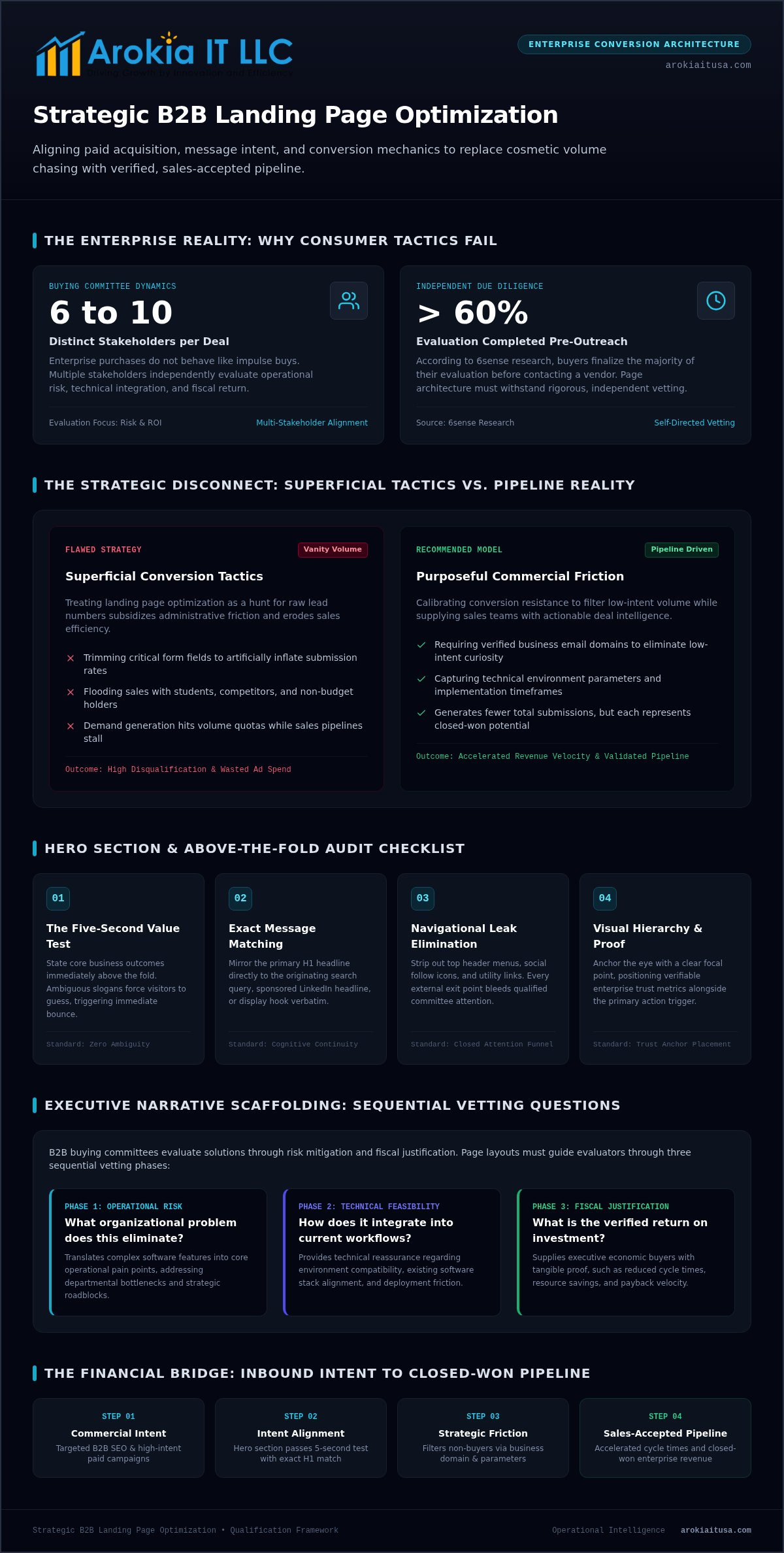
Strategic B2B landing page optimization is not a cosmetic exercise in button styling or superficial copywriting tweaks. It is a disciplined qualification framework engineered to convert high-cost traffic into sales-accepted pipeline. Consumer conversion rate optimization focuses on reducing all resistance to spur immediate, low-risk transactions. In contrast, complex B2B engagements require precision message alignment across long evaluation cycles. While standard lead capture landing pages prioritize raw submission volume, enterprise teams need commercial filters. Your landing page is not simply an ad destination; it is the financial bridge connecting marketing expenditure directly to enterprise revenue.
The Mechanics of Pipeline-Driven Optimization
The High Cost of Superficial Conversion Tactics
Superficial conversion tactics actively erode enterprise pipeline efficiency. Eliminating qualifying form fields to artificially inflate form fills creates an expensive illusion of campaign success. Demand teams celebrate lower acquisition costs on paper, while sales representatives waste critical capacity vetting students, competitors, and non-budget holders.
Purposeful friction fixes this disconnect. Requiring business email domains, technical environment parameters, and project timeframes filters out low-intent curiosity. When tightly integrated with qualified inbound intent from targeted b2b seo, deliberate friction preserves sales resources. You generate fewer total form submissions, but each conversion represents a verified opportunity capable of advancing toward closed-won revenue.
The Structural Audit Checklist: Architecture and Message-to-Intent Matching
Hero Section and Above-the-Fold Prioritization
- The Five-Second Value Test: State your core business outcome clearly above the fold. Ambiguous taglines force visitors to guess, triggering immediate bounce.
- Exact Message Matching: Mirror the H1 directly to the originating search query, sponsored LinkedIn headline, or display hook. Cognitive friction drops when the wording matches the ad verbatim.
Narrative Scaffolding for Executive Stakeholders
Technical Performance and Enterprise Accessibility
A brilliant value proposition is useless if a corporate firewall throttles page delivery. Heavy tracking libraries and bloated scripts hurt client-side performance. Under Google Core Web Vitals guidelines, target a Largest Contentful Paint (LCP) of 2.5 seconds or less, an Interaction to Next Paint (INP) of 200 milliseconds or less, and Cumulative Layout Shift (CLS) under 0.1 at the 75th percentile. Follow standard form usability guidelines to ensure your interactive inputs don’t lag on restricted corporate networks.
When you need to turn sluggish inbound assets into high-performance conversion drivers, align your framework through specialized website development and design. If you want an objective review of where your current assets drop pipeline, talk with our team to isolate those structural leaks.
The Trust and Friction Checklist: Forms, Validation, and Social Proof
Enterprise conversions occur only when perceived commercial risk falls below expected organizational upside. High-growth B2B teams don’t strip away fields to appease volume metrics. They engineer deliberate conversion gates. While industry data shows three-field forms achieve a median conversion rate of 10.1% compared to 3.6% for nine-field forms, slashing fields without a qualification strategy simply shifts the lead-filtering burden onto your sales team. Building a sustainable culture of experimentation means treating landing page optimization as a continuous calibration of trust signals and qualifying friction.
Calibrating Strategic Form Friction
Protecting sales capacity requires collecting actionable intelligence before an opportunity enters the pipeline. High-stakes form design balances accessibility with rigorous gatekeeping:
- Domain Validation: Block free personal email addresses (Gmail, Yahoo) to mandate corporate domains, filtering out unverified submissions immediately.
- Multi-Step Sequencing: Split complex inquiries across sequential screens. Multi-step forms outperform single-page layouts containing the identical fields by 21%, grouping low-threat operational questions ahead of contact capture.
- Reverse-IP and Automated Enrichment: Use backend APIs to populate company size, industry vertical, and tech stack based on visitor IP, keeping consumer-facing fields concise while capturing complete enterprise data.
Deploying High-Impact Enterprise Social Proof
Vague testimonials fail to move skeptical procurement teams. Enterprise buyers look for evidence from peers navigating identical regulatory, technical, and budgetary constraints. Replace surface-level endorsements with verifiable case summaries detailing baseline challenges, operational interventions, and net financial impacts. Displaying recognized client brands, SOC 2 compliance badges, and industry accreditations neutralizes internal buying committee objections. You can review concrete documentation of verified client outcomes across our projects to see how documented results anchor enterprise trust.
De-Risking the Initial Conversion Action
Hesitation at the point of submission usually stems from ambiguity. Enterprise executives won’t fill out a form if they suspect they’ll be subjected to aggressive, low-tier outreach. State the exact workflow that follows submission: outline the duration of the technical briefing, name the specific specialist conducting the session, and confirm the deliverable provided. Replace passive calls to action like “Submit” or “Send Message” with explicit value propositions, such as “Request Technical Feasibility Review” or “Schedule Architecture Walkthrough.”
The Experimentation Checklist: Systematic Testing in Low-Volume B2B Environments
Traditional conversion testing frameworks collapse in enterprise B2B. High-traffic consumer brands run frequentist A/B tests with hundreds of thousands of sessions, reaching statistical significance in days. In high-contract enterprise marketing, median landing page conversion rates sit between 1.5% and 3.8%. A campaign generating several hundred qualified visits per month could take quarters to validate minor cosmetic adjustments. Effective B2B landing page optimization abandons button-color experiments, applying structured testing models to variables that directly sway commercial conviction.
Developing Actionable Strategic Hypotheses
Prioritizing High-Yield Testing Variables
Trivial layout shifts waste limited testing bandwidth. Focus exclusively on structural pivots that alter buyer perception:
Tracking Pipeline Impact Beyond the Form
Optimizing for front-end form fills without pipeline feedback corrupts marketing efficiency. A variant producing 15% fewer form submissions might generate double the sales-accepted opportunities if the messaging attracts higher-tier decision-makers. Close the feedback loop by passing variant parameters directly into your CRM. Synchronize your conversion testing with broader demand generation programs so inbound conversion signals reflect true sales pipeline velocity.
Integrating Landing Pages into Multi-Channel ABM and Demand Generation
Treating landing pages as isolated destinations for pay-per-click ads undermines complex enterprise deals. In high-stakes B2B, a landing page functions as the central orchestration point where paid channels, outbound prospecting, and sales enablement converge. Industry research indicates that landing pages aligned with Account-Based Marketing campaigns achieve 15% to 30% higher conversion rates than static, unsegmented pages. When landing page optimization operates inside an integrated account architecture, it stops acting as a passive capture point and becomes an active accelerator of account consensus.
Account-Based Personalization at Scale
Enterprise accounts reject generic vendor pitches. Deploying dynamic account personalization bridges the gap between high-level brand awareness and account-specific relevance:
- Firmographic Dynamic Injection: Swap industry terminology, compliance indicators, and hero messaging dynamically based on reverse-IP lookup and intent signals.
- Tailored Social Validation: Render case studies and client references specific to the target visitor’s vertical, whether healthcare, manufacturing, or financial technology.
- Account-Specific Routing: Pair targeted display impressions directly with custom micro-hubs via structured abm workflows, greeting target tier-one accounts with custom diagnostic options.
Sales Enablement Alignment for Inbound Conversions
Continuous Optimization and Growth Strategy
Landing page health must be evaluated within your operational revenue reviews, not in marketing silos. Scrutinize inbound asset performance against downstream metrics: sales-accepted opportunities, stage progression velocity, and closed-won revenue contribution. Prune variants that generate volume without pipeline velocity, protecting your media budget from hidden attribution leaks. Discover how Arokia IT builds high-converting enterprise pipeline engines designed to accelerate sales cycles and systematically scale revenue.
Turn Conversion Architecture into Enterprise Revenue
Treating enterprise inbound campaigns like consumer funnels burns paid acquisition capital without generating real pipeline. Sustainable revenue growth demands systematic landing page optimization that connects media investments directly to sales-accepted opportunities. When you enforce message-to-intent matching, calibrate strategic qualification friction, and synchronize digital destinations with account-based orchestration, inbound traffic delivers legitimate commercial velocity instead of administrative noise.
Arokia IT delivers specialized B2B growth and enterprise pipeline acceleration expertise to support complex sales cycles. Powered by proprietary 90-day pipeline forecasting, sales enablement frameworks, and integrated execution across ABM, demand generation, and custom web development, we eliminate acquisition waste to build predictable revenue engines.
Frequently Asked Questions
How does B2B landing page optimization differ from consumer CRO?
How much web traffic is required to run meaningful landing page tests?
You don’t need hundreds of thousands of visitors if you abandon micro-element testing. Enterprise campaigns generate lower monthly traffic volumes than consumer sites, making traditional frequentist A/B tests slow to reach significance. Teams testing high-contract B2B pages focus on radical positioning changes, offer frameworks, or Bayesian models targeting micro-conversions like interactive tours rather than minor cosmetic tweaks.
Should enterprise landing pages remove all main navigation links?
How many form fields should an enterprise B2B landing page include?
Balance friction against pipeline necessity by capturing between four and seven qualified fields, preferably inside a multi-step sequence. While shorter forms produce higher conversion rates, they often swamp sales reps with unvetted leads. Using corporate email validation combined with automated backend enrichment tools lets you gather deep firmographic intelligence without overwhelming the visitor.
What is message match, and why is it vital for conversion rates?
Message match is the verbatim alignment between your originating ad copy and your landing page hero section. When a search ad promises a specific enterprise solution, the landing page H1 must reflect that exact phrase and intent. Inconsistent messaging confuses corporate buyers, creates immediate cognitive friction, and causes high bounce rates on competitive search terms.
How do you measure landing page success beyond the initial form submission?
Track downstream CRM opportunity creation, sales-accepted lead rates, and closed-won pipeline contribution. Front-end conversion volume is a vanity metric if your sales team rejects the incoming contacts. Connecting web analytics directly to CRM opportunity stages reveals which page variants generate legitimate revenue velocity rather than low-intent submissions.
Can dynamic content improve landing page performance for target accounts?
Yes, dynamic personalization based on reverse-IP lookup and firmographic data significantly lifts conversion efficiency. Tailoring hero headlines, compliance references, and industry case studies directly to an enterprise visitor’s sector confirms immediate relevance. This level of customization reassures cautious stakeholders that your organization solves their specific operational challenges.