
An industrial SEO agency can help turn search visibility into qualified opportunities, but rankings and traffic alone do not show whether it is working. For manufacturers and other B2B companies, search should help technical buyers find credible answers, support evaluation across a buying committee, and give sales a clearer path to relevant accounts.
A generic SEO program often misses the mark because industrial products, specialized terminology, long research cycles, and multiple decision-makers shape how buyers search. The right agency connects organic search to business priorities and buyer questions, not just a monthly traffic report.
This article explains how to evaluate industrial SEO expertise, assess reporting beyond rankings and sessions, and align search with sales, account-based marketing, and demand generation. You’ll learn what a pipeline-focused program should address, from technical content and search visibility to lead quality and sales feedback.
Key Takeaways
- Assess whether an industrial SEO agency understands technical products, specialized search behavior, and the different questions asked by B2B buying-committee members.
- Look for a connected approach to crawlability, technical pages, useful content, and AI search visibility rather than isolated SEO tasks.
- Use a practical scorecard to compare agencies on industrial experience, technical depth, content process, measurement, and sales alignment.
- Evaluate performance across search visibility, qualified conversions, and pipeline data, not rankings or organic sessions alone.
- Connect search insights with ABM, demand generation, and sales enablement to support target accounts throughout their research journey.
Why Industrial SEO Requires More Than Rankings and Traffic
An industrial SEO agency helps technical B2B companies make their expertise, products, and applications easier to find through search. The goal is not simply to attract more visitors. It is to connect relevant searches with accurate information, then assess whether that discovery contributes to qualified inquiries and pipeline.
That distinction matters. Search engine optimization (SEO) is the practice of improving the visibility and overall performance of websites and web pages in search engine results pages (SERPs). In industrial markets, visibility matters when it reaches the right people with answers they can use. A high ranking for a broad term may attract attention without reaching a buyer looking for a specific application, material, operating condition, or product capability.
Why industrial buyers use search throughout long buying journeys
One keyword or landing page rarely serves the whole buying committee. A useful search program addresses different stages, from problem definition and specification review to vendor discovery and internal evaluation. A technical product page can help an engineer assess fit, while an application article can explain where a solution may be relevant. Together, these pages give stakeholders useful information as they form a shared view.
What industrial SEO should make more visible
Search visibility should help buyers find a company’s technical expertise, product and application information, and explanations of the problems its solutions address. That may mean clarifying a product page, organizing related application content, or answering a specific technical question in plain language. Priorities depend on the company’s offerings and the questions buyers need to resolve.
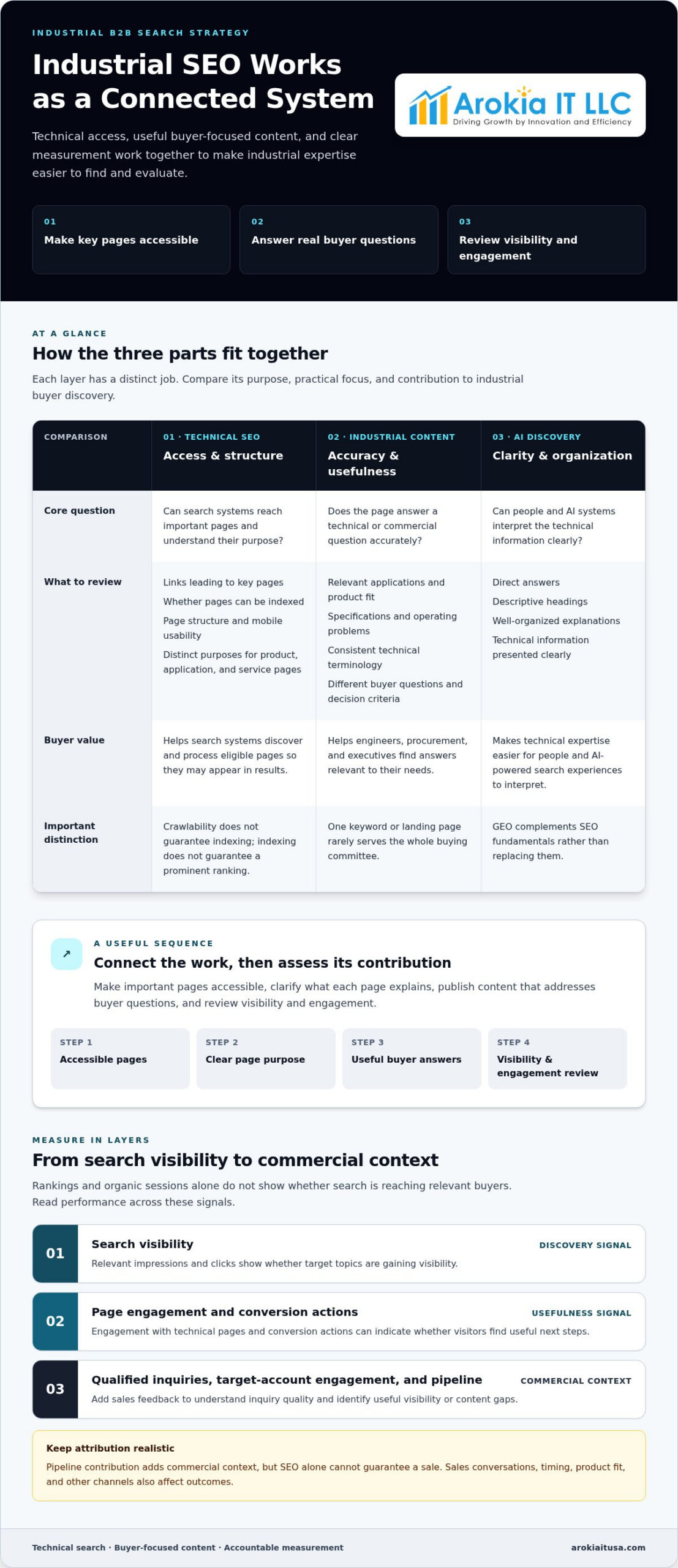
Measure progress in layers instead of treating all organic activity as equal. Relevant impressions and clicks show whether target topics are gaining visibility. Engagement with technical pages and conversion actions can indicate whether visitors find useful next steps. Qualified inquiries, target-account engagement, and pipeline contribution add commercial context, but SEO alone cannot guarantee a sale. Sales conversations, timing, product fit, and other channels also affect outcomes.
A practical review asks whether pages attract relevant audiences and whether those audiences take meaningful next steps. Segment conversions by page purpose, then compare inquiry quality with sales feedback to identify useful visibility and content gaps. Arokia IT LLC’s B2B SEO strategy connects search work to business priorities. The aim is more accountable discovery, not traffic at any cost.
How Industrial SEO Connects Technical Search, Content, and AI Discovery
Industrial SEO works as a connected system, not a set of isolated keywords or page edits. Search engines need to find and understand useful pages, technical buyers need accurate answers, and marketing teams need to know whether the work reaches relevant audiences. If one part fails, the rest has less chance to contribute.
A useful sequence is to make important pages accessible, clarify what each page explains, publish content that addresses real buyer questions, and review visibility and engagement. An industrial SEO agency should explain how these pieces support one another and how it will evaluate their contribution.
Technical SEO foundations for complex industrial websites
Technical SEO starts with whether search systems can reach a page and understand its purpose. Crawling is the process of discovering and accessing pages. Indexing means processing and storing eligible content so it may appear in search results. Ranking is the ordering of results for a particular query. A page can be crawlable without being indexed, and indexing does not guarantee a prominent ranking.
For a complex industrial site, review the links leading to key pages, whether pages can be indexed, how clearly each page is structured, and how well the site works on mobile devices. Give product, application, and service pages distinct purposes rather than relying on near-duplicates with unclear differences. Before implementation, validate recommendations against current search guidance and the site’s actual configuration.
Industrial content that answers technical and commercial questions
Plan content around the questions buyers need to resolve: where a product applies, which specifications matter, what operating problem it addresses, and what a decision-maker needs to evaluate next. Accurate terminology matters. A page that uses technical terms consistently and distinguishes related applications is more useful than one that repeats broad claims without explaining product fit.
Clear, specific content helps search systems interpret a company’s industrial expertise and helps buyers decide whether the information applies to their needs. Arokia IT LLC’s B2B SEO strategy brings site structure, search intent, and content priorities together.
Where AI search fits into industrial discovery
Generative Engine Optimization (GEO) complements rather than replaces SEO fundamentals. Direct answers, descriptive headings, and well-organized explanations make technical information easier for people and automated systems to interpret. They do not guarantee that an AI platform will cite a page or recommend a supplier.
Keep established organic measures, such as impressions, clicks, and conversions, distinct from emerging AI visibility signals. Define how each signal is tracked so an unverified mention is not reported as a qualified opportunity. Arokia IT LLC’s AI search optimization adds this discovery consideration to a sound search foundation. To align technical SEO, content, and AI discovery, discuss your B2B search priorities.
How to Compare an Industrial SEO Agency With a Practical Scorecard
A useful evaluation separates persuasive claims from evidence of how the work will be done. An industrial SEO agency should connect technical understanding, content decisions, measurement, and sales priorities in a plan your team can inspect and question. Use the scorecard below to compare the approach, not to chase a universal rating or benchmark.
Look for an explanation of how the strategy will account for technical offerings, applications, and specialist buyer questions. Strong evidence includes a clear process for learning your terminology and product context, not simply a list of industries served.
Ask to review a sample audit finding and its business rationale. The explanation should prioritize issues, clarify what needs attention first, and identify who owns implementation and quality review. A long list of technical observations without priorities or ownership is difficult to act on.
Review how the agency turns subject-matter input into useful search content. Look for an editorial workflow that shows how experts validate application details, how pages serve distinct purposes, and how content addresses specific buyer questions rather than repeating generic claims.
Reporting should distinguish visibility and engagement from commercial outcomes. A credible plan defines what counts as a conversion, how lead quality is assessed, and how organic activity is reviewed alongside account engagement and pipeline data. It should explain attribution limits instead of assigning every opportunity to SEO.
Look for a process that brings marketing and sales together on target accounts, lead qualification, and feedback from sales conversations. Strong evidence includes shared definitions and a clear way to use feedback to refine priorities, content, and reporting.
Evaluate technical and industrial subject-matter capability
A credible plan makes complex work understandable: what the audit examines, how priorities are selected, who implements changes, and how accuracy is checked. Arokia IT LLC brings industrial marketing and B2B SEO together, connecting search work with how technical companies explain their offerings.
Compare reporting against qualified demand and pipeline
Agree on definitions before assessing results. Impressions and clicks indicate search visibility and visits; conversions show actions; lead qualification and account engagement add context; pipeline indicators connect activity with sales opportunities. Arokia IT LLC offers 90-day pipeline forecasting as a planning service, not as a promise that SEO will produce a specific revenue outcome. A useful scorecard makes the method and accountability visible before work begins.
What an Industrial SEO Engagement Should Measure and Improve
An industrial SEO program needs a decision process, not just a dashboard. Establish a baseline, prioritize buyer needs, execute focused work, review the signals, and refine the next actions. An industrial SEO agency should make each step traceable to a business priority without promising that search activity alone can control revenue.
Set baselines and prioritize work before expanding content
Before adding pages, review current search visibility, site structure, conversion paths, and gaps in relevant content. Prioritize work according to buyer importance, business relevance, and implementation needs. A page tied to a core application may deserve attention before a broader informational topic, especially if buyers lack a clear path from that page to a meaningful next step.
Record the starting point for the pages and actions you select so later comparisons have context. Priorities depend on the website, available subject-matter input, market, and implementation capacity. A sound plan explains what comes first and why, rather than imposing a standard timeline or outcome.
Connect search insights with demand generation and sales
Search questions can reveal the problems buyers are trying to solve and the language they use. Marketing can use those insights to shape account-specific content or equip sales teams with concise material for recurring technical questions. CRM context adds another layer: it can help teams assess whether an inquiry fits the intended audience and whether an opportunity progresses, stalls, or closes.
These signals need shared definitions. Marketing and sales should agree on what qualifies as a conversion, a qualified inquiry, and an engaged target account. Search can contribute discovery and context, but it rarely tells the whole story of an opportunity. Arokia IT LLC’s demand generation services connect search insights with broader programs designed to support pipeline priorities.
Use reporting to make decisions, not just produce dashboards
Interpret metrics together. Impressions show how often pages appear for searches; clicks indicate visits from those appearances. Qualified conversions add evidence about action and fit, while CRM and pipeline data provide downstream sales context. For example, more clicks without relevant inquiries may point to a mismatch between the query, page content, and intended buyer. Treat that as a reason to investigate, not proof of a single cause.
Attribution has limits. Industrial opportunities may involve multiple channels, stakeholders, and extended evaluation, so a final deal cannot always be assigned to one organic visit. Separate observed data from assumptions about channel contribution. Keep reporting concise: agreed goals, accountable owners, notable changes, and next actions. Sales feedback can then refine page priorities and content instead of leaving the dashboard disconnected from buyer conversations.
SEO indicators can be measured and improved, but they do not guarantee revenue outcomes.
How Arokia IT LLC Brings Industrial SEO Into a B2B Growth Strategy
Industrial SEO is more accountable when it informs the broader growth plan instead of operating as a separate traffic channel. Arokia IT LLC connects B2B SEO with industrial marketing, account-based marketing (ABM), and demand generation so search insights can support the audiences and offerings the business has chosen to prioritize.
That connection gives organic research a practical role beyond attracting visits. Questions about an application, product fit, or operating challenge can help shape content for target accounts, clarify what sales teams need to explain, and reveal gaps in buyer education. SEO supports discovery; the broader program helps teams use that insight across the sales journey.
Connect industrial SEO with ABM and sales enablement
ABM focuses marketing and sales activity on selected high-value accounts. Search-informed content can support that work by addressing relevant problems and giving different stakeholders useful material to review. A technical explainer may help an evaluator understand an application, while a concise sales enablement asset can help a seller respond to a recurring commercial question.
Sales enablement content should draw on questions raised during sales conversations, not assume every buyer needs the same explanation. Arokia IT LLC’s industrial marketing strategy connects content planning to the wider B2B context, where technical discovery, account priorities, and sales communication need to work together.
Keep AI search complementary to SEO fundamentals
AI search and Generative Engine Optimization (GEO) can broaden how a company approaches discovery, but they do not replace a sound SEO foundation. Clear page purposes, accessible content, and accurate explanations remain central. Arokia IT LLC includes AI search in its B2B growth work, treating visibility in AI-powered experiences as an opportunity to assess rather than a guaranteed result.
The practical question is whether the strategy gives buyers useful information wherever they conduct research while keeping reporting grounded in observable signals. Organic search data, account engagement, and sales feedback can inform decisions without claiming that one channel caused every opportunity.
Define a focused next step with Arokia IT LLC
Start by identifying the offerings that matter most, the audiences and accounts the business wants to reach, current search gaps, and the objectives behind the work. Those inputs help shape a strategy around the company’s market, website, and sales process rather than a generic list of SEO tasks.
That alignment makes the next conversation more productive: your team can focus on which discovery problems matter, what evidence is available, and how search should support demand generation and sales priorities.
Make Your Next SEO Decision With Clear Priorities
Choosing an industrial SEO agency is also a decision about how your organization will work together. Before the next planning cycle, align on what marketing will own, what sales will validate, and which evidence will guide decisions to continue, change, or pause an initiative. That clarity helps prevent search activity from becoming a separate workstream with no defined role in the business.
A useful next step is a focused conversation about where organic search belongs in your growth agenda and how a strategy should fit your company’s market, website, and sales process. Arokia IT LLC can help frame that discussion around business priorities, practical constraints, and the decisions your team needs to make.
With a shared direction and clear ownership, your team can build a search program that supports the business it is meant to serve.
Frequently Asked Questions
What does an industrial SEO agency do?
An industrial SEO agency improves how technical B2B companies are found and understood through organic search. Work can include reviewing how product information is organized, identifying search questions tied to industrial applications, and shaping pages that help buyers evaluate a solution. The agency should also define how progress will be assessed, so marketing can distinguish useful discovery from visits with little connection to the target market.
How is industrial SEO different from general SEO?
How long does industrial SEO take to show results?
There is no dependable universal timeline. Some changes, such as fixing a page that cannot be reached through the site, may be verifiable before broader visibility or business effects emerge. Search demand, competition, technical condition, content readiness, and implementation pace all influence progress. Set checkpoints for completed work and observable signals, then interpret them over an appropriate period rather than expecting a fixed date for pipeline impact.
How can an industrial company measure SEO results?
Connect search data with lead and CRM records. For example, track whether a relevant organic landing page led to a form inquiry, then assess whether the inquiry matched the intended industry, application, or account profile. This adds context beyond counting form fills. Keep reporting definitions consistent, and note when a sales opportunity involved other channels or prior interactions.
Does an industrial SEO agency need to understand technical products?
Yes. The agency needs a reliable process for understanding technical products, even when company subject-matter experts provide product validation. It should be able to organize interviews or review sessions, clarify unfamiliar terms, and flag claims that need technical review before publication. A page about an industrial component, for example, should explain its intended application accurately rather than imply that it suits every operating condition.
How much does an industrial SEO agency cost?
Pricing depends on the scope and complexity of the engagement, so a useful estimate requires a defined work plan. Factors include website condition and size, the number and depth of pages involved, technical implementation needs, content development, reporting requirements, and how much work internal teams will handle. Compare proposals by deliverables, responsibilities, and measurement approach, not by a monthly figure alone.
Can industrial SEO support AI search visibility?
Yes. Industrial SEO can support AI discovery by making technical pages clear, specific, and well organized, which also helps human readers. A company can answer precise questions about applications or product considerations without assuming an AI platform will cite or display its content. Treat AI visibility as a developing area to monitor separately from established organic metrics such as search impressions, visits, and conversions.