
A technically superior formulation won’t move a deal forward if buyers can’t connect its performance to their application. For specialty chemical manufacturers, b2b marketing for specialty chemical manufacturers must make technical value clear to engineers, procurement teams, and executives while giving sales a useful signal for what to do next.
That balance is difficult. Product evidence can be detailed, buying groups have different priorities, and long evaluations make it hard to connect marketing activity with pipeline progress. More campaigns won’t solve the problem if they don’t help the right accounts assess fit and take a meaningful next step.
This guide explains how to compare marketing approaches with specialty-chemical buying needs and build content around applications, evidence, and buyer questions. It also covers how account-based marketing can complement broader demand generation, and how coordinated engagement, sales follow-up, and pipeline forecasting can provide clearer visibility into opportunity progression. The goal is a practical framework that connects marketing messages to sales engagement and measurable account movement.
Key Takeaways
- Connect application fit and technical validation to the questions each stakeholder needs answered.
- Build content around credible performance evidence, not product announcements alone.
- Compare broad demand generation, ABM, and channel-supported marketing by reach, personalization, and sales coordination.
- Make b2b marketing for specialty chemical manufacturers more measurable by linking account engagement to agreed sales progression signals.
- Coordinate ABM, demand generation, LinkedIn, and sales enablement to improve account visibility and follow-up.
Why B2B Marketing for Specialty Chemical Manufacturers Requires a Different Growth Framework
Specialty-chemical B2B marketing explains a chemical product’s application value to business buyers and helps qualified accounts move toward evaluation and purchase. The purpose isn’t simply to generate inquiries. It is to connect a relevant product, a defined buyer problem, credible supporting information, and a sales process that can advance the opportunity.
That distinction matters because buyers assess more than a product description. They may need to determine whether a formulation fits an application, whether its performance has been demonstrated under relevant conditions, and whether it meets internal purchasing or review requirements. Specialty chemicals are materials used based on their performance or function. Marketing needs to explain the product’s intended role without implying that one formulation suits every use.
For b2b marketing for specialty chemical manufacturers, progress is better measured by qualified opportunities advancing through evaluation than by raw lead volume alone. A large inquiry count can obscure whether the right companies are engaging, whether a product has a plausible application fit, or whether sales has a useful next step. A focused industrial marketing strategy connects market education to account relevance and sales action.
How specialty chemicals differ from commodity-focused marketing
Commodity-focused messaging may emphasize availability, price, or other purchasing terms. Specialty-chemical messaging also needs to explain where a product may fit and what buyer problem it is intended to address. For example, a manufacturer promoting an additive for a particular coating application should connect the claim to that use case and its supporting evidence, rather than imply universal performance.
Technical evaluation can shape the decision alongside commercial terms. Buyers may compare documented performance, application requirements, and supplier information before discussing a purchase. Treating every chemical category or buying journey as interchangeable can lead to broad claims that don’t answer the questions a specific audience needs to resolve.
What the specialty-chemical buying group needs from marketing
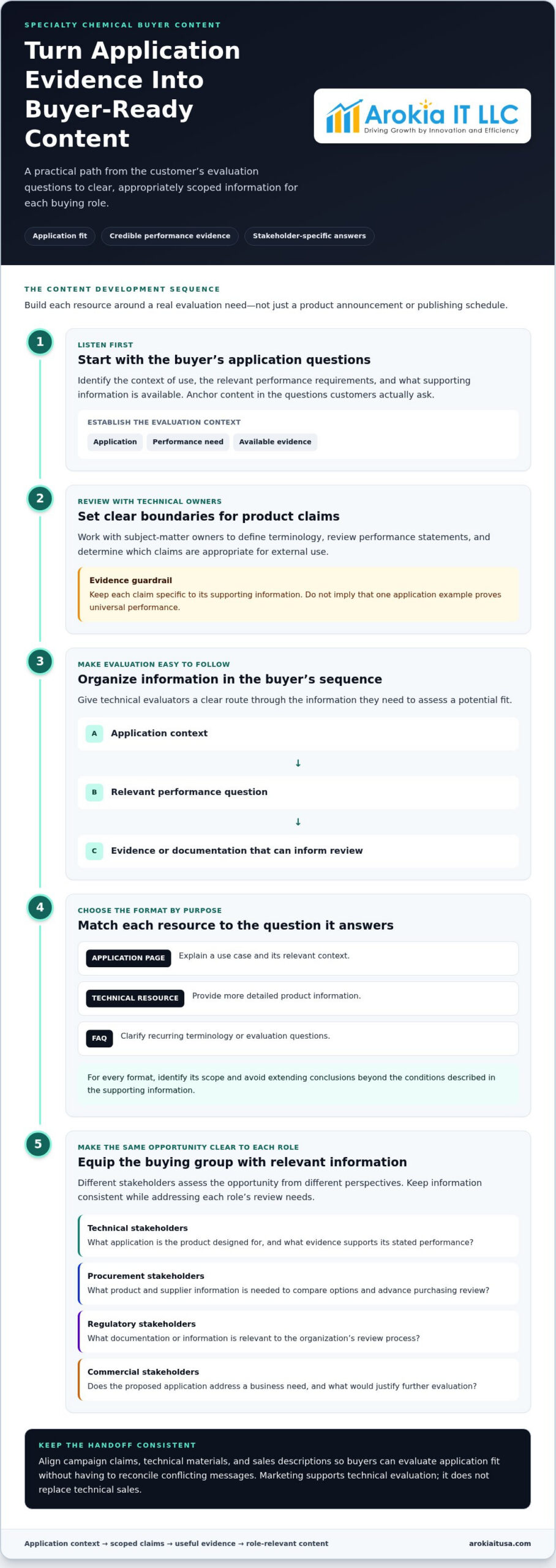
A buying committee can include technical, procurement, regulatory, and commercial stakeholders. Their questions differ, so useful marketing helps each role assess the same opportunity from its own perspective:
- Technical stakeholders: What application is the product designed for, and what evidence supports its stated performance?
- Procurement stakeholders: What product and supplier information is needed to compare options and advance purchasing review?
- Regulatory stakeholders: What documentation or information is relevant to the organization’s review process?
- Commercial stakeholders: Does the proposed application address a business need, and what would justify further evaluation?
Inconsistent claims create friction. If a campaign promises a benefit that technical materials don’t substantiate, or sales describes the application differently, buyers must reconcile the discrepancy before evaluating fit. Marketing should organize clear, approved information for each stage of consideration. It supports technical evaluation and helps sales identify which accounts are ready for a substantive conversation, without replacing technical sales.
Turn Application Evidence into Useful Content for Specialty Chemical Buyers
Start with questions customers actually ask. An application page, technical resource, or FAQ should explain the context of use, relevant performance requirements, and the information available to support evaluation. Avoid turning a single application example into a broad promise. Make each claim specific enough to understand and keep it within the limits of its supporting evidence.
Match application content to technical evaluation questions
Work with technical subject-matter owners to define terminology, review performance statements, and determine which claims are appropriate for external use. Then organize content around the buyer’s evaluation path: application context, the performance question, and the evidence or documentation that can inform review. This structure helps formulators and engineers find relevant information without treating every product or use case as interchangeable.
Choose formats based on the questions they answer, not just a publishing calendar. An application page can explain a use case, a technical resource can provide more detailed product information, and an FAQ can clarify recurring terminology or evaluation questions. Each asset should identify its scope and avoid suggesting that results apply beyond the conditions described in the supporting information.
Give each buying role evidence it can use
Technical evaluators need clear product and application context. Procurement and commercial stakeholders need information that helps them understand the product’s role and assess the supplier as part of their process. Safety or compliance statements require particular care: keep them consistent with approved documentation and have the appropriate internal reviewers assess them before publication. The American Chemistry Council is a useful reference point for broader chemical-industry context, but product-specific statements should rely on the manufacturer’s own approved materials.
A practical content review can prevent mixed messages. Before an asset goes live, confirm:
- Audience and purpose: Which buyer question does the asset address?
- Evidence: Which approved technical information supports each performance claim?
- Scope: Are application conditions and limitations clear?
- Consistency: Do terminology and statements align with current sales and technical materials?
- Ownership: Have the appropriate technical and safety reviewers approved the content?
Once approved, make assets easy for sales to find and share. A concise summary can direct a buyer to relevant technical detail, while a consistent source document helps prevent teams from circulating outdated or conflicting claims. The American Chemistry Council provides broader chemical-industry context. To align technical content with buyer engagement, discuss your marketing priorities with Arokia IT.
Compare Broad Demand Generation, ABM, and Channel-Supported Marketing
No single marketing approach fits every specialty chemical product, market, or account. Broad demand generation can reach relevant audiences across applications, while account-based marketing (ABM) concentrates effort on selected organizations and buying groups. Channel-supported execution coordinates messaging across direct sales and distribution partners. The right mix depends on whether the manufacturer needs reach, focus, or consistency.
Use the comparison to identify which approach fits the commercial priority, then combine methods when the go-to-market model calls for it.
| Approach | Target-account clarity | Audience reach | Personalization | Sales coordination |
|---|---|---|---|---|
| Broad demand generation | Defined by market, application, or audience segment | Broadest reach across relevant audiences | Tailored to segments and buyer intent | Routes qualified engagement to sales |
| ABM | Explicit list of priority organizations | Focused on chosen accounts and buying groups | High, based on account needs and roles | Close coordination around account plans and follow-up |
| Channel-supported execution | May span end users, distributors, or both | Extends through direct and partner channels | Adapted for channel roles while keeping core claims consistent | Requires clear ownership, shared materials, and handoffs |
When broad demand generation fits the growth objective
Broad demand generation is useful when a manufacturer needs to educate a wider relevant market, build awareness around an application, or attract buyers researching a product category. Segment campaigns by application and audience intent instead of promoting an entire portfolio with one generic message. A focused B2B demand generation strategy connects useful content and campaign engagement to sales follow-up without treating every response as equally qualified.
When ABM or channel coordination deserves greater emphasis
ABM fits priorities centered on a defined set of organizations, especially when several roles must understand the product before an opportunity can progress. A disciplined account-based marketing approach aligns account selection, relevant messaging, and sales engagement. Channel coordination matters when distributors and direct sales both influence product discovery or evaluation. Shared application language and approved materials help partners communicate consistently while keeping follow-up ownership clear.
A combined model can be more practical than choosing a single approach. Use broad campaigns to reach a market for an established product category, then apply ABM to strategic accounts with distinct needs. For distributor-led markets, pair that activity with partner-ready content and a defined handoff. Measure each motion against its purpose, such as qualified account engagement or agreed sales progression, rather than comparing every program by lead count alone. That is the practical decision behind b2b marketing for specialty chemical manufacturers.
Build a Measurable Marketing-to-Sales Process for Long Evaluation Journeys
A measurable process follows an account from selection through sales action and review. It gives marketing and sales a shared way to distinguish attention from buying progress, even while a technical evaluation is underway. For b2b marketing for specialty chemical manufacturers, that distinction keeps reporting focused on whether priority accounts are advancing, not just on how much campaign activity has occurred.
Set up the process in sequence:
- Define accounts and fit. Identify priority organizations, relevant applications, and the buyer roles likely to influence evaluation.
- Record engagement. Capture meaningful activity by account, such as engagement with application information or a direct response to outreach. Treat isolated clicks as context, not proof of buying intent.
- Agree on the handoff. Specify what qualifies an account for sales follow-up, who owns that action, and what context marketing must provide.
- Review progression. Compare engagement with sales feedback and documented changes in opportunity status, then adjust targeting or follow-up where needed.
Create an agreed handoff between marketing and sales
Marketing and sales should define qualified engagement together. A combination of account fit and relevant activity may warrant follow-up, while one low-intent interaction may not. The handoff should include the account’s application interest, roles engaged, content viewed or requested, and any known next step. With that context, sales can begin with a relevant conversation rather than asking the buyer to repeat information.
A clear industrial marketing strategy connects campaign activity, account context, and sales priorities. Agree on what sales acceptance means, how follow-up is recorded, and how marketing receives feedback when an account is deferred or disqualified. Shared definitions reduce the risk that an account appears “qualified” in one system and untouched in another.
Measure progress while opportunities are still being evaluated
Keep measurement stages distinct. Reach shows whether intended audiences had an opportunity to see the message. Engagement records meaningful account interaction. Sales acceptance indicates that sales has reviewed the handoff and taken ownership or returned a reason for deferral. Opportunity progression tracks agreed changes in the sales process. Together, these measures show where momentum is building or breaking down.
When an account stalls, review the evidence before increasing campaign volume. Is a technical question unanswered? Is ownership unclear? Has sales follow-up been recorded? This diagnosis helps teams choose a practical next step, such as sharing a relevant resource, clarifying responsibility, or revisiting account fit.
A 90-day pipeline forecast is a planning lens for assessing expected movement and making resource decisions, not a promise that opportunities will close within that period. Pair forecast assumptions with current account status, sales feedback, and explicit next steps. This provides clearer visibility into pipeline conditions while acknowledging uncertainty rather than hiding it behind lead totals.
How Arokia IT Can Support B2B Marketing for Specialty Chemical Manufacturers
Arokia IT supports industrial B2B companies with marketing programs that connect audience engagement, account priorities, and sales follow-up. For specialty chemical manufacturers, this means coordinating marketing around the commercial objective: reaching relevant buyers, helping priority accounts evaluate applications, and giving sales teams useful context for the next conversation.
ABM focuses marketing and sales effort on selected organizations and the roles involved in their evaluations. Demand generation extends relevant content to a wider audience interested in product categories or applications. LinkedIn marketing supports professional audience engagement, while sales enablement content gives sales teams materials for account conversations. These capabilities work best as a connected system, with shared priorities and clear handoffs rather than separate campaigns competing for attention.
Align strategy to accounts, audiences, and pipeline visibility
Connect target-account priorities to application audiences and the evidence buyers need to assess fit. A manufacturer can use broader campaigns to reach relevant markets while reserving tailored engagement for priority accounts. Digital marketing for industrial companies should account for both motions and give sales a consistent view of engagement and next steps.
Arokia IT’s 90-day pipeline forecasting helps leadership review pipeline conditions, plan marketing and sales activity, and make assumptions visible. It is a planning and visibility capability, not a guarantee of closed revenue or a prediction that every opportunity will advance on schedule. Forecast usefulness depends on clear opportunity definitions, current sales input, and realistic expectations about what available pipeline information can show.
AI search and Generative Engine Optimization (GEO) also support discoverability. Clear, well-organized explanations of applications and product information help search systems interpret a manufacturer’s expertise and make content easier to surface. No approach can promise a particular search ranking, AI-generated citation, or level of visibility. Treat AI search as one part of a broader discoverability strategy, alongside content, search optimization, and buyer engagement.
Prepare for a focused strategy conversation
A useful strategy starts with the business context, not a preset campaign template. Bring a short list of priority applications, target-account goals, and current challenges in marketing-to-sales handoffs. Identify which pipeline measures leadership trusts, where opportunities tend to lose momentum, and what content sales needs but lacks. These inputs help shape a plan around actual priorities rather than generic activity.
For b2b marketing for specialty chemical manufacturers, connect relevant evidence and channels to the accounts and pipeline measures that matter. Arokia IT provides B2B marketing capabilities to support those priorities, tailored to the manufacturer’s audience, sales process, and growth objectives.
Make the Next Growth Decision with Confidence
Turn your growth priorities into a decision that marketing and sales can act on. Choose an application or account segment where clearer evidence, more focused engagement, or a stronger handoff could make evaluation easier to manage. Agree on what progress should look like before launching more activity.
That focus gives b2b marketing for specialty chemical manufacturers a practical starting point: connect the commercial priority to a defined audience, a useful next action, and a signal the team can review. The plan should reflect your products, sales process, and route to market, not a template built for a different manufacturer.
A focused conversation can clarify where to concentrate first, what information sales needs, and which pipeline measures support better planning. Bring the priorities that matter most and use them to shape a disciplined path forward.
Frequently Asked Questions
How can specialty chemical manufacturers market products without disclosing proprietary formulation details?
Focus public content on the product’s function, intended application, and verified performance rather than confidential composition details. For example, explain the operational problem a treatment is designed to address and describe relevant evaluation considerations without revealing ingredient ratios or process conditions. Establish internal disclosure levels for public materials, sales documents, and technical discussions. Have technical and legal reviewers assess claims and confidential information before publication or distribution.
Should specialty chemical manufacturers market directly to end users or through distributors?
Choose channels based on how customers discover, evaluate, and purchase each product, rather than applying one route across the portfolio. Direct marketing can educate end users and surface application demand; distributor support can extend product access and reinforce selling relationships. Map who owns prospect communication, technical questions, and follow-up for each route. If both channels engage the same market, agree on shared messaging and account handoffs to avoid conflicting outreach.
Is LinkedIn useful for marketing specialty chemicals?
LinkedIn can support professional visibility and targeted communication, particularly when content addresses a defined industry, application, or technical audience. Use it to share concise explanations, application resources, event updates, or links to deeper product information. Measure whether engagement comes from relevant organizations and roles, not just whether a post receives reactions. For b2b marketing for specialty chemical manufacturers, LinkedIn should complement technical resources and sales engagement rather than carry the entire evaluation process.
How should a specialty chemical manufacturer handle long gaps between buyer interactions?
Use a planned nurture approach that gives buyers a reason to re-engage instead of sending repeated generic check-ins. Match follow-up to the last known interest: share a relevant application resource, clarify an unanswered question, or provide an update when approved product information changes. Record the interaction and next step so sales can distinguish an active evaluation from a quiet account. If there’s no useful new information, pause outreach instead of adding noise.
What should a specialty chemical manufacturer provide a marketing team before launching a campaign?
Provide a campaign brief with priority products and applications, intended audiences, target organizations, approved claims, and the business action the campaign should support. Include current product documentation, terminology preferences, known objections, channel roles, and any subjects that require technical review. Explain how sales records account activity and what qualifies for follow-up. This gives the team a foundation for content and measurement without asking marketers to infer technical details.
Can AI search optimization help specialty chemical buyers discover technical information?
AI search optimization can make technical information easier for search systems to interpret through descriptive page titles, clear headings, consistent product terminology, and direct answers to common application questions. Keep important content accessible on the website rather than relying only on materials shared privately by sales. Accurate, well-organized pages may improve discoverability, but no strategy can guarantee that an AI platform will rank, summarize, or cite a specific resource.