
ABM can generate plenty of activity while a small sales team remains unsure whether target accounts are moving closer to a deal. The right abm goals for small b2b companies connect marketing effort to business priorities, so the team can assess progress before a closed sale tells the whole story.
That uncertainty is understandable. In a small B2B company, the people planning marketing may also coordinate with sales, manage campaigns, and report results. There’s little room for measurement that creates work without helping the team decide what to do next. A clear goal gives both functions a shared point of reference and keeps limited attention focused on accounts that matter to the business.
This article explains how to set realistic ABM goals, choose measures that reflect account progress, and connect marketing activity with pipeline movement. It also covers how to compare results with a baseline, interpret early signals carefully, and adjust the plan when priorities or capacity change. The aim is a practical measurement approach a small team can maintain, not an enterprise-scale reporting system.
Key Takeaways
- Set ABM goals around measurable progress with selected high-value accounts, not campaign tasks such as sending emails or publishing content.
- Choose abm goals for small b2b companies that track early account signals as well as later pipeline and revenue outcomes.
- Make each goal actionable by documenting the account group, desired change, measure, timeframe, and owner.
- Compare results with a clear baseline and review period to assess progress before closed-won revenue appears.
- Align marketing and sales on metric definitions, data sources, ownership, and a recurring review before expanding ABM activity.
What should ABM goals accomplish for a small B2B company?
ABM goals define measurable progress with selected high-value accounts. They translate a business priority into an outcome marketing and sales can pursue together. For example, a company might aim to build relationships in a market where it has relevant expertise or create sales opportunities with a carefully selected group of prospective customers. The goal describes the intended business progress, not the tactics used to pursue it.
This distinction helps a small team avoid confusing completed work with value created. Publishing a technical guide, sending a personalized email, or launching a LinkedIn campaign may support an ABM goal, but each is an activity. The goal should explain why that activity matters. For a manufacturer, that might mean engaging the people involved in evaluating a production solution at selected companies. Content and outreach support the effort; they are not the outcome.
Useful abm goals for small b2b companies also guide prioritization. A small marketing group cannot customize every interaction for every prospect, and sales cannot follow up on every signal with equal attention. A focused goal makes the tradeoffs clear: which accounts deserve coordinated effort, what business progress matters, and how marketing and sales will work toward it. That clarity helps the team make decisions without building an enterprise-scale ABM operation.
ABM can complement broader demand generation rather than replace it. A company can continue building interest across its market while giving selected accounts more relevant content and coordinated attention. The approaches work together when teams connect an account’s broader interest to useful follow-up instead of putting every lead through the same campaign path. Arokia IT provides account-based marketing services to help coordinate targeted account work with sales.
How are ABM goals different from campaign goals?
A campaign goal usually describes channel activity, such as email sends, ad impressions, clicks, or downloads. An ABM goal focuses on the business relationship with a selected account. A campaign can contribute to that relationship, but channel performance alone does not show whether an account is becoming more accessible or commercially relevant. Track activity to assess execution, then check whether it supports the intended account outcome.
For foundational context, the account-based marketing methodology describes a focus on selected accounts and coordinated sales and marketing. In practice, a goal should make that coordination concrete: marketing develops relevant engagement, while sales uses account context to develop the relationship.
Why does a small B2B company need a focused goal set?
A focused goal set gives marketing and sales a shared basis for prioritizing work when time is limited. It can prevent disconnected activity, such as marketing pursuing one account priority while sales concentrates on another. Agree on the business outcome first, then use it to guide account selection and campaign choices. For more program context, see ABM for B2B companies.
Which ABM goals show progress before revenue is closed?
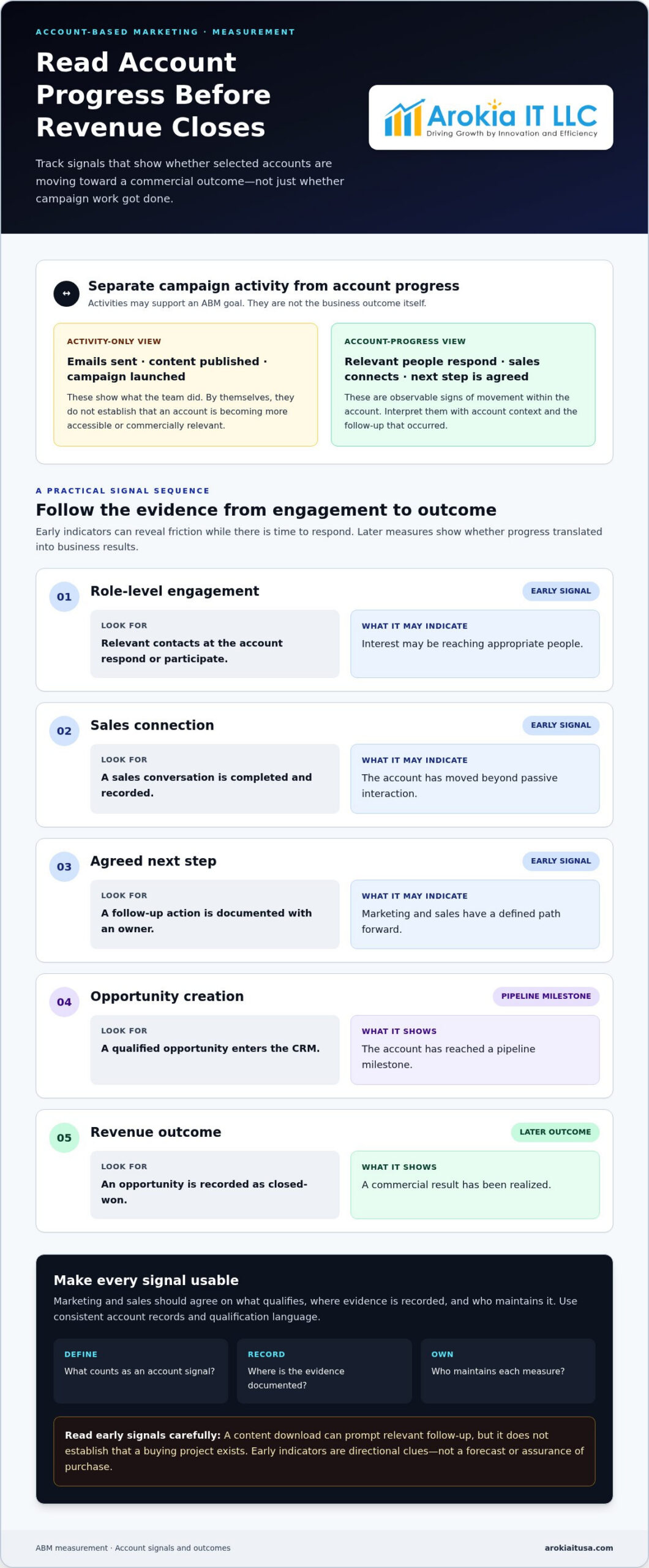
ABM reporting should show movement toward a commercial outcome even when no deal has closed. Leading indicators help the team see whether an account is progressing through its evaluation process. Lagging measures, such as qualified opportunities, pipeline stage changes, and closed revenue, confirm later outcomes. Review both: early signals can reveal friction while there’s time to respond, and later measures show whether progress translated into business results.
For each indicator, agree on what qualifies, where the evidence will be recorded, and who maintains it. For example, define whether an account counts as engaged after a substantive reply, a meeting with an appropriate stakeholder, or another observable action. A content download can prompt relevant follow-up, but it does not establish that a buying project exists. Clear criteria prevent a high-volume activity report from being mistaken for account momentum.
What leading indicators can a small team track?
Useful early measures reflect movement within the account, not simply the number of marketing interactions. A team might track whether relevant roles are participating, whether a sales conversation has happened, whether the parties agreed on a next step, or whether additional members of the buying group have joined the discussion. These are directional clues, not a forecast or assurance of purchase. Interpret them alongside account context and the follow-up that actually occurred.
| Goal stage | Example measure | How to interpret it |
|---|---|---|
| Role-level engagement | Relevant contacts at an account respond or participate | Interest may be reaching appropriate people |
| Sales connection | A sales conversation is completed and recorded | The account has moved beyond passive interaction |
| Agreed next step | A follow-up action is documented with an owner | Marketing and sales have a defined path forward |
| Opportunity creation | A qualified opportunity enters the CRM | The account has reached a pipeline milestone |
| Revenue outcome | An opportunity is recorded as closed-won | A commercial result has been realized |
These stages are useful only when marketing and sales apply the same rules. Use consistent account records and qualification language, and note the source of each measure. Forbes Agency Council discusses clear goals and key performance indicators as part of ABM execution. For a small team, the practical test is whether a metric can guide a decision without creating excessive reporting work.
Which pipeline and revenue outcomes belong in ABM reporting?
Report opportunity creation, stage movement, and closed revenue as separate outcomes. If the team reports account-sourced or account-influenced pipeline, document the attribution rule, including which activity qualifies and the time window. Apply the rule consistently so marketing and sales do not count the same opportunity differently. Arokia IT’s Account-Based Marketing and demand generation services help B2B teams connect account activity with pipeline decisions.
How should small B2B companies choose realistic ABM goals?
Realistic ABM goals start with a business priority, not a metric that happens to be easy to access. A small company can use a practical process: align marketing and sales on the priority, choose accounts that fit it, define the intended progress, assign ownership, and set a review date. Each goal should specify the account group, desired change, measure, timeframe, and responsible owner.
Use this sequence to keep goal setting tied to decisions:
- Align on the business priority. Decide whether the program should support new-account development, expansion, retention, or another defined objective.
- Select the accounts. Choose accounts that fit the priority and that sales can realistically pursue. Prioritization should determine where effort goes, not simply produce a longer list.
- Define progress. State what observable change would move an account closer to the business outcome.
- Assign ownership. Identify who updates the measure and who acts on the signal.
- Set a review point. Choose a timeframe that reflects the sales process and gives the team a consistent moment to assess results.
Targets should reflect the company’s baseline and operating capacity. If the team has no consistent record of account engagement, establish a usable baseline instead of adopting an arbitrary benchmark. A target that requires sales follow-up the team cannot provide is not realistic, even if marketing can generate the activity.
How can a team write a measurable ABM goal?
Use a simple template: “For [account group], achieve [desired outcome], measured by [defined measure], by [review date], with [owner] responsible.” The outcome describes the change the business wants; emails, ads, and content are activities used to pursue it. Choose a measure the team can observe in its existing systems, and clarify what counts before reporting begins.
Illustrative example, not a client result: “For selected industrial accounts, move two accounts from initial research to a documented sales conversation by the end of the next quarter; the sales lead records conversations and agreed next steps in the CRM.” The count, timeframe, and owner make the goal reviewable. If the team cannot reliably record that information, simplify the measure before launching.
How many ABM goals should a small company track?
Keep the list short enough for the available marketing, sales, and data capacity. Every metric should help the team decide what to continue, change, or stop. A measure that creates reporting work without informing an action adds overhead, not control. Add measures only when they clarify a business outcome or reveal a meaningful obstacle in account progression.
For abm goals for small b2b companies, discipline matters more than dashboard size. A focused goal set gives the team a manageable operating rhythm, while account selection and execution determine whether the work is sustainable.
How can a small team tell whether its ABM goals are working?
A small company does not need immediate closed revenue to evaluate ABM. Revenue is a lagging result, and a target account may show useful movement before becoming an opportunity. Ask whether observed progress matches the goal and whether the next step is becoming clearer. Compare results with a documented baseline over an agreed review period, and look for patterns across accounts rather than reacting to one promising interaction.
At each review, record the actual result, the original target, and context that could explain the difference. If engagement increased but no opportunities advanced, separate reach from sales progression: who engaged, which roles participated, what sales follow-up occurred, and whether a next step was documented. That turns a disappointing result into a diagnosis instead of a reason to abandon ABM or declare success based on attention alone.
| Observed pattern | Questions for marketing and sales |
|---|---|
| Engagement rises, but no sales conversations follow | Are the engaged contacts relevant, and is outreach reaching them at the right time? |
| One contact engages repeatedly, but the account stalls | Are other relevant roles involved, and does the content address the account’s needs? |
| Sales conversations occur, but next steps are missing | Are follow-up actions agreed and recorded consistently? |
| Opportunities advance, but attribution is unclear | Are marketing and sales applying the same account and influence definitions? |
What if target accounts engage but do not create opportunities?
Attention is not proof that an account is ready to buy. Check whether engagement reaches the roles involved in evaluation, rather than only one highly active contact, and whether the message addresses an account-specific concern. Then review sales follow-up: Was a conversation offered? Did it happen? Was a next step agreed and entered in the CRM? Missing records can hide progress, while consistent records can reveal where the handoff is breaking down.
When should a small company adjust its ABM goals?
Revise a goal when a material change in business priorities, account fit, team capacity, or data reliability makes the original measure misleading or unattainable. Do not rewrite targets simply because results are slower than hoped. Keep the original goal and results visible, document why the team changed course, and use the new definition going forward. That preserves what the team learned and prevents a revised target from obscuring what happened.
Clear ownership helps a lean team make these decisions without creating a separate reporting operation. Marketing can maintain campaign and engagement records, while sales documents account conversations and opportunity changes. Both teams should review the same account-level picture. Arokia IT’s ABM services help B2B teams align account engagement with pipeline priorities.
How can ABM goals connect to a practical next step?
ABM goals become useful when they connect a business priority to account progress, pipeline outcomes, and revenue measures. That sequence keeps the team focused on why it selected accounts, what change it expects, and how that progress could support a commercial outcome. It also helps leadership distinguish an early signal from a qualified opportunity or closed revenue.
Before expanding campaigns or adding accounts, document the operating basics. For abm goals for small b2b companies, the plan should fit the people available to do the work and the sales team’s ability to follow up. ABM can complement demand generation: broader programs create market interest, while coordinated account engagement gives priority companies focused attention. Neither motion should create more follow-up than the team can manage.
A practical starting plan should make these elements easy to find:
- Account scope: which selected accounts the goal covers and why they fit the priority.
- Outcomes: the small set of account or pipeline changes the team intends to measure.
- Shared measures: agreed definitions, data sources, and review timing for each measure.
- Accountability: who records activity, owns follow-up, and brings results to the review.
- Handoffs: where marketing and sales need a common definition, such as what qualifies as meaningful engagement or an accepted opportunity.
What should an ABM goal-setting discussion produce?
The discussion should end with a focused, reviewable plan, not a promise of revenue. Marketing and sales should be able to explain which accounts matter, what evidence would indicate progress, who owns each action, and where the evidence will be recorded. If they disagree about a handoff or metric, resolve that definition before campaigns begin. Clear operating rules make later reviews more useful.
How can leadership connect goals with pipeline planning?
Leadership can use ABM measures alongside pipeline planning to assess whether account activity is progressing toward sales opportunities and revenue. Arokia IT offers a 90-day pipeline forecast as a planning resource. A forecast is not actual performance or a guarantee; keep it distinct from recorded opportunity movement and closed revenue. Separating these categories lets projections inform planning without being mistaken for achieved results.
With owners, definitions, data sources, and a recurring review in place, leaders can decide whether to maintain the plan, adjust it, or expand account activity. The next step is to connect current priorities with a clear view of the pipeline.
Put your ABM goals into motion
Make your goals usable in the work already happening across marketing and sales. Start with a decision the team needs to make, such as which accounts deserve coordinated attention or what should happen after an account signals interest. Clear priorities help a small team focus effort without turning measurement into another layer of administration.
Strong abm goals for small b2b companies create a basis for action, not a promise that every target account will generate revenue. Use goals to guide where the team invests time, identify handoffs that need attention, and learn what to refine as account and pipeline evidence develops. Progress depends on consistent execution and honest review.
For B2B companies across Oklahoma, Texas, Louisiana, Arkansas, New Mexico, and Northern Mexico, aligning account priorities with sales follow-up can make limited marketing capacity more purposeful.
Start with a plan your team can own, measure, and improve. To connect your account priorities with pipeline planning, request a 90-day pipeline forecast from Arokia IT.
Frequently Asked Questions
What are good ABM goals for a small B2B company?
Good ABM goals connect a selected account group to a business result the company can act on. For example, an industrial supplier might aim to build sales relationships with relevant operations and engineering contacts at selected prospects. The measures should reflect the company’s CRM records and sales process. Start with a real business priority, not a benchmark borrowed from another company.
How many ABM goals should a small B2B team set?
There’s no fixed number that works for every small team. Choose only goals the people responsible can maintain alongside their regular work. Ask whether the owner can explain what decision a metric will inform and where its data comes from. If not, it may belong in a campaign report rather than the core goal set. Review the list when responsibilities or available data change.
Can a small company measure ABM success without closed revenue?
Yes. A company can assess intermediate progress while revenue is pending. For example, a CRM entry might show that a target account added a relevant technical contact to a sales discussion, even though no opportunity has been qualified. Record what happened and what action followed. Treat the signal as evidence of movement, not a prediction that the account will buy.
What is the difference between ABM goals and ABM KPIs?
An ABM goal states the account outcome the team is pursuing; a KPI is a measure used to monitor progress toward it. If the goal is to create stronger engagement with a selected group, a KPI might track participation from relevant roles. Before using that KPI, specify what qualifies as participation and how the team will handle duplicate contacts or repeated interactions.
How long does it take to see results from ABM?
There isn’t a dependable timeline for every ABM program. Account readiness, sales-cycle length, data quality, and follow-up all affect when outcomes appear. Set a review period that aligns with the sales process, then note whether accounts meet expected milestones. If procurement or technical evaluation is still underway, record the stage and next action rather than labeling the account a failure.
Should ABM replace demand generation for a small B2B company?
Not necessarily. ABM can focus attention on priority accounts while demand generation continues to reach a broader market. For instance, a software company could route an inbound inquiry from a priority account into tailored sales follow-up while keeping general educational campaigns active for other prospects. Define how the two approaches share audiences and handoffs so a target account does not receive conflicting or duplicate outreach.
Which ABM metrics should marketing and sales review together?
Review measures that show how an account moves between marketing engagement and sales action. A shared review might cover role-level participation, completed sales follow-up, agreed next steps, opportunity qualification, and changes in opportunity stage. Use the same account names and CRM records across both teams, especially when contacts use different email domains or belong to multiple business units. Consistent records make handoff gaps easier to identify.