
What if ABM doesn’t require a separate campaign for every target account? That’s the premise behind an abm strategy for small marketing teams: focus effort where it can matter most, and make personalization repeatable instead of reinventing it for each company.
When capacity is tight, even a carefully chosen account list can create more work than a team can sustain. Sales and marketing may also disagree on which accounts deserve attention, what counts as meaningful engagement, or who should follow up. Enterprise playbooks often miss these constraints because they assume dedicated ABM staff and complex technology.
This guide shows how to build a practical program around your team’s actual capacity. You’ll learn how to group accounts with genuinely similar needs, reserve deeper customization for top priorities, assign clear sales and marketing responsibilities, and use account-level signals and sales feedback to refine execution. The goal is steady, measurable progress while longer buying cycles continue, not a sprawling campaign that stalls after launch.
Key Takeaways
- Build your ABM workflow around the capacity your team can sustain, with clear ownership for campaign coordination and sales follow-up.
- Choose one-to-one, one-to-few, or one-to-many personalization based on account priority and available effort.
- Use an abm strategy for small marketing teams to coordinate account context, relevant messaging, outreach, and review without creating a separate campaign for every account.
- Track execution, account engagement, sales conversations, and pipeline outcomes as distinct signals when deciding what to improve.
- Use sales feedback and account-level engagement to refine your next campaign rather than treating one interaction as proof of revenue impact.
Why an ABM Strategy for Small Marketing Teams Must Start With Capacity
A small-team ABM program coordinates marketing and sales around a defined set of accounts, with work sized to the people and time available. That’s the practical starting point for an abm strategy for small marketing teams: choose a manageable scope, build shared context about each account, and repeat actions the team can sustain. Without those boundaries, personalization becomes a collection of one-off tasks competing with other revenue priorities.
Account-based marketing is not simply lead targeting with more research. Account-Based Marketing (ABM) is a strategic approach in B2B marketing that focuses coordinated effort on selected accounts. The account is the planning unit, while individual people still matter because different stakeholders can influence a purchase, raise concerns, or shape the next step.
ABM and broad demand generation can work together. Demand generation builds awareness and interest across a wider market; ABM concentrates relevant activity on accounts that merit focused attention. A small team doesn’t need to abandon broad programs to start ABM. Instead, decide where targeted coordination adds value, then connect that work to existing marketing and sales activity.
What makes ABM different from targeting individual leads?
Lead-focused outreach can treat each contact as a separate opportunity. ABM gives marketing and sales a shared view of the account: its business context, likely priorities, known contacts, and agreed next action. For example, a software company pursuing a manufacturer might shape one conversation around production needs for operations leaders and another around integration concerns for IT, while keeping both connected to the same account priority. The interactions should reinforce one another, not arrive as disconnected campaigns.
For broader planning principles, ABM for B2B companies: Start focused explains how account focus shapes the program. That foundation helps teams coordinate account-based campaigns with broader demand generation instead of treating the two as competing strategies.
Which small-team constraints should shape the plan?
Before choosing accounts or channels, check what the team can reliably support. Capacity includes more than marketing headcount: sales participation, usable content, approval time, and campaign coordination all affect execution. A plan that depends on frequent custom assets or immediate sales follow-up may look compelling but fail if those resources aren’t available.
- Staff time: Identify who will coordinate the campaign and how much time they can protect for it.
- Sales participation: Agree on who provides account context, contacts prospects, and shares follow-up notes.
- Existing content: Find useful material that can be adapted before commissioning custom creative.
- Campaign channels: Prioritize channels the team already manages well; add complexity only when there’s a clear reason.
Separate essential work from optional upgrades. A shared account brief, a relevant message, and an agreed follow-up process can establish a workable foundation without a new platform, extensive automation, or unique creative for every company. Add tools or customization only when they solve a specific execution constraint. This capacity-first test keeps the plan focused on coordinated action and gives both teams a realistic basis for consistent follow-through. For B2B manufacturers, energy companies, software firms, or medical equipment businesses across Texas and nearby markets, the same principle applies: prioritize the accounts and buying concerns the team can support well.
Build a Lean ABM Operating Model Before Adding More Tactics
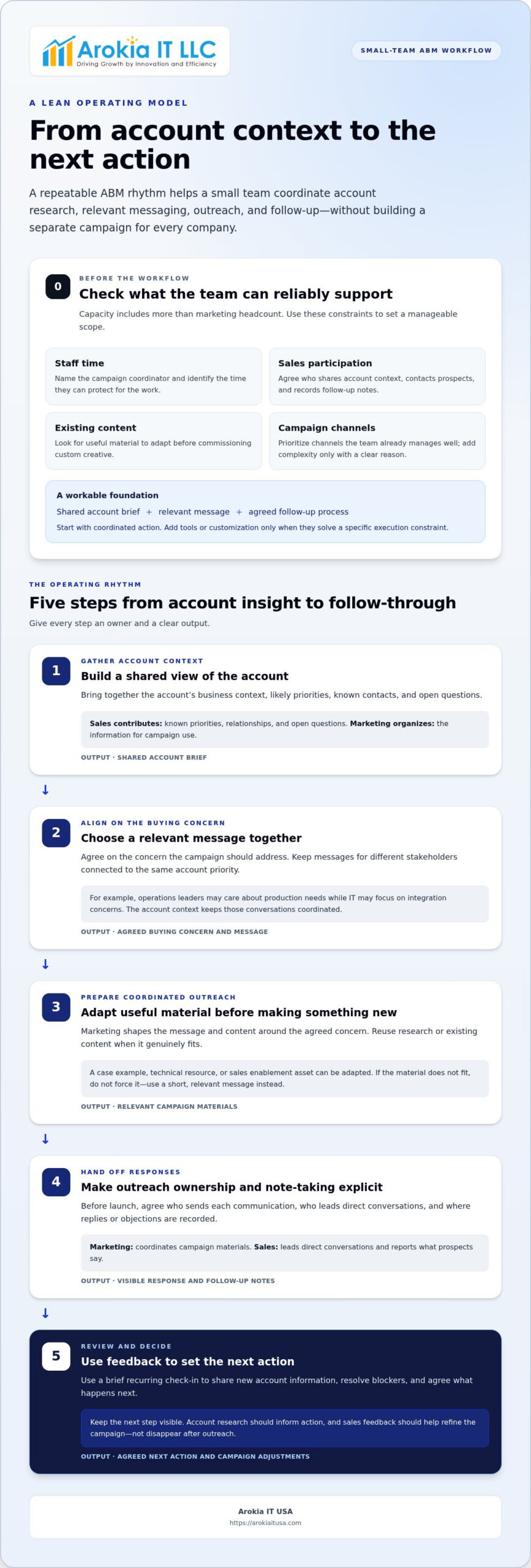
A lean ABM program needs a reliable operating rhythm before it needs another channel or platform. The minimum workflow is straightforward: gather account context, agree on the buying concern, prepare coordinated outreach, hand off responses, and review what to do next. Each step needs an owner and a clear output. Otherwise, account research sits unused, marketing sends a message sales doesn’t recognize, or an interested contact receives no follow-up.
This structure makes an abm strategy for small marketing teams repeatable without making every campaign identical. Reuse existing research and content when they address the account’s actual concern. Adapt a useful case example, technical resource, or sales enablement asset before commissioning something new. If the material doesn’t fit, don’t force it. A short, relevant message is more useful than a polished asset built around the wrong problem.
Set clear marketing and sales responsibilities
Name one person to coordinate the campaign, maintain the brief, and keep next steps visible. Marketing can organize research and prepare campaign materials; sales can contribute account knowledge, lead direct conversations, and report what prospects say. Define those responsibilities before launch so no task depends on an assumed handoff.
- Account context: Sales contributes known priorities, relationships, and open questions; marketing organizes the information for campaign use.
- Campaign materials: Marketing adapts the message and content to the agreed buying concern.
- Outreach and response: Agree who sends each communication and where replies or objections are recorded.
- Review: Use a brief recurring check-in to resolve blockers, share new account information, and confirm the next action.
A useful handoff explains why an interaction matters, not just that someone clicked or visited. Give sales the campaign context, the content or message involved, and a suggested follow-up. This makes the next conversation more coherent and gives marketing useful feedback.
Create a repeatable campaign brief
Use a concise brief that records the account problem, relevant stakeholders, core message, channel, campaign owner, and next action. Keep the fields consistent across accounts, but leave room to update assumptions as sales conversations reveal new information. A shared format helps the team distinguish a genuine account insight from a guess and compare execution without lengthy reporting.
For broader strategic context, the ABM for B2B companies: Start focused guide connects account selection to coordinated execution. The brief turns that focus into a working record: what the team believes, what it will do, and what evidence could change the plan.
Keep the operating model lightweight: one campaign owner, one shared brief, a defined sales handoff, and a regular review. Add process only when a recurring problem justifies it. Arokia IT supports ABM and demand generation for B2B companies, helping connect account strategy with campaign execution. Discuss your ABM needs with Arokia IT LLC.
Choose the Right ABM Personalization Level for Your Team
Personalization should match an account’s importance and the team’s capacity, not an assumption that every prospect needs a bespoke campaign. The three common ABM levels, one-to-one, one-to-few, and one-to-many, are operating choices. Each balances relevance against the time required to research, create, coordinate, and maintain outreach. For an abm strategy for small marketing teams, the right level is the one the team can execute well and sustain.
| Approach | Audience scope | Personalization depth | Workload considerations |
|---|---|---|---|
| One-to-one | Individual strategic accounts | High; tailored to account priorities and stakeholder context | Highest research and coordination effort; reserve for accounts with a clear strategic rationale. |
| One-to-few | Groups with meaningfully similar needs | Moderate; shared message with relevant account-level adjustments | Balances relevance and repeatability when the group has genuine common ground. |
| One-to-many | A broader set of named accounts | Light; common messaging informed by account characteristics | More repeatable, but still requires useful segmentation and relevant content. |
When does one-to-one personalization make sense?
Use one-to-one when the account merits intensive attention and the team has enough context to make that effort specific. Tailor the business problem, stakeholder perspective, and proposed conversation. A manufacturer evaluating a complex production change, for example, may need different questions for operations and finance, while the campaign stays centered on one account-level priority.
Deep personalization doesn’t mean creating a separate campaign or asset for every contact. Keep a shared message foundation, then adjust the details that change the relevance of the conversation. If the account rationale is weak or the available information is thin, elaborate customization adds work without establishing a stronger connection.
How can one-to-few and one-to-many reduce campaign workload?
Group accounts only when their buying context or concerns genuinely overlap. Similar industry labels alone aren’t enough. Two software companies may serve the same market but face different operational challenges; grouping them could make the campaign generic. A useful group shares a problem that the same core message and supporting content can address.
Build one campaign foundation, then adapt examples, proof points, or stakeholder language where they improve relevance. One-to-many can use broad account characteristics to shape messaging, while one-to-few allows closer tailoring across a smaller group. Review the fit as new account information emerges. Move an account into a more tailored approach when its strategic case strengthens, not simply because more personalization feels sophisticated.
Account selection determines whether these workload trade-offs make sense. The ABM strategy overview provides a broader foundation for focusing account-based efforts; apply that focus before deciding which accounts warrant deeper customization.
Launch a Small-Team ABM Campaign With a Manageable Workflow
A manageable campaign turns account insight into coordinated action without adding channels just to appear active. For an abm strategy for small marketing teams, use a defined sequence: confirm what you know, choose one buying concern, align marketing and sales on the message, activate a few appropriate touchpoints, then review the response. This keeps the campaign grounded in evidence and gives the team a clear basis for its next move.
Before launch, decide what the campaign should help the account do or discuss. A useful message connects a documented business challenge to a relevant next conversation, rather than a product pitch that could be sent to any company. Keep the central idea consistent across marketing materials and sales outreach so each interaction advances the same conversation.
- Confirm account context. Review available research and sales notes. Separate verified details from assumptions, and identify what remains unknown.
- Select a buying concern. Choose one relevant challenge or decision point the campaign can address. Avoid bundling unrelated issues into a single message.
- Align the message. Agree on the audience, useful next step, and language sales will use if a prospect responds.
- Activate the campaign. Coordinate a small number of channels, such as email and LinkedIn, with clear ownership and timing.
- Review and adjust. Record what happened, collect sales feedback, and determine whether the evidence supports a change.
Turn account insight into a focused campaign message
Use existing content when it genuinely supports the selected concern. A technical guide, article, or sales enablement asset can provide a useful starting point; adapt its framing or examples to the account without claiming unverified facts about that company. If no existing material fits, a direct, relevant outreach message may be more useful than creating an asset before the need is clear.
Coordinate outreach without overwhelming the team
Set the owner and timing for each planned interaction before the campaign begins. A LinkedIn touchpoint and an email should feel coordinated, not like separate teams contacting the same account without context. Track whether the agreed actions occurred and whether sales followed up, rather than counting channels as evidence of progress.
Sales feedback should refine the campaign, not send the team back to the strategy after every reply. One response may reveal a useful objection or a better contact; look for relevant patterns across conversations before changing the core message. If account context materially changes, update the campaign brief and adjust the next interaction. This preserves consistency while keeping the work responsive.
Account-focused outreach can sit alongside broader programs rather than operating as a separate track. Coordinating ABM with demand generation connects selected-account activity to wider market engagement and follow-up. For B2B teams in Oklahoma, Louisiana, Arkansas, New Mexico, Texas, and Northern Mexico, this can provide a practical way to align targeted outreach with broader regional demand generation.
Measure Small-Team ABM Progress and Decide What to Improve Next
Measure ABM in layers. Campaign completion shows whether the team executed its plan; account engagement indicates whether target accounts interacted; sales conversations reveal whether engagement led to useful dialogue; pipeline outcomes show whether opportunities progressed. These signals answer different questions. A click alone doesn’t establish buying intent, and a closed deal shouldn’t automatically be credited to one campaign or attribution model.
For an abm strategy for small marketing teams, choose a few measures the team can consistently capture in its CRM or campaign records. Match them to the campaign objective. If the goal is to open conversations, sales follow-up and relevant replies may be more useful near-term indicators than pipeline value, which can take longer to change.
- Execution: Were planned messages, content, and follow-ups completed?
- Account engagement: Did relevant people at the account respond or engage with campaign material?
- Sales conversations: Did outreach lead to a substantive discussion, new information, or a clear next step?
- Pipeline progression: Did an existing opportunity advance, or did a new opportunity emerge?
Which signals can a small team review consistently?
Pair CRM indicators with sales observations. Record the response, the stakeholder’s concern, and whether the agreed next action happened. A salesperson’s note that a prospect raised a new implementation question can explain a change in engagement better than a count alone. Keep observations brief and tied to the account so they can inform the next review without creating a separate reporting burden.
Review progress on a set cadence and make a decision: continue what is working, adjust a specific message or handoff, pause activity that isn’t earning its effort, or investigate unclear signals. Compare patterns across accounts where possible. Don’t change the campaign after every interaction, and don’t infer causation from timing alone. ABM may contribute to pipeline movement alongside sales conversations and other marketing activity.
When should a team refine its approach or seek support?
Repeated bottlenecks are useful evidence. If account research stalls, content production takes too much coordination, or sales follow-up is inconsistent, address that constraint before expanding the program. Scale only the workflow the team can execute and assess reliably. Additional strategic or execution capacity can help connect ABM with demand generation and make account activity easier to evaluate.
Arokia IT supports ABM and demand generation, and its 90-day pipeline forecasting can help teams build a view of near-term pipeline activity. Forecasting supports planning; it doesn’t guarantee pipeline or revenue outcomes. Use it alongside account-level engagement and sales feedback, not as a substitute for either.
Turn Your ABM Plan Into a Consistent Growth Practice
Let evidence guide the next stage of your program. Before expanding, identify the decision your team needs to make: deepen focus on a promising account, address a recurring execution gap, or hold the current scope steady. That gives your abm strategy for small marketing teams a clear path forward without adding complexity simply for the sake of growth.
If internal capacity is limiting that next decision, Arokia IT can support your ABM priorities with account-based marketing, demand generation, LinkedIn marketing, and sales enablement content. Keep the objective grounded in what your team can act on, and build from there.
A focused next step is enough to move the program forward. Your team can build momentum one well-supported decision at a time.
Frequently Asked Questions
Can one marketer run an ABM strategy alone?
Yes, one marketer can lead ABM coordination, but the effort needs a defined boundary within that person’s broader responsibilities. Before committing, estimate the work involved in research, approvals, campaign setup, and reporting, then protect time for those tasks. If routine marketing deadlines regularly displace account work, reduce the campaign scope or adjust timing. A focused program should fit the marketer’s real workload, not depend on repeated overtime.
Does a small team need ABM software to get started?
No. First identify a recurring operational problem that current tools cannot handle, such as unreliable account matching or reporting that requires repeated manual cleanup. Document where the problem occurs and what information the team needs to act on. That creates practical requirements for evaluating software later. Without that diagnosis, a platform may add setup and maintenance work without addressing the constraint holding execution back.
How is ABM different from personalized lead generation?
The difference is how the work is organized, not whether a message uses personal details. For example, a lead generation campaign may respond to an individual’s form submission, while an ABM plan can place that contact’s activity in the context of an existing account opportunity. The distinction helps teams decide whether a response calls for routine lead follow-up or a coordinated account conversation, while allowing both motions to operate together.
What if a small B2B company has limited CRM data?
Start by checking whether CRM records accurately represent the companies and relationships the team is targeting. Parent companies, subsidiaries, renamed businesses, and duplicate entries can distort account views before campaign activity begins. Confirm record ownership and distinguish current contacts from outdated ones. This data cleanup can be more useful than building elaborate scores from incomplete records, and it helps prevent outreach from being routed to the wrong account or contact.
How can a small team personalize ABM without writing every message from scratch?
Use an approved library of accurate claims, customer-facing explanations, and technical terms that marketing can draw on without altering their meaning. Subject matter experts can help validate language before it enters campaign materials. Then adapt the appropriate components to the audience and account context. This reduces the risk of overstating product capabilities or introducing unsupported claims, a concern for B2B companies communicating complex software, equipment, or industrial services.
Can ABM work with a long B2B sales cycle?
Yes. Long cycles make continuity especially useful when contacts change roles or account ownership shifts. Preserve a concise history of the business issue discussed, the prospect’s last stated concern, and any open commitment, so a new conversation can pick up without asking the account to repeat itself. That record supports a more informed handoff and protects context over time without treating early engagement as evidence of a guaranteed sale.
How often should marketing and sales review an ABM campaign?
Choose a review rhythm that fits the campaign, and use meaningful account events to determine when an issue needs attention sooner. For example, a new stakeholder entering an active conversation may warrant a quick decision, while routine activity can wait for the team’s established business review. This approach keeps urgent account developments visible without creating a meeting for every interaction or filling calendars with updates that require no action.