
An ABM campaign can generate account insight and still leave sellers unsure what to do next. An abm sales enablement framework closes that gap by turning account signals into timely, coordinated seller action, not another handoff or content folder no one uses.
That disconnect is familiar: Marketing and Sales may target the same accounts but define engagement differently, prioritize different signals, and measure progress on separate dashboards. Sellers then lack the context and materials to start relevant buying-group conversations, while leaders can’t tell whether enablement is helping accounts progress.
This article explains how to build a practical framework around shared responsibilities, account-level workflows, and useful content for each stage of the buying journey. You’ll learn how to define engagement and readiness signals, equip sellers to act on account insight, and measure progress using account and pipeline indicators. The goal is a more accountable connection between ABM strategy and day-to-day sales execution.
Key Takeaways
- Build an abm sales enablement framework as a connected operating system, not a collection of disconnected campaign assets.
- Compare centralized, sales-led, and shared account-team models to balance consistency with seller flexibility.
- Start with a defined account cohort and shared business objective, then map buying-group roles, seller needs, and available resources.
- Use recurring planning and reviews to coordinate seller preparation, campaign activity, and account feedback.
- Align ABM and demand generation around one account strategy while measuring account progression and pipeline indicators.
What an ABM Sales Enablement Framework Does for Target Accounts
An abm sales enablement framework brings together the people, processes, account insights, and resources sellers need to engage selected B2B accounts with relevant, coordinated conversations. It connects what Marketing learns and activates with what Sales needs to do next. Campaign execution creates account-facing activity; enablement helps sellers interpret that activity and respond in ways suited to the account.
This distinction matters because an account is not a single buyer. A technical evaluator may focus on integration or performance, while a finance stakeholder weighs investment and an executive considers strategic fit. A message that reaches one person rarely equips a seller to address every concern. The framework makes account-specific context useful across the buying group. For foundational context on account-based marketing and its sales-and-marketing alignment, see the overview of the discipline. Arokia IT LLC’s B2B ABM approach connects account strategy with execution.
How ABM enablement differs from general sales enablement
General sales enablement typically provides reusable product information, persona guidance, and sales training. ABM enablement adds a defined account and buying situation: why the account was selected, what is known about its priorities, which people are involved, and what engagement signals may inform outreach. That context helps sellers prepare, but it shouldn’t script the conversation. Sellers still need to test assumptions and adapt to what buyers share.
What the framework should help sellers do
The framework should turn shared Sales and Marketing context into useful preparation, not more material to sort through. Before a meeting, a seller should be able to find the account objective, relevant buying-group roles, recent engagement, and recommended next action. For example, if an operations contact engages with material about process efficiency, the seller can prepare questions and evidence relevant to that concern, while choosing different proof for a finance stakeholder.
It should also create a feedback loop. Sellers need a clear way to record which concerns surfaced, whether assumed priorities were accurate, and what response followed. Marketing and account teams can use those observations to refine messaging, content, and campaign activity. Without this loop, account intelligence goes stale and enablement becomes a static library.
The core principle is simple: insight only creates value when sellers can act on it. Make the right context easy to find, relevant resources easy to select, and field observations useful to the next account decision.
The Core Components of an ABM Sales Enablement Framework
An abm sales enablement framework works as a connected system, not a folder of campaign assets. Account selection defines where teams focus; buying-group insight clarifies who matters and what they may need; messaging and content guide relevant conversations; seller workflows assign ownership and next steps; and measurement shows whether accounts are progressing.
Those components need shared operating rules. Sales and Marketing should know who maintains account context, who prepares materials, when an account needs seller follow-up, and how field feedback returns to the team. Clear handoffs reduce the risk that a campaign generates engagement no seller knows how to use. This coordination addresses the friction described in Ending the War Between Sales and Marketing: teams need common goals and practical ways to work together, not simply more communication.
Connect account intelligence to seller priorities
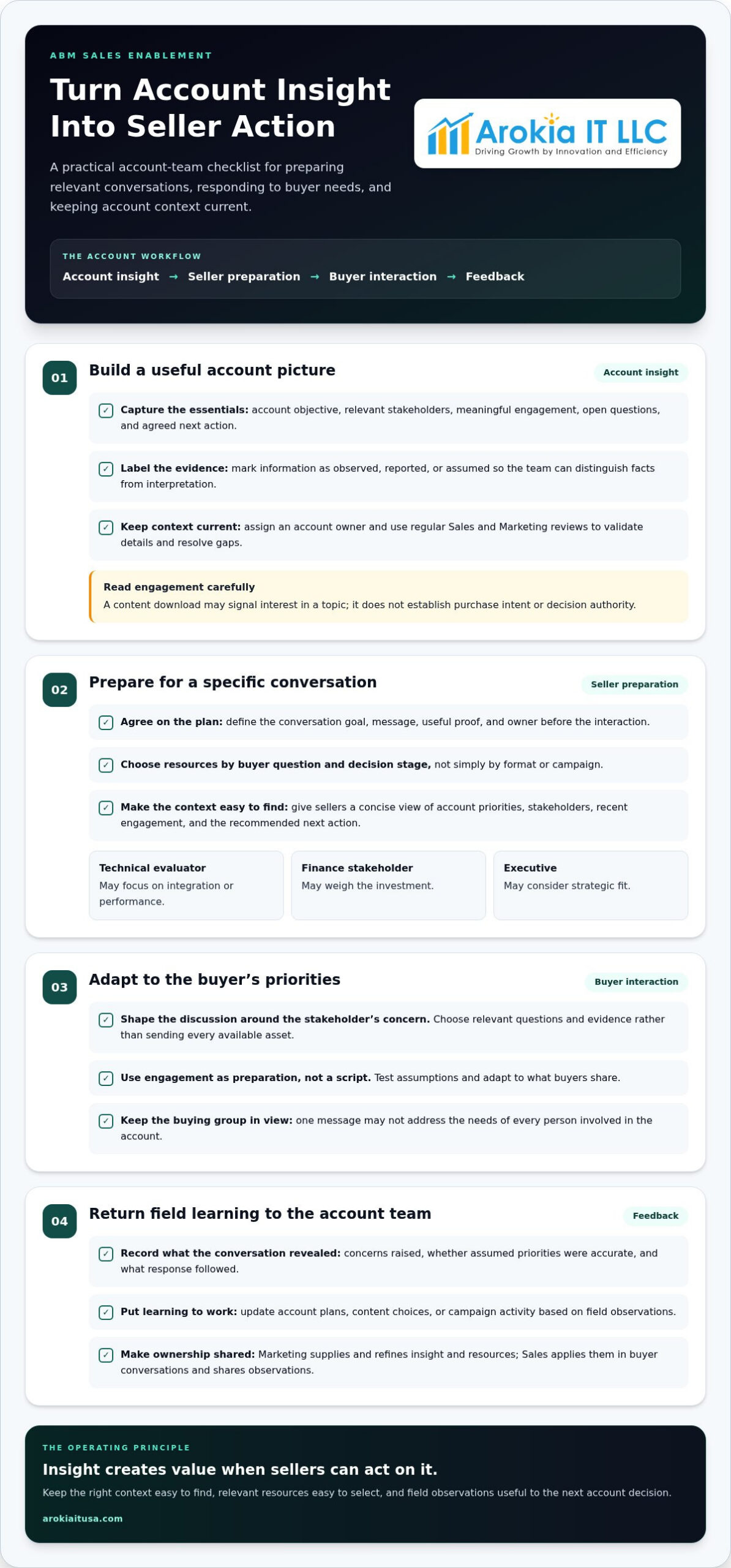
Give sellers a concise view of the account’s business objectives, relevant stakeholders, known engagement, open questions, and agreed next action. Label information as observed, reported, or assumed. A content download, for example, may indicate interest in a topic, but it doesn’t establish purchase intent or decision authority. Assign an account owner to maintain the record, then schedule regular Sales and Marketing reviews to validate context and resolve gaps.
Match enablement content to buying-group needs
Make the operating sequence explicit:
- Account insight: Capture the objective, stakeholders, and meaningful engagement signals.
- Seller preparation: Agree on the conversation goal, message, useful proof, and owner.
- Buyer interaction: Adapt the discussion to stakeholder concerns and new information.
- Feedback: Record what was learned and update account plans, content choices, or campaign activity.
This loop gives each team a defined contribution: Marketing supplies and refines insight and resources; Sales applies them in buyer conversations and shares field observations. Clear ownership and a consistent feedback process help account teams keep enablement aligned with buyer needs.
Compare ABM Sales Enablement Operating Models and Measurement
Operating models determine who governs enablement, how much sellers can adapt it, and how quickly account feedback shapes the next move. The right approach for an abm sales enablement framework depends on account complexity, team capacity, and how consistently Sales and Marketing already coordinate.
| Operating model | Consistency | Seller flexibility | Content relevance | Coordination effort | Feedback speed |
|---|---|---|---|---|---|
| Centralized enablement | High; standards and approved resources are easier to govern. | Lower; sellers work within defined guidance. | Strong for common needs, but can miss account-specific nuance. | Concentrated in the enablement or marketing team. | Can be slower if feedback passes through several owners. |
| Sales-led ownership | Variable across sellers and accounts. | High; reps can adapt quickly to buyer context. | Potentially high for individual accounts. | May duplicate work or create inconsistent materials. | Fast locally, though insights may not reach the wider team. |
| Shared account-team model | Consistent core guidance with room to tailor. | High within agreed boundaries. | High when Sales and Marketing shape resources together. | Requires clear roles and recurring coordination. | Fast when account reviews include a feedback owner. |
Choose a model that fits account complexity
Centralized standards suit teams that need message control, reusable resources, or clear content governance across a broad account set. Sales-led adaptation can fit situations where sellers know their accounts well and need to respond to distinct buying conditions, but it requires guardrails to limit fragmentation. A shared model balances both: central teams maintain core messaging and approved proof, while account teams tailor emphasis, sequencing, and next actions.
Assess the choice against three practical factors: how different target accounts are from one another, how much capacity teams have for coordination, and whether existing handoffs are reliable. Don’t add a complex shared process before assigning owners and defining what each review must decide.
Measure adoption without confusing activity for impact
Activity counts show whether materials were distributed or viewed. They don’t establish that sellers used them or that accounts advanced. Track whether sellers can find and apply relevant resources in their workflow, then review account progression and seller feedback alongside content engagement.
- Adoption: Resource access, use in account preparation, and seller feedback on relevance.
- Account progress: Changes in stakeholder participation, meeting outcomes, or opportunity stage.
- Pipeline contribution: Target-account pipeline movement considered alongside a defined baseline and other influencing factors.
These indicators support better decisions, but they don’t prove enablement caused revenue. Make causal claims only when the measurement method can separate enablement’s contribution from other sales and marketing activity.
How to Build an ABM Sales Enablement Framework From Scratch
Build the framework around a defined account cohort and a shared business objective. A broad rollout can expose process gaps too late; a focused pilot gives Sales and Marketing a practical way to test ownership, resources, and feedback before expanding.
- 1. Define the cohort and objective. Select target accounts using agreed criteria and state what the team needs to advance, such as gaining access to relevant stakeholders or validating a business priority. Clarify which seller roles the initial framework supports.
- 2. Establish the baseline. For each account, document known business context, buying-group roles, current engagement, open questions, and existing opportunity status. Distinguish verified information from assumptions so the team can identify what needs validation.
- 3. Map seller needs and available resources. Ask what sellers need before and during account conversations. Inventory relevant messaging, proof points, and content, then identify gaps. Organize materials around buyer concerns and decision stages rather than giving sellers a collection of unprioritized assets.
- 4. Assign ownership and define the pilot workflow. Name who maintains account context, prepares content, updates sellers, and leads account reviews. Specify how marketing signals become seller actions and how field observations are recorded. Keep the pilot narrow enough to learn from; the right scope depends on team capacity and account complexity, not a universal account count.
- 5. Review, refine, and expand deliberately. Establish a recurring feedback cadence. Review whether sellers can find and use materials, account context remains current, and accounts show meaningful progression. Use what the team learns to adjust ownership, messaging, resources, and priorities before applying the process more broadly.
Coordinate campaigns without blurring responsibilities
In the pilot, keep the roles of ABM and demand generation clear. ABM focuses effort on selected accounts and their buying groups; demand generation can support the broader strategy by creating and nurturing relevant interest. Coordinate timing and messaging, but make account ownership and seller follow-up explicit. Learn more about B2B demand generation as a complementary motion.
A useful pilot should produce more than a set of materials. It should show whether account insight reaches sellers in a usable form, responsibilities are clear, and feedback changes the next action. Those findings provide a grounded basis for refining the abm sales enablement framework as it scales.
To discuss how this approach could support your B2B growth priorities, connect with Arokia IT LLC about an account-focused sales enablement approach.
Turn the ABM Sales Enablement Framework Into a Revenue Routine
A framework only influences account progress if teams use it consistently. Make account planning, seller preparation, campaign coordination, and review recurring parts of the revenue process, with each meeting tied to a decision or action. The purpose isn’t to add meetings. It’s to keep account priorities, seller activity, and marketing support connected as buyer needs change.
Build a repeatable account-team cadence
At the start of each planning cycle, review account priorities, new evidence, buying-group coverage, and the next useful seller action. Before buyer interactions, sellers should have current context and relevant materials. Afterward, capture what changed: which concerns surfaced, who else needs to be involved, and whether the planned follow-up still fits.
Use shared definitions for engagement, readiness, ownership, and next step. Distinguish an observed response from the team’s interpretation of it, and name the person accountable for follow-up. Seller feedback can reveal gaps in timing, content, or account context, but it isn’t buyer evidence on its own. Validate assumptions through actual conversations and account signals.
Coordinate ABM and demand generation around one account strategy
ABM and demand generation can reinforce the same account objective without becoming interchangeable. ABM directs coordinated attention toward selected accounts and their buying groups. Demand generation supports broader interest and engagement that can contribute to those account priorities. Align audience, message, and timing while keeping ownership of account-specific seller action clear. Explore the Arokia IT LLC ABM approach and demand generation service for context on these related motions.
Arokia IT provides B2B ABM, demand generation, sales enablement content, and 90-day pipeline forecasting to support coordinated account execution. These capabilities can help teams plan seller support and improve pipeline visibility without treating activity as a guaranteed revenue outcome.
Decide what to improve before scaling
Review where execution stalls. Is account context incomplete? Can sellers find the right resource? Are materials being used in conversations? Do handoffs leave ownership unclear? Compare those findings with account-level progress, then prioritize the bottleneck that most directly limits useful seller action. Expand after responsibilities, resources, and feedback routines work in practice. This makes the abm sales enablement framework a managed revenue routine, not a campaign that fades after launch.
For a discussion of an ABM sales enablement approach for your B2B growth priorities, contact Arokia IT.
Make Account Insight Part of How Revenue Teams Work
A reliable abm sales enablement framework turns account intelligence into coordinated seller action. Its value comes from connecting account selection, buying-group context, relevant resources, clear ownership, and ongoing feedback, then checking whether target accounts are progressing rather than counting activity alone.
Start with a focused account group and a shared business objective. Give sellers practical guidance for buyer conversations, establish how Sales and Marketing will coordinate, and use account reviews to identify what needs to change. Arokia IT supports this work through Account-Based Marketing, demand generation, sales enablement content, and 90-day pipeline forecasting, connecting account strategy with execution and pipeline visibility without promising a particular outcome.
With clear responsibilities and a routine for learning from each account interaction, your team can build a disciplined approach and keep improving it as priorities evolve.
To discuss your ABM sales enablement priorities, contact Arokia IT.
Frequently Asked Questions
What is an ABM sales enablement framework?
An abm sales enablement framework is the set of people, processes, insights, and resources that helps sellers engage target accounts with relevant conversations. It connects account selection and buying-group context to messaging, content, seller actions, and measurement. Unlike a campaign plan alone, the framework helps sellers use account insight before, during, and after buyer interactions, then feed what they learn back into account planning.
How does sales enablement support account-based marketing?
Sales enablement turns account-based marketing strategy into useful seller action. Marketing can identify target-account priorities and coordinate campaigns, while enablement equips sellers with relevant account context, stakeholder insights, messaging, and content. Sellers use those resources to prepare for buying-group conversations and adapt to what they learn. A feedback process helps Sales and Marketing update account plans and refine future activity.
How do you build an ABM sales enablement framework from scratch?
Choose a defined account cohort and agree on a shared business objective. Document each account’s known context, buying-group roles, engagement, open questions, and opportunity status. Identify seller needs and available resources, then assign owners for account data, content, seller updates, and reviews. Test the workflow with a focused pilot, gather seller feedback, and review account progression before refining or expanding the process.
What content should an ABM sales enablement framework include?
Include content that helps sellers address specific buyer questions and decision stages. Depending on the account, resources might include approved messaging, product or solution information, relevant proof points, case studies, and responses to common objections. Organize materials by stakeholder concern and explain when each is useful. The goal isn’t to send every asset to every contact, but to help sellers choose resources that fit the conversation.
How can you measure ABM sales enablement effectiveness?
Measure whether sellers can find and use the intended resources, then assess those adoption signals alongside seller feedback and account progression. Useful indicators may include resource use in account preparation, stakeholder participation, meeting outcomes, opportunity-stage movement, and target-account pipeline contribution. Separate activity, such as asset views, from outcomes. Don’t claim enablement caused revenue changes unless the measurement approach can account for other sales and marketing influences.
Should sales or marketing own ABM sales enablement?
Sales and Marketing should share responsibility, with specific tasks assigned to named owners. Marketing can maintain campaign context, messaging, and content readiness; Sales can apply those resources in buyer conversations and report field observations. An account owner can coordinate next steps, while both teams review priorities and results. Shared ownership works best when teams agree on engagement definitions, handoffs, and who updates account information.
How is ABM sales enablement different from a sales enablement platform?
ABM sales enablement is an operating framework; a sales enablement platform is a technology tool that may support parts of it. The framework defines account-team responsibilities, workflows, content needs, and measures of progress. A platform may help organize or distribute materials, but it can’t establish shared account priorities or replace seller judgment. Define processes and ownership first, then use technology to support the workflow.