
The platform with the longer feature list may be the one your team never fully uses. That’s the practical question behind rollworks vs 6sense for small to mid-sized marketing teams: which platform can your team operate consistently and connect to sales action and pipeline goals? RollWorks, rebranded as AdRoll ABM in August 2025, has a stronger advertising focus; 6sense centers on predictive intelligence and account prioritization. Both can support account-based marketing, but they call for different levels of strategy, data readiness, and operational capacity.
If you’re weighing platform capabilities against the time and expertise needed to use them, start with your team’s actual workflow. This comparison looks beyond feature counts to help you assess fit with your ABM maturity and target-account motion. It covers campaign execution, sales follow-up, and the requirements to evaluate before choosing a platform. The goal is a defensible decision and an implementation plan your team can sustain, not another tool that adds complexity without clarifying its contribution to pipeline.
Key Takeaways
- Evaluate each ABM platform against your target-account strategy and the work your team can consistently own, not its feature count alone.
- The rollworks vs 6sense for small to mid-sized marketing teams comparison helps clarify which capabilities fit your campaign goals and operating capacity.
- Assess campaign ownership, data hygiene, sales coordination, and analytics before deciding whether advanced functionality is practical for your team.
- Use a weighted buyer scorecard to define outcomes, document workflows, and compare platform fit against shared requirements.
- Turn the software decision into a revenue workflow by assigning clear ownership for account criteria, campaign choices, sales handoffs, and performance reviews.
RollWorks vs. 6sense: What Are You Comparing?
Compare RollWorks and 6sense against your target-account strategy and your team’s ability to operate the platform, rather than comparing features in isolation. RollWorks was rebranded as AdRoll ABM in August 2025, so current product materials may use that name. A useful comparison shows how each option supports your account-based marketing (ABM) workflow, what work remains with your team, and how you’ll measure progress.
An ABM platform helps a marketing and sales team select target accounts, engage people at those accounts, and measure activity against business outcomes. The software can support parts of that process, but it doesn’t define your strategy or take responsibility for execution. For a high-level overview of the underlying approach, see Account-based marketing (ABM).
What does an ABM platform help a marketing team do?
An ABM workflow typically moves from account identification to audience activation. Teams then use engagement signals to guide campaign decisions and sales outreach. Reporting helps them assess whether campaigns are reaching the intended accounts and contributing to agreed outcomes. The tasks a platform supports depend on its product edition, connected data, and implementation.
Software can help organize account data, activate audiences, or surface engagement information. People still need to define account criteria, create relevant campaign content, decide how signals should affect outreach, and follow up with sales. A platform enables those tasks; clear ownership and a coordinated operating process make them actionable.
Why compare RollWorks and 6sense through team fit?
The question behind rollworks vs 6sense for small to mid-sized marketing teams isn’t which platform wins for every company. It’s which one fits your target-account motion, data readiness, channel needs, staffing, and measurement requirements. A team focused on activating account-based campaigns may have different needs from a team that relies on deeper account intelligence to prioritize its work.
Packaging and capabilities can change, and access may vary by edition or implementation. Compare the specific capabilities, integrations, and terms in the proposed packages with the people and workflows available to support them.
Buying software is one decision; building an ABM operating model is another. For a broader view of how account selection, campaigns, and sales coordination fit together, explore Arokia IT’s ABM strategy.
RollWorks vs. 6sense: Compare Capabilities That Affect Execution
Compare capabilities by the work your team needs to complete. For each requirement, distinguish what the platform does natively from what depends on integrations, licensing, or additional execution. The table summarizes distinctions between AdRoll ABM, formerly RollWorks, and 6sense. Use the workflow you plan to run as the basis for your evaluation.
| Evaluation area | AdRoll ABM (formerly RollWorks) | 6sense |
|---|---|---|
| Account identification | Supports account-based advertising. Assess the account identification inputs and targeting controls included in the package under review. | Uses predictive intelligence to help prioritize accounts. Assess available models, inputs, and license requirements. |
| Intent capabilities | Compare intent data sources and capabilities with the account signals your workflow requires. | Offers third-party intent data and predictive AI capabilities. Consider which data sources, access, and configuration fit your use case. |
| Advertising | Has an established focus on account-based advertising, with ad platform integrations. Compare supported channels and activation details with your campaign plan. | Advertising reporting includes pipeline drill-down analysis in RevvyAI, added in September 2026. Compare campaign activation options with your use case. |
| Orchestration | Assess cross-channel workflows and the edition access needed to support your campaign plan. | Assess which orchestration workflows are included and what depends on configuration or add-ons. |
| Integrations | Ad platform integrations are a stated strength. Compare CRM and marketing automation connections and sync behavior with your data needs. | Spring 2026 updates included improved enterprise API compliance. Compare available integrations and synchronization scope with your workflows. |
| Reporting | Compare reporting views with your attribution and measurement requirements. | Spring 2026 brought cross-campaign pipeline reporting; advertising reporting also has pipeline drill-down analysis in RevvyAI. |
| Support | Include the proposed package’s support terms and resources in your evaluation. | Include the proposed license’s support terms and resources in your evaluation. |
Which data, intent, and account signals should buyers evaluate?
Start with signals that could change a decision: whether an account fits your target criteria, shows relevant research or engagement, or merits sales attention. A signal is useful only if your team can interpret and act on it. For each platform, document the signal’s source, coverage, freshness, configuration needs, and how it reaches the people responsible for follow-up. This supports adaptive marketing programs without confusing more data with better prioritization.
How should teams compare activation, integrations, and measurement?
Map the campaign plan first: channels, audience, handoff, and desired outcome. Then assess whether activation and integrations support that workflow, including what syncs and where reporting data comes from. Consider whether measurement covers account engagement, opportunity progression, and pipeline analysis, not just campaign activity. A capability matters only when it supports a defined workflow your team can measure.
To connect platform requirements with account strategy and sales execution, talk with Arokia IT LLC about your ABM strategy.
Which Platform Fits a Small to Mid-Sized Marketing Team?
Advanced functionality doesn’t guarantee adoption or pipeline impact. A platform creates value only when someone owns the work around it: maintaining account criteria, managing campaigns, interpreting signals, coordinating sales follow-up, and reviewing results. The right fit depends on that operating capacity, not headcount alone.
Team size matters, but so do target-account volume, sales-cycle complexity, and the systems already in place. A focused account list and an advertising-led program may call for different workflows than a multi-stakeholder sales motion that relies on predictive account prioritization. In the rollworks vs 6sense for small to mid-sized marketing teams decision, assess how each platform’s current setup and capabilities match the work your team can sustain. A smaller team doesn’t automatically need one product, and a larger team won’t automatically benefit from the other.
What operational capacity does each platform require?
Before selecting either platform, assign an owner to each recurring responsibility. One person may hold several roles, but every task needs a clear accountable owner:
- Account lists: Define target-account criteria, approve changes, and resolve conflicting or outdated records.
- Campaign setup and audiences: Configure campaigns, maintain audiences, and check that activation follows the agreed account strategy.
- Sales coordination: Set expectations for which engagement signals prompt outreach, who follows up, and how sales feedback returns to marketing.
- Reporting and optimization: Review account and opportunity activity, identify gaps, and decide what to adjust.
Separate one-time onboarding from ongoing operations. Implementation documentation can clarify initial setup, training, data connections, and configuration. It won’t replace a practical estimate of recurring work, including list maintenance, campaign changes, data quality checks, and performance reviews. Match the required skills and workflows to the exact product package under consideration.
When can platform complexity become a poor fit?
Warning signs include fragmented ownership, unreliable CRM records, no agreed rules for selecting accounts, or sales teams that don’t know how to respond to engagement. Adding advanced functionality won’t resolve those operating gaps. It may make them harder to diagnose.
Reduce the risk by defining a bounded pilot: select a manageable account segment, connect it to one campaign objective, assign marketing and sales owners, and agree on the signals and outcomes you’ll review. This lets the team test whether the data, workflow, and measurement are usable before expanding scope. For guidance on connecting account-based programs with broader pipeline activity, see integrating ABM and demand generation.
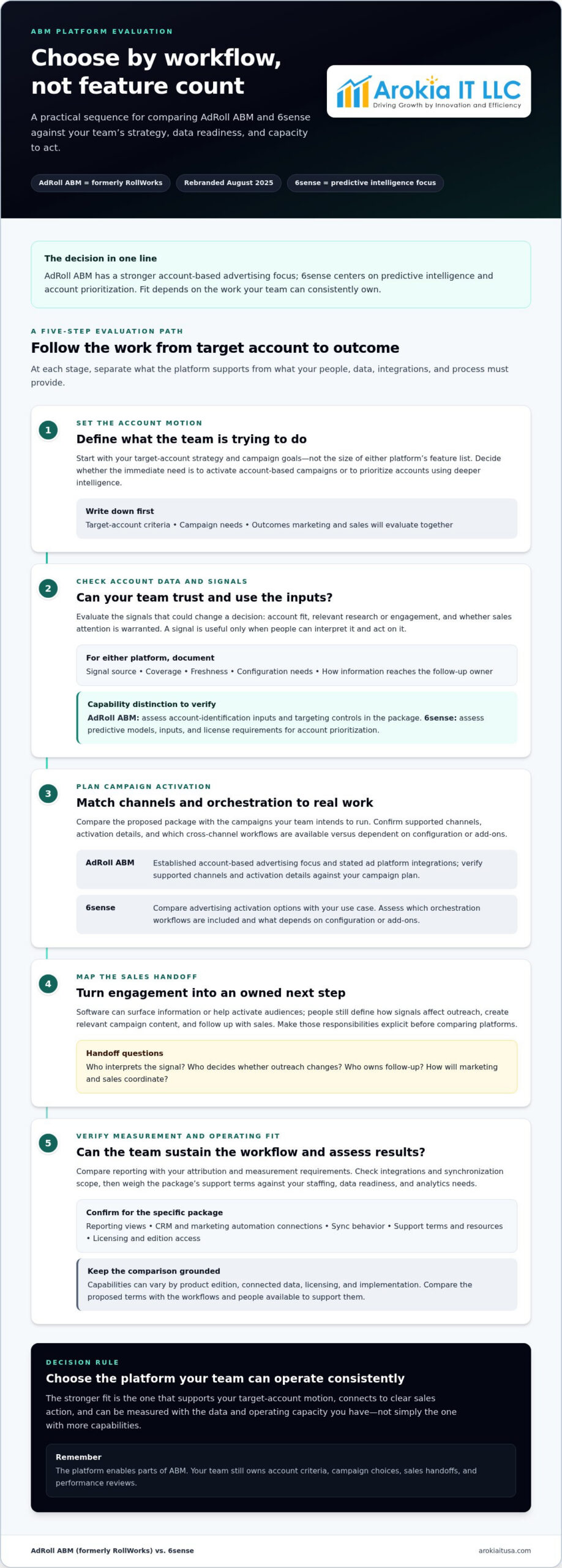
How to Choose Between RollWorks and 6sense: A Buyer Scorecard
A defensible RollWorks and 6sense decision starts with the revenue outcome and workflow you need to support. The scorecard below helps marketing, sales, operations, and finance prioritize requirements before platform demos or feature comparisons shape the decision. For rollworks vs 6sense for small to mid-sized marketing teams, the useful question isn’t which platform earns the highest generic score. It’s which one best supports your defined use case within your budget and execution capacity.
Use a five-step selection process
- Define outcomes. Specify what the program needs to influence, such as engagement from target accounts, sales follow-up, opportunity progression, or pipeline visibility.
- Document workflows. Map how accounts are selected, campaigns are activated, engagement reaches sales, and results are reviewed. Name an owner for each handoff.
- Compare requirements. Review proposed package details for required integrations, data flows, reporting, support, and commercial terms.
- Score fit. Set the importance of each criterion with stakeholders, then rate each platform against the same evidence and use case.
- Test measurement. Pilot a bounded workflow and assess whether the platform supports execution and reporting against your baseline and agreed objectives.
Weight requirements before scoring features
Have stakeholders assign each criterion a weight based on business importance. Use a simple scale, such as 1 for low priority through 5 for critical, and agree on the scale before reviewing vendors. Rate each platform against the same criteria using evidence from documentation, demonstrations, and workflow validation. Keep must-haves separate from optional capabilities; a high total should never offset a failure to meet a non-negotiable requirement.
- Integration and data quality: Can required systems exchange usable data, and can the team maintain dependable account records?
- Adoption workload: Is there clear capacity for setup, campaign management, audience upkeep, and ongoing optimization?
- Reporting: Can the team assess account engagement, opportunity movement, and pipeline in the way its stakeholders require?
- Support: Do the documented support model and resources align with the team’s implementation and operating needs?
- Commercial terms: Do the proposed package and contract terms fit the organization’s requirements and approval process?
Record each platform’s rating, supporting evidence, open questions, and weighted result. The score is a decision aid, not a substitute for judgment.
Make the pilot answer operational questions
Choose a defined account cohort, workflow owner, review period, and success measures. Test data flow, campaign execution, sales usability, and reporting against the documented process. Compare results with the team’s baseline and agreed objectives; don’t treat a pilot as a promise of future outcomes.
For help connecting account strategy, campaign execution, and sales alignment, discuss your ABM strategy with Arokia IT.
Turn the RollWorks vs. 6sense Decision Into a Revenue Workflow
A platform decision only creates value when account strategy, campaign execution, content, and sales follow-up work as one system. For rollworks vs 6sense for small to mid-sized marketing teams, turn the selected use case into a repeatable workflow with named owners and measurable handoffs.
What must happen after the platform is selected?
Translate the use case into operating rules before expanding activity. Define which accounts qualify, how audiences are grouped, what content supports each stage, which channels will reach those audiences, and what sales should do when engagement warrants follow-up. A signal should prompt a specific action only when sales understands its meaning, has the right context, and knows where to record the response.
Assign clear ownership for four decisions:
- Target-account criteria: Marketing and sales agree on account fit and approve changes.
- Campaign decisions: Marketing owns audience, content, channel, and optimization choices.
- Lead and account handoffs: Sales and marketing define response expectations and feedback paths.
- Performance review: A designated owner brings data quality, campaign activity, and pipeline evidence to a recurring review.
Measure progress in stages. Leading indicators, such as whether target accounts engage with campaigns, can help teams adjust execution. Later-stage evidence, including opportunity movement and pipeline activity, helps assess whether the program is contributing to commercial objectives. Neither view alone proves impact; interpret both in context and avoid treating attribution as a guaranteed outcome. Teams coordinating ABM with broader pipeline programs can explore Arokia IT’s demand generation services.
How can a lean team sustain ABM execution?
Start with a focused account motion the team can manage consistently. Keep the initial workflow narrow enough to maintain account data, deliver relevant content, coordinate sales actions, and review performance without unnecessary operational overhead. Expand only when owners can sustain the work and the current process supports a clear next decision.
Sales enablement matters as much as platform configuration. Give sales a shared explanation of the signals they may see, the actions those signals do or don’t warrant, and how to return useful feedback. This keeps engagement data connected to human follow-up rather than leaving it in a dashboard.
Arokia IT’s ABM services help B2B organizations connect account strategy, campaign execution, sales alignment, and pipeline measurement into a coordinated operating model.
Frequently Asked Questions
Is RollWorks or 6sense better for a small marketing team?
Neither platform is automatically better for a small team. The decision in rollworks vs 6sense for small to mid-sized marketing teams depends on your target-account strategy, data readiness, operating capacity, integrations, and measurement needs. Company size alone isn’t decisive. Compare current capabilities against a defined workflow, then assign owners for setup, campaign operations, data quality, and sales coordination.
What is the main difference between RollWorks and 6sense?
The practical difference is how each platform’s capabilities support your ABM workflow. RollWorks, rebranded as AdRoll ABM in August 2025, has a stronger advertising focus, while 6sense emphasizes predictive intelligence and account prioritization. Compare account identification, intent or engagement signals, advertising activation, integrations, orchestration, and reporting against your requirements. Features and packaging can change, so base the comparison on current product details rather than a static feature list.
Can a small B2B marketing team use an ABM platform effectively?
Yes. A small B2B team can use an ABM platform effectively if it starts with a focused use case, reliable account data, clear ownership, and sales agreement on follow-up. Software won’t resolve unclear account-selection rules or disconnected processes. Assign owners for setup, campaign execution, data maintenance, and measurement. A bounded pilot can help the team test the workflow before expanding its account list or campaign scope.
How should we compare RollWorks and 6sense pricing?
Compare current vendor proposals against the same scope, including required capabilities, contract terms, onboarding, support, and any usage or tier limits. Neither platform publishes official pricing for paid plans, so request current quotes and review what each includes. A headline price doesn’t show the full operating effort: account data, campaign management, reporting, and internal staffing also affect the resources needed to run the platform.
Do RollWorks and 6sense integrate with Salesforce or HubSpot?
Integration availability and functionality can vary by platform, package, and configuration. Review each vendor’s current details for Salesforce and HubSpot connections, synchronized records or fields, setup requirements, and reporting dependencies. Then test the data flow against your intended account and opportunity workflow. A listed integration doesn’t necessarily cover every synchronization or attribution need, so assess the specific handoffs and reporting your marketing and sales teams require.
What should we measure when evaluating an ABM platform?
Measure whether the platform supports the objective of your chosen use case. Track whether target accounts are reached and engaged, then assess progression through the agreed sales process and any available opportunity or pipeline evidence. Set a baseline, assign measurement ownership, and agree on evaluation criteria before a pilot begins. Impressions or isolated engagement can inform campaign decisions, but they don’t independently prove revenue impact.