
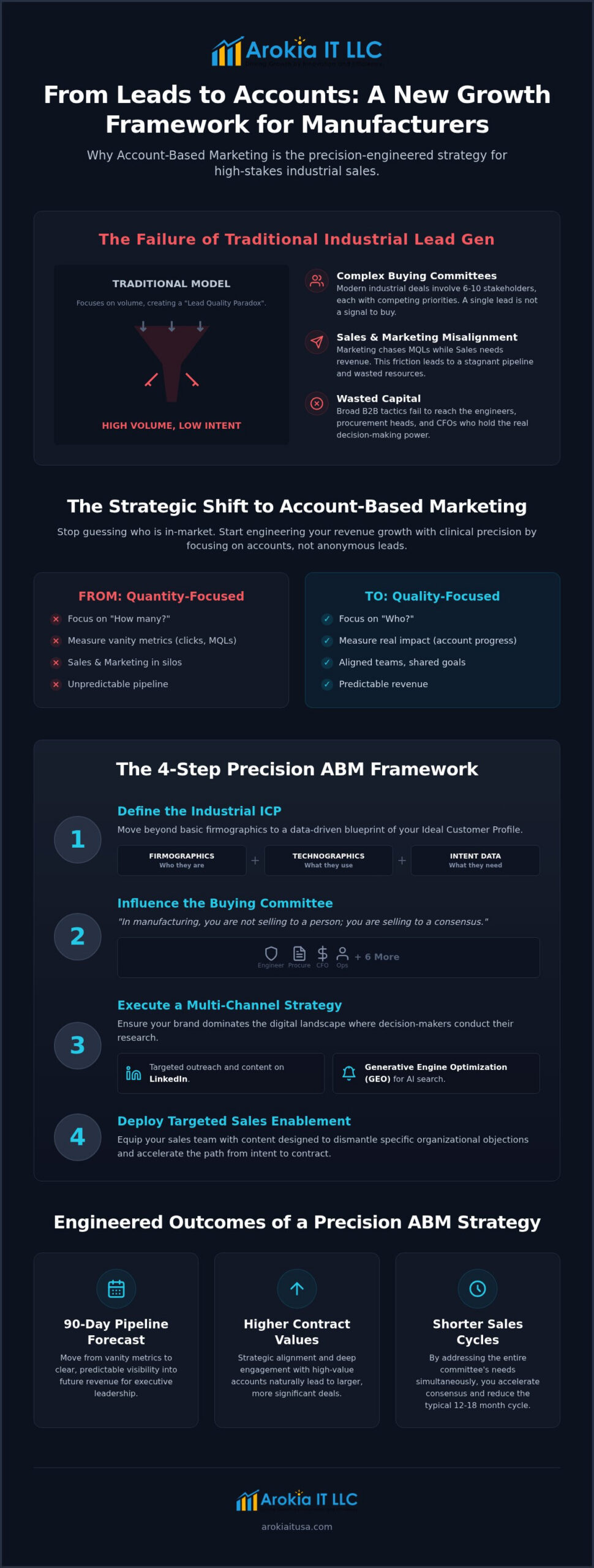
With the average industrial buying committee now reaching up to 10 decision-makers, traditional lead generation is no longer a growth strategy; it’s a liability. You’ve likely felt the frustration of a stagnant pipeline and the friction caused by sales and marketing teams operating in silos. Broad B2B tactics often waste capital on leads that never convert, failing to reach the engineers or procurement heads who actually hold the pen. Transitioning to account based marketing for manufacturers allows you to stop guessing who is in-market and start engineering your revenue growth with clinical precision.
This guide introduces a framework that replaces fragmented efforts with a precision-engineered system. You’ll learn how to replace wasteful spending with a strategy that aligns your internal teams for high-stakes industrial growth. By focusing on accounts rather than anonymous leads, you can secure predictable 90-day pipeline visibility and drive higher contract values through strategic alignment. The objective is to move away from vanity metrics and toward a model where every dollar spent is an investment in a specific, high-value relationship.
We’ll break down the mechanics of identifying high-value accounts, influencing the entire buying committee, and deploying the revenue intelligence required to shorten your industrial sales cycles. This isn’t just marketing; it’s a systematic approach to total market oversight.
Key Takeaways
- Identify the structural flaws in traditional lead generation and learn how to align your strategy with the complex buying committees found in the manufacturing sector.
- Develop a high-precision framework for account based marketing for manufacturers that uses technographic data to isolate accounts ready for a technological transition.
- Shift from tracking clicks to measuring impact with a 90-day pipeline forecast that provides executive leadership with clear visibility into future revenue.
- Execute a multi-channel strategy using LinkedIn and Generative Engine Optimization to ensure your brand dominates the digital landscape where engineers and procurement heads search.
- Equip your sales team with targeted enablement content designed to dismantle specific organizational objections and accelerate the movement from intent to contract.
Why Traditional Industrial Lead Gen Fails in High-Stakes Manufacturing
Traditional lead generation in the industrial sector is fundamentally broken. Many firms fall into the “Lead Quality Paradox,” where marketing teams celebrate a high volume of digital downloads while sales teams report a stagnant pipeline. This disconnect happens because broad B2B tactics focus on individual clicks rather than organizational intent. In high-stakes manufacturing, a single whitepaper download from a junior engineer doesn’t signal a purchase. It signals a search for information. Chasing these low-intent signals creates a false sense of progress while the actual revenue targets remain unmet.
The problem lies in the scale of the decision. Industrial sales aren’t transactional; they’re transformational. When you’re selling multi-million dollar equipment or long-term supply contracts, the risk of a bad decision is catastrophic. This reality makes broad, volume-based marketing a waste of budget. Instead, account based marketing for manufacturers shifts the focus from chasing anonymous traffic to engaging the specific accounts that actually move the needle. It’s a strategic pivot from “how many” to “who,” ensuring that resources are concentrated on accounts with the highest potential for growth.
The Complexity of the Industrial Buying Committee
Modern industrial deals involve 6 to 10 stakeholders, ranging from technical engineers to risk-averse procurement heads and the C-suite. Each role has competing priorities. Engineering wants performance; procurement wants price; the CFO wants ROI. A single lead doesn’t represent a sale. “In manufacturing, you are not selling to a person; you are selling to a consensus.”
To influence this group, marketing must transition into Account-Based Selling (ABS) principles. You need to provide tailored value to each stakeholder simultaneously. If your marketing only speaks to one person, you’ll lose the deal when the other nine members of the committee raise objections you haven’t addressed. Long sales cycles, often lasting 12 to 18 months, mean that your brand must remain visible and relevant to every decision-maker throughout the entire journey.
The Cost of Sales and Marketing Misalignment
Misalignment creates friction and erodes trust. When marketing is measured by Marketing Qualified Leads (MQLs) and sales is measured by revenue, the teams pull in opposite directions. Sales teams waste hours following up on low-intent leads, which leads to frustration and a lack of accountability. This inefficiency is expensive. Budget is burned on broad-reach tactics that don’t reach the right decision-makers at the right time.
Adopting account based marketing for manufacturers forces a strategic pivot. It aligns both departments around a shared list of high-value targets. Success is no longer measured by how many people clicked an ad, but by how much progress is made within a target account. This systematic approach eliminates waste and ensures that every marketing dollar supports a specific sales objective, creating a unified front that is far more effective at closing complex industrial deals.
Defining the Industrial ICP: Beyond Basic Firmographics
Most manufacturing firms operate on a “spray and pray” model disguised as targeting. A Target Account List is often merely a directory of desirable logos or a list of companies within a specific zip code. Conversely, a true Ideal Customer Profile (ICP) for account based marketing for manufacturers is a rigorous, data-driven blueprint of the accounts most likely to convert based on historical performance and future potential. It goes beyond simple revenue and headcount filters to include logistical compatibility, strategic alignment, and technological readiness. Without a validated ICP, your marketing efforts are nothing more than expensive guesswork.
Layering Technographics and Intent Data
Not all accounts deserve equal investment. A strategic tiering system ensures that your resources are optimized for the highest possible return. This structure allows you to scale your efforts without diluting the impact of your messaging.
- Tier 1 (1:1): These are “Whale” accounts. You dedicate significant resources to these high-value contracts because they define your fiscal year. Each campaign is entirely bespoke to the account’s unique pain points.
- Tier 2 (1:Few): You cluster accounts into specific industry verticals. For example, the messaging for aerospace manufacturers should differ significantly from automotive OEMs, even if the core product is the same.
- Tier 3 (1:Many): This programmatic outreach maintains a broad industrial pipeline. It uses automation to stay top-of-mind with a wider list of accounts that fit your ICP but don’t yet show high-intent signals.
Executing ABM for Industrial Manufacturing requires this disciplined allocation of focus. Without it, your team will likely succumb to the “Lead Quality Paradox” mentioned in the previous section. You must validate every account against your ICP before committing significant capital. To refine your targeting further, consider exploring a data-driven demand generation strategy that prioritizes high-intent signals over raw volume. This ensures your sales force spends time only on the accounts with the highest probability of closing, maximizing the ROI of every interaction. This is the fundamental difference between a busy sales team and a productive one.
The 90-Day Pipeline Forecast: Bringing Predictability to Industrial Sales
Industrial leaders often mistake activity for progress. While traditional marketing reports are cluttered with vanity metrics like impressions and click-through rates, these numbers rarely correlate with actual revenue. In the high-stakes world of heavy industry, a click is not a contract. True revenue intelligence requires a shift in focus toward account-level data. By implementing account based marketing for manufacturers, you move beyond superficial engagement to a disciplined 90-day pipeline forecast that provides executive leadership with tangible visibility into future growth.
Predictability is built on the elimination of waste. This includes the strategic use of “negative metrics.” Identifying accounts that fail to meet engagement thresholds allows you to reallocate capital toward higher-probability opportunities. If an account hasn’t shown meaningful movement across its buying committee within a specific timeframe, it should be dropped. This clinical approach ensures your resources are always concentrated on the most viable targets, preventing the slow leak of budget into dead-end pursuits.
Measuring Engagement Depth Within Target Accounts
A single contact engaging with your content is a data point; six stakeholders from the same manufacturing firm engaging with your content is a signal. Measuring engagement depth means tracking how many decision-makers within an account are consuming your sales enablement materials. A 90-day forecast is only as accurate as the engagement data supporting it. When you identify that a buying committee has reached a critical mass of interest, you can confidently move that account into a high-priority sales stage. This account-wide scoring system provides a far more reliable indicator of intent than any individual MQL ever could.
Predictive Modeling for Industrial Revenue
Predictive modeling transforms raw data into a strategic roadmap. By analyzing historical ABM touchpoints, you can calculate the statistical probability of a deal closing within a 90-day window. This isn’t guesswork. It’s a systematic validation of your pipeline based on verified interactions. Aligning this forecast with manufacturing production cycles and fiscal years allows for better resource planning and inventory management. This ensures that sales and production teams are prepared for the exact volume of incoming contracts.
This level of precision is the language of the C-suite. When you can present a forecast that maps marketing activity directly to anticipated revenue, you justify marketing spend to the CFO with objective data. It shifts the perception of marketing from a cost center to a critical driver of financial stability. This alignment is the ultimate objective of account based marketing for manufacturers, turning the sales process into a predictable engine for industrial expansion. Reviewing proven account based marketing examples from elite B2B firms can provide the strategic blueprints needed to accelerate this transformation within your own organization. Selecting the right technology stack is equally critical; evaluating the most effective ABM platforms for B2B enterprise pipeline generation ensures your forecasting infrastructure is built on tools your team will actually use.
Multi-Channel Execution: LinkedIn, AI Search, and GEO
Strategic forecasting is useless without surgical precision in execution. For account based marketing for manufacturers, this means moving beyond broad digital noise to a multi-channel approach that targets the specific IP addresses and professional profiles of your ICP. You don’t need a million impressions; you need the right fifty. Integrating LinkedIn outreach with advanced search strategies ensures your brand isn’t just visible, but authoritative. This level of coordination prevents fragmented messaging and builds a consistent narrative that resonates across the entire buying committee, ensuring your value proposition is reinforced at every digital touchpoint.
Maintaining a consistent narrative across these channels is what builds industrial authority. When an engineer sees a technical case study on LinkedIn and later finds your firm cited in an AI-generated search summary, it creates a sense of market dominance. This isn’t accidental. It’s the result of integrating paid search with account-based IP targeting to dominate the digital landscape where your prospects live. This systematic surrounding of the account eliminates the gaps where competitors often lose momentum.
LinkedIn Strategy for the Industrial C-Suite
Many firms treat LinkedIn as a digital billboard, yet for industrial ABM, it’s a surgical instrument. Sales Navigator is merely the starting point. True authority is built through thought-leadership content that addresses granular engineering bottlenecks or procurement risks. It’s about moving from generic “personal branding” to “organizational validation.” By deploying hyper-targeted LinkedIn ads, you can surround a specific account’s buying committee with case studies that prove your solution’s technical superiority. This ensures that when your sales team reaches out, they aren’t introducing the brand; they’re continuing a conversation that marketing has already started.
Dominating AI Search with GEO
Generative Engine Optimization (GEO) is the critical evolution of search in 2026. Traditional SEO focuses on keywords, but GEO focuses on context and authority for AI-driven engines. When an engineer asks an AI agent to “recommend a manufacturer for high-tolerance turbine components,” your firm must be the primary citation. This requires optimizing technical content, such as whitepapers and spec sheets, so AI models recognize your expertise. The shift from keyword-stuffing to authority-building is mandatory for survival in an AI-first research landscape. If your brand isn’t structured for these generative summaries, you’re effectively invisible to the most modern procurement paths.
Dominating these channels requires a disciplined orchestration of data and content. You can’t afford to let your digital presence be a series of disconnected experiments. To ensure your execution matches your growth targets, you need a partner that understands the mechanics of high-stakes industrial outreach. Explore how a comprehensive LinkedIn and GEO strategy can accelerate your account-based efforts and secure your place in the future of industrial search. By aligning your digital footprint with the specific needs of your target accounts, you eliminate waste and maximize the impact of every touchpoint.
Sales Enablement: Bridging the Gap Between Intent and Revenue
Equipping your sales force with the right data allows them to lead strategic consultations rather than standard sales pitches. When a rep enters a meeting armed with account-wide engagement data, they already know which stakeholders are hesitant and which are advocates. This precision eliminates the guesswork and allows for a more assertive, results-oriented approach. By closing the gap between marketing intent and sales execution, you ensure that no high-value opportunity is lost to internal misalignment or insufficient information. A brochure is not a strategy; a data-driven consultation is.
The middle of the industrial funnel is where deals either solidify or evaporate. Generic content fails here. To maintain momentum, you must develop technical ROI calculators and detailed implementation roadmaps that speak directly to the CFO’s concerns regarding capital expenditure. Personalized “Executive Summaries” that aggregate the specific benefits for a target account will always outperform a standard corporate deck. Additionally, creating “Sales Battlecards” tailored to specific industrial competitors allows your team to proactively address the strengths and weaknesses of the incumbent. This positioning ensures your firm is viewed as the superior alternative before the objection is even raised.
The Feedback Loop: Refining the ABM Engine
A static strategy is a failing strategy. Establishing a bi-weekly “ABM Stand-up” between sales and marketing teams is critical for maintaining the accuracy of your revenue intelligence. These sessions allow sales reps to provide real-world feedback on the objections they face, which marketing then uses to generate new, highly relevant demand-gen content. This feedback loop ensures your messaging is constantly optimized based on actual market resistance. Most importantly, this qualitative data is used to refine the 90-day pipeline forecast, ensuring that your revenue projections remain grounded in the reality of the sales floor. To achieve this level of strategic mastery, you must shorten your sales cycle with a specialized 90-day pipeline forecast from Arokia IT. This systematic approach transforms sales enablement from a support function into a primary driver of industrial growth.
Engineering Predictable Industrial Revenue
Industrial growth is no longer a game of chance. It’s a product of disciplined orchestration. By implementing account based marketing for manufacturers, you replace fragmented lead generation with a system designed for high-stakes precision. This framework ensures that your resources are concentrated on accounts with the highest conversion probability, while advanced AI search and GEO optimization secure your brand’s authority in an increasingly automated research landscape.
The path to a shorter sales cycle requires more than just better content. It requires total alignment between your marketing signals and sales execution. Arokia IT provides the specialized industrial demand generation expertise needed to bridge this gap, transforming stagnant pipelines into predictable growth engines. It’s time to stop chasing anonymous clicks and start influencing the buying committees that define your fiscal year. Your organization deserves the clarity that comes from data-driven revenue intelligence.
Shorten your industrial sales cycle with a 90-day pipeline forecast from Arokia IT. Secure your competitive advantage today.
Frequently Asked Questions
How long does it take to see results from an ABM strategy in manufacturing?
Initial engagement signals usually emerge within 90 days, but full ROI on multi-million dollar contracts often aligns with the 12 to 18 month sales cycle. We use a 90-day pipeline forecast to track early indicators like buying committee penetration and intent surge. This provides visibility before the final contract is signed. It’s about measuring progress through strategic milestones rather than waiting for a single closing date. This approach ensures that your marketing investment is validated by data long before the final revenue is realized.
Can small manufacturing firms compete with larger companies using ABM?
Yes, because ABM is an equalizer that prioritizes precision over massive ad budgets. Small firms can use account based marketing for manufacturers to dominate specific niches where larger competitors are too broad to be relevant. By focusing resources on a handful of high-value accounts, smaller teams can provide the hyper-personalized technical content and executive access that massive corporations often struggle to deliver at scale. This focus allows for a level of strategic intimacy that large-scale operations cannot replicate.
What is the difference between ABM and traditional lead generation for manufacturers?
Traditional lead generation is a volume-based game that treats every click as a potential lead, often resulting in a low-quality pipeline. ABM is a value-based system that identifies specific high-value accounts first and then works to influence every decision-maker within them. While traditional methods focus on “how many,” ABM focuses on “who.” This shift eliminates the waste associated with chasing low-intent leads that never convert, ensuring that sales and marketing efforts are perfectly aligned.
How do we identify which accounts to target in our ABM program?
Identification starts with a data-driven Ideal Customer Profile (ICP) that includes firmographics, technographics, and intent signals. We look for manufacturers using specific legacy systems or those undergoing “trigger events” like facility expansions. This layered approach ensures you aren’t just targeting large companies, but rather those with a documented need and the financial capacity to make a significant technological transition in the near term. This precision prevents the common failure of wasting resources on accounts that lack immediate intent.
What role does LinkedIn play in an industrial ABM strategy?
LinkedIn acts as a surgical tool for surrounding the industrial buying committee with technical authority. It’s used to deliver tailored case studies and thought-leadership content directly to engineers and procurement heads within your target accounts. By leveraging hyper-targeted ad sets and executive outreach, you ensure your brand is validated by the decision-makers who actually hold the pen on complex, high-stakes manufacturing contracts. This systematic approach ensures your message is reinforced across the entire decision-making unit.
What is Generative Engine Optimization (GEO) and why is it important for B2B?
GEO is the process of optimizing your technical content so AI-driven search engines recommend your firm during the research phase. In 2026, engineers frequently use AI agents to summarize vendor capabilities and technical specs. If your documentation isn’t structured for these generative summaries, your firm won’t appear in the AI’s final recommendation list. This makes account based marketing for manufacturers essential for maintaining digital visibility. It represents the shift from simple keyword matching to establishing deep, machine-readable authority.
How do you measure the ROI of an account-based marketing program?
ROI is measured through account-level metrics such as pipeline velocity, average contract value (ACV), and win rates within target segments. We move beyond vanity metrics to track the “90-day pipeline visibility,” which quantifies how much potential revenue is moving through specific engagement stages. By comparing the cost of account acquisition against the total lifetime value of the contract, we provide a clinical assessment of marketing efficiency. This ensures every dollar spent is an investment in a predictable revenue stream.
Does ABM replace our existing SEO and PPC efforts?
ABM doesn’t replace these tactics; it refines them. Traditional SEO and PPC provide the broad demand generation that feeds the wider pipeline, while ABM applies a layer of precision to your highest-value opportunities. For example, you might use PPC for broad category search but switch to IP-targeted ads once a high-value account shows intent. This creates a unified strategy that captures market share at every level, ensuring no high-value prospect is missed.