
The most expensive piece of software in your marketing stack isn’t the one with the highest licensing fee; it’s the one your team never actually uses. High platform shelfware rates continue to plague enterprise organizations, where sophisticated intent signals are routinely ignored by sales teams who don’t trust the data. You likely already feel the frustration of a misaligned strategy that does more than waste budget; it creates friction that stalls high-stakes deals and makes forecasting a guessing game. Identifying the most effective abm platforms for b2b enterprise pipeline generation requires more than a feature comparison. It demands a clinical assessment of how these tools integrate into a systematic revenue engine.
We’ve analyzed the 2026 landscape to identify which platforms actually move the needle on your 90-day pipeline. You’ll learn the strategic framework required to gain full visibility into your target account buying committees while eliminating the waste inherent in traditional demand generation. We’ll examine the market leaders through the lens of agentic AI and capital efficiency. This breakdown provides the roadmap to shorter sales cycles and a predictable, scalable pipeline that finally aligns your marketing spend with tangible financial outcomes. Each section builds a narrative of total oversight and strategic mastery over your enterprise growth.
Key Takeaways
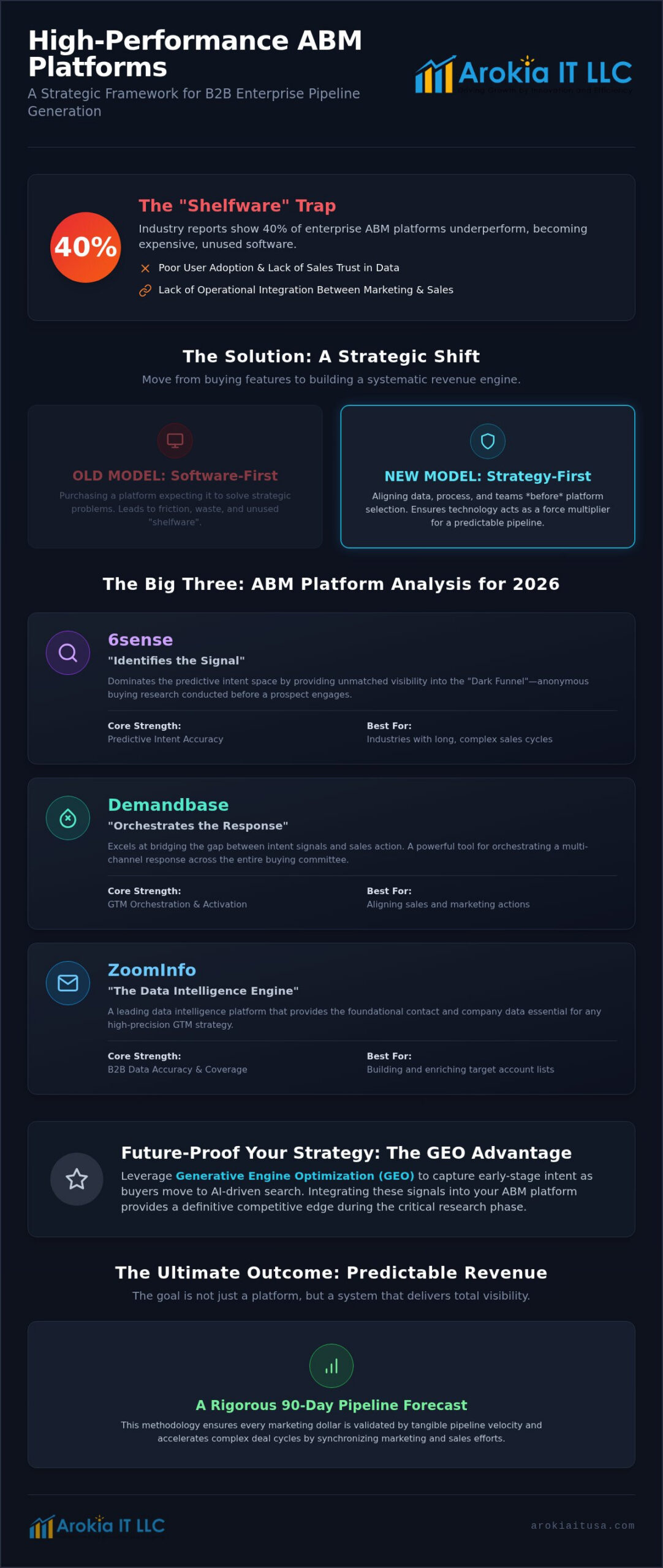
- Stop treating ABM as a software purchase and start treating it as a strategic alignment of intent data and sales execution. This approach eliminates the shelfware trap that causes many enterprise platforms to underperform.
- Evaluate the most effective abm platforms for b2b enterprise pipeline generation through a clinical comparison of 6sense, Demandbase, and ZoomInfo. We prioritize platforms that offer the highest capital efficiency and predictive accuracy for 2026.
- Learn to leverage Generative Engine Optimization (GEO) to capture early-stage intent as buyers move toward AI-driven search. Integrating these signals into your platform provides a definitive competitive edge during the research phase.
- Implement a rigorous 90-day pipeline forecast to provide executive leadership with total visibility into revenue growth. This methodology ensures every marketing dollar spent on ABM is validated by tangible pipeline velocity.
- Accelerate complex deal cycles by synchronizing LinkedIn marketing with tailored sales enablement content. This multi-channel approach ensures your message reaches the entire buying committee during critical decision windows.
The Enterprise ABM Landscape in 2026: Why Platforms Alone Fail
Data fragmentation continues to stall even the most aggressive Go-to-Market (GTM) engines. When marketing intent signals don’t translate into immediate sales action, your financial investment is effectively neutralized. The current market demands a “Strategy-First, Software-Second” procurement model. Identifying the most effective abm platforms for b2b enterprise pipeline generation is a futile exercise if your internal silos aren’t structured to act on the resulting intelligence. Real success involves moving away from vanity metrics and focusing on account-based pipeline reality, where every interaction is measured by its impact on deal velocity.
The Death of the Traditional Marketing Funnel
Linear funnels are obsolete. Modern enterprise buyers don’t move through a predictable sequence of stages. They operate within “Dark Social” networks and maintain anonymity through the majority of the sales cycle, often researching solutions long before they engage with a representative. Success requires multi-threaded engagement. Organizations must pivot toward Account-based selling, where the objective isn’t to convert a single lead, but to influence an entire buying committee across every touchpoint. If your platform doesn’t capture these anonymous signals, you’re missing the majority of the buying journey.
Eliminating Waste in the GTM Stack
Redundancy is the primary driver of budget waste in the modern enterprise. Most stacks suffer from overlapping features between CRM systems, marketing automation platforms, and ABM tools. You don’t need more features; you need a streamlined architecture that ensures data flows without friction. A rigorous strategic audit often reveals that the problem isn’t the software, but a broken process. At Arokia IT, we prioritize the elimination of this waste. We ensure that your stack is optimized to support a 90-day pipeline forecast, turning complex software into a validated tool for financial growth rather than a drain on resources.
The Big Three: Comparative Analysis of 6sense, Demandbase, and ZoomInfo
Precision is the only metric that matters when selecting technology for high-stakes enterprise growth. Software doesn’t generate revenue; execution does. However, the infrastructure you choose determines the ceiling of your success. Identifying the most effective abm platforms for b2b enterprise pipeline generation requires a clinical assessment of how these tools bridge the gap between anonymous intent and closed revenue. In the current 2026 landscape, 6sense, Demandbase, and leading data intelligence platforms remain the dominant forces, each offering distinct advantages for complex GTM strategies.
6Sense vs. Demandbase: The Battle for Intent Precision
6sense identifies the signal. Demandbase orchestrates the response. This distinction is critical for executive leadership focused on capital efficiency. 6sense continues to dominate the predictive intent space by providing unmatched visibility into the “Dark Funnel.” It’s particularly effective for industrial and manufacturing sectors where buying cycles are long and research is conducted in silos. Its 2026 updates have focused heavily on AI-powered engagement, allowing teams to score account readiness with clinical accuracy.
Demandbase One, conversely, leads in unified orchestration and B2B advertising. As B2B marketers face a new reality defined by fragmented buyer journeys, Demandbase provides a centralized command center for multi-channel execution. It’s built for global enterprise deployments that require sophisticated site customization and advertising at scale. While 6sense excels at telling you who is ready to buy, Demandbase provides the superior toolkit for engaging them across every digital touchpoint. Choosing between them depends on whether your bottleneck is account identification or account engagement.
Advanced Data Intelligence: The Foundation Layer
No ABM platform works without a high-precision contact database. A robust data intelligence platform serves as the essential data foundation that powers the other two. It isn’t just a list of names; it’s a mapping engine for the modern buying committee. Research confirms that the average enterprise deal now involves 13 or more stakeholders. If your team cannot identify the technical influencers, financial gatekeepers, and executive sponsors, your pipeline will stall regardless of your intent data. Leading data intelligence platforms have evolved to provide real-time updates that prevent data decay, ensuring your sales team isn’t chasing ghost leads.
Integrating this contact depth into the predictive workflows of 6sense or Demandbase creates a comprehensive view of account health. This integration eliminates the waste associated with manual data entry and unaligned silos. Before committing to a specific stack, it’s vital to ensure your strategy can actually support the technology. Our ABM implementation framework ensures your technology investment translates into a predictable revenue engine rather than expensive shelfware.
Essential Platform Capabilities for Shortening Complex B2B Sales Cycles
Efficiency is the primary differentiator in high-stakes enterprise sales. In 2026, the most effective abm platforms for b2b enterprise pipeline generation must do more than aggregate data; they must catalyze immediate action. Shortening a complex sales cycle requires moving beyond reactive monitoring toward a proactive, intelligence-driven engagement model. You need a system that identifies high-intent behavior and triggers a coordinated response across the entire buying committee. Without this precision, your team is merely guessing which accounts deserve their limited time and resources.
Intent Signaling and Buying Group Identification
Identifying “in-market” accounts before they ever fill out a form is the hallmark of a mature ABM strategy. High-performance platforms utilize technographic and firmographic filters to isolate accounts that possess the specific infrastructure and scale to justify an enterprise deal. This ensures your resources are focused on accounts with a high mathematical probability of closing. Intent Data is the high-octane fuel that powers pipeline acceleration by revealing exactly where a target account sits within their decision-making journey. By mapping these signals to specific stakeholders, you gain the ability to engage the right person with the right message before a competitor even realizes the opportunity exists.
Orchestrating the High-Stakes Engagement
Real-time sales alerts are useless if they don’t live where your sales team works. Bi-directional CRM synchronization is mandatory for maintaining a single source of truth across the organization. This integration allows for a 90-Day Pipeline Forecast that executive leadership can trust for long-term planning. Finally, revenue attribution must close the loop. You need to prove which platform triggers directly influenced closed-won revenue to justify continued investment and eliminate waste in your GTM stack. By focusing on these essential capabilities, you transform your ABM platform from a cost center into a predictable revenue engine.
The Convergence of ABM Platforms and Generative Engine Optimization (GEO)
Traditional search visibility is no longer the primary driver of enterprise awareness. In 2026, generative engines like Perplexity, Gemini, and SearchGPT have replaced the standard search results page for complex B2B research. This shift necessitates a transition from Search Engine Optimization to Generative Engine Optimization (GEO). While the most effective abm platforms for b2b enterprise pipeline generation provide the infrastructure for engagement, GEO provides the visibility required to be considered in the first place. If your technical authority isn’t recognized by these AI models, your target accounts will never discover your solution during their critical research phase.
Preparing for the AI Search Frontier
Traditional SEO fails because it prioritizes traffic volume over contextual authority. Enterprise buyers don’t want a list of links; they want synthesized answers to complex architectural or financial questions. GEO focuses on optimizing your content for the large language models (LLMs) that power these answers. This impacts the earliest stages of the 90-day pipeline by ensuring your brand is cited as a market leader when an AI agent summarizes the vendor landscape for a prospect. Without this optimization, your ABM engine is fueled by incomplete data. You aren’t just competing for a click; you’re competing to be the definitive answer provided by the AI.
GEO and ABM: A Strategic Synergy
The real competitive advantage lies in the integration of GEO signals with your ABM platform. This allows you to identify which accounts are querying your category within AI engines, providing a layer of intent visibility that traditional tracking pixels cannot reach. Crafting content that AI engines prioritize requires a rigorous, data-driven approach to sales enablement. LLMs prioritize content that demonstrates deep technical expertise and verified proof points. This means your sales enablement content must be structured for both human decision-makers and AI scrapers to ensure maximum reach.
When these two forces align, your ABM platform becomes a clinical tool for capturing high-stakes procurement deals. Arokia IT provides the strategic oversight needed to ensure your GEO efforts feed directly into your 90-day pipeline forecast. We eliminate the guesswork that characterizes unoptimized GTM strategies by bridging the gap between AI-driven discovery and account-based execution. We ensure your brand dominates the search discovery phase and translates that momentum into a predictable revenue engine. Consult with our AI Search & GEO experts to secure your position in the 2026 generative search landscape and ensure your platform investment yields tangible financial results.
Implementation Strategy: Moving from Platform Selection to a 90-Day Pipeline Forecast
Software selection is the beginning, not the end. The most effective abm platforms for b2b enterprise pipeline generation only yield returns when governed by a rigorous operational framework. Without a disciplined implementation strategy, even the best tools fail to bridge the gap between marketing intent and sales action. We move past the passive “wait and see” approach that characterizes most agency models. Instead, we implement the Arokia IT Framework: Pilot, Optimize, Scale. This methodology ensures that your technology investment is immediately focused on the elimination of waste and the acceleration of revenue.
The transition from procurement to performance requires a single source of truth that both sales and marketing leadership trust. Misalignment at this stage is the primary driver of platform shelfware. By establishing a shared set of definitions and accountability metrics, we turn your ABM stack into a systematic engine for pipeline growth. Success isn’t measured by platform activity; it’s measured by the clinical validation of your 90-day revenue targets.
The First 30 Days: Data Foundation and Account Selection
Precision begins with the data foundation. The first 30 days are dedicated to clinical CRM hygiene and the seamless integration of your ABM platform. We don’t just import lists. We define a high-precision Ideal Customer Profile (ICP) for the pilot program based on historical win rates and current market signals. This phase includes:
- Cleaning the CRM to remove data decay and duplicate records.
- Integrating intent data signals with existing sales workflows.
- Establishing baseline metrics for pipeline velocity and account engagement.
Days 31-90: Execution and Forecast Validation
Execution must be multi-threaded and relentless. During days 31-90, we launch coordinated campaigns across LinkedIn Marketing and programmatic display, synchronized with the deployment of specialized Sales Enablement Content. We target the entire buying committee rather than individual leads. This phase isn’t about trial and error. It’s about validating the 90-day pipeline forecast against actual account movement within the platform. We measure success by the transition of accounts from anonymous research to active sales engagement, providing a predictable roadmap for future growth.
Next Steps: Partnering for Strategic Mastery
ABM is a marathon of continuous optimization, not a one-off campaign. Enterprise firms choose Arokia IT because we provide the external authority required to resolve internal sales-marketing silos and maintain momentum. We act as the strategic partner that prevents your stack from becoming a financial drain. Our focus remains on tangible outcomes: shorter sales cycles, larger deal sizes, and a scalable revenue engine. Secure your 90-Day Pipeline Forecast with Arokia IT to transform your enterprise GTM strategy into a methodical driver of financial growth.
Securing Your 2026 Revenue Engine
Identifying the most effective abm platforms for b2b enterprise pipeline generation is only the first step in a high-stakes growth strategy. Realizing a return on these significant investments requires a clinical elimination of data silos and a commitment to total strategic alignment. You’ve seen how the convergence of predictive intent, precision data, and Generative Engine Optimization (GEO) creates a competitive moat that traditional demand generation cannot breach. Success in the industrial and enterprise B2B sectors demands more than just software; it requires a systematic methodology that prioritizes accountability and precision.
Arokia IT specializes in transforming complex tools into predictable revenue drivers through our proprietary 90-day pipeline forecasting model. We bridge the gap between anonymous search signals and closed-won revenue, ensuring your marketing spend is never wasted on underutilized shelfware. As leaders in AI search and GEO optimization, we provide the expert-led assurance needed to navigate the complexities of modern procurement. It’s time to move from platform selection to strategic mastery. Shorten your sales cycle with a 90-Day Pipeline Forecast from Arokia IT. Your path to a scalable and transparent pipeline is within reach.
Frequently Asked Questions
What is the most effective ABM platform for B2B enterprise pipeline generation?
The most effective abm platforms for b2b enterprise pipeline generation in 2026 are 6sense, Demandbase, and ZoomInfo. Selecting the right one depends on your specific bottlenecks. 6sense is superior for predictive intent and identifying accounts in the “Dark Funnel.” Demandbase excels in unified orchestration and cross-channel B2B advertising. ZoomInfo provides the essential data foundation required to map complex buying committees. Arokia IT ensures these tools integrate into a systematic revenue engine rather than becoming expensive shelfware.
How much do enterprise ABM platforms typically cost in 2026?
Enterprise ABM platforms in 2026 operate on a custom quote model, requiring annual licensing contracts rather than monthly subscriptions. Costs are typically structured around a base fee plus additional charges for seats, intent data modules, and international data access. Implementation fees are also a standard additional expense. Executive leadership views these platforms as significant capital investments that must demonstrate a clear impact on pipeline velocity and net new annual recurring revenue to justify the spend.
How long does it take to see a measurable impact on pipeline after implementation?
You should expect to see measurable pipeline movement within 90 days if you follow a disciplined implementation framework. While full sales cycles for enterprise deals can take six months or longer, it’s common for leading indicators like account engagement and Marketing Qualified Accounts (MQAs) to surface within the first quarter. Arokia IT utilizes a 90-day pipeline forecast to validate that your platform investment is translating into tangible deal velocity and executive-level accountability.
Can I run an effective ABM strategy using only LinkedIn and my CRM?
It’s possible to execute a foundational ABM strategy using LinkedIn and a CRM, but scaling for the enterprise requires advanced automation. Manual processes often lead to data silos and missed intent signals. High-stakes deals involve 13 or more stakeholders, making it nearly impossible to coordinate multi-threaded engagement without a centralized platform. While LinkedIn is a powerful channel, it lacks the predictive analytics and cross-channel orchestration necessary to build a truly predictable revenue engine.
What is the difference between intent data in 6sense vs. Demandbase?
6sense focuses on “Dark Funnel” visibility and predictive buying stage scoring to identify accounts before they engage. It’s built for precision in account identification. Demandbase One prioritizes GTM orchestration and B2B advertising, providing a superior command center for multi-channel execution. While both offer intent data, 6sense tells you who is ready to buy, while Demandbase provides the more robust toolkit for engaging those accounts across the digital landscape.
How does Generative Engine Optimization (GEO) impact my ABM strategy?
Generative Engine Optimization (GEO) ensures your brand is the definitive answer when enterprise buyers use AI agents like SearchGPT or Gemini. This impacts the Search Discovery phase of your ABM strategy. If your technical authority isn’t optimized for these generative engines, your target accounts may never discover your solution during their research. Integrating GEO signals into your ABM platform allows you to capture early-stage intent that traditional tracking pixels simply can’t reach.
Why do most enterprise ABM implementations fail to generate revenue?
Most implementations fail because they prioritize software over strategy, leading to high shelfware rates. When intent signals from the platform don’t trigger immediate sales action, the investment is effectively neutralized. Failure often stems from a lack of alignment between marketing and sales, resulting in unutilized data and fragmented execution. Arokia IT resolves these silos by implementing a “Strategy-First” model that ensures every platform feature is tied to a specific revenue outcome.
What is a 90-day pipeline forecast and why is it critical for ABM?
A 90-day pipeline forecast is a clinical methodology used to predict revenue growth based on current account engagement and intent signals. It’s critical for ABM because it provides executive leadership with total visibility into the financial impact of marketing spend. This forecast moves beyond vanity metrics to focus on deal velocity and pipeline reality. It ensures that every marketing dollar is validated by tangible progress toward closed-won revenue, creating a culture of precision and accountability.