
Why is your marketing budget still structured as a speculative expense rather than a precision investment? Most B2B organizations lose significant capital in the gap between lead generation and actual revenue because they prioritize volume over velocity. It’s a systemic failure that leaves industrial leaders with unpredictable pipelines and misaligned teams. You likely recognize that the traditional model of broad-spectrum outreach is broken, yet the path to a disciplined, account-centric approach often feels shrouded in complexity.
This article breaks that cycle by analyzing high-impact account based marketing examples from elite firms that have mastered the art of the surgical strike. You’ll learn how to leverage multi-channel engagement to shorten sales cycles by 67% and build a predictable 90-day pipeline forecast. We’re moving beyond creative flourishes to provide a strategic blueprint for selecting target accounts and aligning your teams around a single, high-stakes objective: scalable growth. We’ll examine the specific frameworks required to eliminate waste and transform your marketing department into a clinical driver of enterprise value.
Key Takeaways
- Transition from speculative lead generation to a surgical, account-centric model that prioritizes high-value revenue over vanity metrics.
- Analyze real-world account based marketing examples from enterprise leaders like GumGum and DocuSign to understand how personalized sales enablement content accelerates complex deal cycles.
- Discover how specialized industrial sectors use precision targeting to navigate multi-stakeholder buying groups and high-stakes procurement processes.
- Implement a 90-day pipeline forecasting model that utilizes account tiering strategies to ensure predictable revenue growth and marketing alignment.
- Future-proof your strategy by integrating Generative Engine Optimization to capture and validate authority within AI-driven search environments.
Beyond the Lead: The Strategic Shift to Account-Based Growth
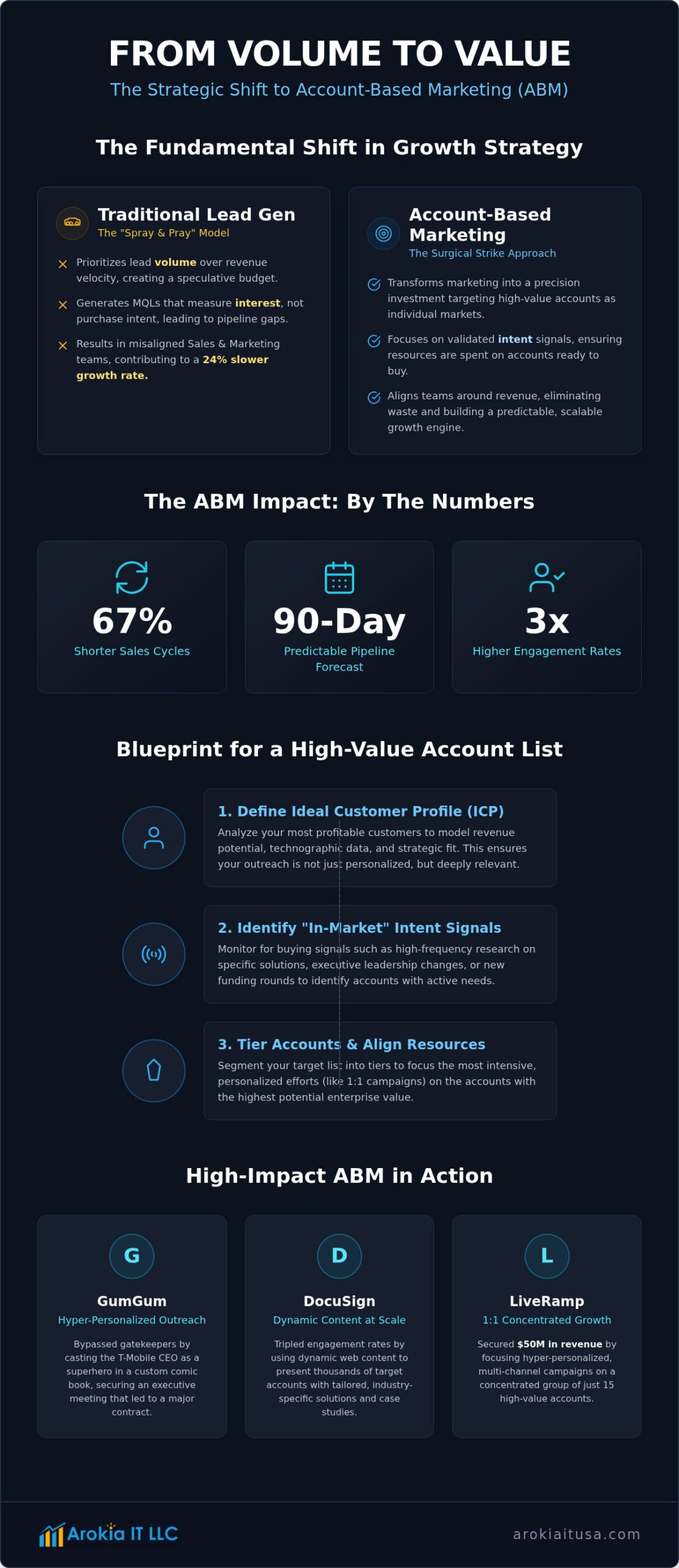
Account-Based Marketing (ABM) is a strategic business initiative, not a marketing campaign. It represents a fundamental shift from high-volume, low-precision lead generation to a clinical focus on high-value opportunities. In industrial sectors, where a single contract can define a fiscal year, the “spray and pray” model is a liability. It consumes resources without providing pipeline visibility. By contrast, account-based growth prioritizes the elimination of waste, ensuring that every dollar spent is directed toward a mathematically validated target. It’s about treating individual accounts as markets in their own right.
The Failure of Traditional Lead Gen in 2026
The traditional Marketing Qualified Lead (MQL) is failing because it measures interest rather than intent. By 2026, organizations have realized that a high volume of leads often masks a stagnant pipeline. This “pipeline gap” occurs when marketing attracts prospects that sales can’t close, leading to wasted effort and internal misalignment. The financial impact is severe; firms often spend significant portions of their budget on leads that never reach the proposal stage. High-impact account based marketing examples demonstrate that by narrowing the focus, firms can achieve a 24% faster growth rate by aligning teams around revenue rather than activity.
The Anatomy of a High-Value Account
Constructing a high-value account list requires more than just a list of company names. It demands an analysis of revenue potential, technographic data, and strategic fit. This process aligns closely with account-based selling, where sales and marketing operate as a single unit. To identify “in-market” accounts, you must monitor intent signals, such as high-frequency research on specific engineering solutions or shifts in executive leadership. Building an Ideal Customer Profile (ICP) that mirrors your most profitable customers ensures that your outreach isn’t just personalized; it’s relevant. This methodical approach allows for the creation of a 90-day pipeline forecast that is based on objective data rather than optimistic projections. When you stop chasing every lead, you finally have the bandwidth to close the accounts that actually matter.
Enterprise ABM Examples: Scaling Engagement for High-Value Contracts
DocuSign scaled this principle by using dynamic content to present industry-specific solutions to thousands of target accounts, effectively tripling their engagement rates by focusing on account-level relevance rather than generic site traffic. Meanwhile, LiveRamp demonstrated the power of the “1:1” model, securing $50M in revenue from a concentrated group of just 15 accounts. These results are often cited as premier account based marketing examples because they prioritize revenue over vanity metrics. Success in these cases wasn’t accidental. It was the result of mapping every touchpoint to a specific stakeholder’s pain point and validating The Rise Of Account Based Marketing as a core growth driver.
Hyper-Personalization at Scale
Generic messaging is a waste of capital. Enterprise accounts require dynamic web content that adjusts based on the visitor’s organization. If a prospect from a global logistics firm visits your site, they shouldn’t see a general SaaS pitch. They should see case studies on supply chain optimization and technical specs relevant to their infrastructure. This transition from broad value propositions to account-specific solutions is essential for maintaining momentum in the middle of the funnel. Effective sales enablement content ensures your team has the right narrative for every stage of the negotiation, turning passive interest into clinical validation.
Multi-Channel Orchestration
Breaking into a Fortune 500 buying committee, which typically includes 13 to 17 stakeholders, requires more than a single email chain. It demands a coordinated sequence across LinkedIn, targeted display ads, and high-value direct mail. You aren’t marketing to a person; you’re marketing to an entity. Measuring engagement must track the collective behavior of the buying group rather than individual clicks. When multiple stakeholders from a target account engage with your LinkedIn content and then download a technical white paper, you’ve validated a high-intent signal. This multi-channel approach ensures your brand remains omnipresent throughout the long, complex procurement cycle.
Industrial ABM Case Studies: Precision Targeting in Complex Markets
Industrial marketing requires a clinical departure from traditional B2B strategies. While SaaS firms often prioritize user experience and rapid adoption, industrial leaders must focus on technical validation and risk mitigation. For instance, an industrial firm targeting a specific tier of aerospace manufacturers must front-load technical authority to bypass the inherent skepticism of engineering leads. These Account-Based Marketing Examples demonstrate that success in manufacturing depends on demonstrating engineered solutions rather than broad brand promises. By the time a prospect speaks to a sales representative, they should already view the firm as a verified subject-matter expert capable of solving complex operational bottlenecks.
Precision targeting also involves using technographic data to identify firms struggling with legacy supply chain infrastructure. By identifying organizations that haven’t updated their ERP or logistics systems in years, an ABM strategist can target them with a specific “digital pivot” narrative. This isn’t a generic pitch; it’s a targeted strike at a documented inefficiency. This level of precision shortens the typically long industrial sales cycle by addressing technical debt before the first discovery call. It transforms marketing from a cost center into a strategic tool for market share acquisition.
Engaging the Technical Buying Committee
Reaching an industrial buying committee requires a multi-pronged approach that satisfies engineers, procurement officers, and C-suite executives simultaneously. Engineers demand technical sales enablement content, such as white papers and detailed specs, that prove feasibility. Procurement focuses on long-term reliability and total cost of ownership. In this high-stakes environment, traditional branding takes a backseat to demonstrated expertise. If your content doesn’t withstand technical scrutiny, the account is lost. Precision here isn’t just a preference; it’s the primary barrier to entry.
LinkedIn for Industrial ABM
LinkedIn has become the primary vector for industrial authority. Using LinkedIn Sales Navigator, marketers can isolate key decision-makers within specialized manufacturing sectors and deliver executive thought leadership directly to their feeds. Sponsored content that highlights proprietary research or industrial breakthroughs resonates far better with this audience than generic “book a demo” calls to action. This data-driven approach allows for a more accurate 90-day pipeline forecast. When multiple stakeholders within a single account engage with your LinkedIn content, it provides a clear, mathematically validated signal that the account is moving toward a procurement decision.
The 90-Day Pipeline Blueprint: Moving from Strategy to Execution
Execution is where most B2B strategies fail. While many organizations can identify a list of targets, few can maintain the discipline required to convert those targets into a predictable revenue stream. The Arokia IT 90-day pipeline forecasting model serves as a clinical standard for this transition. It moves away from the “always-on” ambiguity of traditional marketing toward a time-bound, results-oriented framework. By studying successful account based marketing examples, we see that the most effective firms don’t just launch campaigns; they orchestrate sequences that force a decision within a specific fiscal window.
The process begins with Step 1: Data-driven account selection and tiering. You can’t treat every prospect with the same level of intensity without bankrupting your budget. Step 2 involves mapping content to the specific hurdles of the enterprise buyer journey, ensuring your message is relevant to where the buying group is in their decision-making process. Step 3 requires coordinated sales and marketing “plays” to activate the accounts, followed by Step 4: Weekly pipeline reviews. These reviews are non-negotiable. They provide the clinical oversight needed to validate engagement and adjust strategy before the 90-day window closes.
Tiering Your ABM Approach
Bespoke 1:1 campaigns are reserved for accounts with “whale” potential, where the contract value justifies a high-touch, resource-heavy approach. For these targets, every asset is unique. Conversely, 1:Few and 1:Many programs allow for scalable engagement across clusters of accounts with similar pain points. The goal is to balance broad demand generation with surgical ABM strikes. This tiering ensures your budget is allocated based on mathematical probability rather than creative intuition. You’re investing in outcomes, not just activity.
Sales Enablement: The Last Mile of ABM
Marketing’s job isn’t finished when a lead clicks an ad. The “last mile” of any account-based strategy is providing sales teams with the exact talk tracks and technical assets needed to close the deal. This is where Shortening the Sales Cycle with Sales Enablement Content becomes a critical operational advantage. If your sales team is left to improvise, the precision of your marketing is lost. Bridging the gap between initial engagement and a signed contract requires a seamless transfer of authority. High-performance account based marketing examples prove that when sales and marketing share a single narrative, win rates increase by 2 to 3 times. To start building your own predictable revenue stream, you can request a 90-day pipeline forecast today.
Future-Proofing ABM: Integrating AI Search and GEO for Predictable Revenue
The B2B research phase has moved into a private, AI-mediated environment. Decision-makers no longer rely solely on search engine result pages; they use generative engines to synthesize complex technical solutions. This shift makes Generative Engine Optimization (GEO) a non-negotiable component of any modern account-based strategy. When your target accounts use AI to validate a vendor’s authority, your firm must be the primary citation. It’s a clinical shift from being found to being recommended. High-impact account based marketing examples in 2026 show that the most successful firms are those that have already mapped their technical expertise into the knowledge graphs that power these AI models.
Arokia IT leverages AI-driven search to ensure your brand appears in the “AI-generated shortlist.” This isn’t a creative exercise. It’s a technical optimization of your authority. By aligning your ABM precision with GEO authority, you create a feedback loop where your targeted outreach is validated by the AI tools your prospects trust. This synergy eliminates the friction of the discovery phase and serves as a definitive method for eliminating waste in the buyer journey.
Dominating the AI Shortlist
To ensure your technical expertise is cited by LLMs and AI search engines, you must build a knowledge graph that supports your ABM target account needs. This involves structuring your data and sales enablement content so AI can easily identify your firm as the solution to specific industrial problems. If an aerospace engineer asks an AI for the most reliable provider of high-tolerance components, your firm’s documentation should be the source of truth. Mastering this new landscape is the focus of GEO: Dominating the New Frontier of AI-Driven Search. It’s about ensuring your authority is mathematically undeniable to the algorithms your buyers use.
The Clinical Path to Revenue
A systematic, AI-enhanced ABM approach is the only way to ensure predictable growth in an increasingly fragmented market. By combining the 90-day pipeline blueprint with GEO authority, you move beyond the limitations of legacy marketing. You stop hoping for leads and start engineering revenue. These account based marketing examples prove that precision, alignment, and technical mastery are the only variables that matter. It’s time to transition from speculative marketing to high-stakes revenue generation. Take the first step toward a disciplined growth strategy and request your 90-Day Pipeline Forecast from Arokia IT today.
Engineering Your Revenue Pipeline
The transition from speculative lead generation to clinical account-based growth is a requirement for industrial leaders who demand predictable results. High-impact account based marketing examples demonstrate that success relies on front-loading technical authority and aligning teams around a mathematically validated objective. You now have the blueprint to leverage multi-channel orchestration and GEO to dominate the AI-generated shortlist. It’s time to stop managing marketing as an expense and start optimizing it as a precision engine for market share acquisition.
Arokia IT stands as a critical partner in this evolution. As specialists in B2B industrial growth and AI-driven search, we provide the 90-day pipeline visibility needed to eliminate waste and accelerate enterprise contracts. Our systematic approach ensures your authority is validated by both human decision-makers and the generative engines they trust. Secure your predictable revenue growth with a 90-Day Pipeline Forecast. The path to a scalable, high-stakes revenue stream is clear; it simply requires the discipline to execute.
Frequently Asked Questions
What are the best account based marketing examples for small businesses?
Small businesses should prioritize 1:Few or 1:Many tiers to maintain budget efficiency. Effective account based marketing examples for this scale include targeting a specific industrial niche with personalized LinkedIn sequences or technical sales enablement content. Instead of broad outreach, focus on five to ten high-value accounts where your expertise is a perfect match. This surgical approach ensures your limited resources are spent on accounts with the highest mathematical probability of conversion.
How do you measure the success of an ABM campaign?
Success is measured by revenue-centric metrics rather than vanity signals like clicks or MQLs. You should track account-level engagement, pipeline velocity, and win rates within your target list. Arokia IT utilizes a 90-day pipeline forecast to provide clinical visibility into how accounts move through the funnel. If the buying committee’s engagement increases across multiple channels, you’ve successfully validated your authority and narrowed the pipeline gap between marketing and sales.
What is the difference between 1:1 and 1:Many ABM?
1:1 ABM is a bespoke strategy where every asset is created for a single high-value “whale” account. It’s resource-intensive but offers the highest ROI for enterprise contracts. 1:Many ABM is a scalable model that uses dynamic content to target larger clusters of accounts with similar pain points. While 1:1 focuses on deep personalization, 1:Many prioritizes broad relevance across a specific industry tier or technographic profile. Both require strict alignment.
How long does it take to see results from an ABM strategy?
Initial intent signals and engagement metrics typically emerge within the first 30 to 45 days. However, seeing a measurable impact on closed-won revenue often takes 90 days or longer, depending on your average sales cycle. In industrial sectors, where procurement is complex, the goal is to front-load technical authority to shorten the cycle. Using a disciplined forecasting model allows you to predict revenue outcomes well before the final contract is signed.
Can ABM work for industrial and manufacturing companies?
Yes, ABM is the most effective strategy for industrial and manufacturing sectors due to their long sales cycles and multi-stakeholder buying committees. These industries require a clinical focus on technical expertise rather than generic branding. By analyzing successful account based marketing examples in manufacturing, we see that precision ensures your firm is viewed as a strategic partner. This approach allows you to bypass the noise of traditional lead generation and secure enterprise contracts.
What tools are essential for a successful ABM program?
A high-performance program requires a robust CRM, intent data platforms, and LinkedIn Sales Navigator for precise targeting. For 2026, integrating AI Search and GEO optimization tools is essential to ensure your brand appears in AI-generated shortlists. You also need sales enablement content that your team can use to close the gap during the final stages of the negotiation. These tools must work in a single, aligned ecosystem to eliminate waste.
How does LinkedIn integrate into an account based marketing strategy?
LinkedIn serves as the primary vector for reaching the 13 to 17 stakeholders typically found in a B2B buying committee. It allows you to deliver executive thought leadership and technical sponsored content directly to decision-makers. By integrating LinkedIn marketing with your broader ABM strategy, you can track cross-channel engagement and refine your target list based on real-time professional data. It’s a critical tool for building authority before a sales call occurs.
What is the role of AI in modern ABM?
AI has shifted from a creative tool to a clinical engine for intent prediction and authority validation. In modern ABM, AI helps identify “in-market” accounts by analyzing vast datasets for subtle research signals. It also plays a vital role in Generative Engine Optimization (GEO), ensuring your technical solutions are the primary citations when prospects use AI search. This integration allows for a more precise, data-driven approach to revenue generation and pipeline management.