
A strong Google ranking doesn’t guarantee that an AI assistant will mention your business. AI search visibility for B2B companies depends on whether AI systems can understand a company’s expertise and draw on its content when answering relevant buyer questions. Generative engine optimization, or GEO, focuses on earning those mentions and citations in AI-generated answers, alongside visibility in traditional search.
For manufacturers, energy companies, medical equipment businesses, and B2B software firms, accuracy matters: vague claims or disconnected content can make complex expertise harder to interpret. This article explains how AI search visibility works across the buyer journey, what GEO services involve, and how to assess tools and pricing factors without confusing visibility metrics with pipeline impact. You’ll also learn how expert content and structured data help clarify what your company does, what it knows, and when it is relevant to a buyer’s needs. The goal is a practical framework for evaluating where your brand appears in AI answers and what strategic work can strengthen its presence.
Key Takeaways
- GEO extends traditional search optimization by helping AI systems understand and cite a B2B company’s expertise in relevant answers.
- Measure visibility across realistic buyer prompts, citations, and recommendation gaps, not rankings alone.
- Choose monitoring tools based on the AI platforms, prompt coverage, reporting, and workflow your team needs.
- Clear expert content and well-implemented structured data help explain technical products, services, and expertise to search systems.
- In regulated and technical markets, precise, supportable claims and consistent information are essential to building credible AI visibility.
What is generative engine optimization (GEO)?
Generative engine optimization (GEO) helps a brand appear in AI-generated answers through relevant mentions and citations. Traditional SEO focuses on visibility in search results, including links users can select. GEO also considers how systems such as ChatGPT, Gemini, and Google AI Overviews identify, interpret, and present information. The aim is not simply to rank a page, but to make a company’s expertise clear enough to support a useful answer.
Answer engine optimization (AEO) and GEO overlap, but emphasize different outcomes. AEO helps content provide direct answers in search features and answer engines. GEO focuses more broadly on a brand’s presence in generative responses, including whether the response names or cites the company. A practical strategy connects both: answer a specific buyer question clearly, then support the answer with evidence, context, and accessible technical information.
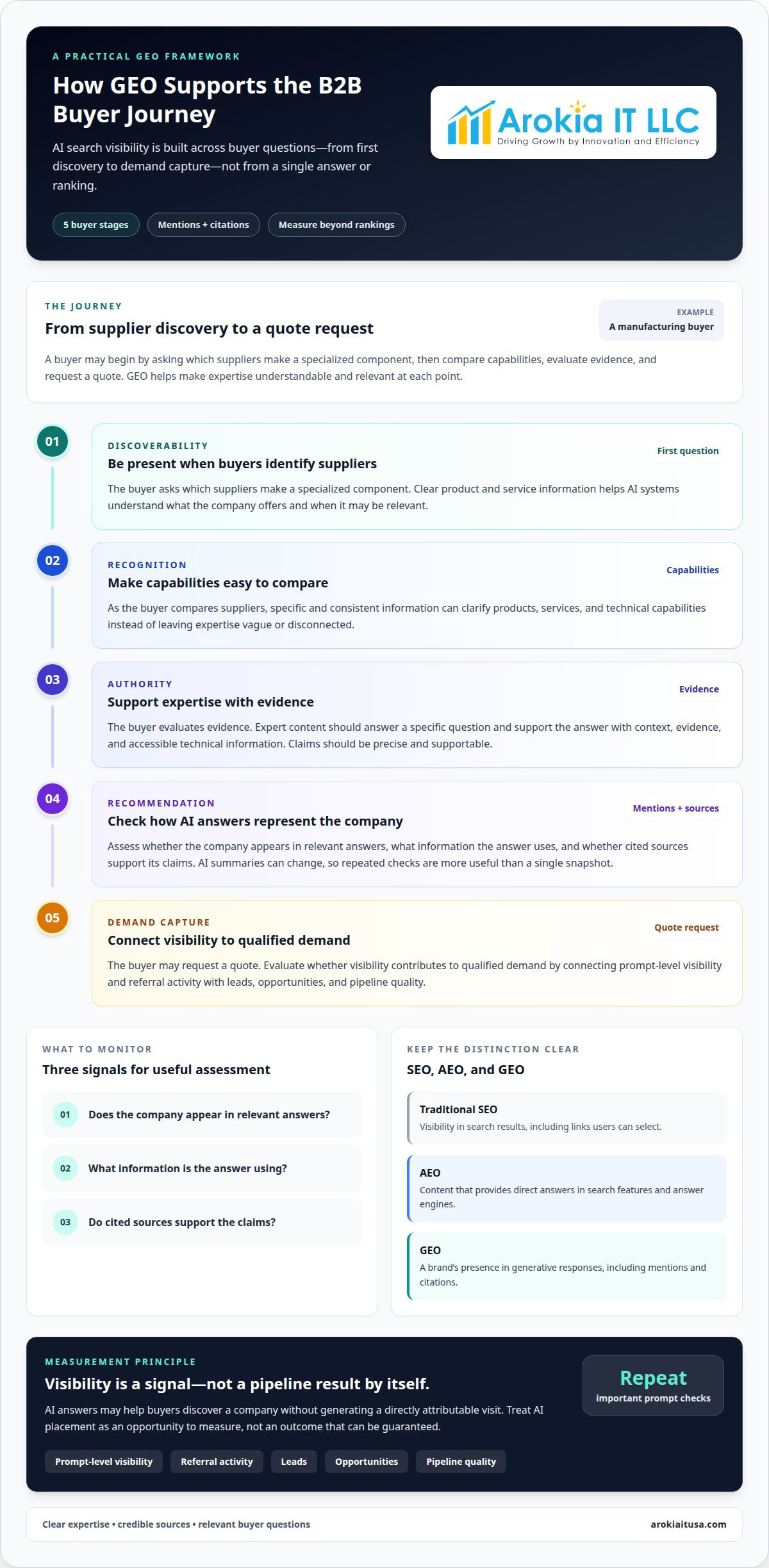
For B2B companies, the buyer journey may involve five stages: discoverability, recognition, authority, recommendation, and demand capture. A manufacturing buyer might first ask which suppliers make a specialized component, then compare capabilities, evaluate evidence, and request a quote. GEO supports visibility across that journey, rather than treating one AI answer as the entire conversion path. Marketers have optimized for link-returning search engines for more than 20 years; generative answers add another discovery environment to measure.
AI search visibility for B2B companies means being represented accurately when prospective buyers ask relevant questions in AI tools. A useful assessment tracks whether the company appears, what information the answer uses, and whether cited sources support its claims. Testing should cover a meaningful set of buying-intent prompts, such as “Which suppliers offer custom industrial sensors?” Answers can change, so repeated checks matter more than a single screenshot. The term “GEO” itself has a reported U.S. search volume of 22,200 searches monthly, signaling growing interest in the discipline.
ROI from AI search visibility depends on whether visibility contributes to qualified demand, not simply on the number of mentions. Connect prompt-level visibility and referral activity with leads, opportunities, and pipeline quality. Then compare those signals with the resources invested, recognizing that AI answers may help buyers discover a company without generating a directly attributable visit.
B2B and local AEO target different intent. A local search such as “machine shop near Tulsa” emphasizes geography and nearby service relevance. A national B2B prompt may ask which equipment suppliers meet a technical need across several states. The first requires clear location and service details; the second requires specific expertise, product context, and credible evidence.
Risks include changing answers, incomplete citations, and inaccurate summaries of technical claims. Monitor important prompts and keep authoritative content consistent. Treat AI placement as an opportunity to measure, not an outcome you can guarantee.
AI search visibility tools and pricing for professional B2B services
AI visibility tools help teams organize how brands appear across answer platforms. ChatGPT, Google AI Overviews, Gemini, and Perplexity may present different information for similar buyer needs. Useful tools can group queries by product line, audience, or use case; preserve dated observations; and show which sources appear in answers. A manufacturer, for example, could track component specifications separately from maintenance applications, rather than combining different buyer questions in one report.
Choose tools based on the decisions your reporting needs to support. A strategy team may need prompt coverage and answer history, while sales leadership may need reporting by product category or target account. Review platform coverage, export options, user access, and consistent response-labeling features. A polished dashboard is of little use if teams cannot trace a recommendation to its prompt, source, and date.
- Coverage: Confirm that the tool tracks the AI platforms and buyer topics relevant to the business.
- Organization: Check whether prompts can be grouped by product, audience, and intent.
- Reporting: Determine whether teams can preserve records and share useful findings.
Software is only one part of an engagement. Professional support may include setting a measurement framework, reviewing technical pages, identifying content gaps, coordinating subject-matter input, and reporting findings. The effort depends on the number of product lines, subject complexity, existing content, and required depth of analysis. A focused review and an ongoing program have different scopes, even if they use the same monitoring platform.
Program pricing should reflect the work and decisions involved, not just tool access. The price depends on the case and is provided after a quote request. Scope factors include platform coverage, prompt research, content needs, technical review, reporting cadence, and coordination with internal experts. These factors define the work; a tool subscription alone does not establish what a visibility program requires.
B2B SEO and AI visibility can overlap in content and technical foundations, but they require distinct deliverables. A program may address conventional search priorities alongside AI answer monitoring, or focus on a narrower visibility need. The right scope depends on where buyers seek information, which products matter most, and how the business will use the findings. Clear deliverables make the engagement easier to assess than a general promise of visibility.
Before selecting a program, align its reporting with a specific business decision, such as prioritizing technical content or improving visibility for a product category. If your team needs to define that scope, request a conversation about AI visibility priorities.
What is AI search visibility?
AI search visibility describes how often and how accurately a company appears in responses from systems such as Google AI Overviews, ChatGPT, and Perplexity. For a nationally competing B2B firm, visibility means more than a brand mention. The answer should connect the company with the right products, capabilities, and buyer needs. An enterprise software provider, for example, should be represented for its actual use cases, not simply named in an unrelated summary.
Traditional search rankings and AI visibility measure different outcomes. A page can rank for a competitive keyword without appearing in a generated answer. Conversely, an AI answer may cite a company page even if that page does not appear near the top of conventional results. Report organic rankings, AI mentions, citations, and qualified website activity separately. These measures show where the channels overlap and where they differ.
A professional competitor comparison starts with a consistent prompt set. A strategist groups prompts by buyer need, product category, technical problem, and evaluation stage. For a U.S. industrial supplier, prompts might ask which companies provide corrosion-resistant components or what specifications buyers should compare. Test the same prompts across ChatGPT, Perplexity, and Google AI Overviews, then record answer text, cited sources, and named brands.
Next, identify who appears and why. Classify each answer as a company mention, source citation, or explicit recommendation. Review whether competitor claims are supported by product pages, technical documentation, or third-party references. If a competitor is cited for installation guidance while your company is absent, the gap may be useful technical coverage, not just keyword placement. That distinction points to a specific visibility barrier.
Competitive B2B keyword rankings remain useful, but they need intent-level context. A high ranking for a broad term may attract researchers rather than buyers. A lower ranking for a specific application query could reach a procurement team evaluating suppliers. A combined analysis maps conventional keyword groups to related AI prompts, then compares search position with AI answer presence. The result is a clearer view of discoverability across channels.
National comparisons need consistent controls. Keep prompt wording, platform, location settings, and review dates consistent, since each can affect recorded responses. Separate national coverage from local intent, and track distinct product lines rather than blending them into one brand score. A medical equipment company, for example, may need separate views for devices, applications, and technical support content. This structure helps leadership prioritize gaps tied to real buying questions.
AI visibility does not equal market share or revenue. A defensible assessment connects answer presence with citation quality, relevant organic rankings, referral activity, and qualified opportunities. It also preserves dated records, so teams can distinguish a lasting shift from a single response change. For companies pursuing AI search visibility for B2B companies, the useful measure is whether AI answers represent the business accurately in commercially relevant contexts.
Content, schema, and structured data for AI search
B2B buyers use ChatGPT, Perplexity, and Google AI Overviews to investigate suppliers, compare technical approaches, and identify questions for sales conversations. They may move from a broad problem, such as reducing equipment downtime, to a specific vendor or product comparison. The content and citations surfaced along that path can shape which companies enter consideration.
Strong visibility starts with useful source material, not repeated keyword placement. A technical article should answer a defined buyer question, explain relevant terminology, and distinguish product capabilities from limitations. For example, a manufacturer describing a sensor can explain its intended application, operating context, and compatibility details. Keep product pages, documentation, and expert-authored articles consistent on these facts.
Schema markup gives search systems structured context about page content. Schema.org types such as Organization, Product, and Article can identify a business, an offering, or an editorial resource. Structured data does not guarantee an AI citation or recommendation. Its value is clearer interpretation, especially when the markup accurately reflects visible page content and the company’s actual product information.
Content research turns buyer questions into a prioritized editorial plan. Group prompts by awareness, evaluation, and selection, then map each group to a useful asset. An engineering buyer comparing filtration methods, for instance, may need a technical comparison, while a procurement team may need clear product specifications. Audit existing pages first to find gaps, conflicting details, and outdated claims.
A practical AI search visibility strategy follows a sequence:
- Establish the baseline: Record relevant prompts, current answers, citations, and competitor mentions.
- Prioritize gaps: Identify missing technical explanations, weak source support, and unclear product relationships.
- Improve core pages: Align product, industry, and expertise content around specific buyer needs.
- Apply structured data: Use accurate Schema.org markup that reflects the visible page.
- Measure movement: Retest prompts and track citations, qualified visits, and sales signals.
Marketing agents can support the workflow by organizing research, clustering prompts, and flagging content for human review. They should not publish technical claims without subject-matter validation. A subject expert must confirm details such as material compatibility or software integrations before publication, because inaccurate information can undermine trust.
Third-party citations also matter. Buyers and AI systems may encounter information beyond a company’s own site, so consistent, factual descriptions across credible industry references can strengthen context. New citations may take months of content and third-party work. A provider can coordinate research, technical content development, structured data, and measurement as one optimization process.
AI search visibility for regulated and technical industries
Technical and regulated markets need visibility grounded in precise, supportable information. A medical equipment manufacturer, oil and gas supplier, or industrial software company may sell products with specialized applications and limitations. If Gemini or another assistant oversimplifies a claim, buyers could misunderstand what the product does. The goal is not just a brand mention, but clear, contextual information about the company’s expertise and scope.
Start by mapping high-value prompts to the decisions buyers actually make. A prompt about choosing a diagnostic device differs from one about maintenance procedures or compatibility. For each prompt, content specialists should identify the right technical owner and authoritative source. Then compare the proposed answer with product documentation, service descriptions, and approved claims. This review helps prevent unsupported statements from entering pages intended for AI discovery.
Resolve ambiguity before publishing content. A product page can describe its intended use, relevant operating conditions, and known constraints in direct language. An engineering article can explain a process without suggesting that every facility or application is identical. For example, a software company can distinguish a supported integration from a roadmap item. Clear distinctions help AI systems summarize what the business offers without overstating its capabilities.
A disciplined review workflow can protect accuracy while supporting discoverability:
- Classify the prompt: Separate product selection, technical education, and service questions.
- Assign an expert: Route claims to the product, engineering, or compliance reviewer responsible for them.
- Match claims to evidence: Align each statement with current documentation and approved public information.
- Review the generated answer: Record whether Gemini or another platform describes the company correctly.
- Update the source: Revise unclear pages, then retest the same prompt and related questions.
External authority also shapes how technical brands are understood. Industry associations, research institutions, and trade publications can provide context beyond a company’s website. Identify which credible references support the topic and whether company information matches across sources. This does not mean pursuing every mention. A relevant citation describing a specific capability can be more useful than broad exposure unrelated to buyer needs.
Measure visibility and accuracy separately. Track whether a brand appears, whether Gemini or another assistant cites a relevant source, and whether the response preserves important qualifications. Review changes over time, since generated answers can vary by prompt and platform. For a technical manufacturer, a correct answer about product scope is a stronger signal than an unqualified mention that creates the wrong expectation.
The central principle is simple: publish content that answers real technical questions, and govern claims with expert review. That balance gives AI systems clear source material without sacrificing precision. A focused conversation about your technical search visibility can help define the right priorities.
Arokia IT: AI Search & GEO
Arokia IT helps B2B companies strengthen their presence in AI-generated answers through AI Search & GEO. This work can connect technical content, buyer questions, and search visibility, giving AI systems clearer information about a company’s expertise and relevance. For businesses that need visibility tied to target accounts or revenue opportunities, Account-Based Marketing (ABM) and Demand Generation can support the broader strategy. Industrial Marketing is also relevant when products, applications, and buying processes require specialized industry context.
Consider this approach when your company has useful expertise but struggles to appear accurately in AI answers, or when visibility efforts need stronger alignment with B2B demand. Contact Arokia IT to discuss your priorities.
Make AI visibility part of your growth plan
The next step is to connect AI search visibility for B2B companies with the decisions your leadership team already tracks. Choose the product lines, buyer questions, and target accounts where accurate representation could support commercial priorities. Then establish ownership for technical accuracy, content updates, and performance review. This turns AI visibility from an isolated marketing activity into a coordinated part of demand planning.
A focused assessment can clarify where your company appears, which information shapes those answers, and where the most important gaps remain. Use the findings to set priorities that fit your sales process and resources, rather than pursuing visibility for its own sake.
With clear priorities and accountable execution, your team can make its expertise easier for prospective buyers to understand.
Frequently Asked Questions
What is the difference between AEO and GEO?
AEO is commonly used for work focused on answer formats, while GEO addresses a brand’s representation in generative responses. For a B2B team, the distinction can clarify project deliverables: an answer-focused brief might prioritize concise responses to technical questions, while a generative-search brief might assess how a product category and company are portrayed together. Teams can define both scopes without treating the terms as interchangeable.
Can a smaller B2B company afford this, or is it only for enterprise brands?
A smaller company can focus on a specific product line or buyer segment instead of tackling every market at once. A specialized supplier could begin with the product questions most relevant to its sales pipeline, then expand as internal resources allow. Set the scope according to content capacity, technical-review processes, and commercial priorities, not company size or whether it competes with enterprise brands.
How do professionals measure AI visibility for a B2B company?
For competitor benchmarking, professionals use the same prompt set and review conditions for each brand. They can classify responses by whether a company is named, recommended, or associated with a relevant product attribute, then compare those observations across competitors. This creates a structured comparison rather than relying on a few memorable examples. Consistent categories also help explain why one brand appears more often in a particular buyer scenario.
How long does it take to see AI citations after starting this work?
Citation timing depends on when useful content becomes discoverable and whether relevant sources support the topic. A newly published technical explanation may need time to be found and referenced, while an established resource may already be available to answer systems. Separate publication milestones from citation observations, and record when a source first appears. This helps set realistic internal expectations without assigning an unsupported deadline.
What does AI search visibility mean for B2B companies?
For a B2B company, AI search visibility means buyers can encounter its expertise while researching a business problem through AI tools. The practical question is whether the company’s role is clear enough to support a useful next step, such as evaluating a solution category or preparing a vendor shortlist. Marketing and sales teams can use that lens to judge whether AI discovery aligns with the company’s intended market position.
How can a provider measure a B2B company’s visibility in AI search results?
A provider can connect AI observations to business reporting by tagging relevant inquiries and referral activity in the company’s existing analytics and CRM processes. Unlike competitor benchmarking, this approach asks whether AI-related discovery corresponds with engagement or sales conversations. Preserve the distinction between a direct referral and an AI-assisted journey so leadership does not mistake correlation for a confirmed source of demand.
What factors help B2B brands appear in AI-generated answers?
Clear brand identity helps answer systems distinguish a B2B company from similarly named organizations, products, or industry terms. Consistent naming, a well-organized product taxonomy, and explicit relationships between the company and its offerings can reduce ambiguity. For example, separate pages for a manufacturer, its product families, and their applications make those relationships easier to interpret than one broad page mixing unrelated capabilities.
How can a provider optimize B2B content for AI search and answer engines?
Sales-call questions and recurring support inquiries can reveal what buyers still struggle to understand. Use them to identify content to improve, clarify who the information serves, and assign an owner for future updates. This governance keeps technical content aligned with product changes and sales language. A periodic review is more useful than publishing pages without a clear maintenance process.