
More follow-ups don’t automatically create more sales momentum. Lead nurturing for long B2B sales cycles works by staying relevant over time, with a useful touchpoint every two to three weeks as a starting point, then adjusting frequency to audience engagement and buying signals.
That’s the challenge for teams selling complex solutions: buyers need time to evaluate options, build internal alignment, and reduce risk. A rigid sequence can feel intrusive, while long gaps can leave a promising opportunity without the information it needs to move forward.
This guide explains how lead nurturing works across a long sales cycle and how to pace outreach. You’ll learn how email, teleprospecting, and marketing automation can work together, when buyer behavior should prompt a sales conversation, and how sales and marketing can coordinate their messages. The goal is a disciplined follow-up process that keeps prospects informed without adding noise or involving sales before a conversation is useful.
Key Takeaways
- Map nurture content to buyer roles and decision stages so each touchpoint addresses a relevant concern.
- Coordinate email, LinkedIn, and phone outreach around prospect activity rather than relying on a fixed sequence alone.
- Use marketing automation to organize follow-ups and surface meaningful engagement signals for sales.
- Set shared lead-scoring and handoff criteria so sales and marketing agree on when a prospect is ready for a conversation.
- Keep nurturing aligned with the length and complexity of the buying process, adjusting content as priorities evolve.
1. What Is Lead Nurturing?
Lead nurturing is the planned delivery of relevant information as buyers evaluate a potential purchase. For long B2B sales cycles, the strategy should follow the buyer journey, not simply repeat a fixed sales pitch. A mapped sequence connects each message to a prospect’s interest, questions, and next decision. A useful lead nurturing program gives buyers a clear path from recognizing a problem to assessing solutions.
Start by mapping the buying process from problem recognition through internal research, vendor comparison, risk validation, and stakeholder alignment. A 2023 Gartner report says the average B2B purchase involves 22 people, so one contact’s activity rarely represents the entire buying group. For example, an operations leader may prioritize production issues, while finance evaluates investment risk. Content should help each person contribute to the same decision.
Build separate nurture tracks around buyer personas, using each role’s goals and concerns to shape the content. An engineer evaluating manufacturing software may need technical explanations, while a plant manager may need implementation details and an executive may focus on business impact. The tracks can share a core message, but examples, proof, and calls to action should reflect each person’s responsibilities. This keeps outreach relevant without fragmenting the overall strategy.
Then match content to the buyer’s journey stage. During problem recognition, an educational article can clarify the operational challenge. During internal research, a guide can help buyers define requirements. For vendor comparison, a buyer’s guide can explain evaluation criteria. Risk validation calls for evidence that addresses implementation or performance concerns. Stakeholder alignment benefits from role-specific materials colleagues can share and discuss.
A six-month nurture plan can pace this progression. Month one can introduce the topic with a welcome message, an explainer, and a customer story. Month two can provide a comparison guide and invite questions. Month three can deliver role-specific information for buying-group members. Month four can share a case study, and month five can include a personal note from sales. In month six, fresh proof and a direct question can help determine whether the purchase remains a priority.
Trust grows when each touchpoint answers a buyer’s current question instead of pushing a product too soon. Someone researching vendor differences needs clear criteria before receiving a sales-led proposal. A prospect assessing risk needs credible proof tied to that concern, not another general introduction. Track engagement and topic interest throughout the journey, then adjust the next message when behavior signals a new question or decision stage. That makes nurturing purposeful, coordinated, and responsive to how buying decisions progress.
2. How do professionals pace follow-ups during a long B2B sales cycle?
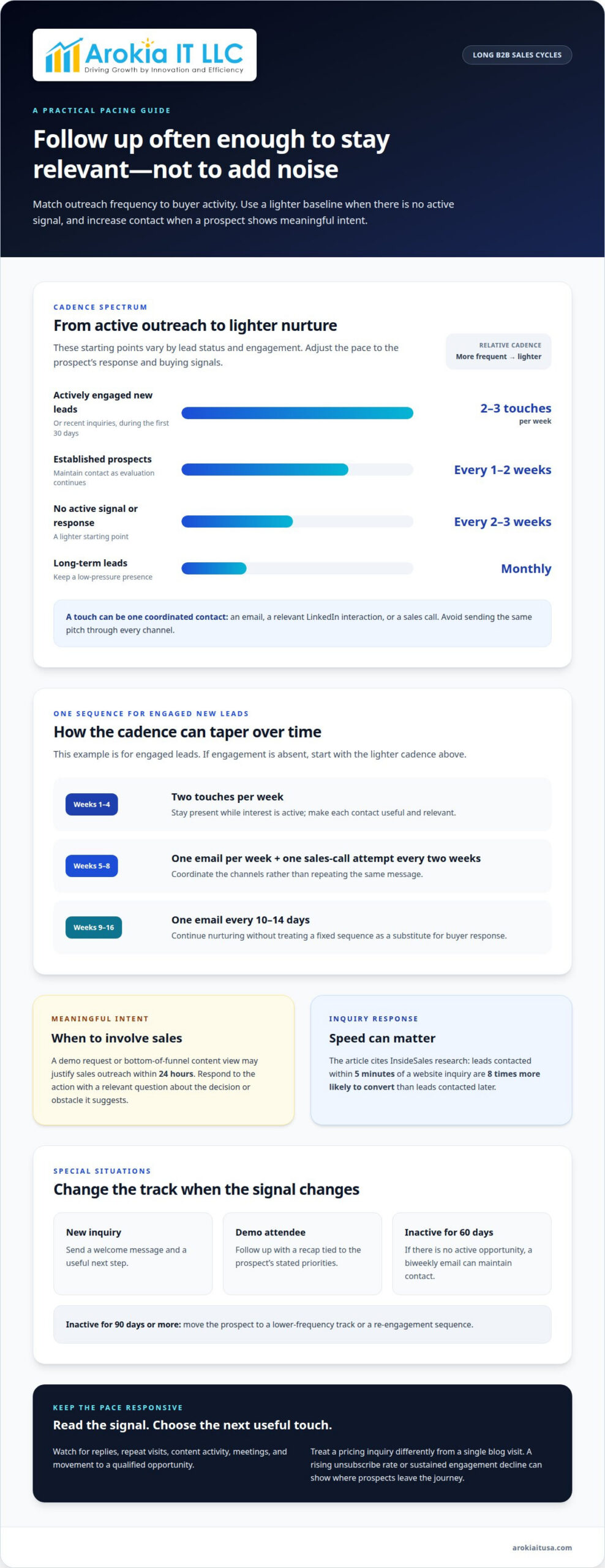
Professionals pace follow-ups by combining a baseline cadence with buyer behavior. For new leads, 2-3 touches per week can be appropriate during the first 30 days when the prospect is actively engaging or has recently made an inquiry. If there is no active signal or response, use a lighter starting cadence of one touch every two to three weeks, then adjust based on engagement. Established prospects can move to contact every 1-2 weeks, while long-term leads may receive monthly outreach. A touch can be an email, a relevant LinkedIn interaction, or a sales call, rather than three messages through one channel.
Cadence should taper as prospects move through the funnel, then rise when engagement signals active interest. One practical sequence for engaged new leads uses two touches per week during weeks 1-4. During weeks 5-8, it shifts to one email per week and one sales-call attempt every two weeks. Weeks 9-16 can use one email every 10-14 days. For leads without active engagement, begin with the lighter cadence instead. These are starting points, not a substitute for adjusting to audience response.
Channel choice matters as much as timing. Email can deliver an explainer or comparison resource; LinkedIn can reinforce a relevant idea; a cold call can test whether a business concern warrants discussion. A coordinated sequence avoids repeating the same pitch everywhere. After a prospect downloads a technical guide, for example, an email can offer a related resource while a call explores the operational issue behind that interest.
Sales handoff should follow meaningful intent, not just a calendar milestone. A prospect who requests a demo or views bottom-of-funnel content may warrant sales outreach within 24 hours. According to InsideSales research, leads contacted within 5 minutes of a website inquiry are 8 times more likely to convert than leads contacted later. A consultative first call should reference the action and ask about the decision or obstacle it suggests.
Welcome and re-engagement sequences need different triggers. New inquiries can receive a welcome message and useful next step; demo attendees can receive a recap tied to their stated priorities. If a lead has no activity for 60 days and no active opportunity, a biweekly email can maintain contact. Prospects inactive for 90 days or more can move to a lower-frequency track or a re-engagement sequence.
Measure re-engagement through replies, repeat visits, content activity, meetings, and movement to a qualified opportunity. A rising unsubscribe rate or sustained engagement decline can reveal where prospects leave the journey. Real-time alerts should distinguish high-intent actions from routine browsing, so sales responds to a pricing inquiry differently than a single blog visit. If follow-up timing and channel coordination need a consistent operating model, discuss a tailored approach.
3. Integrating email, teleprospecting, and marketing automation
Marketing automation, a CRM, and sales engagement tools can work together to coordinate campaigns. Marketing automation manages email delivery and behavior-based triggers; the CRM records account activity and pipeline status. Sales engagement tools support rep tasks, call logging, and follow-up. These tools serve different functions. The right setup depends on whether the priority is complex segmentation, consistent email delivery, or sales visibility. No platform replaces clear handoff rules or useful content.
A connected sequence starts with a prospect’s action. A repeat visit to a product page, for example, can trigger an email addressing the related pain point. A reply or request for technical details can pause automated messages and alert a sales representative. Teleprospecting then adds context through a relevant conversation instead of repeating the email. After the call, the representative records the concern and next step in the CRM so the campaign can adapt.
Use automation to personalize content by role, account, and intent. An operations contact who reads implementation material may receive a deployment checklist; a finance contact may receive a guide to evaluating business impact. One technical article can be adapted into an email summary, a LinkedIn post, and a call discussion point. This content marketing approach keeps the central message consistent while tailoring it to each channel.
Measure email performance beyond opens. Track clicks, replies, meetings, qualified opportunities, and movement through pipeline stages. A campaign with strong email engagement but few sales conversations may attract interest without resolving a buying obstacle. Compare performance by audience segment and content topic, then adjust the next message. A sustained increase can indicate excessive frequency or weak relevance.
Set frequency according to behavior, not automation convenience. Suppress a scheduled email after a prospect replies, books a meeting, or enters an active sales conversation. Conversely, a renewed visit to a high-intent page can prompt timely personal follow-up. These controls prevent overlapping messages from marketing and sales. They also preserve good timing without treating every click as an equal sign of intent.
Use past campaign and sales outcomes to refine scoring and routing. Assign values to meaningful actions, such as a demo request or repeat visits to solution pages, then compare those signals with opportunity progression. Teleprospecting can validate whether stated interest reflects a real business need, while automation maintains relevant communication between conversations. Review the integrated workflow with sales and marketing together: confirm trigger definitions, message ownership, suppression rules, and the CRM fields that capture each next step.
A connected setup of marketing automation, a CRM, and sales engagement tools supports long-cycle B2B nurturing: automation handles email and behavior-based triggers, the CRM tracks account activity and pipeline status, and sales engagement tools support calls and follow-up. The right mix depends on whether the priority is complex segmentation, consistent email delivery, or sales visibility; no single platform replaces clear handoff rules and useful content.
4. Sales and marketing alignment
Sales and marketing alignment starts with shared funnel-stage definitions. A lead can show interest without representing a qualified opportunity, so teams should document what distinguishes an inquiry, a marketing-qualified lead, a sales-qualified lead, and an opportunity. A white paper download may indicate early research, while a request to discuss implementation can signal a more immediate business need. Clear definitions prevent stage changes based on opinion alone.
Lead scoring can make those definitions operational. The model ranks prospects using criteria the company selects, such as account fit, role, and meaningful actions. An example model treats a prospect who reaches 50 points as sales-ready. That threshold is useful only when sales and marketing agree on the points behind it. A high score based on repeated low-intent activity should not automatically outweigh poor account fit or an irrelevant role.
Agree on handoff details before routing leads. Sales needs the account context, the prospect’s recent actions, the likely problem, and a clear reason for outreach. Marketing needs an agreed status when sales accepts, rejects, or recycles a lead. This shows whether a lead stalled because of timing, fit, missing information, or a follow-up gap. Each outcome should map to a defined next action.
Alignment also requires consistent communication across active opportunities. Marketing should know when sales has started a direct buying conversation, and sales should know which campaigns and materials are reaching the account. This prevents a prospect from receiving an introductory message after discussing a detailed proposal. In a complex account, sales can identify unresolved concerns in conversations; marketing can support the team with relevant educational material for other stakeholders.
Use feedback to improve the system, not assign blame. When sales rejects a lead, record a specific reason instead of a generic “not qualified” label. Marketing can compare those reasons with account and campaign patterns, then refine targeting or messaging. Sales can also identify which content helped prospects explain the business case internally. These observations make future nurturing more useful and give both teams a shared basis for decisions.
Measure alignment through progression and quality, not message volume. Review accepted leads, qualified opportunities created, recycled leads that later advance, and reasons deals stall. If marketing generates interest but few opportunities, examine fit and qualification. If sales accepts leads but conversations do not progress, review the handoff context and follow-up relevance. Connecting these measures to pipeline outcomes helps leaders assess marketing’s contribution to revenue and focus on the stage that needs improvement.
5. Lead nurturing across long B2B sales cycles
The best strategies for complex B2B purchases coordinate role-specific education, account-level messaging, and timely sales input. Effective lead nurturing for long B2B sales cycles reflects the buying group’s decision process, not just one contact’s clicks. For example, a software evaluation may involve operations, IT, finance, and procurement, each assessing different risks. Nurturing works when those perspectives move toward a shared decision and stakeholders can evaluate the same core evidence.
Start with the decisions buyers must make before choosing a solution. A manufacturing team might define production constraints, assess technical fit, review implementation demands, and evaluate vendor risk. Create an educational message for each milestone. A process overview can support early awareness; a technical comparison can help during evaluation; implementation guidance can address late-stage concerns. This gives every touchpoint a distinct purpose and prevents repetitive product introductions.
Map content to buying roles as well as stages. An operations leader may need workflow examples, while IT evaluates integration questions. Finance may focus on business impact and approval requirements. Give each role material to share internally, such as a concise comparison guide or stakeholder briefing. Coordinate at the account level: one person’s increased interest should inform outreach, but should not trigger a mismatched pitch to every colleague.
Long sales cycles also require planned pauses. A stalled decision can reflect budget timing, internal approvals, or competing priorities rather than lost interest. Use a sequence that changes purpose over time: clarify the problem, support evaluation, then provide evidence for internal review. If engagement drops, shift to a lower-pressure educational message. If a prospect returns to high-intent content, sales can start a relevant conversation instead of restarting the sequence.
Trust depends on proof that matches the buyer’s concern. A case study is more useful when it addresses a comparable challenge, not merely a similar industry. A prospect concerned about operational disruption, for example, needs implementation details alongside outcome context. A broad product overview may create awareness, but specific evidence helps buyers discuss risk with colleagues. Keep claims precise and connect each example to the decision it supports.
Measure progress through buying signals and account movement, not message volume alone. Track whether contacts from relevant roles engage, whether new stakeholders enter the conversation, and whether the account advances to a defined evaluation step. A consistent nurturing strategy for a long B2B sales cycle should also flag stalled opportunities for review. Examine whether the account needs new evidence, clearer ownership, or a different next step. The central takeaway: sustain relationships by making every message useful to the decision ahead.
Arokia IT: Lead Nurturing
Arokia IT LLC helps B2B teams structure lead nurturing when follow-ups lack coordination, content misses buyer needs, or sales receives leads without useful context. Its approach can connect educational communication with demand generation and Account-Based Marketing (ABM), aligning outreach with target accounts and their buying groups.
Turn to Arokia IT LLC when a long sales cycle needs a consistent process across early interest, evaluation, and sales engagement. The work can shape nurture sequences around buyer behavior and connect marketing activity with sales priorities. AI Search & GEO can also support how prospects discover and evaluate a business through AI-powered search experiences.
Contact Arokia IT LLC to discuss your lead nurturing needs.
Turn follow-up into a deliberate growth system
Treat nurturing as an operating discipline, not a collection of disconnected campaigns. Give each touchpoint a clear purpose, assign ownership, and connect engagement signals to decisions sales can act on. This framework helps leaders see whether communication is advancing buyer understanding or simply adding activity.
A disciplined approach to lead nurturing for long B2B sales cycles also creates a basis for improvement. Review where prospects pause, which information supports their decisions, and where sales conversations begin. Use those observations to refine the process over time, keeping customer relevance and pipeline accountability in view. Arokia IT LLC can help teams shape that system through its B2B marketing expertise.
With a clear process in place, your team can make every follow-up more purposeful and build stronger momentum toward the next opportunity.
Frequently Asked Questions
What Is Lead Nurturing?
Lead nurturing is the ongoing process of helping potential buyers make informed decisions through relevant communication. Unlike lead generation, which attracts interest, nurturing responds to questions that emerge after a prospect enters the pipeline. For example, a manufacturer evaluating new equipment may need operational details before discussing a purchase. Useful nurturing gives that prospect information to assess the issue, involve colleagues, and determine an appropriate next step.
How often should you follow up with a lead during a long sales cycle?
Set a steady cadence, then adjust it to each prospect’s engagement and intent. A touchpoint every two to three weeks can be a useful starting point, but a reply, meeting request, or renewed interest may call for faster personal follow-up. If a prospect stops engaging, reduce the frequency rather than repeating the same message. Track replies and meaningful actions to see when the cadence needs adjustment.
How do you keep B2B leads engaged when they are not ready to buy?
Give prospects a reason to stay connected without requiring an immediate buying decision. Share educational material that helps them clarify requirements, evaluate tradeoffs, or explain an issue internally. A software buyer waiting for budget approval, for example, may benefit from a concise implementation overview to share with finance. Keep the next step optional, and change the topic when the prospect’s questions or activity reveal different priorities.
How long should a nurture sequence last?
A nurture sequence should cover at least the expected sales cycle, then continue if the buying decision remains active. A six-month sales cycle, for instance, calls for at least six months of relevant communication. Don’t let the sequence run indefinitely without review. If the prospect’s timing changes, move them into a suitable lower-frequency track; if they enter an active opportunity, coordinate the next communication with sales.
Should sales follow up during nurture?
Yes. Sales should engage when a prospect’s behavior or direct request makes a conversation useful. A sales representative can follow up after a demo request, an email response, or a question about implementation. The outreach should refer to the prospect’s action and add context rather than repeat an automated message. Marketing can continue supporting the account while suppressing communications that conflict with an active sales conversation.
What content should you send leads at each stage of the buying journey?
Match the material to the buyer’s decision. Early-stage prospects may need an explainer that frames the business problem; evaluators may need comparison criteria or a requirements worksheet. During internal review, provide a concise summary stakeholders can circulate. For late-stage risk discussions, use relevant proof and implementation details. A prospect evaluating medical software, for example, may need different material from a procurement lead comparing contract terms.
What content works best for nurturing?
The strongest content answers a real buyer question and helps move a decision forward. Practical guides, technical explainers, comparison resources, customer examples, and implementation information can all serve that purpose. A short resource clarifying one evaluation issue may be more useful than a broad product overview. Choose formats based on audience needs and what sales conversations reveal, then assess whether the content supports replies and next steps.
What is the biggest mistake in long-cycle nurturing?
The biggest mistake is treating every prospect as if they share the same needs and buying timeline. A generic sequence can send introductory material to an evaluator who needs technical validation, or prompt sales contact before a buying group is ready. Segment by role and intent, and update the message as the account progresses. Also review disengagement: repeated silence can signal a need to change the content or cadence.