
Traffic is not a pipeline. If a b2b marketing firm reports more clicks and leads but can’t show how its work affects near-term revenue, your marketing and sales teams are still operating on different scorecards. The real question isn’t how much attention a campaign attracts. It’s whether the right accounts are moving toward a decision within a forecastable window.
That disconnect is familiar to marketing leaders: sales ignores leads, buying cycles stretch, and broad campaigns consume budget without creating clear progress. The answer isn’t simply more activity. It’s a disciplined growth system that connects account-based marketing, sales enablement, and demand generation to measurable pipeline movement.
This article explains how the modern B2B marketing firm is evolving from vanity metrics to revenue precision. You’ll see how AI search and Generative Engine Optimization can strengthen visibility while buyers research, how account-based alignment focuses effort on high-value opportunities, and how a 90-day pipeline forecast can give leadership a clearer view of what’s advancing. The goal is practical: better revenue visibility, more useful support for sales, and less wasted spend.
Key Takeaways
- Evaluate marketing performance by pipeline value and movement, not lead volume alone. Generic consumer-style tactics can miss the complexity of B2B buying.
- A 90-day pipeline forecast can help connect campaign activity to high-value accounts and give leadership a clearer basis for planning.
- Traditional SEO and Generative Engine Optimization serve different discovery moments. A modern b2b marketing firm should account for both search results and AI-generated answers.
- Use a rigorous partner framework to prioritize B2B expertise, alignment with sales, and measurable revenue accountability over generalist execution.
- Arokia IT LLC’s B2B-only approach focuses on ABM, AI-driven GEO, industrial demand generation, forecasting, and sales enablement, not B2C consumer marketing, managed IT, or e-commerce retail.
The 2026 Pivot: Why Traditional B2B Marketing Firms are Failing
Lead volume is not a revenue strategy. A campaign can generate a full CRM queue and still fail if the leads lack buying authority, fit the target account, or have a credible path to a sales conversation. The shift is from counting individual responses to assessing whether marketing is helping priority accounts progress toward a purchase.
That shift matters especially in complex B2B markets, where decisions involve multiple stakeholders, technical evaluation, and business risk. Broad consumer-style tactics often optimize for quick clicks or form fills, not the evidence and coordination a buying group needs. Understanding Business Marketing helps frame why business purchasing differs from consumer buying, but the operational test is sharper: can marketing activity be connected to account progression and revenue outcomes?
The Death of the MQL: Moving Toward Revenue Precision
An MQL can create friction when marketing and sales define readiness differently. A downloaded guide or webinar registration may meet a scoring threshold without indicating a live project, access to decision-makers, or a fit with the company’s capabilities. Sales then spends time sorting weak signals, while marketing reports success based on a number that doesn’t reflect opportunity quality.
Account-level engagement offers a more useful view. Teams can assess whether relevant people from a target organization are engaging with useful content, returning to product or technical information, and taking actions that sales can follow up on. A specialized b2b marketing firm aligns account selection, messaging, and sales handoffs so reporting reflects movement within the buying group, not just isolated contacts.
The Industrial Complexity Gap
Industrial marketing requires more than attractive campaign concepts. Buyers may need to understand specifications, operating conditions, implementation requirements, service implications, and the business case before they’ll consider a conversation. Content that glosses over those questions can attract attention without earning trust. Technical depth helps translate product knowledge into clear, usable information for engineers, operators, procurement teams, and executives.
Agencies without industrial specialization can miss the distinctions that shape demand: who influences the evaluation, what evidence each role needs, and where a prospect’s uncertainty stalls progress. A focused industrial marketing strategy starts with those buying realities, then builds messaging and demand generation around them. Creative work still has a role, but it must clarify value rather than substitute for product understanding.
That’s why “creative first” can be a poor fit when it means prioritizing campaign polish over commercial accountability. A stronger partner brings disciplined measurement, professional authority, and alignment with sales. Arokia IT LLC applies that B2B and industrial focus to growth strategy, including account-based marketing, demand generation, and sales enablement. Its work is not B2C consumer marketing, managed IT, or e-commerce retail. The standard is straightforward: marketing should help the right accounts make informed progress, and leadership should be able to see how the system supports pipeline performance.
Strategic Alignment: Engineering the 90-Day Pipeline Forecast
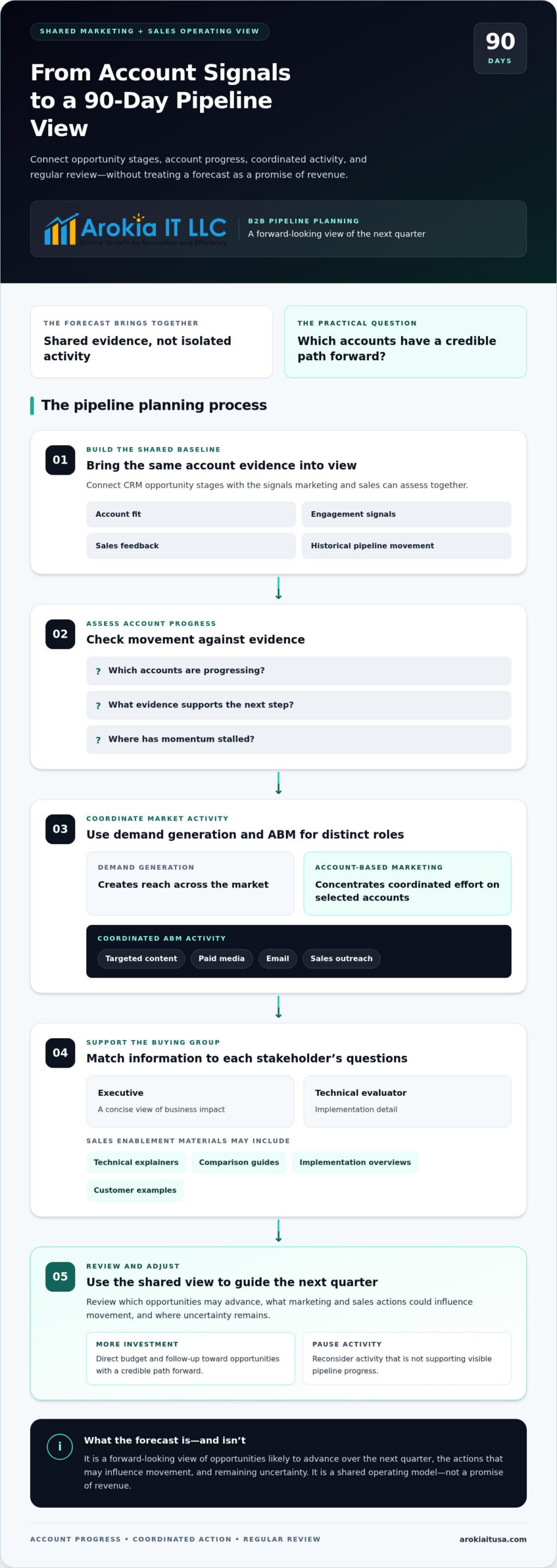
A 90-day pipeline forecast is a forward-looking view of which opportunities are likely to advance over the next quarter, what marketing and sales actions may influence that movement, and where uncertainty remains. It is not a promise of revenue. It is a shared operating model that replaces unsupported optimism with visible assumptions, defined account priorities, and regular review.
A useful forecast connects CRM opportunity stages with account fit, engagement signals, sales feedback, and historical movement through the pipeline. Marketing and sales can then examine the same questions: Which accounts are progressing? What evidence supports the next step? Where has momentum stalled? Which activity deserves more investment, and which should be paused? The answers help teams direct budget and follow-up toward opportunities with a credible path forward.
Account-Based Marketing as a Revenue Engine
Enterprise decisions rarely involve one contact, so account-based marketing (ABM) coordinates relevant outreach across the buying group. A structured ABM strategy can align targeted content, paid media, email, and sales outreach around an account’s needs. Its value increases when it complements broader demand generation: demand creates reach across the market, while ABM concentrates coordinated effort on selected accounts.
Personalization should answer a specific business question, not simply insert a company name into a template. An executive may need a concise view of business impact, while a technical evaluator needs implementation detail. Giving each stakeholder relevant evidence can address objections earlier and help sales guide the evaluation with greater precision.
Sales Enablement: The Missing Link in Demand Generation
Sales enablement content gives representatives useful, consistent material for advancing complex conversations. Depending on the buying question, that may include technical explainers, comparison guides, implementation overviews, customer examples, or executive business cases. The transition from demand generation to sales-ready conversation works best when marketing captures context and sales receives content matched to the account’s stage and concerns.
Operational discipline makes the forecast actionable. Marketing and sales should agree on account criteria, stage definitions, ownership, and the signals that warrant follow-up. A weekly review can compare forecast assumptions with actual opportunity movement, document why deals advanced or stalled, and adjust the next set of actions. For example, if a target account shows engagement but no agreed next step, the team can determine whether sales outreach, a technical resource, or a clearer business case would address the gap.
A forecast also exposes waste. If activity generates engagement from accounts outside the intended market, targeting or channel choices may need revision. If priority accounts repeatedly stall at the same evaluation point, the content or sales handoff may be missing evidence buyers need. A data-driven b2b marketing firm connects those findings to accountable decisions rather than treating campaign reports as the final measure of performance.
Arokia IT LLC’s 90-day pipeline forecasting and sales enablement work gives B2B teams a framework for aligning those decisions. For organizations seeking clearer ownership between marketing and sales, a conversation about pipeline alignment can help define the operational starting point.
The AI Frontier: GEO vs. Traditional B2B SEO
Traditional search engine optimization helps pages earn visibility in search results. Generative Engine Optimization (GEO) focuses on making a brand’s expertise clear and usable in AI-generated answers, where platforms such as ChatGPT, Claude, and Perplexity may synthesize information from multiple sources. The disciplines overlap, but they are not interchangeable: strong search foundations support discoverability, while GEO also emphasizes clear, attributable answers that systems can interpret and reference.
For B2B buyers, discovery can now happen through a direct question rather than a list of links. Someone evaluating an industrial supplier might ask an AI tool to explain a technical category, compare approaches, or identify decision criteria. If a company’s content is vague, promotional, or difficult to parse, it gives answer systems less reliable material to work with. Traditional B2B SEO remains essential for search visibility, but it cannot by itself address every way buyers encounter expertise.
Mastering AI Search Optimization
No technical tactic guarantees inclusion in an AI Overview or a large language model response. A practical foundation is accessible, well-organized content: descriptive headings, concise explanations, consistent terminology, and pages that clearly identify the subject and source. Structured data can clarify entities and page details for search engines, but it should accurately reflect visible content, not serve as a shortcut to authority.
A focused AI search optimization strategy pairs those foundations with credible, specific answers. For technical data, define terms, distinguish specifications from recommendations, and present conditions or limitations alongside claims. That structure helps human buyers assess the information and gives machines cleaner context to interpret.
Information Gain: The New Currency of Search
Information gain is the practical value a page adds beyond what a reader can find in generic summaries. It may come from expert analysis, a useful decision framework, or an explanation of tradeoffs that reflects real B2B buying questions. Rewording common advice adds little. Showing how a technical choice affects implementation, evaluation, or risk gives the reader a reason to trust the page.
For example, a generic article might list product benefits. A more useful resource explains which operational conditions make each benefit relevant, what a buyer should evaluate, and what remains uncertain. Keep each key answer self-contained so it still makes sense when surfaced apart from the full page. Use headings that express the question, then answer directly before adding context.
Content marketing supports AI-driven discovery when it consistently demonstrates subject-matter depth instead of publishing volume for its own sake. A B2B marketing firm should connect editorial planning to the questions buyers ask, verify technical statements, and maintain clear authorship and sourcing. Arokia IT LLC’s approach to GEO centers on making expertise structured and accessible, while preserving the nuance complex B2B decisions require.
Evaluating a B2B Marketing Partner: An Executive Framework
A partner’s creative portfolio can show execution quality, but it won’t tell executives whether the agency understands complex procurement or can connect marketing activity to commercial progress. Evaluate the operating model: industry understanding, alignment with sales, measurement discipline, and the ability to explain what the data does and does not prove.
B2B-Only Focus: Why It Matters
B2C campaigns often broadcast messages to broad consumer audiences. B2B marketing requires narrower targeting, role-specific information, and coordination across procurement, technical evaluators, users, and executives. In industrial markets, an agency also needs to understand how product requirements and operational considerations shape evaluation. A focused industrial marketing approach reflects those buying realities rather than applying consumer tactics by default.
Before engaging a b2b marketing firm, executives should ask how the partner defines a qualified opportunity, connects campaign activity to CRM stages, incorporates sales feedback, and reports uncertainty in forecasts. Ask who owns account selection and lead handoff, what happens when engagement doesn’t convert to a conversation, and how the strategy changes when pipeline evidence contradicts the original plan. A sound partner answers with a process, not just a promise.
Precision Metrics: Beyond Traffic and Clicks
Traffic and clicks can diagnose channel activity, but they don’t establish business impact on their own. Agree on shared definitions, data sources, reporting cadence, and attribution limits before launch. Revenue accountability means tracing how marketing contributes to opportunity creation and progression, not assigning every closed deal to a single campaign or implying guaranteed outcomes.
- Target-account engagement: whether relevant people at priority organizations are responding to outreach and content.
- Qualified opportunity creation: opportunities that meet agreed fit and readiness criteria.
- Pipeline contribution: sourced and influenced opportunities, reported with clear attribution rules.
- Stage progression and velocity: how opportunities advance and where they stall.
- Conversion and revenue outcomes: stage-to-stage conversion and closed revenue, interpreted alongside sales execution and market conditions.
These measures make reporting useful for decisions. If traffic rises while target-account engagement and qualified opportunities remain flat, the team has reason to inspect audience quality, message relevance, or conversion paths. If opportunities advance but repeatedly stall at a technical review, the next action may be stronger evidence for that evaluation stage. Vanity metrics become a warning sign when they replace these questions instead of helping answer them.
Arokia IT LLC applies a B2B-focused, data-driven approach to growth strategy. This framework is for B2B marketing, not B2C consumer marketing, managed IT, or e-commerce retail. The relevant standard is professional authority backed by transparent measurement and systematic problem-solving.
Arokia IT: Engineering Predictable Growth
Arokia IT approaches B2B growth as a system to measure and improve, not a sequence of creative deliverables. For industrial and other complex B2B organizations, marketing has to account for technical evaluation, multiple stakeholders, and sales activity that unfolds over time. The work starts by connecting business priorities to account selection, buyer needs, and the signals that indicate whether opportunities are progressing.
The Arokia IT Methodology
The process brings account-based marketing and AI-driven Generative Engine Optimization together. ABM focuses coordinated outreach on high-value organizations, while GEO strengthens the clarity and accessibility of expertise for AI-assisted discovery. LinkedIn can support professional authority with relevant business content. These activities connect to a 90-day pipeline forecast, giving leadership a structured view of priorities, assumptions, and potential gaps rather than a report built only around campaign output.
That forecast is a planning instrument, not a guarantee of closed revenue. Its value lies in making the operating picture clearer: which accounts merit attention, where sales and marketing need to coordinate, and what evidence supports the next action. Arokia IT’s B2B and industrial focus helps keep strategy grounded in the realities of technical offerings and considered purchasing decisions, instead of applying broad consumer tactics to a business sales process.
For executive teams, the practical test is whether the forecast informs decisions. If target accounts show interest but sales conversations aren’t advancing, leaders can examine message relevance, stakeholder coverage, and the content available to answer buyer questions. If activity is concentrated outside priority accounts, targeting and channel allocation may need adjustment. This is how a b2b marketing firm can help turn measurement into action: surface friction, clarify ownership, and direct resources toward the work most connected to pipeline progress.
Next Steps for Revenue Acceleration
A strategy review should begin with evidence already available across marketing and sales: account priorities, CRM stages, campaign engagement, handoff definitions, and the assumptions behind current forecasts. The goal is to identify where visibility breaks down and which decisions lack reliable inputs. Arokia IT’s AI Scorecard offers an initial assessment point for examining AI search readiness as part of that broader review.
Leadership can use the findings to set practical priorities: improve account focus, strengthen buyer-facing content, clarify sales follow-up, or refine how pipeline is monitored. LinkedIn marketing and demand generation can support the plan, but neither should be treated as an end in itself. Each channel needs a defined role tied to the audience, buying stage, and business objective it is meant to serve.
Make Your Next Growth Decision With Confidence
The next step isn’t another campaign by default. It’s deciding which assumption in your current growth plan most needs validation. Look at where the path from buyer interest to sales action becomes unclear, where investment lacks a measurable purpose, and where leadership is relying on optimism instead of shared evidence. Those are practical starting points for improving accountability.
A capable b2b marketing firm should help turn that review into priorities your team can act on, with clear ownership and measures that support better decisions. The goal isn’t to remove uncertainty from complex sales. It’s to make uncertainty visible early enough to respond with focus.
With a clearer view of the gaps and opportunities ahead, your team can move forward deliberately, and build growth around evidence rather than guesswork.
Frequently Asked Questions
What is the primary difference between a B2B marketing firm and a general agency?
A B2B marketing firm builds strategy around business buyers, longer evaluations, and the roles involved in organizational purchasing. A general agency may serve a wider mix of markets, while a specialized partner can tailor audience research, messaging, and sales handoffs to B2B buying conditions. For example, an industrial campaign may need separate materials for an engineer assessing technical fit and an executive reviewing business impact.
How does a 90-day pipeline forecast improve marketing accountability?
A 90-day pipeline forecast gives marketing and sales a defined period for reviewing opportunity movement against shared assumptions. It can help executives see which accounts are progressing, which require intervention, and where campaign activity isn’t translating into sales action. To make it useful, teams should record the basis for each forecast, note changes in opportunity status, and discuss variances instead of treating the forecast as a guaranteed revenue result.
Why is Generative Engine Optimization (GEO) critical for B2B companies in 2026?
GEO matters because potential buyers may use AI tools to clarify technical categories, compare approaches, and identify vendors before speaking with sales. B2B companies need clear, attributable information that explains what they do and supports their claims. For example, a manufacturer can publish a precise explanation of a process and its relevant operating conditions, helping prospective buyers evaluate expertise even when discovery begins outside a traditional search results page.
Can an ABM strategy work for smaller industrial companies?
Yes. Account-based marketing can be scaled to a manageable group of high-fit organizations rather than requiring a large enterprise program. A smaller industrial company might prioritize accounts by application, region of service, or product fit, then create focused outreach for the roles that influence a purchase. The key is to select accounts the sales team can realistically support and coordinate marketing activity with available sales capacity.
How does sales enablement content actually shorten the B2B sales cycle?
Sales enablement content can reduce repeated explanation by giving representatives useful material for common evaluation questions. A technical comparison, implementation overview, or concise internal business case can help a prospect share accurate information with colleagues who weren’t in the original meeting. Content won’t control a buyer’s decision timeline, but it can help resolve specific information gaps and support more productive follow-up conversations.
What are the risks of hiring a marketing firm that also handles B2C clients?
Serving B2C clients isn’t automatically a problem, but a firm that applies consumer campaign assumptions to complex B2B sales may optimize for the wrong behavior. Broad reach, quick conversions, or individual-level engagement can distract from account fit, technical evaluation, and committee needs. Executives should assess whether the proposed strategy reflects their actual buying process, and whether the team can explain how its approach adapts to B2B requirements.
How do you measure the ROI of AI search optimization?
Measure AI search optimization with a combination of visibility indicators and business outcomes, while recognizing that attribution may be incomplete. Track relevant referral visits, qualified inquiries that mention AI tools, engagement with pages designed for AI discovery, and opportunities associated with those accounts. Compare trends over time and document the measurement method. AI visibility alone isn’t ROI; connect it to meaningful buyer actions and pipeline wherever reliable data allows.
What should be the first step in aligning our marketing and sales teams?
Start by agreeing on what makes an account or opportunity sales-ready, using recent examples from your CRM rather than abstract definitions. Have both teams review a small set of accepted, rejected, advanced, and stalled opportunities. Record where their interpretations differ, then establish shared qualification criteria, follow-up ownership, and feedback expectations. This gives both teams a practical operating agreement before changing campaigns, scoring rules, or reporting dashboards.