
What if the pages earning the most organic traffic do little to move your revenue pipeline? For many B2B teams, the disconnect is familiar: rankings and leads look healthy, yet sales can’t tell whether search activity reaches technical buyers, decision-makers, or target accounts. B2B search engine optimization needs to do more than attract visitors. It should help the right buyers find useful answers and give marketing and sales a shared view of what happens next.
That takes a coordinated program, not a collection of disconnected keywords and content assets. Search insights can inform account-based marketing, sales enablement, and demand generation. Clear measurement can then connect organic discovery to qualified opportunities. Rankings matter, but they are not the final measure of success.
This guide explains how to prioritize search topics around buyer needs, create content for different stakeholders, and improve the technical visibility that helps buyers discover it. You’ll also learn how to align SEO, sales, and demand generation around pipeline signals, so your team can assess contribution more carefully and spend less effort on irrelevant traffic.
Key Takeaways
- Define SEO success by whether the right business buyers discover your expertise, not by traffic volume alone.
- Build a b2b search engine optimization strategy by connecting growth goals, buyer research, search intent, topic priorities, and measurement.
- Use several kinds of evidence to understand how organic search supports engagement and sales opportunities, including when it is not the final recorded touch.
- Sequence execution deliberately: establish a baseline, address significant technical barriers, then develop priority content and strengthen internal links.
- Coordinate SEO with ABM, GEO, demand generation, and sales enablement so search insights inform account engagement and pipeline planning.
What B2B Search Engine Optimization Means for Complex Buying Journeys
B2B SEO improves relevant organic discovery across business buying journeys. In practical terms, b2b search engine optimization helps the right organizations find useful, credible information as they investigate a problem, compare approaches, and assess potential providers. The goal is not simply to appear for more searches. It is to earn visibility for questions that matter to buyers and support their next decision.
Search engine optimization (SEO) describes the broader practice of improving a website’s visibility in organic search results. B2B SEO applies that work to business audiences, where a technical evaluator, executive, or procurement stakeholder may search for different information and use different criteria to assess a provider.
How B2B SEO differs from consumer-focused search
Consumer searches often support an individual decision. Organizational purchases may involve several people assessing fit, risk, implementation, and business value. A technical user might search for integration requirements, an executive may look for strategic or financial implications, and procurement may examine vendor qualifications or terms. Their research can overlap, but each person needs evidence suited to their role.
There is no single B2B journey to map. Some buyers arrive with a defined solution in mind; others are still clarifying the problem. Build content around the questions and decisions your buyers actually face rather than forcing every query into a rigid funnel.
Which business outcomes should SEO support?
Organic visibility is an indicator, not a business outcome by itself. Rankings and impressions can show whether pages are being discovered. Engaged visits and relevant inquiries add context. Qualified opportunities and revenue are further downstream, and organic search may contribute to them without being the final recorded touch.
Before evaluating attribution, marketing and sales should agree on what makes an inquiry relevant, what qualifies as an opportunity, and how account fit is recorded. Shared definitions help teams distinguish a high-traffic page from content that helps the right buyer understand a solution or start a sales conversation.
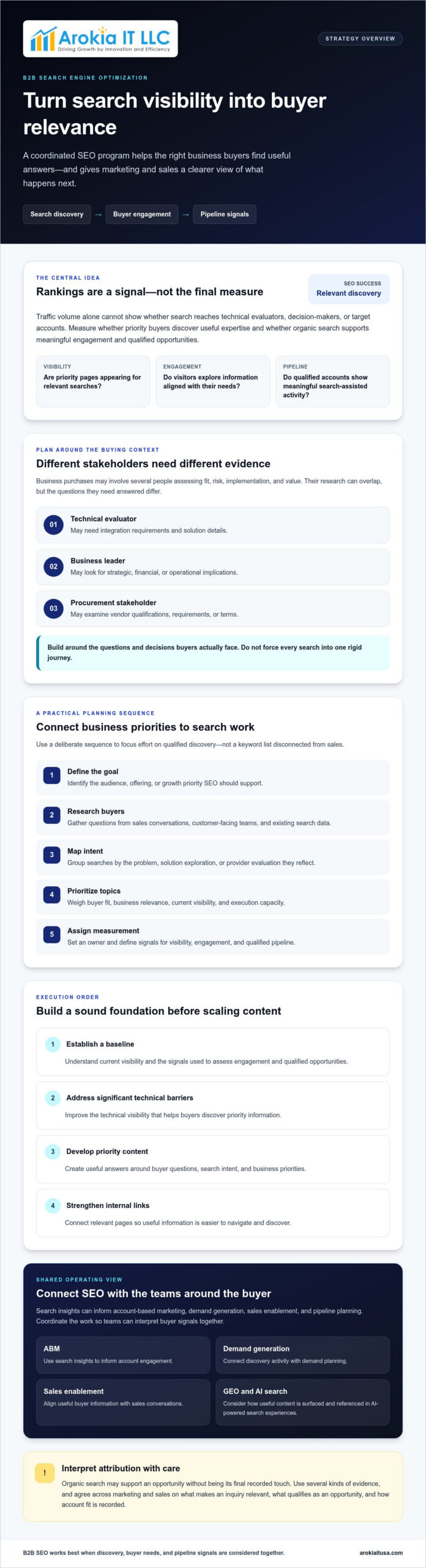
- Visibility: Are priority pages appearing for relevant searches?
- Engagement: Do visitors explore information aligned with their needs?
- Pipeline: Do qualified accounts and opportunities show meaningful search-assisted activity?
For teams extending discovery into AI-powered search, AI search optimization can complement SEO by considering how useful content is surfaced and referenced in those experiences. The standard remains the same: connect visibility to buyer relevance instead of relying on a ranking report alone.
Build a B2B SEO Strategy Around Buyer Intent and Search Demand
A useful strategy connects search activity to business priorities before assigning keywords or content formats. For b2b search engine optimization, follow a clear planning sequence: define the growth goal, research buyers, map intent, prioritize topics, and decide how to measure progress. This keeps the work focused on qualified discovery instead of a large keyword list with no connection to sales.
- Define the goal: Identify the audience, offering, or growth priority SEO should support.
- Research buyers: Gather questions from sales conversations, customer-facing teams, and existing search data.
- Map intent: Group searches by the problem, solution exploration, or provider evaluation they reflect.
- Prioritize topics: Weigh buyer fit, business relevance, current visibility, and execution capacity.
- Assign measurement: Set an owner and define the signals that indicate visibility, engagement, and qualified pipeline.
Map search intent to buying roles and decisions
Search terms rarely explain the whole decision. A technical evaluator may ask whether a solution integrates with existing systems; a business leader may research expected operational impact; procurement may seek vendor details, requirements, or risk information. Group queries by the decision they support, but do not assume every buyer follows the same sequence.
Validate your interpretation with sales and customer-facing teams. Ask what prospects wanted to know before a conversation, which objections recur, and what terms they use to describe the problem. Those answers can reveal gaps between keyword-tool language and the language buyers actually use.
Prioritize topics without chasing volume alone
Estimated search demand is useful context, not a decision rule. Assess whether a topic attracts organizations that fit your ideal customer profile, supports a relevant offering, and gives your team room to provide specific, credible guidance. Then check existing visibility and whether the team has the expertise and capacity to produce and maintain the content.
For example, a broad topic may have more estimated searches but attract a mixed audience. A narrower query about a business problem or evaluation criterion may better match the accounts and sales conversations the company wants to support. Compare both against business fit before committing resources.
Record each priority with its intended audience, buyer question, target page, and success measure. This makes the plan easier to review with sales and demand generation, and helps teams revisit assumptions when customer questions or search performance change. Arokia IT LLC’s B2B SEO services describe strategic support for this work. Teams aligning search priorities with growth goals can also discuss their SEO priorities.
Measure B2B SEO Beyond Rankings and Last-Click Attribution
Last-click reports can obscure the path to a B2B opportunity. A buyer may find an educational page through search, return later through another channel, and involve colleagues before sales records an opportunity. The answer is not to credit SEO automatically. Build reporting that shows what the data supports and where evidence is incomplete.
No single metric proves SEO caused a complex B2B sale. Assess patterns across search activity, account engagement, and opportunity history. A useful b2b search engine optimization dashboard separates diagnostic signals from commercial evidence and makes assumptions visible.
Which B2B SEO metrics belong in a useful dashboard?
Organize reporting around the question each measure can answer. Search visibility and organic sessions can indicate whether priority pages are being discovered. Engagement and relevant conversions help assess how visitors interact with those pages. Sales outcomes add account and opportunity context, but should not be presented as direct SEO results without supporting evidence.
Discovery diagnostics: Review search impressions, query themes, and organic sessions for priority pages. Segment by page or topic where possible, so a sitewide increase does not mask declining visibility for strategically important content.
Content response: Examine agreed actions alongside the pages and audiences involved. Changes to forms, calls to action, or page purpose can affect these measures, so note meaningful updates when reviewing trends.
Commercial context: Review opportunity history and account-level interactions with sales. Look for relevant patterns, then record what the available data does and does not establish.
Consistent CRM fields and shared definitions make comparisons more dependable. Specify how teams record source, account, qualification, opportunity status, and known interactions. Note where fields are incomplete or applied inconsistently. A dashboard should show those data limitations, not disguise them with a single attribution label.
How can teams interpret SEO influence across a long sales cycle?
Use available CRM records and touchpoint history to examine whether priority accounts engaged with organic resources before or during opportunity development. Compare pages and account patterns over consistent reporting periods, and note major content or technical changes. Treat the findings as evidence of potential contribution, not proof that search initiated or closed a deal.
Interpret results alongside other active programs. ABM, paid media, sales outreach, and demand generation may engage the same accounts, while tracking gaps can leave parts of the journey unobserved. Discuss those overlaps with sales and revenue operations before drawing conclusions.
Arokia IT LLC’s 90-Day Pipeline Forecast can provide a planning context for reviewing pipeline signals with cross-functional teams. Use a forecast to inform discussion, not as a substitute for clear SEO measurement or verified CRM data.
Turn B2B SEO Priorities Into a Practical Execution Plan
A prioritized strategy needs an operating plan. For b2b search engine optimization, sequence the work so teams can identify what is broken, build what buyers need, and review evidence before expanding effort. A practical cycle is to establish a baseline, resolve material barriers, publish priority assets, and assess what changed before deciding what to do next.
Keep distinct workstreams visible. Technical SEO addresses whether search engines can access and understand important pages. Content answers buyer questions. Internal linking connects related resources and helps users navigate to relevant information. Authority-building work strengthens credibility through useful expertise and relevant external recognition. These efforts support one another, but they need different owners and validation steps.
Start with technical and measurement foundations
Use available evidence to review crawlability, indexation, page experience, and analytics configuration. Google Search Console can help teams inspect search visibility and indexing signals. Google Analytics 4 can provide site-engagement data when its setup supports the questions being asked. Neither tool replaces a clear baseline or reliable tracking definitions.
Turn findings into assigned work, not a vague “fix SEO” task. Document the affected pages, issue, owner, dependencies, and how the team will validate completion. A web team may own a template change, while marketing checks page-level tracking and confirms priority URLs remain accessible. Some fixes depend on development capacity or approvals, so plan accordingly rather than promising immediate results.
Create content sales teams can use
Build priority pages around specific buyer questions, technical evaluation needs, and decision-stage concerns. Ask subject-matter experts to review technical explanations, and support factual or performance claims with clear evidence. A page answering an implementation question may also become a sales enablement resource, provided its format and level of detail fit the conversation.
Assign responsibility across the workflow: marketing manages search priorities and measurement; subject-matter experts validate accuracy; web teams handle technical changes; sales shares recurring questions and feedback on whether content helps prospects. Review these inputs after publication, then update pages when offerings, buyer concerns, or evidence change.
Coordinate SEO execution with campaigns. Aligning priority content with demand generation can help teams connect organic discovery with broader audience engagement, without treating search as a standalone channel.
Discuss a practical B2B SEO execution plan
Connect B2B SEO With ABM, GEO, and Revenue Operations
SEO, account-based marketing (ABM), generative engine optimization (GEO), demand generation, and sales enablement serve different functions. SEO creates useful resources buyers can discover through search. ABM focuses engagement on selected high-value accounts. GEO considers how content may be surfaced in generative search experiences. Demand generation coordinates programs that create and develop interest, while sales enablement equips sales teams to use relevant information in buyer conversations.
These channels work best when their priorities connect. Search research can surface recurring problems and questions across an audience. Marketing can use those insights to shape discoverable content, then coordinate account-relevant outreach and sales resources around the same buyer needs. Revenue operations can help align definitions, systems, and reporting so teams can review engagement and opportunity context together.
Where SEO and ABM reinforce each other
SEO and ABM are complementary, not interchangeable. A search resource can address a shared technical question for a broad audience; ABM can tailor engagement around how that issue affects a selected account. Sales feedback can reveal whether the content answers real objections or needs more specific evidence. Arokia IT LLC’s account-based marketing services are relevant for teams considering account-focused execution.
Coordinate search quality with GEO
GEO does not replace sound SEO foundations or guarantee inclusion in AI-generated answers. Clear, accurate, useful content and accessible pages remain central to discoverability. Teams can extend search planning to consider how content is structured for answer engines, then evaluate visibility with appropriate context and without promising outcomes. Arokia IT LLC’s AI search optimization page is a related resource for exploring that work.
When to bring in an integrated B2B partner
Consider whether strategy, content, technical work, analytics, and sales processes have clear owners and shared priorities. A prospective partner should explain how progress is defined, how uncertainty and data limitations are reported, and how work coordinates with internal teams. Ask how search insights will inform account strategy and sales enablement, rather than treating SEO as a separate traffic program.
To identify where search and account strategy diverge, compare priority buyer questions with the content currently used in ABM and sales conversations. Gaps can point to practical next steps, such as improving a discoverable resource, refining account messaging, or aligning how teams review results.
Make Search a More Accountable Growth Channel
A durable b2b search engine optimization program starts with buyer questions and ends with shared business accountability. Prioritize content for the organizations and roles you want to reach, then connect technical execution and useful resources to measures sales and marketing understand together. Rankings can help diagnose visibility, but qualified engagement and opportunity context provide a more meaningful view of progress.
That work is stronger when search informs the rest of the revenue process. Arokia IT LLC focuses on B2B Account-Based Marketing and demand generation, with related offerings in AI search and GEO, sales enablement content, and 90-day pipeline forecasting. These capabilities can help teams consider search, account engagement, and pipeline planning as connected priorities, without treating any single channel as a guaranteed source of revenue.
Start with gaps your teams can verify, agree on what progress means, and build from there. A coordinated program gives your business a clearer path from discovery to qualified conversations.
Frequently Asked Questions
What is B2B search engine optimization?
B2B search engine optimization improves a company’s visibility in organic search for topics relevant to business buyers. It combines technical site readiness with content that helps organizations research challenges, compare approaches, and evaluate providers. The objective is not to attract every possible visitor. It is to make useful information discoverable by relevant audiences and support informed decisions throughout a business buying journey.
Why is SEO important for B2B companies?
SEO helps B2B companies become discoverable while potential buyers research needs and options, including before they contact sales. A well-planned search presence can answer specialized questions, clarify a solution’s fit, and give different stakeholders useful information to share internally. SEO is most valuable when topics align with the company’s expertise and target market, rather than when traffic grows without a clear connection to qualified business interest.
How do you measure B2B SEO success?
Measure B2B SEO with a combination of visibility, engagement, and sales indicators. Search impressions and organic sessions can help diagnose discovery; relevant actions and lead quality show whether visitors fit agreed criteria; CRM opportunity data adds pipeline context. Align marketing and sales on qualification definitions and tracking fields before reporting. Treat attribution carefully: a recorded organic touch may show influence, but it does not prove SEO caused a sale.
How long does B2B SEO take to produce results?
There is no reliable universal timeline for B2B SEO results. Progress depends on factors such as the site’s technical condition, existing search visibility, topic competition, content quality, and the team’s capacity to implement and maintain work. Monitor early signals, such as whether priority pages are accessible and gaining relevant visibility, then evaluate qualified engagement and sales context over an appropriate period. Avoid treating a fixed deadline as a guarantee.
What is the difference between B2B SEO and B2B content marketing?
B2B SEO focuses on making relevant pages discoverable through organic search and ensuring the website supports that discovery. B2B content marketing plans and delivers useful material for business audiences across channels and purposes, including education, engagement, and sales support. The disciplines overlap: SEO research can guide content topics, while expert content can answer buyer questions. Content marketing can also serve needs that are not driven by search demand.
Can B2B SEO support account-based marketing?
Yes. Search research can reveal recurring questions and problems relevant to the audiences an ABM program wants to reach. SEO can provide broadly discoverable resources around those needs, while ABM coordinates more focused engagement with selected accounts. Teams can connect the two by sharing buyer insights, aligning content with account priorities, and gathering sales feedback on usefulness. Search visibility alone does not identify account intent or replace account-specific strategy.
Should B2B companies optimize for AI search as well as traditional search?
B2B companies can account for AI search alongside traditional organic search, but AI-focused work should not replace sound fundamentals. Clear, accurate, useful content and technically accessible pages remain central to discovery. Generative engine optimization considers how information may be interpreted or referenced in AI-powered answers, but no tactic guarantees visibility or citations. Assess AI search as part of a broader discovery strategy, with realistic expectations and available evidence.