
A database boasting hundreds of millions of records is useless if your sales development reps spend their mornings dialing disconnected switchboards. When evaluating Cognism vs ZoomInfo B2B contact data accuracy, revenue leaders quickly realize that sheer record volume never compensates for poor verification. You already know the compounding cost of bad prospecting data: compromised email domain reputations from high bounce rates, wasted sales rep hours chasing departed contacts, and quarterly pipeline targets missed due to stale account lists.
Data accuracy is determined by verification methodology, not database size. This executive comparison cuts through vendor positioning to evaluate how human-in-the-loop phone verification, data decay management, and international compliance separate high-converting intelligence platforms from bloated directories. We examine how each data engine impacts connect rates and rep efficiency, giving leadership the exact criteria needed to eliminate wasted outbound touches and select the right platform for predictable pipeline growth.
Key Takeaways
- Evaluating Cognism vs ZoomInfo B2B contact data accuracy reveals that automated community scraping models favor database breadth, whereas phone-verified intelligence engines prioritize live connect rates.
- Human-verified direct dials bypass switchboard gatekeepers and disconnected corporate numbers, directly accelerating sales rep productivity and pipeline conversion.
- International compliance frameworks like GDPR and automated Do-Not-Call list screening separate legally secure intelligence providers from high-risk directories.
- Unchecked contact decay silently burns primary sending domain reputations through hard bounces, creating measurable drag on outbound demand generation.
- Selecting the ideal data partner requires auditing your geographic focus and addressable market density rather than buying into gross record volume claims.
Evaluating Data Architectures: Cognism vs ZoomInfo Verification Engines
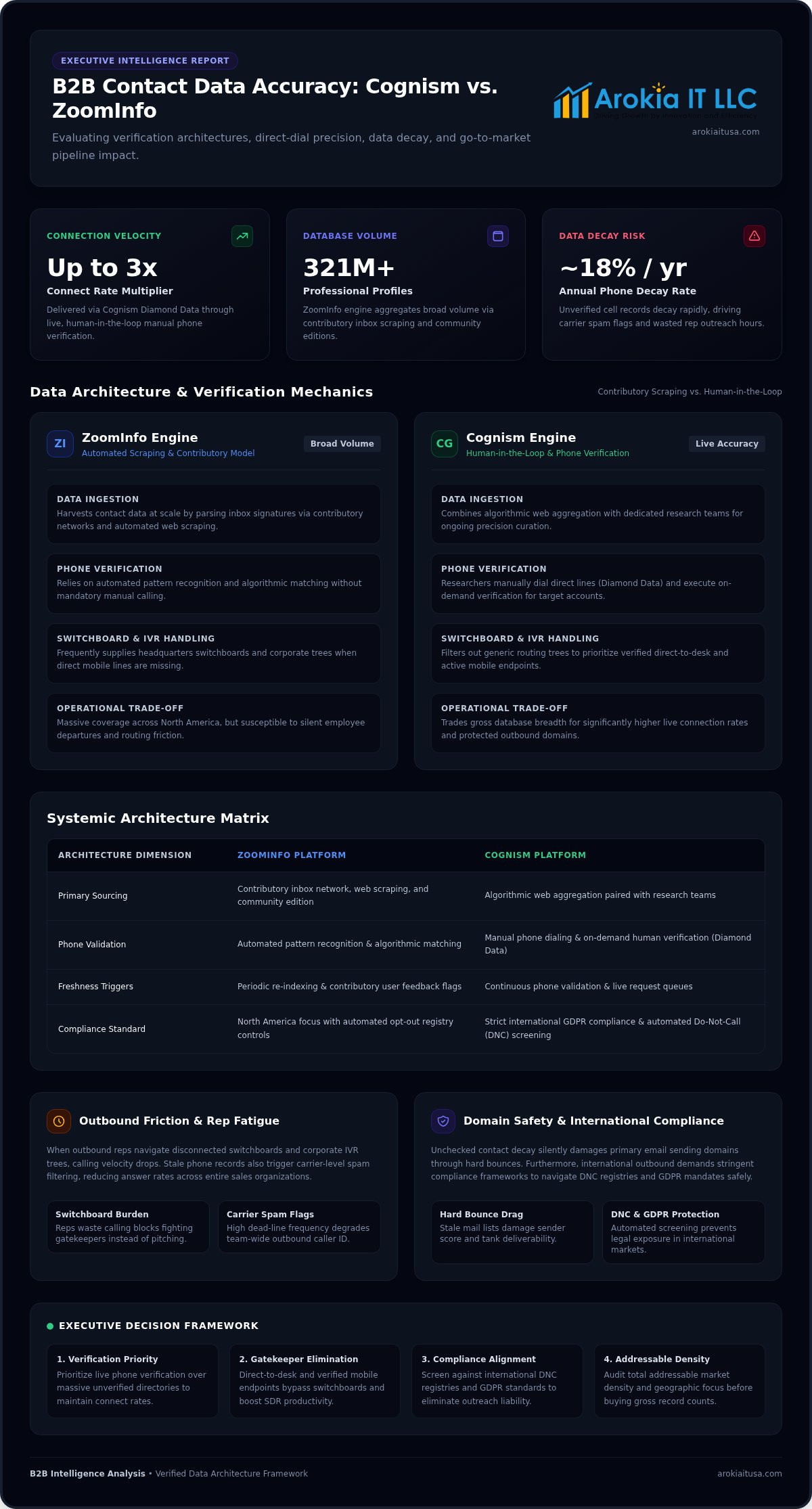
Modern revenue engines stall when fed unverified inputs. Contact data accuracy governs go-to-market performance, dictating whether sales development reps generate pipeline or burn through valuable outreach cycles. When evaluating Cognism vs ZoomInfo B2B contact data accuracy, the fundamental distinction lies not in marketing claims, but in underlying data architecture. ZoomInfo prioritizes massive record volume via automated scraping and contributory networks, compiling over 321 million professional profiles. Cognism focuses heavily on human-in-the-loop verification to enforce rigorous data quality standards across critical outbound channels.
Contributory Networks and Algorithmic Scraping Mechanics
Contributory networks harvest contact information by integrating directly with enterprise inbox systems, parsing signatures at scale. While this ingestion engine builds volume rapidly, it introduces structural vulnerabilities. Automated scraping cannot reliably detect silent departures or stealth corporate restructuring. Algorithms routinely misclassify shared department lines as direct numbers. The resulting lag between an employee’s departure and the database update creates immediate delivery failures. When unverified records feed into strategic Account-Based Marketing programs, stale data inflates acquisition costs and distorts lead prioritization.
Human-in-the-Loop and On-Demand Dial Verification
Cognism addresses automated decay through dedicated research teams who manually dial numbers to verify live lines, branded as Diamond Data. This human-in-the-loop workflow trades gross database breadth for live connection reliability. Sales teams can also trigger on-demand verification for high-priority targets, deploying researchers to confirm direct dials before reps initiate outreach. You trade access to millions of unverified records for higher connect ratios and protected sending reputations.
| Architecture Dimension | ZoomInfo Engine | Cognism Engine |
|---|---|---|
| Primary Sourcing | Contributory inbox network, web scraping, community edition | Algorithmic web aggregation paired with research teams |
| Phone Validation | Automated pattern recognition, algorithmic matching | Manual phone dialing and on-demand human verification |
| Data Freshness Trigger | Periodic re-indexing, user feedback flags | Continuous phone validation, live request queues |
Direct Dial Precision: Benchmarking Mobile and Phone Accuracy
Direct dials dictate outbound sales velocity. When sales development reps spend half their calling blocks navigating dead lines or automated switchboards, pipeline velocity collapses. The operational friction in cognism vs zoominfo b2b contact data accuracy centers on whether a platform delivers verified mobile direct lines or static headquarters numbers masquerading as direct extensions. False positives drain rep morale and burn outbound capacity on automated phone trees.
Mobile Connection Rates and Direct-Dial Accuracy
Mobile connect rates determine whether an outbound motion scales predictably. Cognism reports up to a 3x improvement in connect rates using human-verified Diamond Data, actively scrubbing dormant numbers before they enter CRM sequences. ZoomInfo supplies broad mobile volume across North America through algorithmic matching, yet unverified records suffer from standard phone decay rates hovering near 18% annually. When reps repeatedly call unverified cell records, telecom carrier filtering flags your outbound numbers as spam, depressing answer rates across entire sales teams.
Managing Corporate Switchboards and Gatekeeper Hurdles
Enterprise accounts present intricate phone trees and gatekeepers designed to deflect cold outreach. ZoomInfo frequently provides headquarters switchboard numbers when individual direct dials are unavailable, pushing the burden of navigating complex Interactive Voice Response (IVR) systems onto your reps. Cognism mitigates this friction by prioritizing direct-to-desk and verified mobile endpoints, filtering out generic routing numbers. Navigating switchboards drains hours that should be spent presenting value propositions. The broader financial impact of data decay surfaces directly in these wasted calling cycles, where reps trade strategic selling time for manual directory navigation.
Eliminating phone tree friction requires verifying contact accuracy before launching multichannel outbound sequences. If poor connect rates and stale numbers compromise your team’s pipeline efficiency, it is time to audit your data infrastructure and deploy targeted outreach that reliably reaches decision-makers.
Geographic Coverage and Compliance: North America vs Global Markets
Regional boundaries alter vendor capabilities instantly. A data platform that dominates enterprise accounts across North America often falters when deployed across strict European regulatory zones. Comparing cognism vs zoominfo b2b contact data accuracy requires evaluating where your prospective buyers sit geographically and how local privacy laws govern outreach. Enterprise leaders must balance deep corporate mapping with strict legal risk containment.
North American Enterprise and Mid-Market Market Density
ZoomInfo remains the benchmark for database depth across the United States. Its engine tracks specialized mid-market tiers, traditional distribution chains, and industrial sectors where digital footprints are sparse. For teams executing multi-tiered outreach, targeting precision forms the backbone of specialized programs like industrial marketing campaigns. ZoomInfo uncovers deep corporate hierarchies across regional accounts, giving domestic field teams immediate visibility into buying committees.
European Compliance, Do-Not-Call Registries, and GDPR Guardrails
Deploying aggressive outbound campaigns into European territories introduces serious regulatory friction under GDPR. ZoomInfo operates an opt-out architecture originally designed for the American market, which creates compliance headaches overseas. Cognism built its platform around European regulatory frameworks from inception. It automatically cross-checks numbers against national Do-Not-Call (DNC) registries across 15 countries, including the TPS/CTPS in the United Kingdom and Robinson lists throughout mainland Europe.
Cold calling non-compliant records exposes enterprise organizations to severe financial penalties and reputational damage. Cognism relies on legitimate interest legal arguments paired with active opt-out screening, giving revenue teams a fully governed pipeline. When evaluating data quality across global boundaries, compliance rigor must carry equal weight alongside coverage depth. Unchecked contact sourcing across international borders turns simple sales touches into corporate legal liabilities.
- North American Reach: ZoomInfo provides unmatched coverage across domestic commercial sectors, public institutions, and industrial supply lines.
- European Coverage: Cognism delivers superior verified direct lines across the UK and mainland Europe with native compliance.
- DNC Cleansing: Cognism scrubs against 15 international do-not-call registries; ZoomInfo relies primarily on broad domestic flags and manual customer exclusions.
- Legal Governance: Cognism reduces statutory GDPR risk through embedded compliance-first sourcing workflows.
The Financial Impact of Data Decay on Revenue Pipeline
Data erosion functions as a silent tax on enterprise go-to-market execution. B2B contact records naturally decay at an average rate of 2.1% per month, compounding to roughly 22.5% annually. In high-turnover segments like enterprise software, turnover rates climb to 40% or 50% within a single calendar year. Evaluating Cognism vs ZoomInfo B2B contact data accuracy means assessing how each platform protects your outbound pipeline from this systematic baseline erosion.
Calculating the True Cost of Bad Contact Records
Inaccurate contact records destroy field productivity and compromise infrastructure. When sales development reps dial disconnected lines and send prospecting emails to obsolete inboxes, the financial drag compounds across multiple operational line items:
- SDR Labor Waste: Reps lose hours every week researching replacement contacts after hitting dead corporate switchboards or bounced email addresses.
- Domain Invalidation: Hard email bounce rates exceeding 2% trigger corporate spam filters, burning core secondary sending domains and requiring costly technical remediation.
- Sales Attrition: Prospecting into low-converting, stale account lists causes missed quotas, rep frustration, and voluntary turnover.
Bad records fundamentally distort pipeline projections. Marketing targets appear fully staffed on paper, but field reps fail to convert due to invalid endpoints. Revenue teams rely on clean, reliable data inputs to feed multichannel demand generation programs that deliver consistent sales opportunities rather than vanity database counts.
Data Decay Velocity and Automated CRM Enrichment Workflows
Approximately 10.9% of business professionals change jobs annually. When roles shift, titles, business emails, and direct routing numbers become obsolete simultaneously. ZoomInfo counters this decay through automated batch enrichment, continuously updating records via background community network indexing. Cognism mitigates decay by combining automated data updates with human phone verification, allowing teams to queue high-value accounts for manual dial checks before launching aggressive sales cadences.
Preventing decay requires continuous CRM synchronization rather than annual data cleanups. Establishing automated trigger-based enrichment keeps account lists current, protecting rep efficiency and preserving domain health across prolonged enterprise sales cycles.
Strategic Selection Framework: Choosing the Right Data Partner
Procuring sales intelligence without an objective evaluation framework invites budget waste and platform abandonment. When resolving cognism vs zoominfo b2b contact data accuracy for your enterprise, the decision rests on alignment between your go-to-market motion, buyer geography, and primary outreach channels. Follow a disciplined three-step selection sequence before signing multi-year agreements:
- Step 1: Audit Addressable Market Concentration. If your revenue model targets broad mid-market accounts across the United States, ZoomInfo provides expansive directory depth. If your expansion focuses heavily on the UK, Europe, or highly regulated global accounts, Cognism delivers superior compliance and direct mobile reach.
- Step 2: Prioritize Dominant Sales Channels. Dial-heavy outbound teams requiring live pickup rates benefit immediately from Cognism’s phone-verified records. Multi-channel marketing teams executing broad programmatic coverage across digital channels often capitalize faster on ZoomInfo’s immense database volume.
- Step 3: Execute Live Rep Blind Pilots. Never evaluate accuracy using vendor-curated demo environments. Pull raw lists of 200 priority target accounts across both platforms and test live connection rates with your frontline sales development reps.
Auditing Tech Stack Compatibility and Native CRM Integrations
Bi-directional CRM synchronization across Salesforce or HubSpot prevents field reps from working with orphaned records. Examine licensing mechanics carefully. ZoomInfo operates on credit allotments where export limits can restrict operational throughput, whereas Cognism utilizes seat-based licensing governed by fair-use thresholds. Ensure intent data signals integrate cleanly into your marketing automation platform to trigger real-time routing rather than creating manual spreadsheet queues.
Connecting Intelligence to Integrated ABM and Demand Generation
Clean contact records provide the raw material, but strategic activation creates enterprise value. Sales intelligence achieves maximum leverage when embedded within multi-channel demand generation programs that warm target accounts across paid and organic touchpoints. High-precision contact lists accelerate account-based marketing orchestration by aligning SDR outreach directly with executive buyer intent. Arming reps with accurate direct lines and targeted sales enablement assets compresses complex evaluation timelines and builds predictable quarterly revenue pipeline.
Transforming Verified Contact Intelligence into Predictable Revenue
Resolving the debate over cognism vs zoominfo b2b contact data accuracy requires aligning your tooling choice with your go-to-market motion. Database size means little without verification rigor. ZoomInfo delivers the domestic record density and intent data depth necessary for broad North American coverage. Cognism provides the phone-verified mobile precision and international compliance essential for connecting with European enterprise accounts without exhausting sales capacity.
Sustainable growth demands more than static contact records; it requires disciplined execution. Integrating verified intelligence into our 90-day predictable pipeline forecasting framework stops contact decay before it compounds. Supported by multi-channel account-based marketing programs tailored for high-stakes B2B and enterprise sales enablement strategies that eliminate revenue leakage, your revenue engine converts verified endpoints directly into active pipeline.
Stop letting invalid numbers dictate rep quota attainment. Deploying verified intelligence across your target accounts gives your team the exact foundation needed to command every sales cycle.
Frequently Asked Questions
Is Cognism or ZoomInfo more accurate for direct mobile phone numbers?
Cognism provides higher direct dial accuracy through its Diamond Data verification tier, where researchers manually call numbers to confirm live human endpoints. ZoomInfo maintains a larger volume of mobile numbers using automated matching algorithms, but unverified lines suffer higher error rates. For outbound calling teams evaluating cognism vs zoominfo b2b contact data accuracy, Cognism’s human-in-the-loop validation substantially increases live connect rates.
How do Cognism and ZoomInfo maintain data compliance with GDPR and CCPA?
Cognism uses a compliance-first architecture designed around European GDPR standards, screening contacts against Do-Not-Call registries across 15 countries and notifying individuals when their data is processed. ZoomInfo operates an opt-out compliance model built primarily for domestic CCPA regulations, offering privacy management tools for data removal. Organizations targeting European buyers gain stricter automated regulatory protection with Cognism, while ZoomInfo requires more manual oversight for overseas campaigns.
What is the average data decay rate for B2B contact intelligence platforms?
B2B contact data decays at an average rate of 2.1% per month, compounding to roughly 22.5% each year. In fast-moving sectors like software and technology, annual turnover can reach 40% to 50% as professionals change positions. Contact databases experience continuous erosion across job titles, corporate emails, and direct routing numbers, making automated CRM enrichment workflows essential for maintaining data accuracy over time.
Can sales teams integrate both Cognism and ZoomInfo into a single CRM?
Yes, revenue teams often integrate both platforms into Salesforce or HubSpot by establishing custom field mapping and priority rules. Enterprise organizations frequently deploy ZoomInfo as the primary enrichment engine for North American accounts, while using Cognism to pipe phone-verified mobile numbers and European contacts into the database. Clear field hierarchy rules ensure that verified records overwrite older scraped data without creating duplicate entries.
How does B2B contact data accuracy directly impact cold email deliverability?
Invalid contact records cause hard bounces that damage your domain reputation with internet service providers like Google and Microsoft. When bounce rates exceed 2%, mailbox providers route outbound messages directly into spam folders, neutralizing sales campaigns before buyers ever see them. High data accuracy keeps bounce rates low, protects sending authentication records like SPF and DKIM, and preserves primary domain health during active outreach.
Which platform offers better data coverage for North American enterprise accounts?
ZoomInfo delivers superior database depth across North American enterprise and mid-market accounts, boasting more than 321 million professional profiles. Its platform maps complex corporate parent-child hierarchies and provides granular org charts across regional facilities. When assessing cognism vs zoominfo b2b contact data accuracy within domestic markets, ZoomInfo captures broader account coverage across traditional industrial sectors, supply chain operators, and domestic commercial enterprises.
What key metrics should revenue operations track during a data vendor pilot?
Revenue operations should track four core metrics during a live data pilot: direct dial connect rates, email deliverability and bounce rates, job title accuracy, and switchboard routing percentages. Teams must test both vendors using an identical sample of target accounts dialed by active sales reps. Blind testing under real-world calling conditions reveals actual endpoint accuracy far better than vendor-curated software demonstrations.