
A forecast can look precise and still be wrong when buyer signals, pipeline data, and team priorities don’t line up. That disconnect sits at the center of chief revenue officer challenges 2026: CROs must build dependable growth while buyers research independently, AI changes how teams work, and departments measure success differently.
If your pipeline is harder to trust, the issue may not be a lack of activity. It may be fragmented evidence, unclear ownership, or processes that reward local wins over shared revenue outcomes. Adding another platform won’t fix those operating gaps on its own.
This guide explains the forces shaping CRO accountability and offers a practical way to decide what to address first. You’ll learn how to connect buyer evidence to forecasting, align marketing, sales, customer success, and RevOps around common priorities, and assess AI based on its contribution to execution. The goal isn’t to chase every trend. It’s to improve revenue visibility, accountability, and follow-through.
Key Takeaways
- Understand why chief revenue officer challenges 2026 call for decisions that connect teams, data, and customer-facing work.
- Recognize how inconsistent pipeline stages, outdated records, and disconnected systems weaken forecast confidence.
- Distinguish AI that supports informed decisions from automation that can amplify unreliable inputs or unclear ownership.
- Use a four-step diagnostic to trace a revenue symptom to its cause, assign accountability, and track progress.
- Connect ABM, demand generation, lead nurturing, and sales enablement to shared pipeline priorities.
Why chief revenue officer challenges are changing in 2026
A CRO’s central responsibility is to align revenue decisions across sales, marketing, revenue operations, and other customer-facing teams. That means connecting what each function sees and does, from how marketing engages target accounts to how sales qualifies opportunities and customer teams surface renewal or expansion needs. The Chief Revenue Officer role has a broad revenue remit, but shared coordination is not the same as controlling every factor that affects growth.
The phrase chief revenue officer challenges 2026 describes a planning context, not a claim that every organization will face the same conditions. Buyer behavior, internal processes, data quality, and market conditions vary. CROs need a way to distinguish visible symptoms from underlying causes and decide where coordinated action can make a difference.
What has expanded in the chief revenue officer role?
The CRO is responsible for improving how revenue teams work together, not simply overseeing sales performance. Marketing, sales, customer success, and RevOps can each influence the customer journey, yet conflicting targets or handoffs can leave gaps between interest, opportunity, and retention. Revenue operations, or RevOps, brings together the processes and information that help these functions coordinate decisions, including shared definitions for lead qualification, opportunity stages, and reporting.
Why do familiar pipeline measures leave executives with blind spots?
Activity counts show that work happened. They don’t necessarily show whether the right account is engaged, whether the buying group is aligned, or whether a deal has a credible next step. A high number of meetings may look encouraging, for example, but without context about who attended, what changed, and who owns follow-up, leaders can’t reliably interpret that activity as buying readiness.
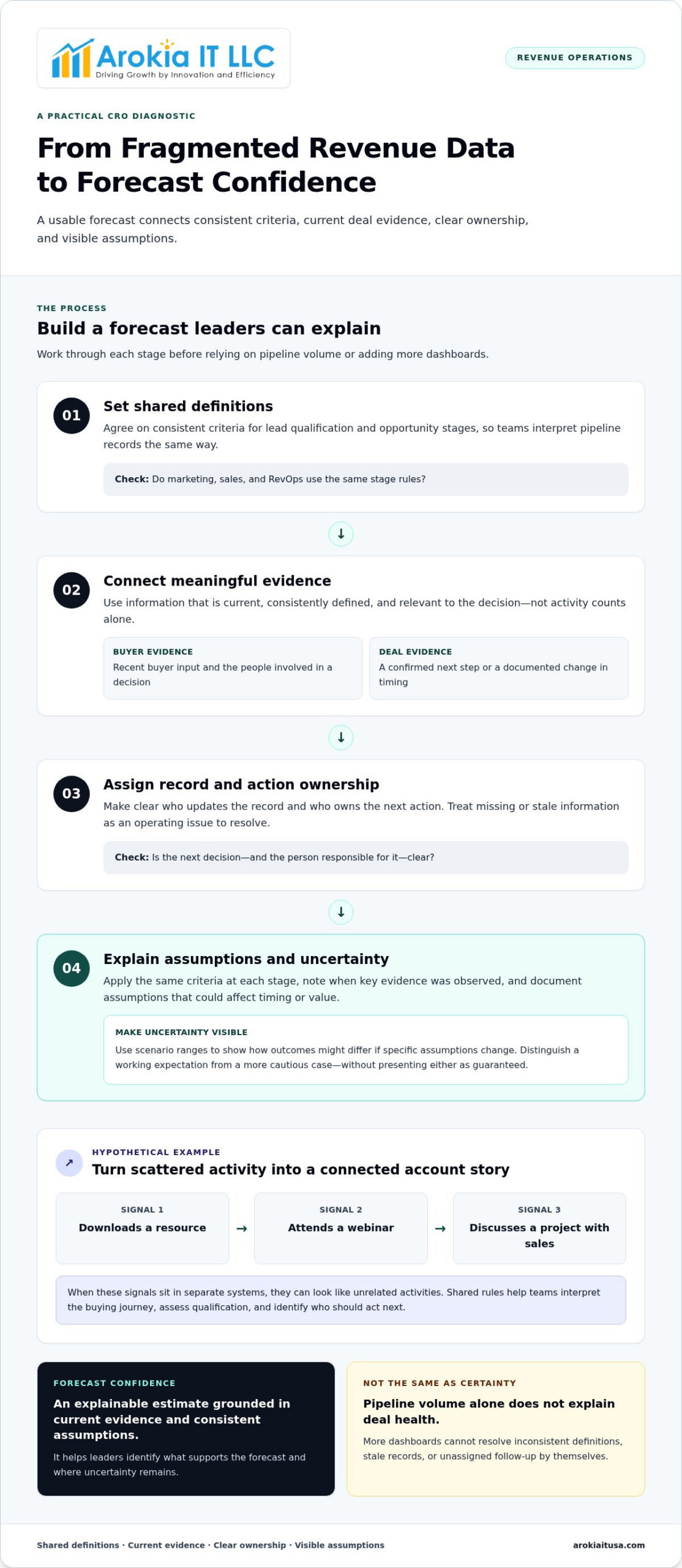
A pipeline is a record of opportunities. A usable forecast also explains the evidence behind those opportunities, the assumptions attached to them, and the risks that could change timing or outcome. More dashboards won’t resolve inconsistent stage definitions, stale records, or unassigned follow-up.
Forecast confidence is the degree to which leaders can explain a revenue forecast using current, relevant evidence and consistent assumptions. It does not mean certainty. It means the team can show what supports the forecast, identify what remains uncertain, and act on the gaps rather than relying on pipeline volume alone.
That distinction defines the practical work: improve shared definitions, make buyer and pipeline evidence easier to interpret, and assign ownership for the next decision. The following sections examine how data fragmentation, AI, and cross-functional execution affect that work.
The 2026 CRO challenge of fragmented data and forecast confidence
Among the chief revenue officer challenges 2026 brings into focus is the gap between having revenue data and being able to use it consistently. A CRM may show an opportunity as late-stage while marketing automation records only an early interaction, and a sales update may not reflect a changed decision date. When teams use different stage criteria or leave records stale, pipeline reports can look complete while misrepresenting deal health.
How do disconnected systems weaken revenue visibility?
Customer and deal information often accumulates across sales and marketing workflows, each designed to support different tasks. More data does not automatically create better visibility. Decision-useful data is current, consistently defined, connected to a clear owner, and relevant to the decision at hand.
Hypothetical example: A target account downloads a resource, attends a webinar, and later discusses a project with sales. If those signals sit in separate systems, the account may appear as three unrelated activities rather than one developing buying journey. A dashboard can display all three records, but it can’t determine whether the opportunity is qualified or who should act next unless teams define those rules.
Start with shared stage definitions, clear responsibility for record updates, and regular inspection of meaningful deal evidence. That evidence might include a confirmed next step, recent buyer input, the people involved in a decision, or a documented change in timing. Treat gaps as operating issues to resolve, not as a reason to add more fields or charts.
What makes a forecast more useful to executive teams?
Forecast confidence is the degree to which leaders can explain a forecast using current deal evidence, consistent criteria, clear ownership, and documented assumptions. It is not a promise of certainty. It helps executives understand what supports an estimate and where uncertainty remains.
A useful forecast applies the same criteria to each stage, records when key evidence was observed, identifies who owns the next action, and states assumptions that could affect timing or value. Scenario ranges can then show how outcomes might differ if specific assumptions change. For instance, leaders can distinguish a working expectation from a more cautious case without presenting either as guaranteed or disguising uncertainty with false precision.
Revenue intelligence platforms may help organize and interpret deal signals, but tools work best after the organization agrees on definitions, data responsibilities, and the questions leaders need answered. Tie technology evaluation to an operating need rather than treating a new dashboard as a fix for process gaps. Teams reviewing those foundations can also explore B2B revenue forecasting support as part of a coordinated pipeline approach.
AI, buyer behavior, and alignment: challenges CROs must manage together
AI and sales technology can help teams interpret information and coordinate work. They can’t compensate for unreliable inputs, unclear handoffs, or conflicting definitions of a qualified opportunity. These connected chief revenue officer challenges 2026 require CROs to assess not only what a tool can do, but whether the revenue organization is ready to use it responsibly.
Why is more revenue technology not an automatic solution?
A tool may surface patterns or automate a workflow, but its usefulness depends on the quality of the data and the process around it. If account records are incomplete, teams apply different qualification rules, or employees use the system inconsistently, automation can make unclear processes run faster without making them more reliable.
Before deploying AI or sales technology, define the use case, the accountable owner, and where human review is needed. For example, a system might flag an account for follow-up, while a team member checks the underlying signals and decides whether outreach is appropriate. Clear oversight keeps decision support distinct from unchecked automation.
The difference is operational readiness:
| Technology capability | Operating readiness |
|---|---|
| Summarizes account or deal information | Teams agree which sources are reliable and who reviews the summary |
| Recommends a next action | An owner is responsible for evaluating and acting on the recommendation |
| Automates a workflow | The workflow has clear criteria, exception handling, and accountable oversight |
The point isn’t to delay useful technology. It’s to connect adoption to a defined business decision and a process someone owns.
How does sales and marketing alignment affect buyer progression?
B2B buyers may research independently, consult multiple stakeholders, and engage with sales at different points in their decision process. No single team necessarily sees the full picture. Marketing may observe content engagement, while sales hears about evaluation criteria and customer-facing teams learn what matters after purchase. Coordinating these signals gives teams a stronger basis for deciding what a buyer needs next.
Alignment is more than agreement on a revenue target. Teams need shared account priorities, audience definitions, qualification criteria, and handoff rules. If marketing flags an account as engaged, sales should know what that signal means, who follows up, and how the outcome is recorded. Without those specifics, shared goals can hide disconnected execution.
Account-based marketing and demand generation can support coordinated priorities when campaigns, audience signals, and sales follow-up reinforce one another. Arokia IT provides account-based marketing and demand generation to help B2B teams connect account focus with broader demand efforts.
A practical framework for prioritizing CRO challenges in 2026
The chief revenue officer challenges 2026 teams face can feel interconnected, but leaders don’t need to tackle every issue at once. Use this four-step diagnostic to move from a visible revenue symptom to a focused operating response:
- Define the symptom: State the business problem precisely, such as stalled opportunities or inconsistent follow-up.
- Trace the cause: Test whether process, data, audience, or handoffs contribute to the problem.
- Assign ownership: Name one accountable owner and identify the functions that must contribute.
- Measure progress: Select a small number of shared indicators and review them at a cadence suited to the sales cycle.
Then rank potential priorities by business relevance, evidence quality, controllability, and the effort required to address them. A concern that affects a key revenue objective, has credible supporting evidence, and can be changed through coordinated action may deserve attention before a broad technology initiative with uncertain impact.
How can CROs distinguish symptoms from root causes?
Start with the pattern, not a presumed culprit. If deals are stalling, examine where they pause, which next steps are missing, and whether qualification or handoff criteria are applied consistently. Interviews with sales, marketing, and customer-facing teams can explain why a process unfolds as it does; CRM records can show whether the pattern appears across opportunities. Use both. If records are incomplete or accounts describe events differently, document the evidence gap instead of assigning blame.
How should leaders turn diagnosis into a focused operating plan?
For each priority, identify one accountable owner, the cross-functional contributors, the action to test, and the evidence that will indicate progress. Choose leading indicators tied to the diagnosed cause, such as completion of agreed handoffs or documented next steps, rather than adding measures simply because a dashboard can display them.
Review progress on a schedule that reflects how quickly the team can observe meaningful change. A short-cycle activity may warrant more frequent inspection than a complex B2B purchase that takes longer to advance. Keep a compact set of shared indicators, clarify their definitions, and retire measures that don’t inform a decision. This helps mid-market and enterprise teams maintain focus without building separate scorecards for every function.
Arokia IT’s 90-Day Pipeline Forecast supports structured pipeline review, while its B2B demand generation work aligns campaign priorities with revenue needs. These capabilities support the operating process, not guaranteed revenue outcomes.
Turning CRO priorities into coordinated B2B revenue execution
Durable revenue progress depends on three operating conditions: teams share priorities, leaders can use the evidence behind decisions, and people know who is accountable for execution. A practical response to chief revenue officer challenges 2026 brings into focus is to connect those conditions to a specific buyer or pipeline need, rather than launching disconnected campaigns or adding activity without a clear purpose.
Marketing can create and sustain buyer interest, sales can turn relevant engagement into informed conversations, and customer-facing teams can contribute context about account needs. Those efforts work best when teams agree on which audiences matter, what progress looks like, and how information moves between functions. Marketing supports revenue execution, but it does not control the full outcome. Product fit, buyer decisions, sales execution, and other factors also matter.
Where can ABM and demand generation support CRO priorities?
Account-based marketing (ABM) coordinates engagement around selected high-value accounts and the relevant people involved in their buying decisions. Demand generation supports broader awareness and interest among an intended market. Used together, the approaches can balance account focus with wider market reach: ABM organizes attention around priority accounts, while demand generation builds a broader base of informed prospects.
Arokia IT provides account-based marketing alongside demand generation, lead nurturing, and sales enablement content. Nurturing can maintain relevant communication as prospects progress, while enablement content helps sales teams address buyer questions with consistent information. Choose each capability based on the diagnosed priority, rather than assuming a particular tactic guarantees pipeline or revenue.
What should a coordinated next step look like?
Choose one consequential gap, such as inconsistent follow-up on engaged target accounts. Sales and marketing can document the current baseline, name one accountable owner and cross-functional contributors, and agree on the evidence they will review. Set a review cadence that fits the sales cycle, then use findings to adjust the work rather than adding measures that don’t guide a decision.
This creates a bounded operating plan: a defined issue, shared responsibility, and a clear way to assess progress. It also gives leaders a basis for deciding whether the response should involve account focus, broader demand creation, nurture communication, sales content, or a combination.
Arokia IT helps B2B teams align marketing activity with revenue execution through ABM and demand generation. A discussion can help clarify the priority and the evidence needed to assess it.
Make the next revenue decision count
The chief revenue officer challenges 2026 brings into focus are best addressed through disciplined execution, not a rush to adopt every new tool. Start with the revenue symptom, validate its causes with usable evidence, then assign clear ownership and track progress against a small set of shared indicators. Better alignment across marketing, sales, and customer-facing teams makes that evidence more actionable.
For B2B organizations, ABM, demand generation, lead nurturing, and sales enablement content can support coordinated engagement across priority accounts and broader audiences. Arokia IT also provides a 90-Day Pipeline Forecast to support structured pipeline planning. These capabilities strengthen the operating process, while revenue outcomes still depend on execution and factors beyond marketing alone.
Choose one meaningful gap, bring the right teams around it, and build from evidence. Clear priorities create a stronger path forward.
Frequently Asked Questions
What are the biggest challenges facing chief revenue officers in 2026?
Key chief revenue officer challenges 2026 include fragmented revenue data, less dependable forecasts, disconnected sales and marketing priorities, and adopting AI without clear workflows or oversight. CROs also need to interpret buyer progress when research and evaluation happen across multiple channels and stakeholders. The practical priority is to connect evidence, ownership, and action so teams can identify execution gaps instead of reacting to surface-level pipeline symptoms.
How can a CRO improve forecast accuracy?
A CRO can improve forecasting by standardizing opportunity stage criteria, assigning responsibility for record updates, and reviewing current evidence behind important deals. Track documented buyer commitments, next steps, decision participants, and changes to timing or scope. Record assumptions and uncertainty rather than presenting estimates as certain. Regular deal reviews should test whether evidence supports the forecast and identify actions that could clarify risks or advance an opportunity.
Why do sales and marketing teams struggle to align?
Sales and marketing often work from different goals, audience definitions, qualification standards, and measures of success. A shared revenue target alone won’t resolve those operational differences. Marketing may consider an account engaged based on content interaction, while sales expects direct evidence of an active project. Teams can improve alignment by agreeing on priority accounts, defining engagement and qualification signals, and documenting who follows up and how outcomes are recorded.
Can AI solve a CRO’s pipeline and forecasting problems?
AI can support analysis and workflow tasks, but it can’t independently fix unreliable data, inconsistent processes, or unclear accountability. If an AI tool uses stale records or conflicting opportunity definitions, its recommendations may not be useful. CROs should define the intended decision, assign an owner, and establish human review before relying on automated outputs. Treat AI as decision support, then assess whether it improves the quality of the team’s evidence and actions.
How should a CRO prioritize revenue challenges?
A CRO should define the revenue symptom, investigate its likely cause, assign an accountable owner, and measure progress. Compare candidate issues by their relevance to business priorities, strength of supporting evidence, degree of team control, and effort required to address them. Use interviews and operational records together, and flag missing information rather than assuming a cause. This approach helps mid-market and enterprise teams focus on a tractable problem before launching a broad initiative.
What role can ABM play in a CRO’s revenue strategy?
Account-based marketing (ABM) coordinates engagement around selected high-value accounts and relevant buying groups. It can help marketing and sales focus content, outreach, and follow-up on shared account priorities. ABM can complement demand generation, which supports broader awareness and interest. Arokia IT provides ABM alongside demand generation, lead nurturing, and sales enablement content. These capabilities support coordinated execution, but they don’t guarantee pipeline or revenue outcomes.
What should a CRO measure beyond pipeline volume?
Beyond pipeline volume, measure whether opportunities show credible buyer engagement and progress through clearly defined stages. Useful indicators can include stage conversion, time spent in a stage, completion of agreed next steps, and whether an opportunity has a documented owner and current evidence. Select measures that help teams make decisions, and define them consistently across functions. A large pipeline is less actionable if leaders can’t explain its quality, risks, or movement.