
The platform with more features can still give your team the wrong answer about revenue. A factors ai vs caliber mind b2b marketing analytics comparison should start with how each platform supports your reporting, attribution, and pipeline decisions, not the length of its feature list. If campaign reports and revenue records tell different stories, the priority is finding a measurement model your marketing and sales teams can use consistently.
Both platforms address B2B measurement, but their product direction and company context differ. Factors.ai remains independent, while CaliberMind became an Integrate product line after its acquisition on August 26, 2026. Those distinctions are relevant context, but they don’t determine which platform fits your workflow.
This comparison outlines how to assess the capabilities that matter, identify product claims to verify in a demo, and test each platform against your data and revenue processes. It also explains why attribution definitions, data foundations, and the path from insight to action deserve more weight than feature volume. The goal is to make a decision based on your business requirements, not a polished product checklist.
Key Takeaways
- Use the factors ai vs caliber mind b2b marketing analytics comparison to assess fit against your reporting and revenue workflows, not feature count alone.
- Compare how each platform handles your data inputs, CRM alignment, attribution logic, and reporting needs. Verify details with current vendor documentation.
- Decide whether your priority is account-level engagement analysis or a broader view of marketing’s contribution to pipeline and revenue.
- Bring the same business questions and representative workflows to both product demos, then record evidence and open questions consistently.
- Before choosing, document the measurement model, shared definitions, accountable owners, and review cadence your team will use.
Factors AI vs. CaliberMind: What B2B Buyers Should Compare First
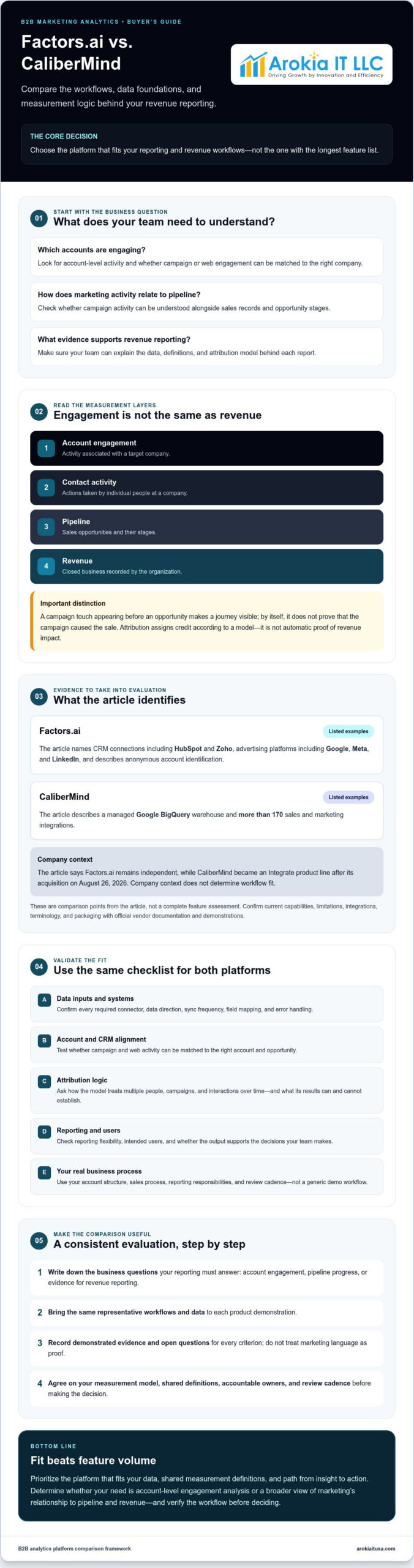
Choose the platform that fits your business requirements, not the one with the longest feature list. A useful factors ai vs caliber mind b2b marketing analytics comparison starts with the decisions your team needs to make: which accounts are engaging, how marketing activity relates to pipeline progress, and what evidence supports revenue reporting.
Those questions involve distinct measurement layers. Account engagement tracks activity associated with a target company; contact activity captures actions by individual people. Pipeline reflects sales opportunities and their stages, while revenue records closed business. Connecting these layers requires consistent data and definitions. A report showing a campaign touch before an opportunity can make the journey visible, but it does not, by itself, prove that the campaign caused the sale.
Assess how each platform would fit your current data flow, reporting responsibilities, and decision cadence. Confirm current capabilities, integrations, terminology, and packaging in official vendor documentation and demonstrations. Product claims can change, and a capability that sounds relevant may not support your specific workflow as configured.
What does B2B marketing analytics need to explain?
B2B marketing analytics should help teams understand how campaigns relate to account progress and pipeline outcomes. For example, a team might ask whether target accounts engaged with a campaign before entering an opportunity stage, then compare that activity with sales records. The answer depends on reliable account matching, agreed definitions, and a clear understanding of what the data can and cannot establish.
Buying groups make attribution more complex. Several people at one company may interact with different campaigns while sales conversations and opportunity changes unfold over time. A single-touch report can simplify that journey, but it may hide earlier or later interactions. Treat attribution as a model for assigning credit, not automatic proof of revenue impact.
Why are Factors AI and CaliberMind being compared?
Factors AI and CaliberMind are options in this buyer’s evaluation, but that does not mean they serve identical use cases. Compare their current positioning in analytics and marketing measurement, then test whether each addresses your organization’s reporting needs. For a neutral introduction to the broader data concept, see this overview of a Customer Data Platform (CDP). Don’t assume that label alone establishes either platform’s architecture or capabilities.
Before drawing conclusions, ask vendors to confirm supported data sources, CRM alignment, attribution logic, reporting flexibility, and the intended users for each capability. Teams measuring campaigns across industrial marketing programs, for instance, should check that the platform can represent their account structure and sales process. Document evidence and unanswered questions rather than treating marketing language as proof.
Compare Factors AI and CaliberMind Across Data, Attribution, and Reporting
A useful factors ai vs caliber mind b2b marketing analytics comparison separates three things: what a vendor documents, what the product demonstrates, and what fits your organization. The table summarizes available product information. Confirm current capabilities and limitations in official documentation and with each vendor.
| Criteria | Buyer question | Available evidence | Validate before deciding |
|---|---|---|---|
| Data inputs and systems | Can it connect the CRM, marketing automation, ad, and warehouse systems we rely on? | Factors.ai lists CRM connections including HubSpot and Zoho, plus advertising platforms such as Google, Meta, and LinkedIn. CaliberMind describes a managed Google BigQuery warehouse and more than 170 sales and marketing integrations. | Confirm each required connector, data direction, sync frequency, field mapping, and error handling. |
| Account and CRM alignment | Can campaign and web activity be matched to the right account and opportunity? | Factors.ai describes anonymous account identification and account scoring. CaliberMind describes unifying marketing and sales data for a buyer-journey view. | Test your account matching rules, CRM objects, duplicate handling, and opportunity definitions. |
| Attribution | Which documented models can represent our buying journey? | Both platforms describe multi-touch attribution. | Ask each vendor to show model options, touch inclusion rules, credit assignment, and how assumptions can be inspected or changed. |
| Reporting and users | Can the right teams answer their recurring pipeline questions? | CaliberMind is positioned for enterprise B2B teams; Factors.ai serves a broader market that includes SMB and mid-market organizations. | Demonstrate reporting flexibility, access needs, and intended users against your workflows. Don’t infer these from positioning alone. |
Which data sources and systems must each platform support?
How should buyers assess attribution and revenue reporting?
Attribution is a model for assigning credit across measured marketing and sales interactions, not proof that an interaction caused revenue. Ask both vendors to use the same sample journey and your agreed opportunity definitions. Find out how users can inspect the underlying interactions, explain a result to finance or sales, and revise assumptions when the measurement model changes. Keep vendor-stated functionality separate from your team’s assessment of fit.
Before choosing, capture evidence and unresolved questions for both evaluations in the same scorecard. If you need to align reporting criteria with pipeline goals, you can discuss your measurement priorities.
Which Platform Fits Your B2B Analytics Use Case?
There’s no defensible overall winner without knowing what your team needs to measure. In a factors ai vs caliber mind b2b marketing analytics comparison, start with the recurring decisions behind your reports. Are teams prioritizing account engagement and follow-up, or do leaders need a broader view of marketing activity alongside pipeline and revenue? Then confirm that the platform can support those jobs using your data and definitions.
When should account-level engagement be a priority?
Make account engagement central if ABM teams need to see activity across target companies and buying groups, plan campaign follow-up, or understand how accounts progress. Tie each view to a real task: identifying engaged accounts, preparing sales outreach, or reviewing movement against account goals. Factors.ai describes account intelligence capabilities, including account scoring. Validate the specific definitions, views, and workflows your team needs, and confirm the same requirements directly with CaliberMind rather than assuming feature parity.
When should pipeline and revenue measurement lead?
Put pipeline and revenue reporting first when leadership needs consistent answers about sourced pipeline, influenced opportunities, or campaign contribution. Before comparing dashboards, agree on what counts as sourced or influenced, which opportunity stages qualify, what time window applies, and how revenue is defined. Without shared rules, platforms may produce different numbers because they’re measuring different things, not because one report is necessarily more accurate.
Marketing and sales leaders should be able to interpret the same reporting framework and use it to make decisions. If each team needs a separate explanation for the figures, the measurement model needs attention alongside the software choice.
Balanced fit framework
- Factors.ai, potential fit: Consider it when account-level engagement and account intelligence are central to the evaluation. The vendor describes account scoring and anonymous account identification; confirm how those capabilities work with your account definitions, data, and required reporting views.
- CaliberMind, potential fit: Consider it when your evaluation centers on broader marketing-to-revenue measurement across sales and marketing data. The vendor positions its platform for enterprise B2B teams; validate reporting scope, data requirements, and fit for your operating model.
- For both platforms: Confirm current capabilities, configuration needs, and limitations with official documentation and a workflow-based demonstration. These fit indicators are decision prompts, not a substitute for product validation.
The better platform is the one that answers agreed revenue questions with usable data. To make a sharper decision, document the report each team needs, the action it should inform, and the evidence required to trust its output. Choose based on demonstrated fit, not assumed superiority.
How to Evaluate Factors AI and CaliberMind in a Product Demo
A strong demo should test your operating reality, not just showcase polished dashboards. For a fair factors ai vs caliber mind b2b marketing analytics comparison, give both vendors the same questions, definitions, sample workflow, and evaluation scorecard. This helps distinguish demonstrated capability from a product claim that still needs documentation or follow-up.
What should your team ask vendors to demonstrate?
Request an end-to-end walkthrough that follows campaign activity through account matching and opportunity association to a report your team would use. Bring representative scenarios and ask the vendor to explain what data, configuration, and business definitions produce each result. Test edge cases as well, including incomplete records, several contacts at one account, and an opportunity whose stage changes during the reporting period.
Use the same test cases for both platforms. Record what happened when data was missing, how the report reflected the issue, and whether the explanation was clear enough for marketing, sales, and leadership to trust the output. Don’t accept a screenshot as a substitute for tracing the underlying workflow.
How should you score the comparison fairly?
Set criteria and weights before the demos, then score both vendors against the same priorities. Useful criteria include data fit, reporting flexibility, usability, governance, and the resources required to maintain the reporting process. Include marketing operations, sales, analytics, and executive stakeholders so the evaluation reflects both daily use and leadership decisions.
- Demonstrated: The vendor showed the workflow using your agreed scenario.
- Documented: Current official materials support the claim, but it wasn’t demonstrated.
- Unclear: The answer or evidence needs follow-up.
- Unavailable: The vendor confirmed the requirement isn’t supported in the evaluated configuration.
Also assess your organization’s readiness. Identify who owns source data, account and opportunity definitions, report maintenance, and user adoption. A platform can meet technical requirements and still fail to deliver dependable reporting if ownership is unclear or teams don’t use shared definitions.
For broader evaluation context, compare your shortlist with Top B2B Revenue Intelligence Platforms: 2026 Guide. Treat it as adjacent research, then confirm current product claims with vendors. Keep the demo scorecard grounded in your workflows, documented evidence, and the work required to sustain the measurement model.
Make the Decision: Platform Fit, Measurement Strategy, and Next Steps
The factors ai vs caliber mind b2b marketing analytics comparison should end with a documented fit decision, not an unsupported declaration of a universal winner. Select the platform whose verified capabilities best support your agreed reporting workflows, data environment, and operating capacity. Treat measurement alignment as ongoing work, not a problem software selection resolves on its own.
What should the final decision memo include?
Give stakeholders a clear record of why the selected option fits. Summarize business requirements, capabilities demonstrated or confirmed in current vendor documentation, unresolved questions, and dependencies such as data quality, configuration, and internal ownership. Explain how the team will assess whether reporting is useful, including which recurring decisions it should inform.
The memo should also define the measurement model: what counts as sourced or influenced pipeline, which opportunity stages are included, who owns each definition, and how often marketing and sales will review the framework. Keep platform selection separate from the governance required to maintain consistent reporting.
How can strategy support better analytics decisions?
Analytics software organizes and reports data. Strategy determines which questions matter and how teams act on the answers. For ABM, connect target-account priorities and engagement signals to sales follow-up and account progression. For demand generation, establish how campaign activity should be evaluated against pipeline goals. Both efforts depend on shared definitions, clear accountability, and reports designed around leadership decisions.
For additional account-based marketing context, see AI in Account-Based Marketing: The 2026 Executive Guide to Revenue Precision. Arokia IT LLC provides B2B marketing strategy, including account-based marketing and demand generation. Its role is to help connect marketing priorities with pipeline objectives, not to provide Factors AI or CaliberMind.
A practical next step is to align the evaluation scorecard with the reports executives, marketing operations, and sales leaders actually need. That creates a consistent basis for vendor selection and the measurement decisions that follow.
Turn Your Platform Evaluation Into a Clear Measurement Plan
The right choice in a factors ai vs caliber mind b2b marketing analytics comparison depends on verified fit with your data, reporting needs, and revenue workflows, not feature volume. Use the same business questions and demo scenarios to assess both platforms, then document which capabilities were demonstrated, which need confirmation, and who will own the measurement model.
Software supports measurement, but shared definitions and consistent review determine whether teams can act on the results. Agree on how account engagement connects to opportunity progress, how pipeline contribution will be assessed, and when marketing and sales will revisit those assumptions.
Arokia IT specializes in B2B ABM and demand generation, and offers a 90-day pipeline forecast and sales enablement content. That strategic perspective can help connect campaign priorities with the reporting leaders need to guide pipeline decisions.
With clear requirements and accountable owners, your team can make a more confident platform decision and build a stronger foundation for revenue measurement.
Frequently Asked Questions
What is the difference between Factors AI and CaliberMind?
Factors.ai emphasizes identifying anonymous website visitors as companies, account intelligence, and marketing analytics. CaliberMind is positioned as an enterprise-focused go-to-market intelligence and multi-touch attribution platform that brings marketing and sales data together in a managed Google BigQuery warehouse. These are broad product distinctions, not proof that one platform fits every workflow. Confirm current capabilities, integrations, packaging, and limitations directly with each vendor before deciding.
Is Factors AI or CaliberMind better for B2B marketing analytics?
Neither is universally better; the right choice depends on your team’s measurement requirements, data environment, and operational capacity. This factors ai vs caliber mind b2b marketing analytics comparison should test whether account engagement analysis or broader marketing-to-revenue measurement is the priority. Compare both platforms using the same workflows and definitions, then score demonstrated capabilities separately from claims that still need verification. Choose based on validated fit, not feature count.
Can these platforms show marketing’s impact on pipeline?
Both platforms describe multi-touch attribution, which can help teams examine how measured interactions relate to accounts and opportunities. A report may show campaign activity alongside pipeline, but that alone doesn’t prove the campaign caused revenue. Ask vendors to demonstrate how their reports handle opportunity stages, attribution rules, and time windows. Align those definitions with sales before comparing results so teams understand what the reported pipeline contribution does and doesn’t mean.
How should a B2B company compare marketing attribution platforms?
Start with the business questions leaders need answered, then compare each platform’s documented data inputs, CRM alignment, attribution approach, reporting flexibility, and operational requirements. Use identical demo scenarios and a shared scorecard. Record whether evidence was demonstrated, documented, unclear, or unavailable. Include marketing operations, sales, analytics, and executive stakeholders. This process makes tradeoffs visible and prevents polished dashboards or broad feature lists from substituting for evidence of workflow fit.
What data should a company prepare before an analytics platform demo?
Prepare an inventory of required systems, including your CRM, marketing automation, advertising platforms, and data warehouse. Define account matching rules, opportunity stages, campaign naming conventions, and the time period your team wants to assess. Bring representative examples, including incomplete records, multiple contacts at one account, and opportunities that change stages. Ask the vendor to trace data from source to report and explain the mapping, configuration, and assumptions behind each result.
How much do Factors AI and CaliberMind cost?
Factors.ai lists a free plan with up to 200 identified companies monthly; paid pricing should be confirmed because published rates and packaging may change. As of September 2026, listed Basic pricing was around $399 monthly when billed annually or $549 month-to-month, with higher tiers and custom enterprise pricing. CaliberMind doesn’t publish pricing; its enterprise-focused pricing is flexible and based on data volume. Request current quotes from both vendors.
Does buying an analytics platform fix marketing and sales alignment?
No. A platform can make shared data and reporting more accessible, but it can’t decide which opportunity stages count, who owns definitions, or how teams should act on attribution results. Marketing and sales need agreement on account and revenue measures, clear data ownership, and a review cadence. Without those foundations, teams may continue to interpret the same dashboard differently, even after adopting analytics software.