
The most recognizable name isn’t necessarily the right fit. Choose a manufacturing marketing agency whose strategy matches your revenue model, buying cycle, and sales process. Evaluate its case studies by qualified leads, RFQs, and pipeline contribution, not traffic alone.
That decision matters when technical buyers, procurement teams, and sales representatives all shape a deal over an extended cycle. A broad service list may look impressive, but it doesn’t show whether an agency can connect marketing activity to the opportunities your team needs.
This guide explains how to compare agency options, assess services and case studies, and identify the support that can strengthen lead generation and revenue predictability. It also looks at how agency choices vary across U.S. metro markets, so you can weigh specialist expertise against the kind of integrated strategy your sales model requires.
Key Takeaways
- Match an agency’s specialization to your sales model, whether growth depends on RFQs, distributors, catalog sales, or complex enterprise deals.
- Assess case studies by their connection to qualified opportunities and revenue, not by traffic or engagement figures alone.
- Compare services based on the gaps in your marketing and sales process, from demand generation to content and paid media.
- Use metro-area listings as a starting point, then weigh geographic presence against manufacturing expertise and strategic fit.
- Consider account-based marketing when a focused set of high-value accounts and a multi-stakeholder buying process shape your growth strategy.
Manufacturing lead generation and revenue predictability
Manufacturing marketing agencies generate B2B leads by connecting buyer research to relevant content, targeted campaigns, and clear conversion steps. A prospect might find a technical page through search, download a product guide, then submit an RFQ after comparing specifications.
The strategy depends on how buyers make decisions. Manufacturing sales cycles can be lengthy, so marketing may need to answer technical questions before prospects speak with sales. Marketing must therefore answer technical questions early, not wait for sales outreach to explain the product.
Manufacturing demand generation coordinates early education with lead capture and sales follow-up. Useful assets include application guides, capability pages, case studies, and email sequences. For example, a component manufacturer can build a page around a specific application, attract relevant search traffic, and route qualified inquiries to the appropriate sales representative.
What marketing strategies work best for manufacturers? The right strategy depends on the sales model: account-based marketing for a defined list of complex accounts, and search, paid advertising, and conversion-focused product pages for catalog or RFQ demand. Content supports both by answering technical questions throughout the buying cycle.
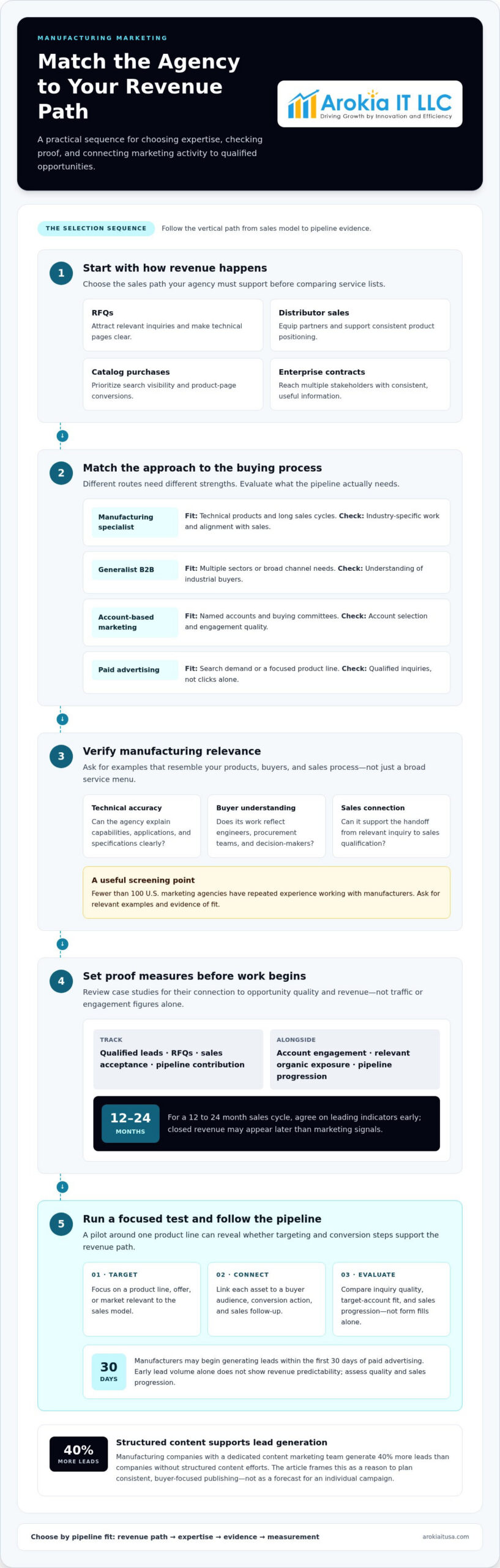
Specialist agencies bring manufacturing context to technical messaging and long sales cycles. Generalist B2B agencies may offer broader channel coverage, but their fit depends on experience with industrial buyers, RFQs, and sales handoffs. Compare the options by the work your pipeline needs:
| Option | Best fit | Evaluate |
|---|---|---|
| Manufacturing specialist | Technical products and long cycles | Industry-specific work and sales alignment |
| Generalist B2B agency | Multiple sectors or broad channel needs | Industrial buyer understanding |
| Account-based marketing | Named accounts and buying committees | Account selection and engagement quality |
| Paid advertising | Search demand or a focused product line | Qualified inquiries, not clicks alone |
Choose an approach that matches your revenue path: RFQs, distributor sales, catalog purchases, or enterprise contracts. A focused pilot around one product line can show whether targeting and conversion steps support that path.
For a 12 to 24 month sales cycle, agree on leading indicators before work begins. Track account engagement, relevant organic exposure, qualified inquiries, and sales acceptance alongside pipeline progression. These measures show whether marketing is reaching buyers before closed revenue appears.
- Use paid campaigns to test a specific offer or market, then assess lead quality and sales follow-up.
- Build content around buyer questions, such as tolerances, applications, or production capabilities.
- Connect campaign reporting to RFQs, qualified leads, and pipeline value.
Manufacturers often begin generating leads within the first 30 days of paid advertising, but early lead volume alone says little about revenue predictability. Compare inquiry quality, target-account fit, and sales progression. A campaign generating form fills from outside the serviceable market needs refinement, even if its traffic rises.
Content structure also affects performance: manufacturing companies with a dedicated content marketing team generate 40% more leads than companies without structured content efforts. Treat this as a reason to plan consistent, buyer-focused publishing, not as a forecast for an individual campaign. The strongest system links each asset to an audience, a conversion action, and a sales follow-up.
How should a manufacturer choose an agency?
Start with your revenue model, then match agency expertise to how buyers evaluate and purchase your products. An RFQ-driven supplier needs qualified inquiries and clear technical pages; a catalog manufacturer may prioritize search visibility and product-page conversions. Enterprise sales depend on reaching multiple stakeholders with consistent, useful information.
Manufacturing experience is a meaningful filter. Fewer than 100 U.S. marketing agencies have repeated experience working with manufacturers, so ask for examples that resemble your products, buyers, and sales process. A campaign for a consumer brand may show creative skill, but it doesn’t demonstrate an understanding of industrial specifications, procurement teams, or distributor relationships.
Specialty alloy manufacturers show why fit matters. Marketing must explain material capabilities and applications accurately, while helping engineers, purchasing teams, and decision-makers find relevant information. An agency should translate subject-matter experts’ technical input into clear web pages, search content, and sales materials without losing important distinctions.
Review the agency’s actual areas of expertise, not just its service menu. Search engine optimization, paid search, content, social media, and email can each support a different stage of demand generation. The right mix depends on whether buyers search by product category, application, material, process, or supplier capability.
- For catalog-driven sales: Look for search and paid advertising expertise, plus conversion improvements to high-intent product pages.
- For RFQ-led sales: Assess how the agency attracts relevant inquiries and supports sales qualification.
- For distributor or channel sales: Examine how marketing equips partners and supports consistent product positioning.
- For enterprise deals: Look for experience coordinating messaging across accounts and buying committees.
Then examine how the agency will deliver the work. Ask to see its planning process: how it learns product terminology, prioritizes audiences, maps buyer questions, and measures results. A tailored plan should connect each activity to a business need. For example, a technical article should serve a defined audience and lead to a relevant next step.
Compare reporting expectations before choosing. The agency should distinguish activity, such as impressions or page visits, from business signals, such as qualified inquiries and sales acceptance. Agree on who reviews leads, how feedback reaches marketing, and how campaigns change in response. That rhythm helps keep demand generation connected to sales.
A practical selection process has three steps: define the revenue model, shortlist agencies with relevant industrial marketing experience, then compare their proposed work against your buyer journey. A focused discussion can clarify those priorities; discuss your manufacturing marketing needs.
Case studies and agency quality checks
Case studies show how an agency connects strategy, execution, and measurable outcomes. To assess marketing ROI, compare revenue attributed to marketing with the investment, while also tracking qualified leads and pipeline progression.
Manufacturing Marketing Case Studies
A manufacturing case study should identify the company’s challenge, target buyers, campaign work, and resulting business outcomes. For example, a CNC manufacturer’s paid advertising campaign generated 509 leads and $5,188,938 in deal opportunities. Its reported closed-won revenue was $963,959. Those figures offer more context than a general claim about improved visibility or engagement.
Compare case studies by business model and buying process. A CNC supplier’s search campaign differs from a three-site redesign, which was associated with a 14,000% traffic surge. Traffic can signal greater visibility, but it doesn’t establish qualified demand. A case involving Miller Welding, a small metals fabrication company in a town affected by 25 years of economic downturn, offers a different lens: business context and market conditions matter.
Agency Outcomes and ROI Measurement
ROI measurement connects campaign activity to sales outcomes, while case studies show work completed for other brands. Read each metric alongside its definition, timeframe, and conversion stage. Otherwise, an impressive figure may not reflect the result your sales team needs.
How can manufacturers measure marketing agency ROI? Track marketing-sourced opportunities, qualified leads, pipeline value, closed-won revenue, and the campaign investment tied to each result. For long buying cycles, include intermediate indicators such as target-account engagement and sales-accepted inquiries.
Use this review sequence when assessing an agency’s evidence:
- Confirm the starting point: Identify the original business problem, audience, and channel, such as paid search or a website redesign.
- Define each metric: Separate impressions, visits, leads, sales-qualified leads, opportunities, and closed revenue.
- Check attribution: Understand how the case connected marketing activity with inquiries and sales outcomes.
- Assess relevance: Compare the featured company’s products, buying process, and channel mix with your operation.
Ask whether reported leads matched the manufacturer’s target accounts and sales criteria. A high lead count can hide poor fit if inquiries lack the right application, buying authority, or purchasing intent. Engagement and visibility are useful indicators, but they should support a clear commercial objective.
Separate association from attribution. A redesigned website may coincide with a traffic increase, while paid advertising may generate measurable inquiries. In either case, examine the campaign’s scope, the outcome measured, and the handoff to sales. Evidence tied to RFQs, qualified leads, pipeline, and revenue gives manufacturers a stronger basis for comparing agency work.
Manufacturing marketing services
A manufacturing marketing agency plans and executes marketing to help industrial businesses reach buyers, explain technical products, and generate sales opportunities. Its work may include digital strategy, search visibility, content, advertising, and measurement tied to business goals.
The service scope should fit the task. A manufacturer launching a new component may need application-focused web content and paid search; a supplier with low visibility may need search optimization and technical content. A company that relies on distributors may need sales materials to help partners explain product value consistently.
Digital marketing connects channels that often operate separately. Search optimization can help engineers find a product page, while an email sequence can provide follow-up information after an inquiry. Paid advertising can test interest in a defined product or market, and analytics can reveal which pages or campaigns lead to qualified actions.
Content marketing turns engineering knowledge into useful resources for buyers. For example, a process manufacturer might publish capability pages, application guides, and answers to common specification questions. Subject-matter experts should review technical details before publication, while marketers shape the material for search and readability.
- Search and website work: Improve product and capability pages so buyers can find relevant information and take a clear next step.
- Content and email: Develop technical resources and follow-up messages for prospects who need more information before contacting sales.
- Advertising and social campaigns: Promote selected products or expertise to defined audiences, then evaluate inquiry quality.
- Measurement: Connect campaign activity with inquiries, sales qualification, and pipeline reporting.
An agency’s location is separate from the markets it serves. Being near a plant may make in-person collaboration easier, but digital planning and campaign execution can also reach buyers across regions. Manufacturers selling nationally should prioritize market understanding, channel coordination, and communication with sales over an office address alone.
Define the service area based on your company’s actual selling footprint. A regional equipment supplier might target buyers across neighboring states, while a specialized parts maker may serve customers nationwide. Campaign geography should reflect shipping capacity, sales coverage, distributor territories, and the locations the company can serve.
Before selecting a partner, connect every requested service to a business need. If qualified search inquiries are the priority, assess SEO, product-page content, and conversion paths together. If awareness in a new market matters, align audience targeting, advertising, and sales follow-up. This avoids disconnected campaigns and clarifies responsibilities.
Finally, establish who supplies technical input, approves claims, manages campaign changes, and reviews results. Engineering can validate application details, sales can identify recurring buyer objections, and marketing can turn those insights into pages and campaigns. Clear ownership keeps digital execution grounded in the manufacturer’s products and market.
Manufacturing marketing agency listings by U.S. metro
No single agency is the best fit for every manufacturer. The strongest choice combines industrial experience and technical understanding with a strategy aligned to your buyers, sales coverage, and conversion goals.
Metro listings can help build a shortlist, but an office location doesn’t prove manufacturing expertise. A manufacturing marketing agency near Oklahoma City or Tulsa may understand regional business networks, while a team in Dallas or Houston may offer convenient access for Texas manufacturers. Location is useful context, not a substitute for evaluating relevant work.
Start by mapping your sales footprint. A manufacturer serving Oklahoma, Louisiana, Arkansas, New Mexico, Northern Mexico, and Texas may need coordinated messaging across several markets. Compare agency experience with the industries, buyer roles, and distribution routes that matter to your business, rather than choosing by metro visibility alone.
| Metro-listing signal | What it helps you assess | What it cannot establish |
|---|---|---|
| Local office presence | Potential ease of in-person meetings | Knowledge of your products or buyers |
| Industrial case examples | Relevant experience and market context | Future performance for your business |
| Service coverage | Ability to coordinate work across your markets | Quality of strategy or execution |
| Team structure | Who may handle planning and delivery | Whether the team fits your project needs |
For example, a Tulsa manufacturer serving oil and gas customers may prioritize technical content and familiarity with industrial buying processes. A Houston supplier selling specialized components across state lines may need search visibility and messaging that supports several sales territories. Assess a manufacturing marketing agency against those operating realities, not its directory position.
Geography matters most when it changes how work gets done. In-person workshops may help engineers explain product details; remote collaboration can work well when teams share documents and feedback efficiently. Define the practical need first, whether that means plant visits, time-zone overlap, or coordination with distributors across the region.
Use a consistent shortlist process: identify agencies serving relevant markets, confirm manufacturing experience, examine comparable technical work, and compare proposed services with your sales model. A listing can surface potential candidates, but it can’t show how an agency handles product terminology, buyer questions, or sales feedback. Compare each manufacturing marketing agency on these capabilities before choosing.
Which agencies are the best fit in the United States? Prioritize teams with relevant industrial knowledge, services aligned to your revenue model, and clear measurement practices. Local proximity can support collaboration, but understanding your buyers and market should carry more weight.
There is no single manufacturing marketing agency that is best for every U.S. manufacturer. The strongest fit is an agency with relevant industrial experience and technical understanding, and a strategy that matches your buyers, sales coverage, and conversion goals.
Arokia IT LLC: Account-Based Marketing (ABM)
Arokia IT LLC helps manufacturers engage selected business accounts and coordinate marketing across buying groups. Its Account-Based Marketing (ABM) focuses activity on chosen organizations, while LinkedIn Marketing reaches professional audiences. Demand Generation supports broader opportunity creation, and AI Search & GEO addresses visibility in AI-powered search.
This approach can suit manufacturers selling technical products to defined accounts and coordinating marketing with sales. It is less suited to a one-off creative project without an ongoing account-engagement or demand-generation objective.
Turn your agency decision into a focused growth plan
Give your agency search a clear operating brief. Identify the market you want to reach, the sales challenge that needs attention, and the internal team members who will guide technical messaging and follow-up. A focused brief makes the first planning conversation concrete and helps your team distinguish strategic alignment from a polished presentation.
A manufacturing marketing agency should fit how your business builds demand and engages buyers. Arokia IT LLC offers Account-Based Marketing (ABM), AI Search & GEO, and Demand Generation. These services can support priorities such as focused account engagement, visibility in AI-powered search, and a more coordinated approach to creating demand.
Bring your growth priorities and sales context to the conversation. A clear starting point gives both teams a stronger basis for discussing how marketing can contribute and what progress should look like.
A deliberate next step can turn agency evaluation into a more confident, business-led decision.
Frequently Asked Questions
How quickly can a manufacturing business expect to see results, and what are realistic milestones?
Plan milestones around evidence the team can act on, not a promised revenue date. Begin with a baseline of current inquiries and source tracking, then set checkpoints for campaign readiness, audience response, and sales-team feedback. For example, ask whether engineers can use a new product guide in customer conversations. This makes early progress assessable while longer-term opportunities move through the buying process.
Should manufacturers choose a specialist or generalist B2B agency?
A specialist suits teams that need rapid fluency in manufacturing terminology; a generalist can fit companies seeking broader B2B perspectives. The useful test is how each candidate handles a working session about a product, application, or buyer objection. If the team can turn that discussion into accurate messaging without oversimplifying the technical details, its expertise is relevant to your needs.
What budget ranges are realistic?
Build a budget by separating agency work from internal labor and media spend. Pricing depends on scope and is provided after a quote request; cost factors include the number of workstreams, production needs, channel mix, and approval complexity. Before allocating funds, identify which tasks your team can own, such as technical review or sales follow-up, and which need external execution.
How much do manufacturing marketing agencies charge?
Charges depend on the engagement’s scope and delivery model. Pricing is provided after a quote request; factors include campaign volume, reporting requirements, content production, and the level of ongoing management. To compare proposals, separate recurring work from one-time projects and note any excluded expenses. This makes differences in scope clearer than comparing headline totals alone.
What services should a manufacturer look for in a marketing partner?
Choose capabilities that address your team’s operational gaps rather than selecting every available service. A company preparing for a product launch may need coordinated messaging and buyer education; a team with established campaigns may need stronger lead follow-up. Map each proposed service to an owner, deliverable, and business purpose to avoid duplicated work between internal staff and outside specialists.
How do I choose a marketing agency for a manufacturer?
Use a short evaluation exercise before deciding. Give each candidate the same product description and ask for a sample audience map, key buyer questions, and proposed first deliverable. Compare how accurately they interpret the product and explain their assumptions. This practical exercise reveals communication quality and working style that a presentation or credentials list may not show.
What questions should manufacturers ask before hiring a marketing agency?
Ask how the agency will handle technical review, approvals, and revisions. Clarify who owns source materials, how product changes are reflected in active campaigns, and what happens when sales feedback conflicts with initial messaging. Also ask who will be your day-to-day contact and how decisions are documented. These details establish a workable process before deliverables move into review.
What are the risks of hiring a generalist marketing agency for manufacturing?
A generalist may need more onboarding to distinguish meaningful technical details from background information. That can slow reviews or result in messaging that needs extensive correction. Reduce this risk by assigning a subject-matter expert to approve technical details and defining terms the agency should use consistently. A shared glossary of product names, applications, and specifications can make collaboration more precise.